Featured Case
-
Abstract
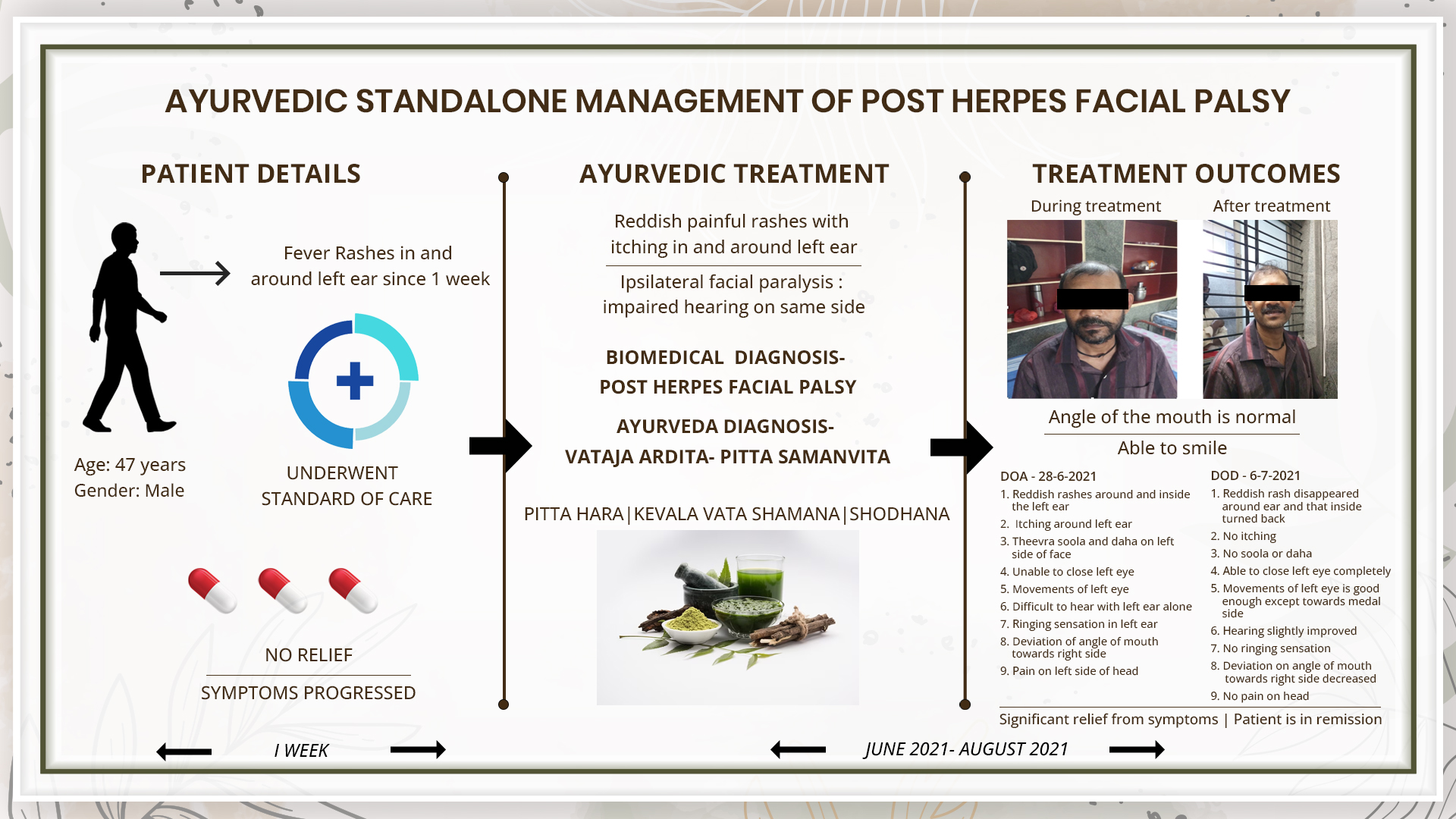
A 47-year-old male patient complained of a reddish, painful rash with itching in and around the left ear associated with facial paralysis and impaired hearing on the same side for 1 week. He had a sudden onset of fever followed by the appearance of red rashes. So he consulted an allopathic doctor and took modern medications. He now developed severe pain and a burning sensation on the left side of his face, making it difficult to lie on the bed on his left side. The symptoms were progressive in nature. So he consulted Dr Pervaje who made the biomedical diagnosis based on clinical examination as Post herpes facial palsy. The Ayurvedic diagnosis was Pitta samavita vataja ardita. The line of treatment was pitta hara cikitsa, shodhana and kevala vata shamana cikitsa to address the condition. After 2 weeks of standalone ayurvedic treatment, rashes disappeared, pain reduced, and the angle of the mouth became normal. The patient got complete relief from his symptoms and could lead a normal life.
-
Summaries
-
Listen
-
Watch
-
View
-
Read
A 47-year-old male patient complained of a reddish, painful rash with itching in and around the left ear associated with facial paralysis and impaired hearing on the same side for 1 week. He had a sudden onset of fever followed by the appearance of red rashes. So he consulted an allopathic doctor and took modern medications. He now developed severe pain and a burning sensation on the left side of his face, making it difficult to lie on the bed on his left side. The symptoms were progressive in nature. So he consulted Dr Pervaje who made the biomedical diagnosis based on clinical examination as Post herpes facial palsy. The Ayurvedic diagnosis was Pitta samavita vataja ardita. The line of treatment was pitta hara cikitsa, shodhana and kevala vata shamana cikitsa to address the condition. After 2 weeks of standalone ayurvedic treatment, rashes disappeared, pain reduced, and the angle of the mouth became normal. The patient got complete relief from his symptoms and could lead a normal life.
-
-
Timeline
-
Tabulated Summary
-
Narrative
TITLE OF CASE
Standalone successful ayurvedic treatment of Post herpes-Facial palsy- A case report
Dr Ravishankar Pervaje
ABSTRACT
A 47-year-old male patient complained of a reddish, painful rash with itching in and around the left ear associated with facial paralysis and impaired hearing on the same side for 1 week. He had a sudden onset of fever followed by the appearance of red rashes. So he consulted an allopathic doctor and took modern medications. He now developed severe pain and a burning sensation on the left side of his face, making it difficult to lie on the bed on his left side. The symptoms were progressive in nature. So he consulted Dr Pervaje who made the biomedical diagnosis based on clinical examination as Post herpes facial palsy. The Ayurvedic diagnosis was Pitta samavita vataja ardita. The line of treatment was pitta hara cikitsa, shodhana and kevala vata shamana cikitsa to address the condition. After 2 weeks of standalone ayurvedic treatment, rashes disappeared, pain reduced, and the angle of the mouth became normal. The patient got complete relief from his symptoms and could lead a normal life.
KEYWORDS
Facial palsy, herpes, ardita, case report, standalone
INTRODUCTION
Post herpes facial palsy/ Ramsay Hunt Syndrome (RHS) [1] is a complication of the Varicella-zoster virus (VZV). After the initial state of illness, the virus can remain dormant in the various ganglia throughout the body. Initial symptoms typically include pain along the ipsilateral side of the face and ear. This usually will present with facial paralysis.
Diagnostic criteria:
The diagnosis of RHS is considered to be a clinical one, and investigations are not generally done. The presence of rash, pain, and facial droop further confirms the diagnosis.
Treatment:
VZV infections are generally self-limiting in nature. The treatment's primary goal is to decrease complications, including facial paralysis and postherpetic neuralgia duration. Antiviral therapy is recommended for both immuno-competent and immuno-compromised patients. The combination of corticosteroids with antiviral medications has been shown to have improved outcomes compared to antiviral alone. Symptomatic management is also essential.
Assessment: House-Brackmann facial nerve scale is a widely used assessment criteria.
Prognosis:
Full recovery of facial paralysis can vary from 27.3% to 70% if proper treatment has been started within 72 hours of symptom onset. If treatment is not commenced within 72 hours, total recovery chances decrease to 50%.
PATIENT INFORMATION
A 47-year-old male was suffering from a reddish rash along with itching on the inner side and around the left ear since 1 week. The associated symptoms were deviation of the angle of the mouth towards the right side, difficulty in closing the left eye, impaired hearing on the left ear, headache mainly on the left side, giddiness, and ringing sensation on the left ear, all persisting since 1 week.
Medical history: The patient was apparently normal 1 week back, and then he had a sudden onset of fever followed by the appearance of red rashes in and around the left ear. So, he consulted an allopathic doctor and took medications. But the symptoms persisted, so he opted for ayurvedic treatment.
Past illness: History of skin allergy on the hand and legs (present with itching, brown rash ) 2 months back.
CLINICAL FINDINGS/PHYSICAL EXAMINATION
Nervous system:
Oriented, conscious, able to speak fluently.
Facial asymmetry – present
Deviation of the angle of mouth – towards the right side (normal side)
Unable to close the left eye (indicate orbicularis oculi muscle weakness)
Difficult to hear exclusively with the left ear provided that the right ear is closed.
Facial nerve – asymmetry of the face
unable to close the left eyelid.
smiling deviated to one side.
TIMELINE
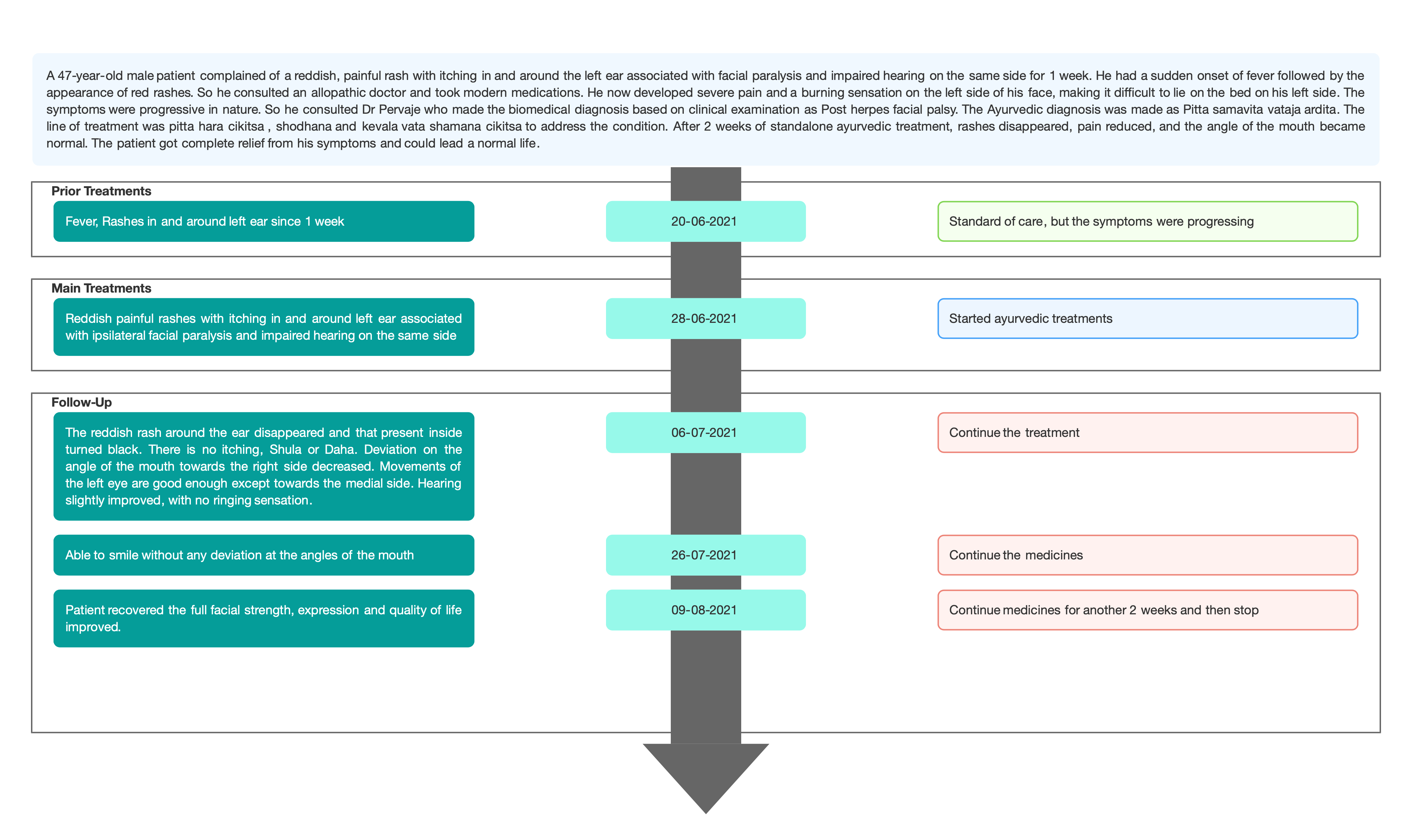
Image 1. The timeline of events is added below
DIAGNOSTIC ASSESSMENT
Modern Diagnostic parameter: The Biomedical diagnosis was made based on the clinical presentation, examination and history taking.
Image 2. Rash in the left ear of the patient at baseline
Image 3. Image of the patient at baseline
Ayurvedic Assessment was done based on the clinical evaluation by the ayurvedic physician.
Differential Diagnosis- The diagnosis, was confirmed with clinical examination and history taking.
Prognosis- Complete recovery of facial paralysis can vary from 27.3% to 70% if proper treatment has been started within 72 hours of symptom onset. If treatment is not commenced within 72 hours, full recovery chances decrease to 50%. The main factor that affects prognosis is the severity of symptoms at onset. In this case, the patient presented with signs of facial weakness on the left side for one week. With standalone Ayurvedic treatment, the patient recovered full facial strength, expression and quality of life improved.
THERAPEUTIC INTERVENTION
See the tab ‘Treatment details’
FOLLOW-UP AND OUTCOMES
Clinician-based assessment: The assessments pre and post-treatment, have been tabulated.
Table 1. The assessments pre and post-treatment, have been tabulated.
DOA - 28 / 06 / 2021
DOD - 06 / 07 / 2021
REDDISH RASHES AROUND AND INSIDE THE LEFT EAR
REDDISH RASH DISAPPEARED AROUND THE LEFT EAR THAT INSIDE TURNED BLACK
ITCHING AROUND LEFT EAR
NO ITCHING
TIVRA SHULA AND DAHA ON LEFT SIDE OF FACE
NO SHULA OR DAHA
UNABLE TO CLOSE LEFT EYE
ABLE TO CLOSE LEFT EYE COMPLETELY
MOVEMENTS OF LEFT EYE
ENOUGH EXCEPT TOWARDS MEDIAL
MOVEMENTS OF LEFT EYE IS GOOD
DIFFICULT TO HEAR WITH LEFT EAR
HEARING SLIGHTLY IMPROVED
RINGING SENSATION IN LEFT EAR
NO RINGING SENSATION
DEVIATION OF ANGLE OF MOUTH TOWARDS RIGHT SIDE
DECREASED
PAIN ON LEFT SIDE OF HEAD
NO PAIN
Patient-assessed: Not relevant.
Image 4. Patient image after treatment added below
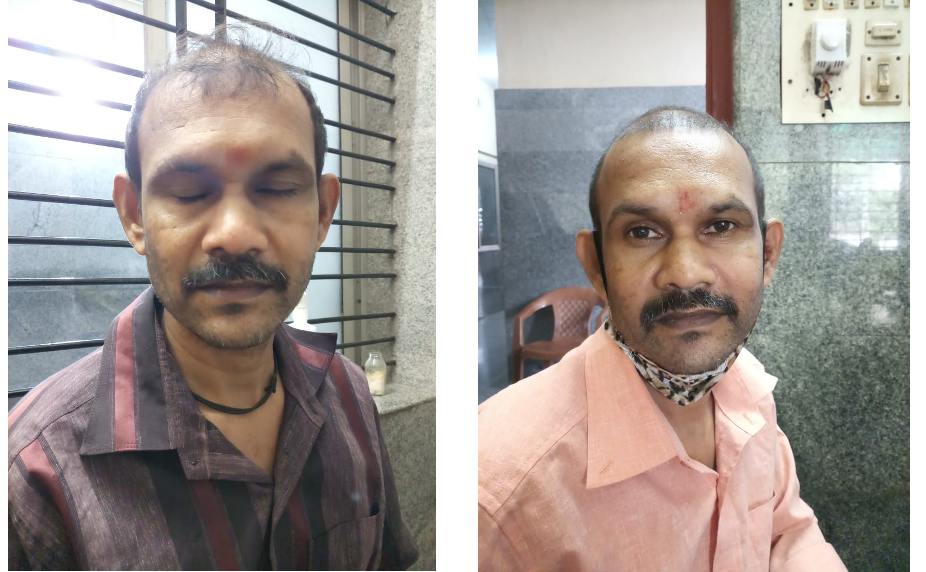
Image 5. Patient image during follow-up added below
Intervention adherence and tolerability – The patient adhered to the prescribed treatments and tolerated the treatments well.
Method of assessment- By monitoring the patient.
Adverse and unanticipated events; None reported.
DISCUSSION ;
Based on the diagnosis pitta samanvita vataja ardita- the main treatment planned was pitta hara cikitsa, shodhana and kevala vata samana chikitsa.
PATIENT’S PERSPECTIVE
Not available.
LEARNING POINTS/TAKE-HOME MESSAGES
Complete recovery of facial paralysis can vary from 27.3% to 70% if proper treatment has been started within 72 hours of symptom onset. If treatment is not commenced within 72 hours, full recovery chances decrease to 50%. In this case, the patient presented with signs of facial weakness on the left side for one week. Based on the clinical assessment, the diagnosis was confirmed as post-herpes facial palsy. With standalone Ayurvedic treatment, the patient completely recovered full facial strength and expression. Ayurveda can be adopted for the recovery of facial muscle strength and the prevention of recurrence.
INFORMED CONSENT
Written consent was obtained from the patient to publish the case report.
CONFLICT OF INTEREST
None declared.
FUNDING
None
REFERENCE
- Khan YMT, Fatema N. Ramsay Hunt syndrome. Pan Afr Med J. 2019 Dec 16;34:201. doi: 10.11604/pamj.2019.34.201.19207. PMID: 32180875; PMCID: PMC7060913.
Image 1. Timeline of events
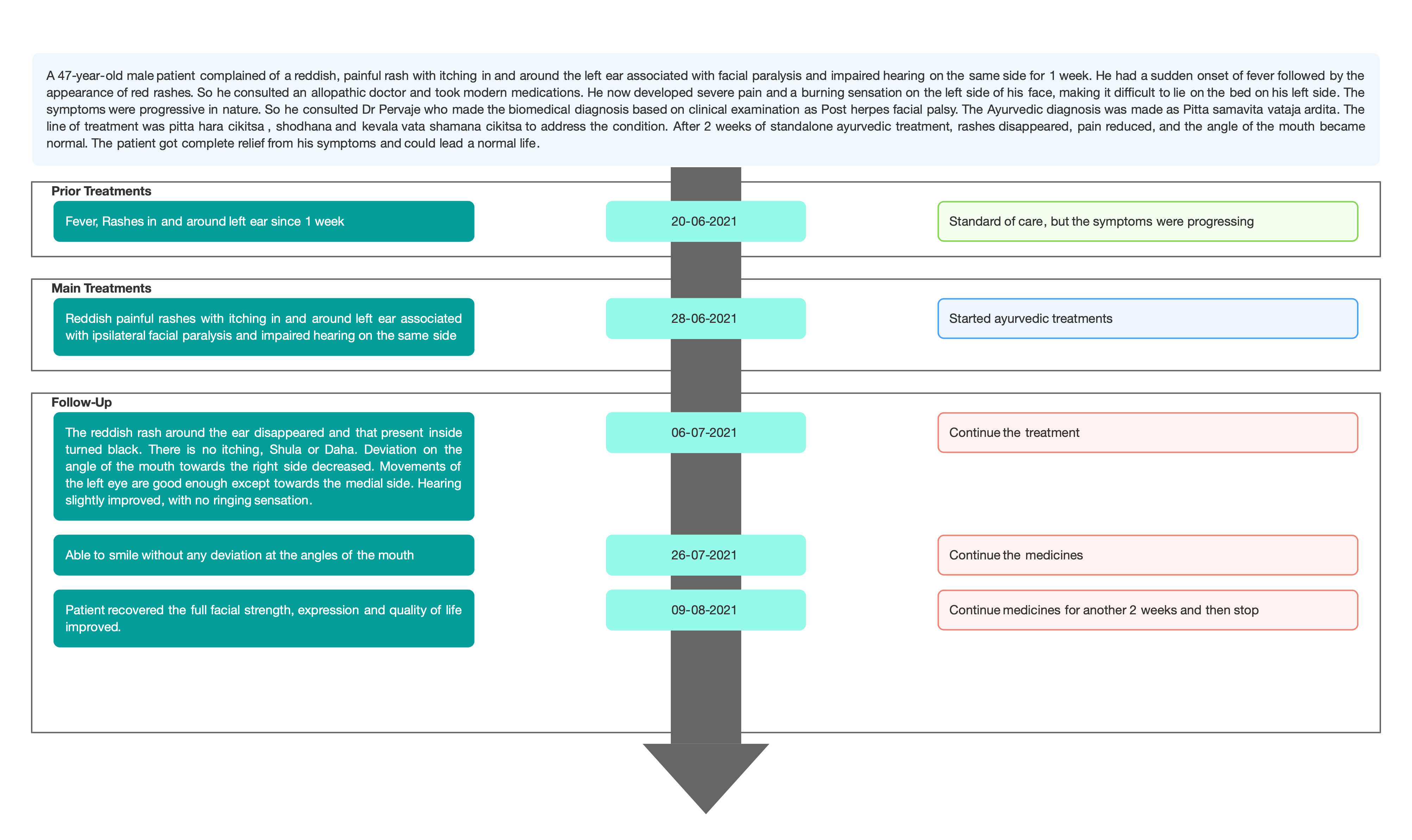
Image 2. Rashes in the left ear of the patient
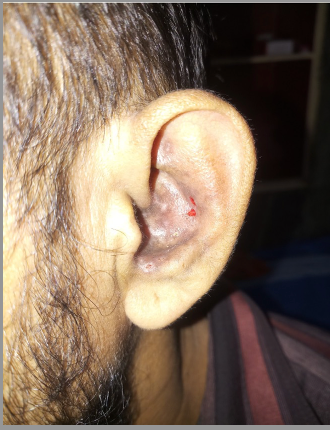
Image 3. Image at baseline
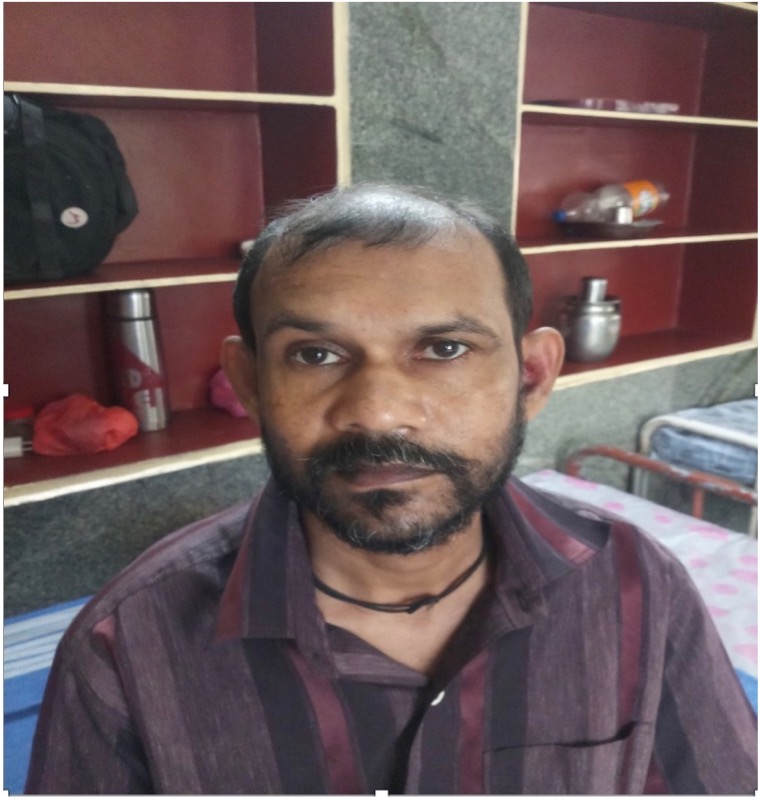
Image 4. Patient image after treatment
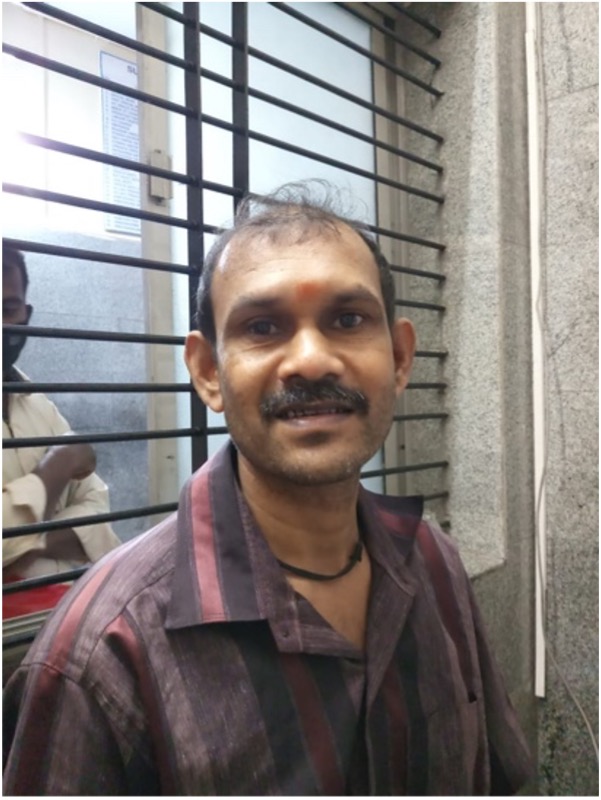
Image 5. Patient image during follow-up
-
Immersive Learning
-
Modern Diagnosis
BIOMEDICAL DIAGNOSIS: Facial palsy as a post-herpes infection
ABOUT THE DISEASE:
Post herpes facial palsy/ Ramsay Hunt Syndrome (RHS) is a complication of the Varicella-zoster virus (VZV). After the initial state of illness, the virus can remain dormant in the various ganglia throughout the body. Initial symptoms typically include pain along the ipsilateral side of the face and ear. This usually will present with facial paralysis.
Diagnostic criteria:
The diagnosis of RHS is considered to be a clinical one, and clinical testing is generally not done. The presence of rash, pain, and facial droop indicates the condition.
Treatment:
VZV infections are generally self-limiting in nature. The treatment's primary goal is to decrease complications, including facial paralysis and postherpetic neuralgia duration. Antiviral therapy is recommended for both immunocompetent and immunocompromised patients. The combination of corticosteroids with antiviral medications has been shown to have improved outcomes compared to antiviral alone. Symptomatic management is also essential.
Assessment: House-Brackmann facial nerve scale is a widely used assessment criteria.
Biomedical diagnosis of this case:
The presence of rash, pain and facial droop in clinical assessment indicates facial nerve palsy on the left side.
Prognosis:
Full recovery of facial paralysis can vary from 27.3% to 70% if proper treatment has been started within 72 hours of symptom onset. If treatment is not commenced within 72 hours, total recovery chances decrease to 50%. In this case, the patient presented with signs of facial weakness on the left side for one week associated with a reddish, painful rash in and around the left ear which persist even after taking modern treatments. After 2 weeks of standalone Ayurvedic treatment, rashes disappeared, pain reduced, and the angle of the mouth became normal. In further follow-ups, the patient recovered full facial strength, expression, and the hearing improved.
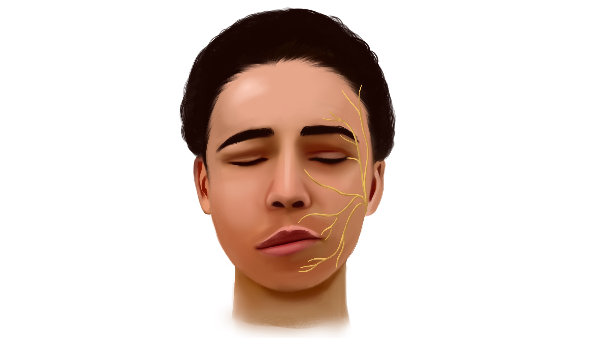
Image 1. Rashes in the left year and mouth deviated on the left side at baseline were added below
Reference
Khan YMT, Fatema N. Ramsay Hunt syndrome. Pan Afr Med J. 2019 Dec 16;34:201. doi: 10.11604/pamj.2019.34.201.19207. PMID: 32180875; PMCID: PMC7060913.
Image 1. Rashes in the left year and mouth deviated on the left side at baseline
Image 2. Patient at baseline
-
Ayurveda Diagnosis
AYURVEDA DIAGNOSIS: Pitta samanvita Vataja Ardita
ABOUT THE DISEASE:
Ardita is considered as a Vata Vyadhi, according to Bruhatrayi. It has been enlisted among eighty types of Vataja Nanatmaja Vyadhis.
The aggravation of Vata is the key factor in the pathology of the disease. The vitiated vata gets localised in the regions of the head, nose, chin, forehead and the eyes and manifests as the disease called “Ardita”. The symptom of vaksanga indicates that the vitiated Vata affects the tongue. Also, Vagbhata has marked the affliction of the ear on the affected side. As per Caraka, the vitiated Vata settling in the above-mentioned regions in the head leads to Soshana of the Rakta Dhatu resulting in Ardita.
Sadhya-Asadhyata of Ardita
क्षीणस्यानिमिषाक्षस्य प्रसक्ताव्यक्तभाषिणः ।
न सिध्यत्यर्द्दितं वाढं त्रिवर्षं वेपनस्य च ॥ (Bhavaprakasha)
If Ardita is present in patients who are ksheena, animeshaksha, avyakta bhashina, trivarsha and vepana, discharge from the mouth, eyes and nose is said to be asadhya.
The spectrum of Vata vyadhi which includes Ardita can be cured effectively if the patient is strong and if the disease is of recent onset.
Treatment:
अर्द्दिते नावनं मूर्द्ध्नि तैलं श्रोत्राक्षितर्पणं ।
सशोफे वमनं दाहरागयुक्ते शिराव्यधः” | Harita Samhita
According to Acarya Sushruta first Vatavyadhi chikitsa is done.
Then Mastishkya (Shirobasti vishesha), Nasya, Dhuma, Upanaha, Sneha, Nadiswedadi Vishesha upacara is carried out. Acarya Vagbhata explained Ardita cikitsa sutra as teekshna navananasya, murdhnitaila, shrotra tarpana and akshi tarpana.
Diagnosis in this case: This is a case report of a 47-year-old male patient who presented with signs of facial weakness on the left side for one week associated with a reddish, painful rash in and around the left ear.
Based on the clinical assessment, the condition is diagnosed as pitta samanvita vataja ardita
Samprapti : Apathya aahara vihara / krimi causing Paitthika rakta dushti.
Raktaavarana of vata at ardita snayu leads to the condition pitta samanvita vataja ardita
Vata kaphaja ardita is excluded as kandu, gaurava, shaithya are not present.
Pakshaghata – affects one-half of the body, so that condition is also excluded.
Treatment rationale: Clinician adopted Pitta hara cikitsa, followed by shodhana and kevala Vata samana cikitsa. Even though Ardita is mentioned in Vata vyadhi adhyaaya, as it is told that any condition is to be treated according to the avastha, it is therefore done accordingly.
-
Treatment
Name of Medicine Dosage Form Dosage Mode of Administrtation From - To (Date) Medicine Reference Gokshuradi guggulu Tablet 1-1-1 Oral with warm water 2021-06-28 - 2021-07-13 Sharangadhara samhita, Madhyama khanda 7/84-87 Chandraprabha vati Vati 1-1-1 Oral, with warm water 2021-06-28 - 2021-08-23 Sharangadhar Samhita, Rasa varga Kamadugdha rasa Tablet 1-1-1 Oral with warm water 2021-06-28 - 2021-08-23 Rasayoga sagara, Rasa rasayana prakarana Sutashekhara rasa Tablet 1-0-1 Oral with warm water 2021-06-28 - 2021-08-23 AFI Volume 1.20:52 Vasantha Kusumakara rasa Tablet 1-0-1 Oral with warm water 2021-06-28 - 2021-07-06 Rasendra Sara Sangraha, Rasapariksha Prakarana Panchatikta Kasaya Kasaya 3-3-3 tsp Oral after food 2021-06-28 - 2021-07-06 Chakradatta. 27 Himadhara Drava Required quantity External application 2021-06-28 - 2021-07-06 Anubhuta Yoga Rasnadi curnam + Tandulodaka lepam Lepa Drava Required quantity External application 2021-06-28 - 2021-07-11 Rasnadi churnam (AH.Ci.14) Patoladi ghritam Ghritam Required quantity Tarpanam 2021-07-01 - 2021-07-07 AH.Su.13 Mashatmaguptadi Taila Taila Required quantity Apply on head 2021-07-07 - 2021-07-13 AH.Ci.27 Murchita tila taila Taila 10 ml mixed with a pinch of saindhava Kavalagraha, done twice daily. 2021-07-03 - 2021-07-25 Anubhuta Yoga Triphala + Makaradhwaja Curnam 1/2-0-1/2 Oral with warm water 2021-07-07 - 2021-07-13 Anubhuta Yoga Mahamanjistadi Kasayam Kasayam 3 tsp-0-3 tsp Oral 2021-07-07 - 2021-07-25 Sahasra yogam, Kasaya prakarana Nirgundi Dattura goli Lepa Required quantity Apply on face 2021-07-12 - 2021-07-25 Patent & proprietary medicine Amalaki curnam 15 gms + Lohabhasma 5 gms Curna 1/2 - 0 -1/2 tsp Oral, mixed with honey and sugar 2021-07-19 - 2021-07-25 Anubhuta Yoga Kshirabala 101 Taila 2-0-2 Nasya 2021-07-07 - 2021-07-25 Bhaishajya ratnavali. Vatarogadhikara.10 -
Outcome Measures
OUTCOME MEASURES
A 47-year-old male patient complained of reddish, painful rashes with itching in and around the left ear associated with facial paralysis and impaired hearing on the same side for one 1week.
The patient was normal one week back, and then he had a an acute onset of fever followed by the appearance of red rashes. He took modern medications. But patient developed severe pain and a burning sensation on the left side of the face. The patient had difficulty lying on the bed with that side of the face. Symptoms were progressive in nature.
The condition was treated as pitta samanvita vataja ardita . So pitta hara cikitsa, shodhana and kevala vata samana cikitsa was given.
Assessment criteria:
Subjective parameters:
With 2 weeks of standalone Ayurvedic treatment, rashes disappeared, pain reduced and the angle of the mouth become normal. In further follow-ups, he was able to smile without deviation of the corner of the mouth, his hearing capacity had improved and Ardita was almost relieved. With standalone Ayurvedic treatment, the patient recovered full facial strength and expression. The quality of life improved.
Table 1. Assessment pre and post-treatment are added below
DOA - 28 / 06 / 2021
DOD - 06 / 07 / 2021
REDDISH RASHES AROUND AND INSIDE THE LEFT EAR
REDDISH RASH DISAPPEARED AROUND THE LEFT EAR THAT INSIDE TURNED BLACK
ITCHING AROUND LEFT EAR
NO ITCHING
TIVRA SHULA AND DAHA ON LEFT SIDE OF FACE
NO SHULA OR DAHA
UNABLE TO CLOSE LEFT EYE
ABLE TO CLOSE LEFT EYE COMPLETELY
MOVEMENTS OF LEFT EYE
ENOUGH EXCEPT TOWARDS MEDIAL
MOVEMENTS OF LEFT EYE IS GOOD
DIFFICULT TO HEAR WITH LEFT EAR
HEARING SLIGHTLY IMPROVED
RINGING SENSATION IN LEFT EAR
NO RINGING SENSATION
DEVIATION OF ANGLE OF MOUTH TOWARDS RIGHT SIDE
DECREASED
PAIN ON LEFT SIDE OF HEAD
NO PAIN
Image 1. Patient image before treatment
Image 2. Patient image after treatment
-