Featured Case
-
Abstract
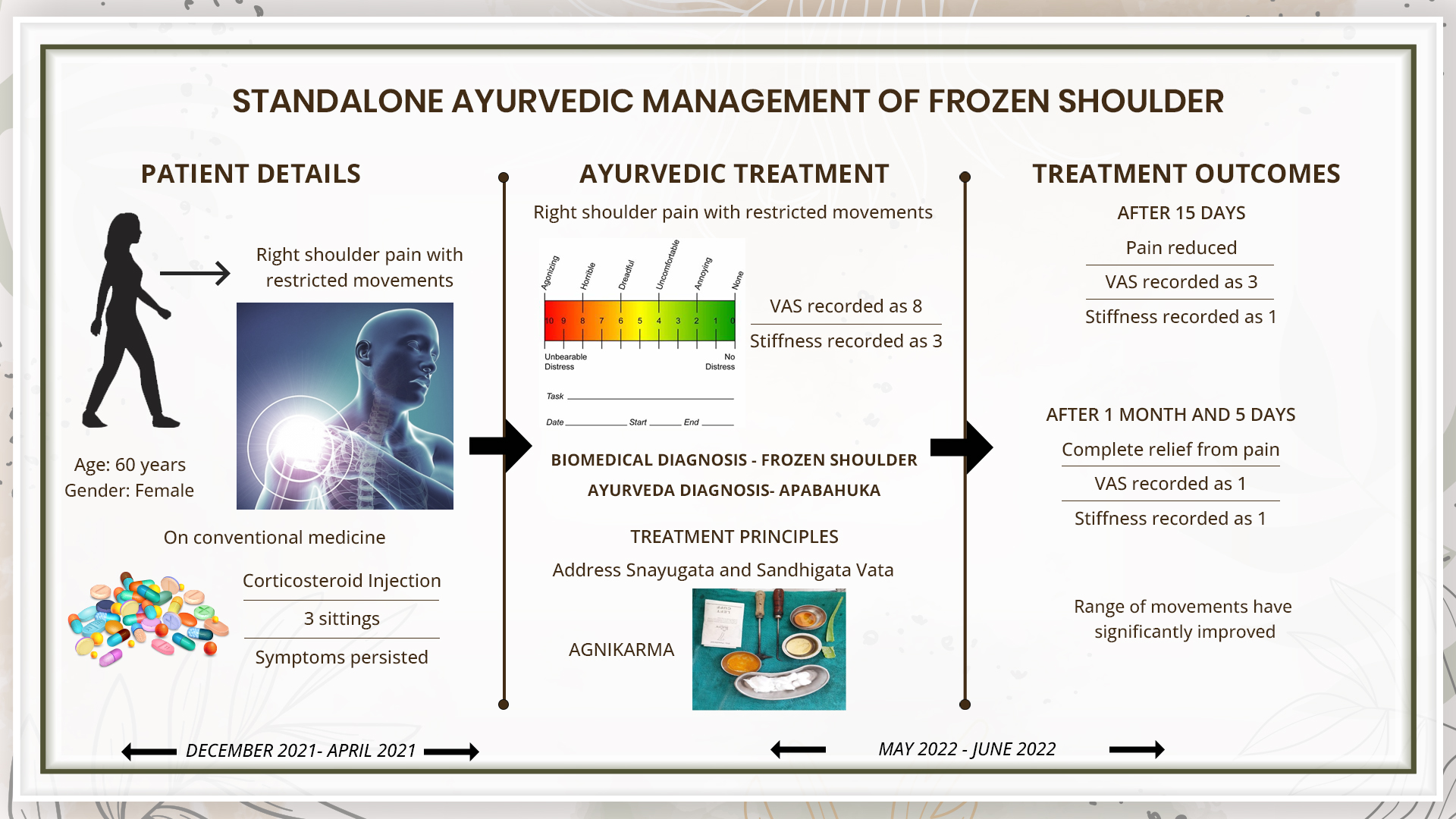
A 60-year-old female patient was suffering from right shoulder pain with restricted movements for 10 months. She is a known case of Hypertension and is under medication. She underwent conservative treatments like corticosteroids injection 3 sittings in an orthopaedic hospital. The symptoms persisted. So, she approached Dr Dudhmal, who made the biomedical diagnosis of a Frozen shoulder based on the clinical examination and presentation. The Ayurvedic diagnosis was Apabahuka. The line of treatment followed was Agnikarma, to address the snayugata and sandhi gata vata. VAS was used as the criteria for pre- and post-treatment assessment. After 3 sittings of Agni karma, she got relief from her symptoms. The VAS scale recorded 8 before treatment reduced to 1 indicating a significant reduction in pain. Range of movement also improved after treatment with reduced stiffness. The patient is in remission.
-
Summaries
-
Listen
-
Watch
-
View
-
Read
A 60-year-old female patient was suffering from right shoulder pain with restricted movements for 10 months. She is a known case of Hypertension and is under medication. She underwent conservative treatments like corticosteroids injection 3 sittings in an orthopaedic hospital. The symptoms persisted. So, she approached Dr Dudhmal, who made the biomedical diagnosis of a Frozen shoulder based on the clinical examination and presentation. The Ayurvedic diagnosis was Apabahuka. The line of treatment followed was Agnikarma, to address the snayugata and sandhi gata vata. VAS was used as the criteria for pre- and post-treatment assessment. After 3 sittings of Agni karma, she got relief from her symptoms. The VAS scale recorded 8 before treatment reduced to 1 indicating a significant reduction in pain. Range of movement also improved after treatment with reduced stiffness. The patient is in remission.
-
-
Timeline
-
Tabulated Summary
-
Narrative
TITLE OF CASE
Successful standalone ayurvedic management of Frozen shoulder- A case report
Dr Dudhmal
ABSTRACT
A 60-year-old female patient was suffering from right shoulder pain with restricted movements for 10 months. She is a known case of Hypertension and is under medication. She underwent conservative treatments like corticosteroids injection 3 sittings in an orthopaedic hospital. The symptoms persisted. So, she approached Dr Dudhmal, who made the biomedical diagnosis of a Frozen shoulder [1 & 2] based on the clinical examination and presentation. The Ayurvedic diagnosis was Apabahuka [3, 4 &5]. The line of treatment followed was Agnikarma, to address the snayugata and sandhigata vata. VAS was used as the criteria for pre- and post-treatment assessment. After 3 sittings of agnikarma, she got relief from her symptoms. The VAS scale recorded 8 before treatment reduced to 1 indicating a significant reduction in pain. Range of movement also improved after treatment with reduced stiffness. The patient is in remission.
KEYWORDS
Frozen shoulder, Apabahuka, Avabahuka, Agnikarma, VAS, Case report, Standalone
INTRODUCTION
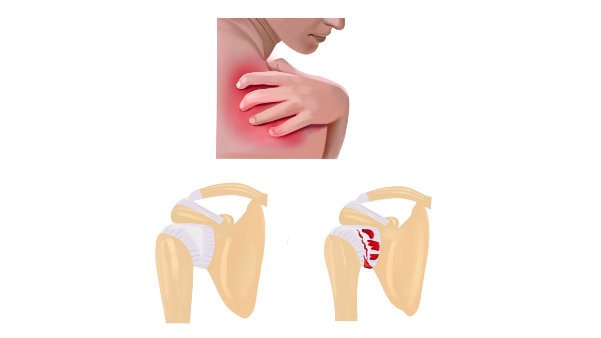
Frozen shoulder (FS) is a common shoulder disorder characterized by a gradual increase of pain of spontaneous onset and limitation in the range of motion of the glenohumeral joint. The pathophysiology of FS is relatively well understood as a pathological process of synovial inflammation followed by capsular fibrosis, but the cause of FS is still unknown. This is frequently associated with other systemic conditions or occurs following periods of immobilization, and has a protracted clinical course, which can be frustrating for patients as well as healthcare professionals.
Diagnosis- Diagnosis is based on physical examination and can be difficult depending on the stage of disease or if concomitant shoulder pathology is present.[2]
PATIENT INFORMATION
A 60-year-old female patient was suffering from right shoulder pain with restricted movements for 10 months.
Medical history: She took conservative treatments like corticosteroids injection 3 sittings, 5 months back for a frozen shoulder in an Orthopaedic hospital. The symptoms persisted and so the patient opted for Ayurvedic management. The patient is a known Hypertensive and is under medication.
PHYSICAL EXAMINATION/CLINICAL FINDINGS
No signs of pallor, icterus, clubbing, cyanosis, lymphadenopathy, or oedema were found with both lung fields clear & in CVS examination s1 s2 heard normally with no added sound, the patient was well oriented with time, place, and person.
Appley’s scratch test - Positive
Drop arm test, Press belly test, Hornblower tests - Negative
Impingement test- Negative
TIMELINE
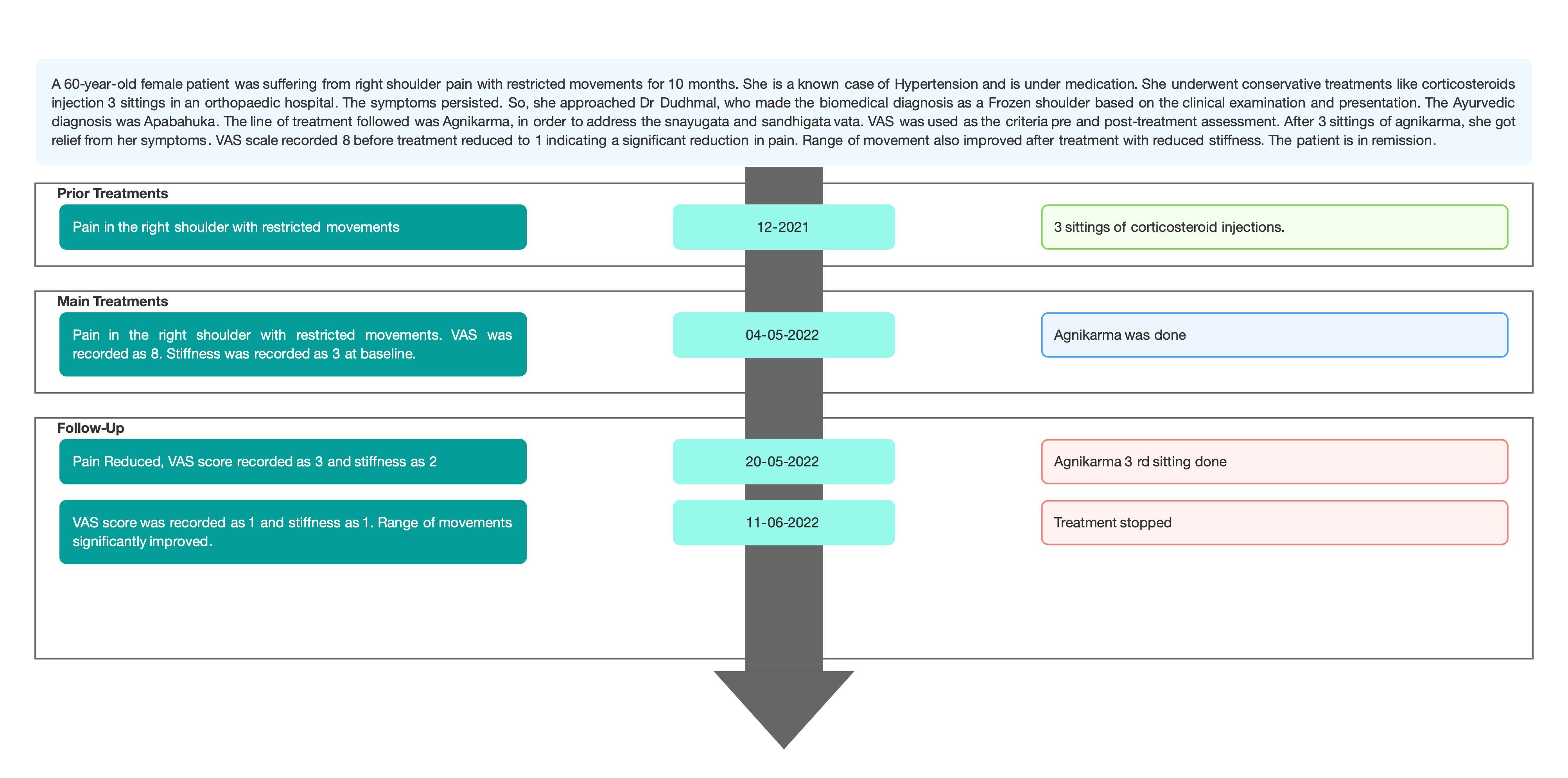
Image 1. Timeline of events added as an attachment.
DIAGNOSTIC ASSESSMENT
Modern Diagnostic parameter: In the patient’s words, she took corticosteroid injections for frozen shoulder. The biomedical diagnosis was confirmed by Dr Dudhmal, based on clinical examination and presentation. The X ray of the right shoulder was normal. Routine blood tests were also done, and no significant abnormality was detected in the levels.
Image 2. X ray done at baseline dated 6.5.2022
Ayurvedic Assessment was done based on the clinical evaluation by the ayurvedic physician.
Differential Diagnosis- The biomedical and ayurvedic diagnosis was confirmed by the ayurvedic physician, ruling out other possible pathologies.
Prognosis- Frozen shoulder is a self-limiting condition but, in some patients, permanent restricted range of movements persists. In this case, the patient had pain for 10 months and no improvement was found even after 3 injections of corticosteroids. With 3 sittings of Agnikarma, the VAS scale reduced from 8 to 1 indicating a significant improvement. The range of movements was also improving.
THERAPEUTIC INTERVENTION
See the tab ‘Treatment details’
Image 3. Materials required for agnikarma
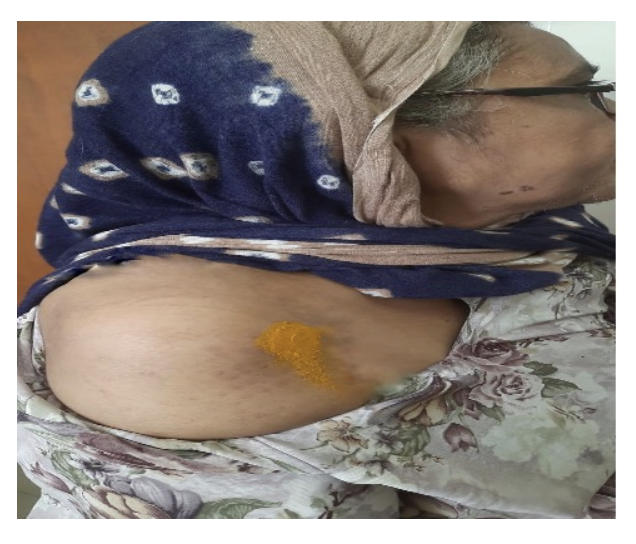
Image 4. Patient during the agnikarma.
FOLLOW-UP AND OUTCOMES
Clinician-based assessment; After 3 sittings of Agnikarma- pain reduced, Range of movement also improved after treatment with reduced stiffness.
Patient-assessed: VAS scale recorded 8 before treatment reduced to 1 after treatment.
Table 1. Assessments recorded before, during and after treatment.
Parameters
BT
(5/5/22)
AT
FOLLOW UP (AFTER)
1st week
(6/5/22)
2nd week
(13/5/22)
3rdweek
(20/5/22)
6th week
(11/6/22)
Pain (VAS score)
VAS 8
VAS 6
VAS 4
VAS 3
VAS 1
Stiffness
3
3
2
2
1
ROM
(measured with goniometer)
Abduction
90
100
120
150
160
Adduction
90
110
140
140
150
Extension
100
120
120
160
165
Flexion
40
40
40
50
60
Internal rotation
60
60
60
60
70
External rotation
70
80
80
90
100
Wasting of Shoulder muscle
-
-
-
-
-
Intervention adherence and tolerability – The patient adhered to the prescribed treatments and tolerated the treatments well.
Method of assessment- By monitoring the patient.
Adverse and unanticipated events; None reported.
DISCUSSION ;
Classical reference of Sushruta and Vagbhata have advised Agnikarma in the diseases like Snayugatavata and Sandhigatavata (osteoarthritis). In Avabahuka, there is the involvement of the Sira (veins), Snayu (muscles), Kandara (tendons), For Avabahuka (frozen shoulder), no definite site is mentioned for Agnikarma in samhita. In Vasavarajeeyam, author has narrated site for Agnikarma at Bahushiro (~gleno-humeral joint). Agnikarma to Asthi Sandhi by approaching Tvak Dhatu (~skin), it improves Mahabhutagni by Ushna (~hotness), Sukshma (~penetrating) and Ashukari (~fast acting) properties of Agni. Ushna Guna supposed to improve Rasa-Rakta circulation and remove degenerated and necrotised tissue, fibrous tissue aggregated in joint. By establishing proper nourishment to shoulder joint, it recommences proper shoulder joint function. Establishment of direct therapeutic heat to most tender part of affected joint provides permanent pain relief and improves range of motion of joint, so this kind of treatment has a rational approach.
PATIENT’S PERSPECTIVE
Not available.
LEARNING POINTS/TAKE-HOME MESSAGES
This case report demonstrates the successful standalone ayurvedic management of frozen shoulder. The 60-year-old female patient had been suffering from the symptoms for 10 months, and there was no satisfactory response even to corticosteroid injections. With 3 sittings of Agni karma, the VAS recorded 8 before treatment reduced to 1, depicting a significant improvement. There was also an improvement in the range of movements.
INFORMED CONSENT
Written consent was obtained from the patient to publish the case report.
CONFLICT OF INTEREST
None declared.
FUNDING
None
REFERENCE
- Cho CH, Bae KC, Kim DH. Treatment Strategy for Frozen Shoulder. Clin Orthop Surg. 2019 Sep;11(3):249-257.
- Millar NL, Meakins A, Struyf F, Willmore E, Campbell AL, Kirwan PD, Akbar M, Moore L, Ronquillo JC, Murrell GAC, Rodeo SA. Frozen shoulder. Nat Rev Dis Primers. 2022 Sep 8;8(1):59.
- Sushruta Samhita, Dalhana. Nidana sthana, 1/82. Chaukhamba Orientalia; Varanasi: 1991.
- Madhava nidana, madhukosha commentary, 22/65. Varanasi: Chaukhamba Surabharati prakashan; First edition 1986.
- Ashtanga Hridaya, commentary on Sarvangasundari tika. published by Motilal Banarasi Das, Varanasi, editor. Uttara sthana, 24/7. Varanasi; Eighth edition 1998
Image 1. Timeline of events
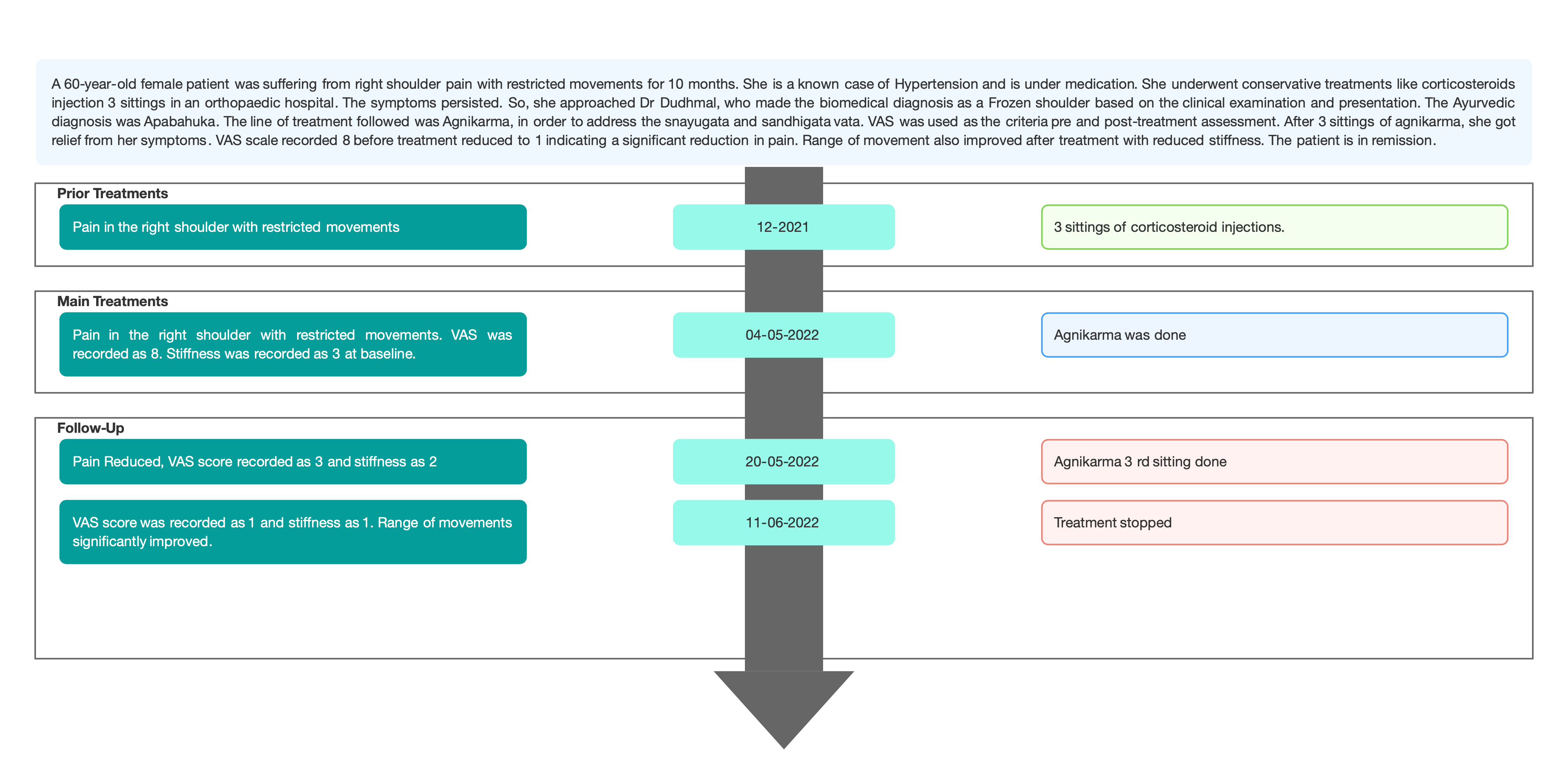
Image 2. X ray done at baseline dated 6.5.2022
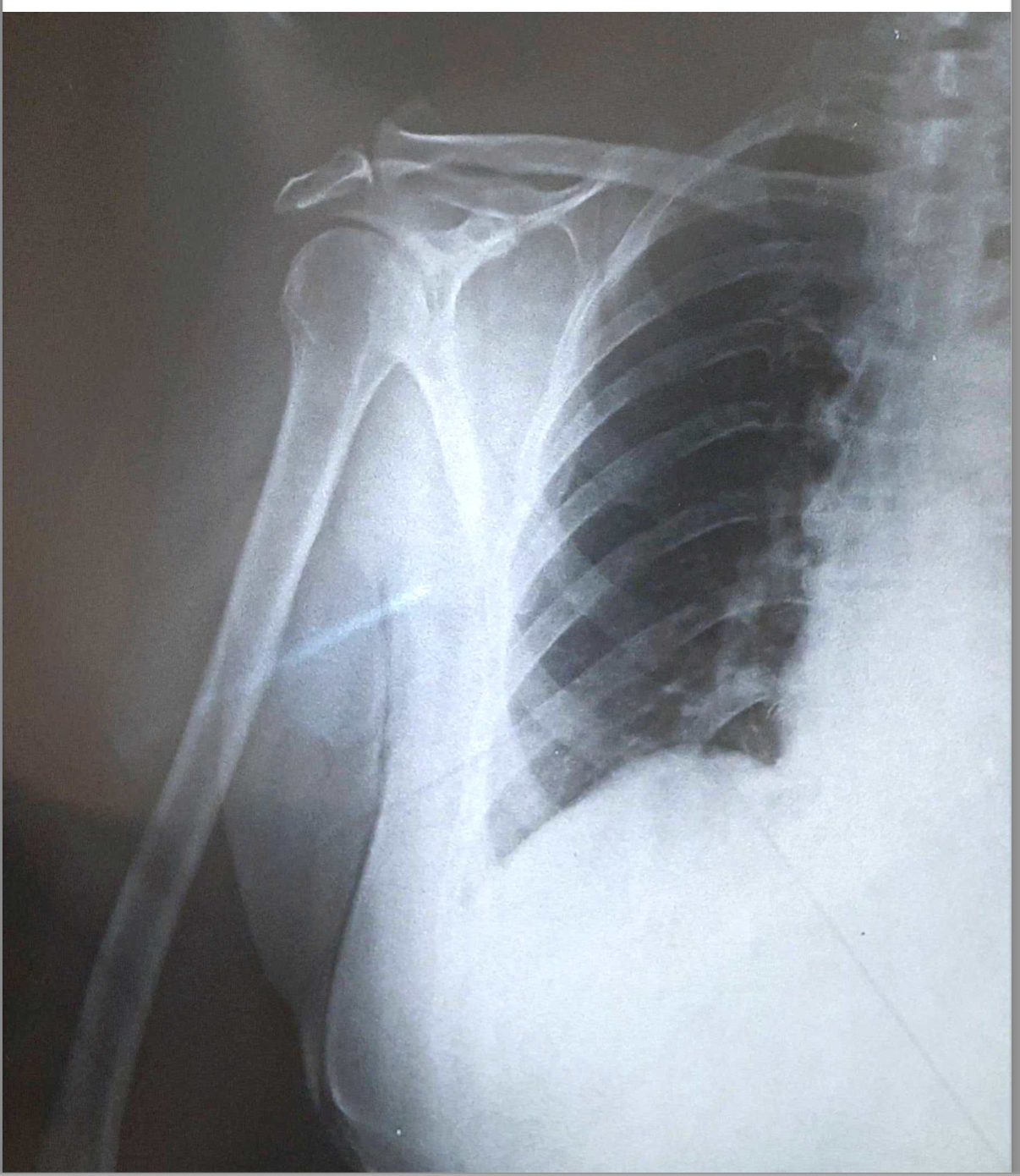
Image 3. Materials required for Agni karma
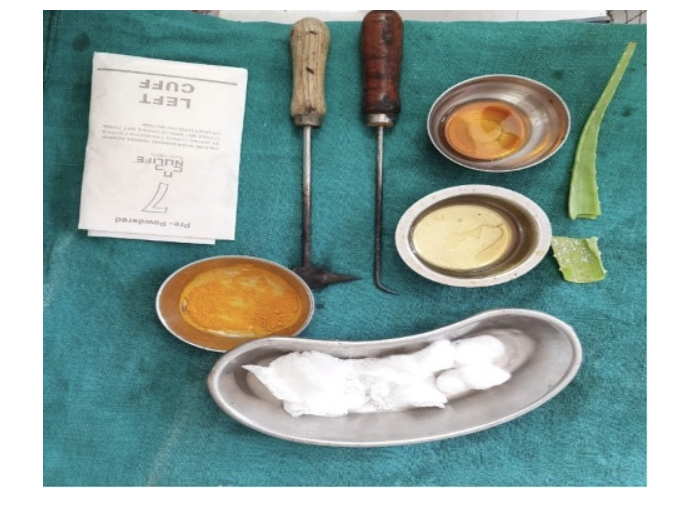
Image 4. Patient during the Agni karma
-
Immersive Learning
-
Modern Diagnosis
MODERN DIAGNOSIS: Frozen shoulder
ABOUT THE DISEASE:
Frozen shoulder (FS) is a common shoulder disorder characterized by a gradual increase of pain of spontaneous onset and limitation in the range of motion of the glenohumeral joint. The pathophysiology of FS is relatively well understood as a pathological process of synovial inflammation followed by capsular fibrosis, but the cause of FS is still unknown. This is frequently associated with other systemic conditions or occurs following periods of immobilization, and has a protracted clinical course, which can be frustrating for patients as well as healthcare professionals.
Diagnosis- Diagnosis is based on physical examination and can be difficult depending on the stage of disease or if concomitant shoulder pathology is present.[2] In this case report, the patient underwent treatment at an orthopaedic hospital. Getting no relief from the symptoms, she approached Dr Dudhmal. The biomedical diagnosis was made by Dr Dudhmal, based on the clinical presentation and examination. An X-ray done of the right shoulder AP view was normal, ruling out any pathologies. Blood tests done as a routine were well within normal limits.
Image 1. X ray Right shoulder dated 6.5.2022 added below
Treatment modalities for FS include medication, local steroid injection, physiotherapy, hydrodistension, manipulation under anaesthesia, arthroscopic capsular release, open capsular release, anti-inflammatory medications, hydrodilation and surgical interventions. However, their effectiveness remains unclear. Conservative management leads to improvement in most cases.
Prognosis- There are conservative and surgical methods to address the condition. Failure to obtain symptomatic improvement and continued functional disability after 3 to 6 months of conservative treatment are general indications for surgical management. However, there is no consensus as to the most efficacious treatments for this condition.
Reference
- Cho CH, Bae KC, Kim DH. Treatment Strategy for Frozen Shoulder. Clin Orthop Surg. 2019 Sep;11(3):249-257.
- Millar NL, Meakins A, Struyf F, Willmore E, Campbell AL, Kirwan PD, Akbar M, Moore L, Ronquillo JC, Murrell GAC, Rodeo SA. Frozen shoulder. Nat Rev Dis Primers. 2022 Sep 8;8(1):59.
Image 1. Xray of the Right shoulder at baseline
-
Ayurveda Diagnosis
AYURVEDA DIAGNOSIS: Avabahuka/Apabahuka
ABOUT THE DISEASE:
Apabahuka is a disease that usually affects the Amsa sandhi (shoulder joint). It is caused by Vata dosha. Even though the term Apabahuka is not mentioned in the nanatmaja vata vyadhi, Acarya Sushruta has considered Apabahuka as a vataja vikara. Amsa shosha (wasting of the shoulder) can be considered the preliminary stage of the disease, where loss or dryness of sleshaka kapha from amsa sandhi occurs. Apabahuka, occurs due to the loss of Shleshaka Kapha and symptoms like shoola during movement, restricted movement, and so on, are manifested. Even as this is commented on in the Madhukosha teeka, it is mentioned that Amsa shosha is produced by dhatukshaya, that is, shuddha vata janya, and apabahuka is Vata Kapha janya [1 and 2]
Causes:
The hetu of Apabahuka may be classified into two types - Bahya hetu - Causing injury to the marma or the region surrounding the amsa sandhi. This is also known as bahya abhigataja that manifests into the vyadhi; (ii) Abhyantara hetu - Indulging in the etiological factors that aggravate Vata leading to the vitiation of vata in that region and is also known as dosha prokopajanya (Samshraya), which in turn leads to karmahani of bahu.
Cikitsa:
The general line of treatment mentioned for vatavyadhi include snehana (both internal and external), swedana, mrudusamshodhana, vasti, sirovasti, nasya, and so on. Caraka further states that, depending on the location and dushya (tissue element vitiated by vata) each patient should be given specific therapies. Vagbhata has mentioned nasyakarma in the jatrurdhva vatavikaras [3]. In this patient only Agni karma was performed.
Rationale of treatment: Classical references of Sushruta and Vagbhata have advised Agnikarma in the diseases like Snayugatavata and Sandhigatavata (osteoarthritis). In Avabahuka, there is the involvement of the Sira (veins), Snayu (muscles), Kandara (tendons), For Avabahuka (frozen shoulder), no definite site is mentioned for Agnikarma in samhita. In Vasavarajeeyam, author has narrated site for Agnikarma at Bahushiro (~gleno-humeral joint). Agnikarma to Asthi Sandhi by approaching Tvak Dhatu (~skin), it improves Mahabhutagni by Ushna (~hotness), Sukshma (~penetrating) and Ashukari (~fast acting) properties of Agni. Ushna Guna is supposed to improve Rasa-Rakta circulation and remove degenerated and necrotised tissue, fibrous tissue aggregated in joints. By establishing proper nourishment to the shoulder joint, it recommences proper shoulder joint function. The establishment of direct therapeutic heat to the most tender part of the affected joint provides permanent pain relief and improves the range of motion of the joint, so this kind of treatment has a rational approach.
Reference
- Sushruta Samhita, Dalhana. Nidana sthana, 1/82. Chaukhamba Orientalia; Varanasi: 199
- Madhava nidana, madhukosha commentary, 22/65. Varanasi: Chaukhamba Surabharati prakashan; First edition 1986.
- Ashtanga Hridaya, commentary on Sarvangasundari tika. published by Motilal Banarasi Das, Varanasi, editor. Uttara sthana, 24/7. Varanasi; Eighth edition 1998
-
Treatment
Name of Medicine Dosage Form Dosage Mode of Administrtation From - To (Date) Medicine Reference Agnikarma with Shalaka As decided by the physician External 2022-05-06 - 2022-05-06 Agnikarma with Shalaka As decided by the physician External 2022-05-13 - 2022-05-13 Agnikarma with Shalaka As decided by the physician External 2022-05-20 - 2022-05-20 -
Outcome Measures
OUTCOME MEASURES
The 60-year-old female patient had been suffering from right shoulder pain with restricted movements for 10 months, and there was no satisfactory response even to corticosteroid injections.
Assessment criteria- VAS, Range of movements and stiffness pre- and post-treatment were the basic assessment criteria.
Table 1. The assessment pre- and post-treatment recorded is tabulated as follows:
Parameters
BT
(5/5/22)
AT
FOLLOW UP (AFTER)
1st week
(6/5/22)
2nd week
(13/5/22)
3rdweek
(20/5/22)
6th week
(11/6/22)
Pain (VAS score)
VAS 8
VAS 6
VAS 4
VAS 3
VAS 1
Stiffness
3
3
2
2
1
ROM
(Measured with goniometer)
Abduction
90
100
120
150
160
Adduction
90
110
140
140
150
Extension
100
120
120
160
165
Flexion
40
40
40
50
60
Internal rotation
60
60
60
60
70
External rotation
70
80
80
90
100
Wasting of Shoulder muscle
-
-
-
-
-
1st sitting agnikarma – 6.5.2022.
2nd sitting - 13.5.2022.
3rd sitting - 20.5.2022.
Image 1. Materials required for agnikarma
Image 2. Image was taken during treatment
-