Featured Case
-
Abstract
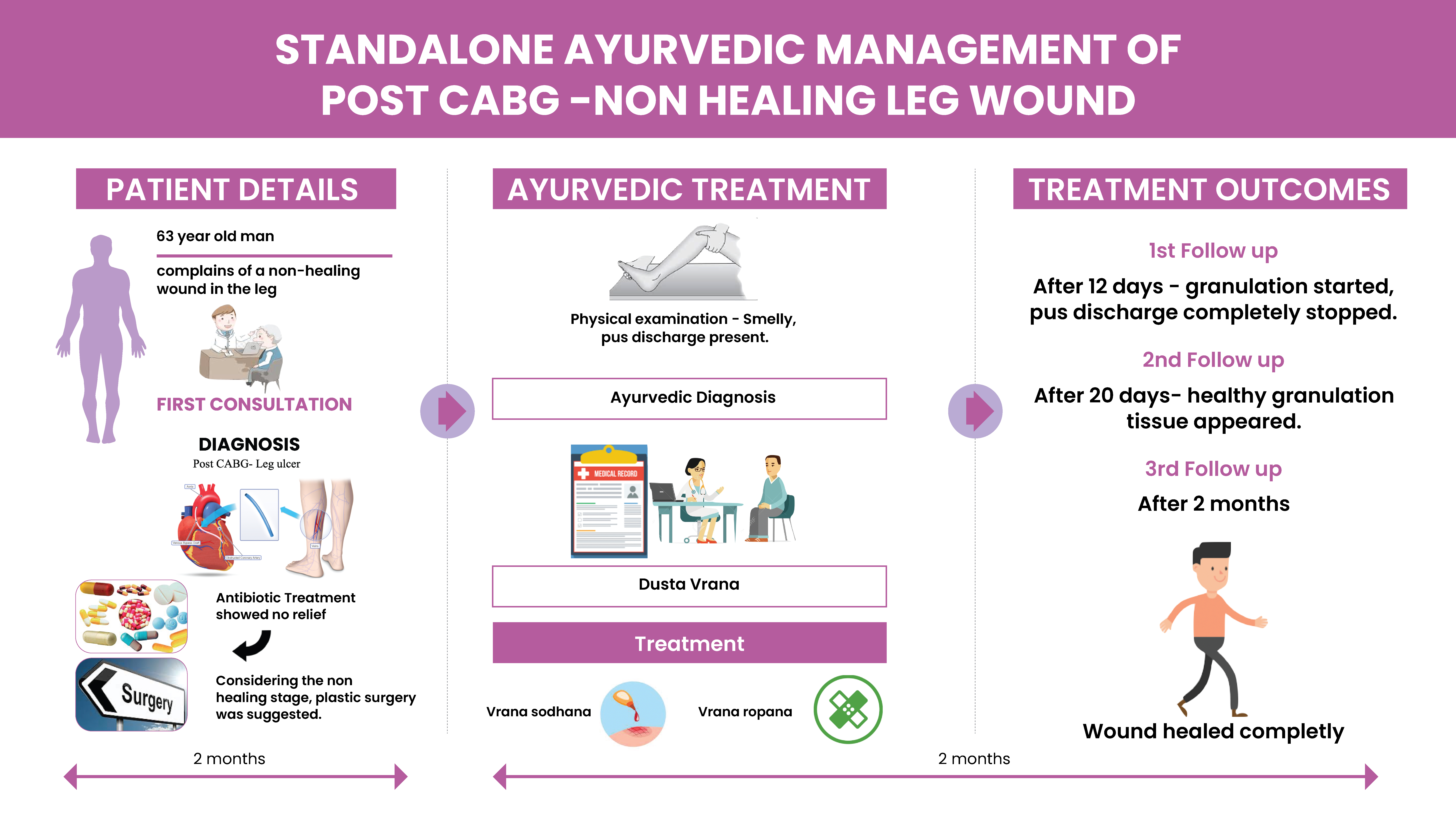
A 63-year-old businessman was diagnosed with a non-healing wound in the leg after a coronary artery bypass graft, at the harvest site. The condition was pre-diagnosed based on the wound's non-healing and infective nature. He underwent antibiotic therapy and wound dressing for two months. Considering the poor prognosis even after the administration of antibiotic medicines, plastic surgery was suggested. He denied surgery and opted Ayurvedic line of management. The patient presented to Dr. Jyoti Joshi with a non-healing wound in the right leg after coronary artery bypass graft at the harvest site for 2 months. The wound was deep with pus discharge and emitted a foul smell on clinical examination. Her condition was diagnosed as dusta vrana. The line of management adopted was Vrana shodhana and Vrana ropana. After two weeks of treatment, pus discharge had almost stopped, and a healthy granulation tissue had formed. With two months of Ayurvedic medicine, infection resolved and the wound healed completely.
This case demonstrates the scope of Ayurvedic treatment in non-healing wounds.
-
Summaries
-
Listen
-
Watch
-
View
-
Read
A non-healing wound of the leg Post CABG, management with Ayurveda- A case report
A 63-year-old businessman was diagnosed with a non-healing wound in the leg after a coronary artery bypass graft, at the harvest site. The condition was pre-diagnosed based on the wound's non-healing and infective nature. He underwent antibiotic therapy and wound dressing for two months. Considering the poor prognosis even after the administration of antibiotic medicines, plastic surgery was suggested. He denied surgery and opted Ayurvedic line of management. The patient presented to Dr. Jyoti Joshi with a non-healing wound in the right leg after coronary artery bypass graft at the harvest site for 2 months. The wound was deep with pus discharge and emitted a foul smell on clinical examination. Her condition was diagnosed as dusta vrana. The line of management adopted was Vrana shodhana and Vrana ropana. After two weeks of treatment, pus discharge had almost stopped, and a healthy granulation tissue had formed. With two months of Ayurvedic medicine, infection resolved and the wound healed completely.
This case demonstrates the scope of Ayurvedic treatment in non-healing wounds.
-
-
Timeline
-
Tabulated Summary
-
Narrative
TITLE OF CASE
Stand-alone Ayurvedic management of Post CABG- Non-healing leg wound- A case report
Dr Jyoti Joshi
ABSTRACT
A 63-year-old businessman was diagnosed with a non-healing wound in the leg after a coronary artery bypass graft, at the harvest site. The condition was pre-diagnosed based on the wound's non-healing and infective nature. He underwent antibiotic therapy and wound dressing for two months. Considering the poor prognosis even after the administration of antibiotic medicines, plastic surgery was suggested. He denied surgery and opted Ayurvedic line of management. The patient presented with a non-healing wound in the right leg after coronary artery bypass graft at the harvest site for 2 months. The wound was deep with pus discharge and emitted a foul smell on clinical examination. Dr Jyothi Joshi diagnosed the condition as dusta vrana. The line of management adopted was Vrana shodhana and Vrana ropana. After two weeks of treatment, pus discharge had almost stopped, and a healthy granulation tissue formation was observed. With two months of Ayurvedic medicine, the infection resolved, and the wound healed completely. So, Ayurveda can be opted for managing such non-healing wounds.
KEYWORDS
Non healing Ulcer, Dusta vrana, Ayurveda, Case report
INTRODUCTION
Coronary artery bypass grafting is a commonly performed surgery worldwide that gives good results. Great saphenous vein is used as a conduit for bypass in over 95% cases[1]. However, wound complications from harvesting the great saphenous vein by open method can be a major source of postoperative morbidity. The incidence of saphenous vein harvest site infection is reported to be between 1% and 24% in the literature. In such infected non-healing wounds, Ayurvedic management could be a better treatment option.
PATIENT INFORMATION
A 63-year-old businessman presented with a non-healing wound in right leg after CABG at the harvest site.
Medical history: K/C/O DM/ HTN/Asthma/ pancreatitis /umbilical hernia. The patient had c/o dyspnoea, bilateral pedal oedema, loose motion and tiredness, for which he took treatment and was referred to the cardiologist on 23/4/19. The patient had a history of CVA 20 years back. Coronary Angiography done on 24/4/19 revealed Triple vessel CAD. CABG did on 12/6/19 LIMA to LAD, SVG to RCA. The patient had a non-healing wound at the harvest site in the right leg. He underwent antibiotic therapy and wound dressing for 2 months. Considering the non-healing stage of the wound, even after the antibiotic medicines, plastic surgery was suggested. He denied surgery and opted Ayurvedic line of management.
CLINICAL FINDINGS
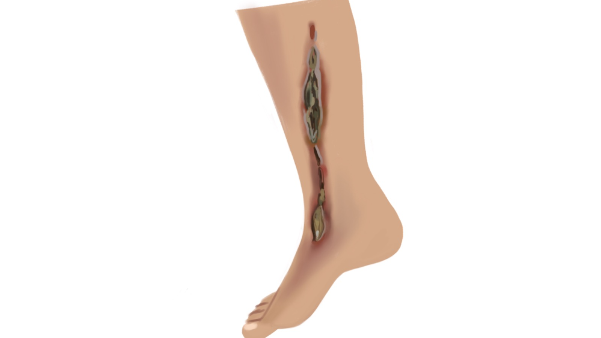
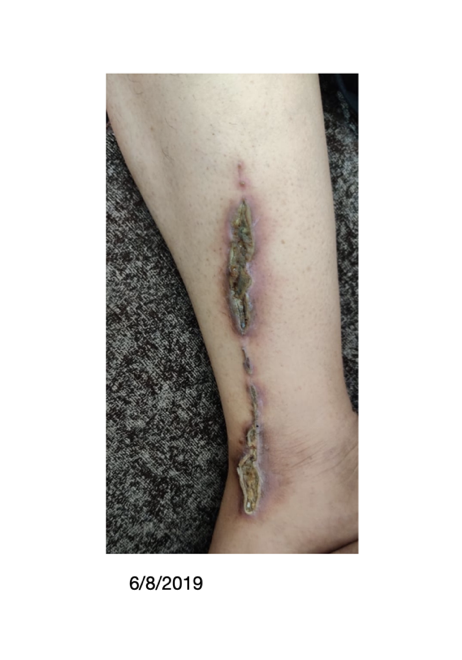
The wound bed was deep with pus discharge and a foul smell on clinical examination.
TIMELINE
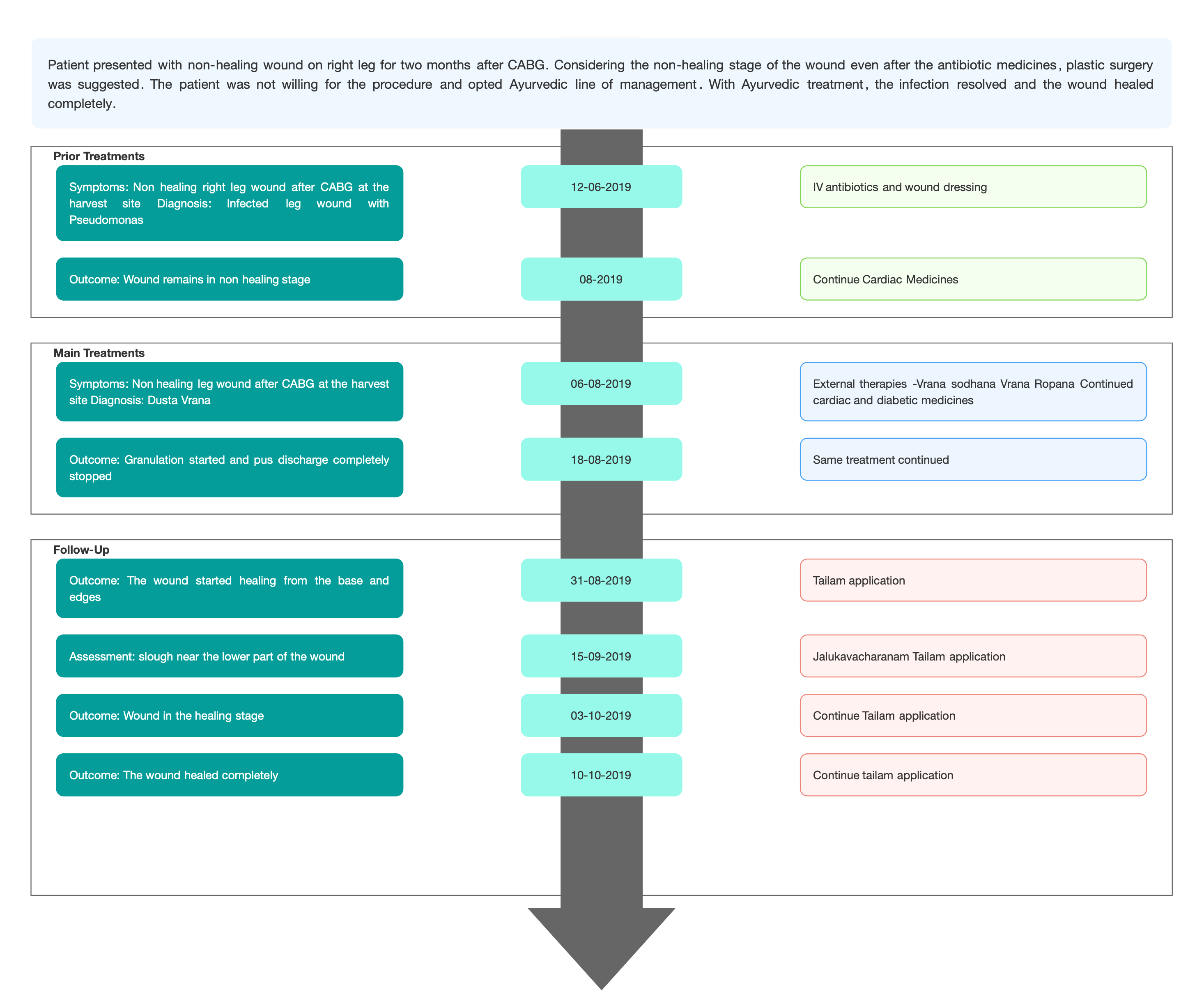
Image 1. Attached
DIAGNOSTIC ASSESSMENT
Modern Diagnosis: The condition was pre-diagnosed as a post-CABG- non-healing leg wound based on the non-healing and infected nature of the wound.
Image 2. Diagnosis proof document- Previous treatment record
Ayurvedic diagnosis: The treating physician clinically diagnosed the condition as dusta vrana.
Differential Diagnosis: Irrelevant as the patient's condition was pre-diagnosed.
Prognosis: The patient presented with a non-healing wound on rt leg for two months after CABG. Considering the non-healing stage of the wound, even after the antibiotic medicines, plastic surgery was suggested. Still, the patient was not willing for the procedure and opted Ayurvedic line of management. With Ayurvedic treatment, the infection resolved, and the wound healed completely.
THERAPEUTIC INTERVENTION
See tab Treatment details
FOLLOW-UP AND OUTCOMES
6/8/2019- non-healing wound- open, pus+, foul smelling, Wound bed - deep
15/8/2019- pus + in the upper part of the wound
19/8/2019- Granulation tissue growth - started, Pus discharge- reduced
26/8/2019- Healthy granulation tissue from the wound base, Pus discharge stopped
31/8/2019- Wound started healing from base and edges
15/9/2019- Slough at the lower part of the wound
3/10/2019- Wound in the healing stage
10/10/2019 - Wound healed
Image 3. Stages of healing after initiation of treatment
Clinician-based assessment: After 2 weeks of Ayurvedic treatment, pus discharge has almost stopped and started with healthy granulation tissue formation.
Patient assessed: Not relevant
Follow-up investigations: Nil
Intervention adherence and tolerability – The patient adhered to the prescribed treatments and tolerated the treatments well.
Method of assessment- By monitoring the patient.
Adverse and unanticipated events; None reported
DISCUSSION
A wound associated with severe pain, profuse discharge having putrified smell, and irregular floor and margin is known as DushtaVrana[2]. Dushta Vrana refuses to heal or heals very slowly in spite of the best efforts by Chikitsa Chatuspada. In this case, the condition was diagnosed as dusta vrana. So Vrana shodhana and after that, Vrana ropana line of management was followed. The physician opted jalaukavacharanam on alternate days for vrana sodhana, and to promote healing, kshiridrumavalkadi churna wound dressing was done.
PATIENT’S PERSPECTIVE:
Not available
LEARNING POINTS
This patient suffered from a non-healing leg wound at the CABG harvest site. Considering the non-healing stage of the wound, even after the antibiotic medicines, plastic surgery was suggested. With Ayurvedic treatment, the infection resolved, and the wound healed completely. Ayurveda can be opted for managing such non-healing wounds.
INFORMED CONSENT
Written Informed consent was given by the patient for publication.
ACKNOWLEDGEMENTS
None
CONFLICT OF INTEREST
None declared
FUNDING
None
REFERENCE
1. Siddiqi MS. Saphenous vein harvest wound complications: risk factors, identification, prevention, and management. Chronic Wound Care Management and Research. 2016;3:147-156
https://doi.org/10.2147/CWCMR.S826012. Acharya Priyavrat Sharma(ed), Sushruta Samhita with Dalhana virachita Nibandha Sangraha vyakhya, published by Chaukhamba samskrita Samsthana, Varanasi, 8th edition 2005, sutrasthana 22.7
Image 1. Timeline
Image 2. Previous treatment records
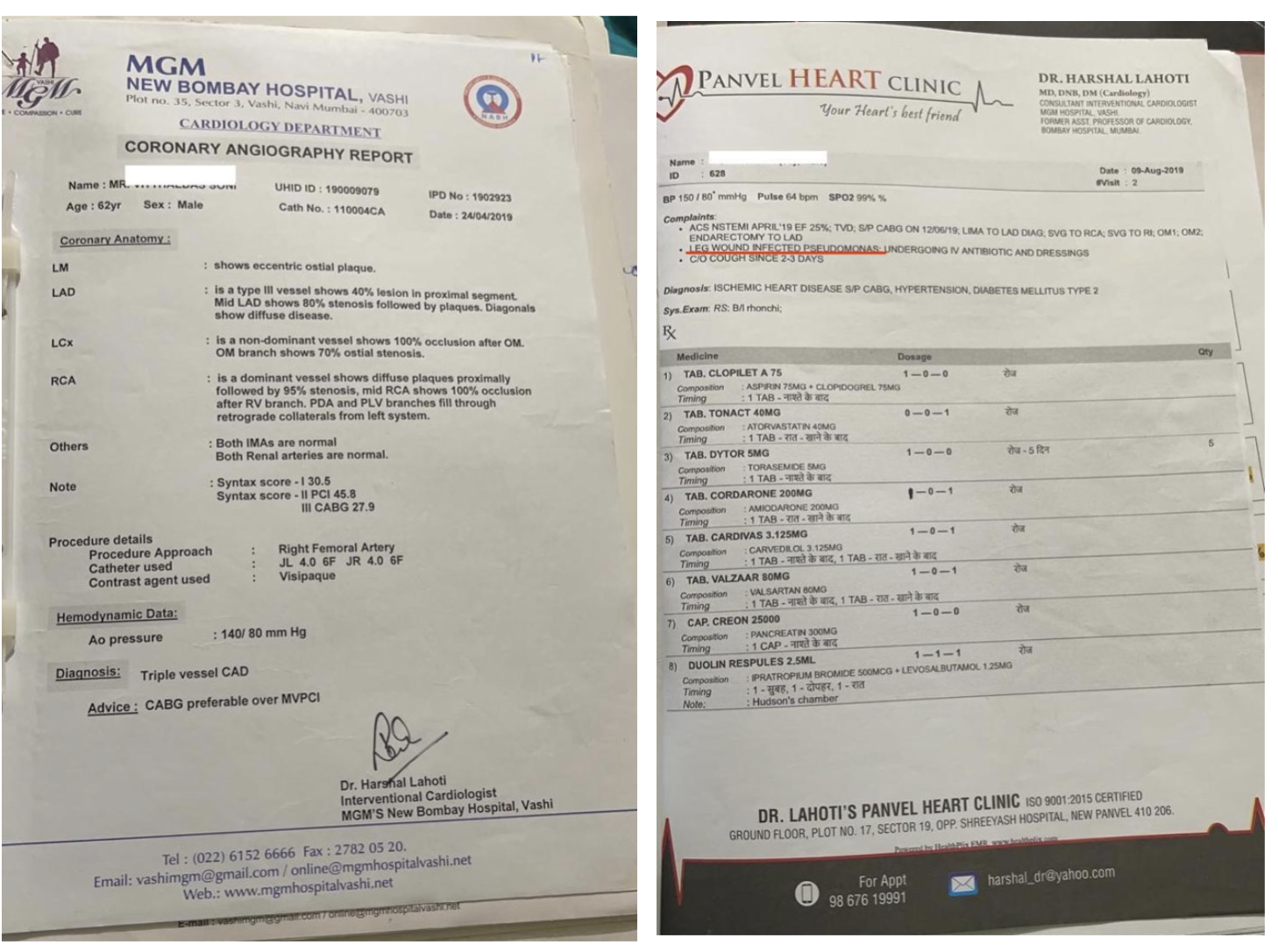 Image 3. Wound healing stages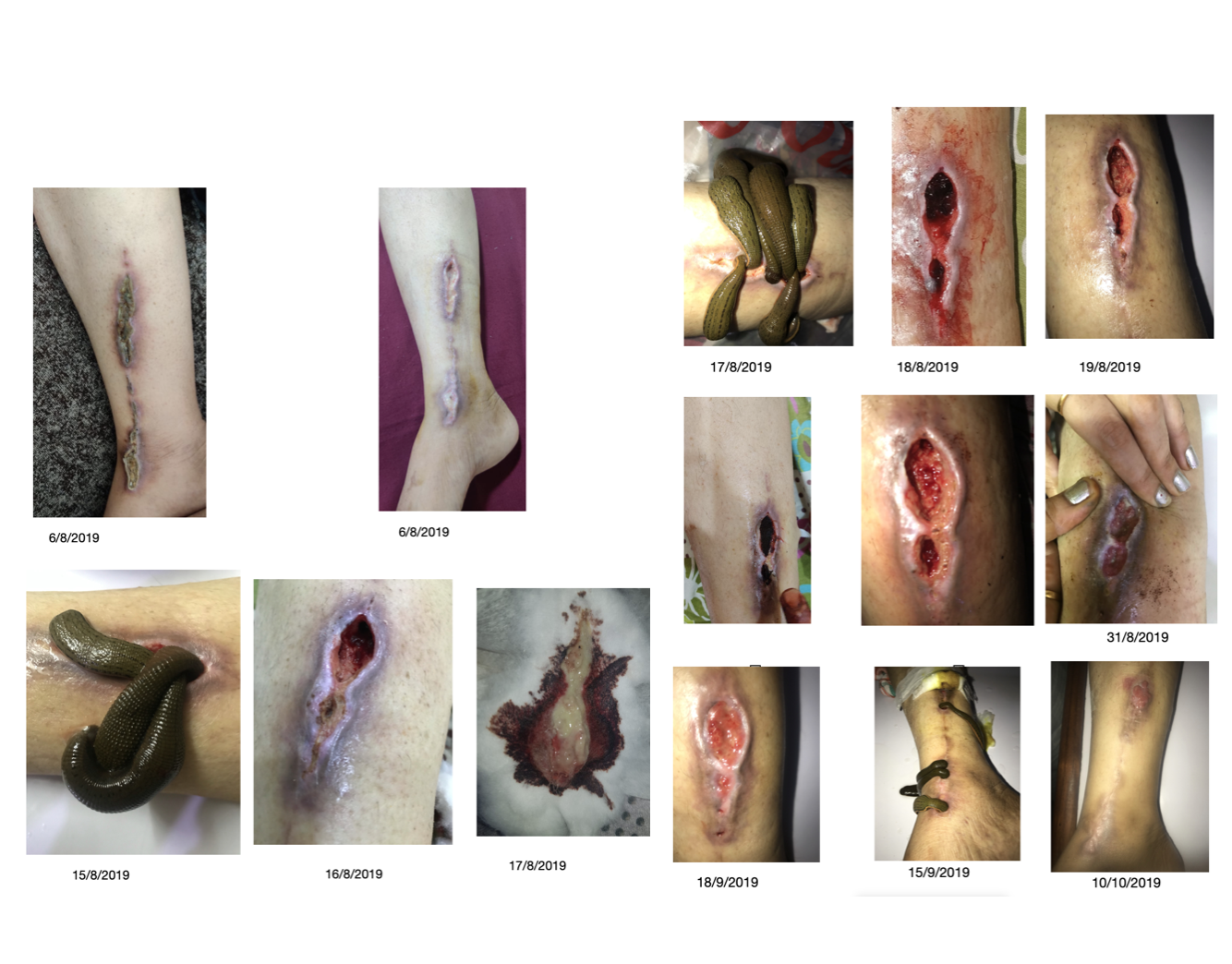
-
Immersive Learning
-
Modern Diagnosis
Modern Diagnosis: Post Coronary Artery Bypass Grafting (CABG) non-healing Leg wound
About the Disease:
Coronary artery bypass grafting is a commonly performed surgery worldwide that gives good results. The Great saphenous vein is used as a conduit for bypass in over 95% of cases. However, wound complications from harvesting the great saphenous vein by the open method can be a major source of postoperative morbidity. The incidence of saphenous vein harvest site infection is reported to be between 1% and 24% in the literature.
Diagnostic Criteria:
Diagnostic criteria of surgical site infection:
Purulent drainage from the deep incision
The deep incision that spontaneously dehisces or is opened by the surgeon
Organisms are identified by culture (or non-culture-based microbiologic testing method) performed either for clinical diagnosis or treatment. In case the wound is big and the edges cannot be approximated, that cannot be managed by the above-mentioned conservative procedures, plastic surgical procedures should be used. If ischemia is the cause of the wound problem, then it must be managed by restoration of the blood supply. In extreme cases where circulation cannot be restored and limbs appear unsalvageable, amputation is the only option. The presence of any one of the clinical features like fever, or localized pain in the absence of microbial testing confirms the infection.
Diagnosis of this case:
This is a case of 63 years old male patient who presented with complaints of a non-healing leg wound since 2 -months after CABG at the graft site. The infected stage of the harvest site wound was pre-diagnosed. Considering the non-healing stage of the wound even after the antibiotic medicines, plastic surgery was suggested by the cardiologist. Based on the previous treatment records and clinical examination, the condition was diagnosed as Post CABG leg wound.
Image 1. Previous treatment record
Image 2. Wound before treatment
Prognosis: If the wounds are large, healing by secondary intention will take a long time, delaying the patient’s recovery.
Treatment: In wounds with first intention healing, nonoperative techniques will suffice with a simple moist dressing. If there is cellulitis and inflammation, limb elevation and the use of broad-spectrum antibiotics are advised.
Image 1. Previous treatment record
Image 2. Wound before treatment
-
Ayurveda Diagnosis
Ayurveda Diagnosis: Dusta Vrana
About the Disease
व्रण गात्र विचूर्णने व्रणयति इति व्रणह….(AH.Utt.25.22)
There is a destruction, break, rupture or discontinuity in the body tissue, it is called as Vrana.
वृणोति यस्मात् रूढे'अपि व्रनवस्तु न नश्यति ।आदेह धारणात्तस्मत्व्रणैत्युच्च्यते ॥
Susruta explains Vrana as that which retains the scar even after complete healing of the wound, and the imprint remains the entire life. (Su.Ci.1.6)
दोषैरधिष्ठितो दुष्टः…..
When it becomes the seat of the vitiated dosa then it is called as Dushta Vrana.
In Dushta Vrana, there is severe pain, profuse discharge having putrified smell, and irregular floor and margin.
पूतिगन्धान् विवर्णांछ्च बहुस्रावान्महारुजः॥८३॥
व्रणानछुद्धान् || (ch.chi)
Dushta Vrana is difficult to heal and heals very slowly in spite of the best efforts by Chikitsa Chatuspada.
Lakshanas of Dushta Vrana
तत्रातिसंवृतोऽतिविवृतोऽतिकठिनोऽतिमृदुरुत्सन्नोऽवसन्नोऽतिशीतोऽत्युष्णः
नगन्धात्यर्थदाहपाकरागवेदनावानिति पित्तेन, शेषाः कफेन; उन्मार्गी मुखात् मुखान्तरवान्, उत्सङ्गः कोटरः’ इति चक्रः; कृष्णरक्तपीतशुक्लादीनांवर्णानामन्यतमवर्णो भैरवः पूतिपूयमांससिरास्नायुप्रभृतिभिः पूर्णः पूतिपूयास्राव्युन्मार्ग्युत्सङ्ग्यमनोज्ञदर्शनगन्धोऽत्यर्थंवेदनावान्दाहपाकरागकण्डूशोफपिडकोपद्रुतोऽत्यर्थं दुष्टशोणितास्रावी दीर्घकालानुबन्धी चेति दुष्टव्रणलिङ्गानि | (Su.Su 22/7)Management of Vrana
Treatment varies depending on the type of vrana and the management is given till the complete removal of scar tissue. In the treatment of nija vrana, i.e., those ulcers which recur due to aggravation of doshas, Sushruta explained 60 upakrama, Charaka explained 36 upakrama and Vagbhata mentioned 26 upakramas. Seven measures of Vrana Vimlapana, Avasechana, Upanaha, Patana kriya, Shodhana, Ropana, Vaikritapaham are explained by Acharya Sushruta. Sapta upkrama are a principal line of treatment which is explained in detail as shashthi upakrama.
This patient is 63 years old male patient who presented with complaints of a non-healing leg wound 2 months after CABG at the harvest site. The condition was pre-diagnosed as post-CABG harvest site infection, and considering the non-healing stage of the wound even after the antibiotic medicines, the cardiologist suggested plastic surgery. The patient opted for Ayurvedic treatment. The wound was deep with pus discharge and foul smell on clinical examination. Based on the previous treatment records and clinical examination, the physician diagnosed the clinical condition as Dusta vrana.
Treatment rationale: The physician opted for Jalaukavacaranam on alternate days for Vrana sodhana, and to promote healing, Kshiridhrumavalkkadi curna wound dressing was done. After 20 days, healthy granulation tissue appeared and then jatyadi was given for external application.
-
Treatment
Name of Medicine Dosage Form Dosage Mode of Administrtation From - To (Date) Medicine Reference Kshiridhrumavalkadi churna Choornam Daily External application for wound dressing 2019-08-06 - 2019-08-25 Anubhuta yogam Jalaukavacharanam On alternate days External 2019-08-15 - 2019-09-15 Jatyadi tailam Daily External application 2019-08-26 - 2019-10-10 Sharangadhara Samhita, Sneha Kalpana, Madhyama Khanda -
Outcome Measures
OUTCOME MEASURES
A 63 years old male patient presented with complaints of non-healing leg wound since 2 months after Coronary Artery Bypass Graft. On considering the non-healing stage, plastic surgery was suggested, but the patient opted Ayurvedic line of management. Wound bed and peri-wound area, amount, and consistency of exudate were assessed during the treatment period.
The condition was diagnosed as dusta vrana. So Vrana shodhana and after that, Vrana ropana line of management was followed. The physician opted for jalaukavacharanam on alternate days for Vrana sodhana, and to promote healing, ksheeridhrumavalkkadi churna wound dressing was done. After 12 days, granulation started, and pus discharge completely stopped. After 20 days, healthy granulation tissue appeared and then jatyadi was given for external application. After 2 months, the wound completely healed.
Date
Assessment
6/8/2019
Non healing wound- open , pus+, foul smelling
Wound bed - deep
15/8/2019
pus+ in upper part of the wound
19/8/2019
Granulation tissue growth - started
Pus discharge- reduced
26/8/2019
Healthy granulation tissue from the wound base
Pus discharge stopped
31/8/2019
Wound started healing from base and edges
15/9/2019
Slough at the lower part of wound
3/10/2019
Wound in healing stage
Patient discharged
10/10/2019 (Follow up)
Wound healed
Image 1. Wound healing stages
-