Featured Case
-
Abstract
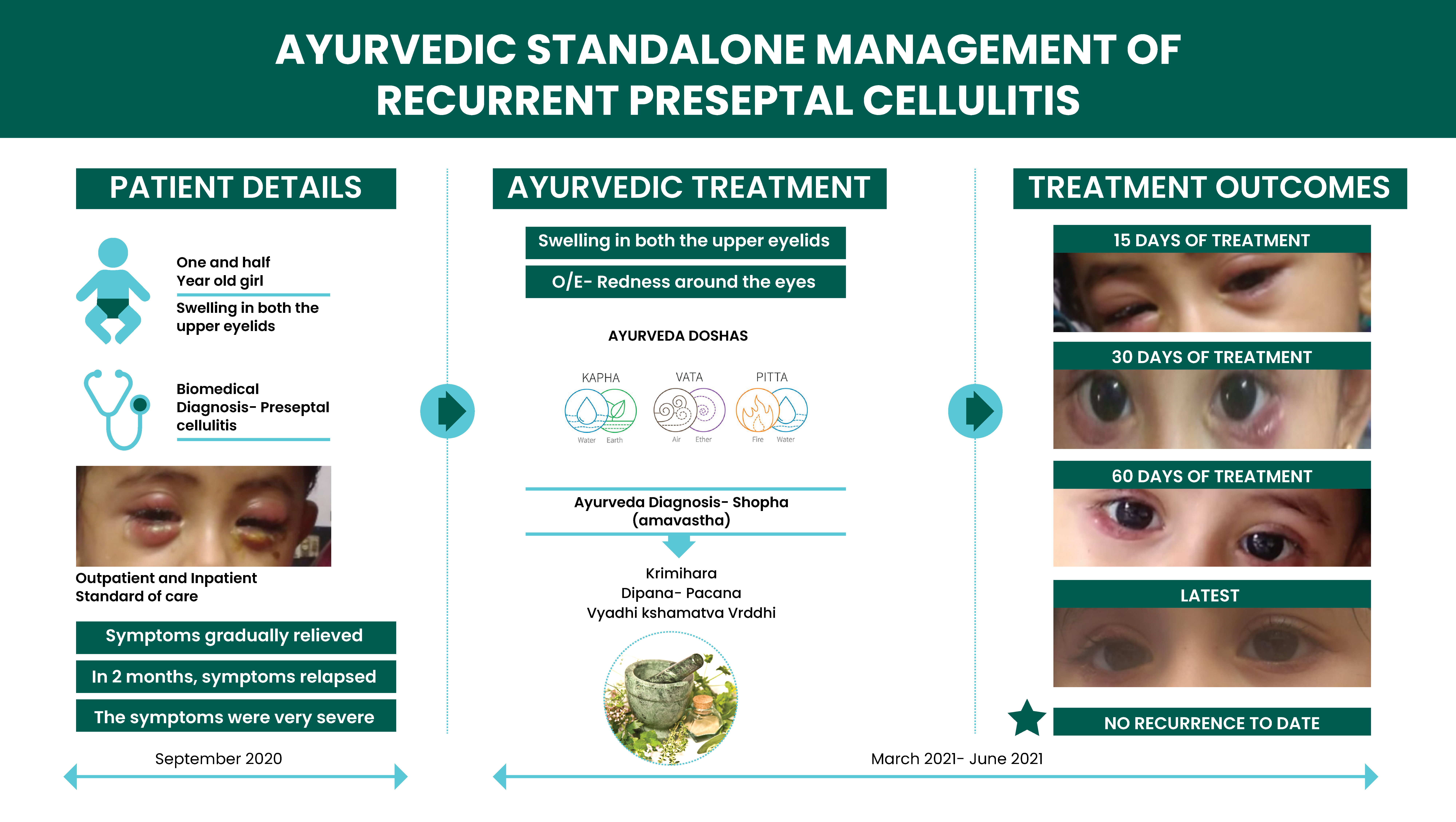
A one and half year-old girl child was diagnosed with Preseptal cellulitis. The biomedical diagnosis was confirmed by clinical examination and culture tests done at the Paediatric Hospital. The first episode of swelling and redness in the eyelids was when the child was 1 year old. She had undergone standard of care, at a multi-specialty hospital. During the In-patient treatment, she gradually improved symptomatically and was discharged with medicines. But after 2-3 months the condition recurred and this time it was more severe than earlier episode. So, the parents decided that this time, they would try Ayurvedic treatments instead. The parents brought the child to consult Dr Ashwini seeking Ayurvedic treatment. The presenting complaints were upper eyelid oedema of both the eyes for 3 months. This was diagnosed as Shopha in the amavastha and the appropriate treatment was given. After 15 days of ayurvedic medicines, oedema and redness reduced significantly. After 30 days of treatment, only mild oedema and redness persisted. After 60 days, oedema and redness were completely relieved. The child has no recurrence to date.
This case report demonstrates the successful Ayurvedic management of preseptal cellulitis in a child that was not satisfactorily responding to the standard of care.
-
Summaries
-
Listen
-
Watch
-
View
-
Read
A one and half year-old girl child was diagnosed with Preseptal cellulitis. The biomedical diagnosis was confirmed by clinical examination and culture tests done at the Paediatric Hospital. The first episode of swelling and redness in the eyelids was when the child was 1 year old. She had undergone standard of care, at a multi-specialty hospital. During the In-patient treatment, she gradually improved symptomatically and was discharged with medicines. But after 2-3 months the condition recurred and this time it was more severe than earlier episode. So, the parents decided that this time, they would try Ayurvedic treatments instead. The parents brought the child to consult Dr Ashwini seeking Ayurvedic treatment. The presenting complaints were upper eyelid oedema of both the eyes for 3 months. This was diagnosed as Shopha in the amavastha and the appropriate treatment was given. After 15 days of ayurvedic medicines, oedema and redness reduced significantly. After 30 days of treatment, only mild oedema and redness persisted. After 60 days, oedema and redness were completely relieved. The child has no recurrence to date.
This case report demonstrates the successful Ayurvedic management of preseptal cellulitis in a child that was not satisfactorily responding to the standard of care.
-
-
Timeline
-
Tabulated Summary
-
Narrative
TITLE OF CASE
Standalone Ayurvedic management of preseptal cellulitis (recurrent) - A Case report
Dr Ashwini B.N
ABSTRACT
A one and half year-old girl child was diagnosed with Preseptal cellulitis. The biomedical diagnosis was confirmed by clinical examination and culture tests done at the Paediatric Hospital. The first episode of swelling and redness in the eyelids was when the child was 1 year old. She had undergone standard of care, at a multi-specialty hospital. During the In-patient treatment, she gradually improved symptomatically and was discharged with medicines. But after 2-3 months the condition recurred and this time it was more severe than earlier episode. So, the parents decided that this time, they would try Ayurvedic treatments instead. The parents brought the child to consult Dr Ashwini seeking Ayurvedic treatment. The presenting complaints were upper eyelid oedema of both the eyes for 3 months. This was diagnosed as Shopha in the amavastha and the appropriate treatment was given. After 15 days of ayurvedic medicines, oedema and redness reduced significantly. After 30 days of treatment, only mild oedema and redness persisted. After 60 days, oedema and redness were completely relieved. The child has no recurrence to date.
This case report demonstrates the successful Ayurvedic management of preseptal cellulitis in a child that was not satisfactorily responding to the standard of care.
KEYWORDS
Standalone, Preseptal cellulitis, Shopha, Ayurveda
INTRODUCTION
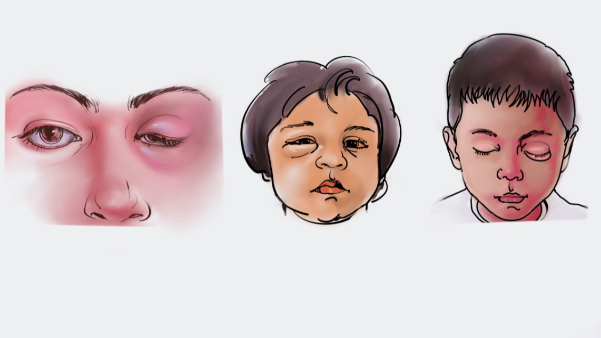
Skin and soft tissue infection that develops around the eye anterior to the orbital septum is called Preseptal cellulitis. Though this can occur at any age, it is a very common condition seen in children and complications arising out of this condition are very rare as the disease has a good prognosis. But if the treatment is not effective, then it can lead to severe damage and even blindness. The causative factor is an infection.
Diagnostic Criteria- There are no specific diagnostic criteria for this condition. Clinical evaluation and detailed case taking are the basis of diagnosis. To identify the intensity, a computed tomography scan of the sinuses and orbits can be done.
PATIENT INFORMATION
One and half year-old baby girl was pre-diagnosed as Preseptal cellulitis, presented with upper eye lid oedema of both the eyes for 3 months. Child was active and was playing. The mother mentioned that the kid did have some skin allergy, but not aware what the exact allergy was. This could not be confirmed because, when the child came for consultation, she did not have any allergic presentation. No relevant family, surgical, and genetic history.
Medical History: When the baby was 1 year old, she developed swelling and redness of both eyelids, and discharge from both eyes. She was treated with a course of topical and oral antibiotics, but the symptoms persisted. So, she had IP treatment in a modern hospital (11.9.20 to 18.9.20). Immunization- Done at par with age. Development milestones- Normal. Born to parents of a non-sanguineous marriage. The blood parameters were normal except CRP which was borderline high. Culture and sensitivity Eye swab - detected no growth. Pus cells were moderate, and there were no microorganisms. During the IP treatment, she gradually improved and was discharged with medicines. But 2 months the condition recurred and this time it was more severe than earlier. So, the parents decided that they would try Ayurvedic treatment.
CLINICAL FINDINGS
Examination of both eyes showed bilateral swelling and redness of the upper lids associated with crusting. Visual acuity and bilateral pupillary reflex were normal.
Image 1. Baseline 18.3.2021 attached below
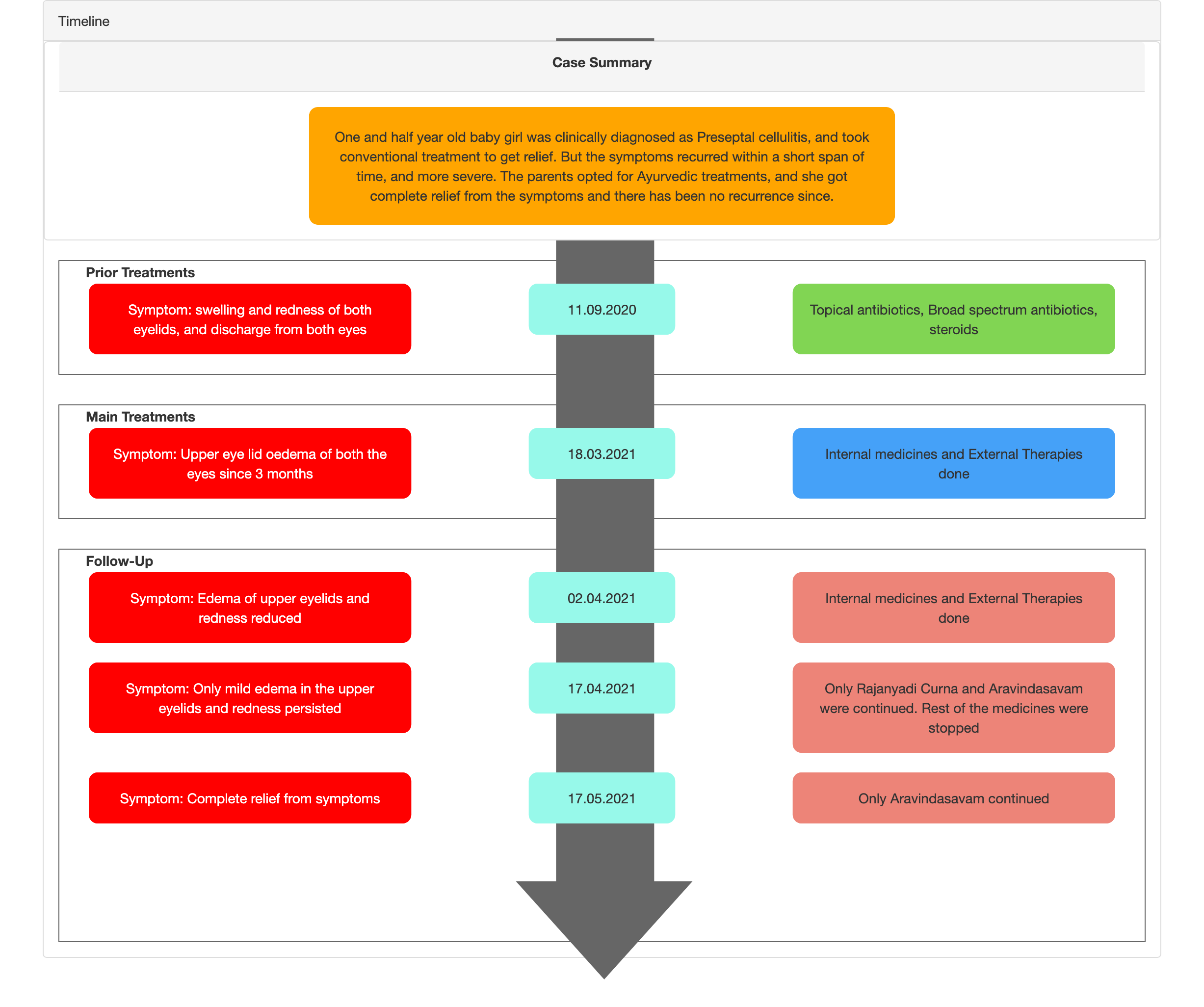
TIMELINE
Image 2. Attached below
DIAGNOSTIC ASSESSMENT
Modern Diagnostic parameter: The records available from the modern hospital confirm the diagnosis as Preseptal cellulitis with multiple hordeolum. All the treatments given and the investigations done at the hospital were submitted.
Image 3. Documents Confirming Diagnosis & previous medicines; (11.9.2020-18.9.2020). Attached below
Ayurvedic Assessment was done based on the clinical evaluation by the ayurvedic physician.
Differential Diagnosis- This does not apply as the patient came in with a definite diagnosis.
Prognosis- Preseptal cellulitis has a good prognosis and responds well to a short course of antibiotics. If the treatment is not effective, then this causes orbital cellulitis and loss of vision. In extreme cases, it can extend further to cause a subperiosteal abscess, orbital abscess, cavernous sinus thrombosis, and intracranial infection such as intracerebral abscess, meningitis, empyema or abscess of the epidural or subdural space. In this patient, though the diagnosis was confirmed, there were no pathogens detected in culture and sensitivity. She did not respond satisfactorily to the OP and IP conventional interventions. Though the patient did get better symptomatically, the symptoms recurred within a few months and with greater intensity. So this time they opted for Ayurveda. With Ayurvedic treatments for 2 months, her condition resolved completely without any recurrence to date.
THERAPEUTIC INTERVENTION
See the tab ' Treatment details'
FOLLOW-UP AND OUTCOMES
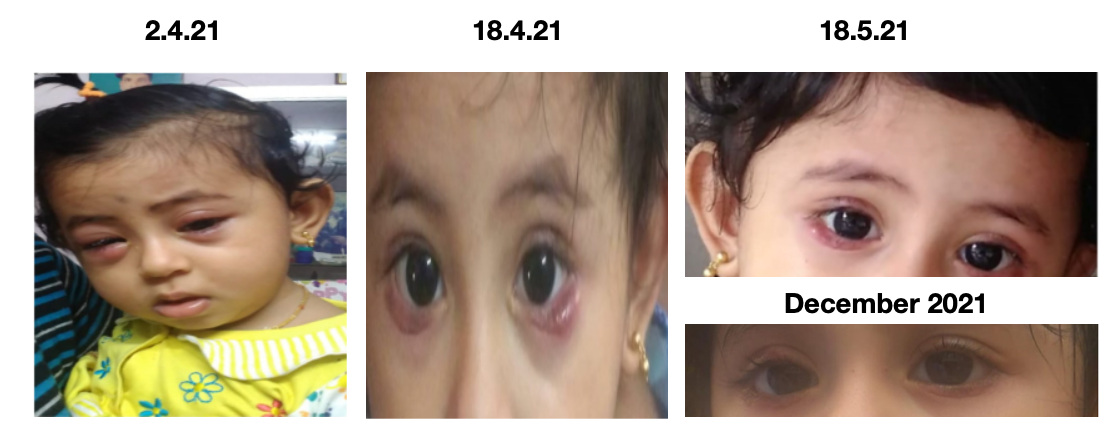
Subjective parameters were assessed. After 15 days of ayurvedic medication, oedema and redness reduced significantly. In the first follow-up visit - only mild oedema and redness were present. In the next follow-up visit, after 2 months oedema and redness were completely relieved.
Image 4. Images taken during and after treatment.Attached below
Clinician-based assessment; After 15 days of medicines, edema and redness reduced significantly. After 1 month, only mild edema and redness persisted. After another month, the edema and redness were completely relieved.
Patient-assessed; Not relevant.
Intervention adherence and tolerability – The patient adhered to the prescribed treatments and tolerated the treatments well.
Method of assessment- By monitoring the patient.
Adverse and unanticipated events; None reported
DISCUSSION:
According to Ayurveda, edema will have 3 stages. In the first two stages, surgical measures are not advised and, in this stage, measures to ripen the oedema are to be adopted like external application and hot fomentation. Once oedema ripens and there is pus collected, incision and drainage which is then followed by bandaging. In certain cases, medical management will suffice. The patient was examined, and the stage of oedema was assessed as amavastha and appropriate treatment measures were adopted. As the patient is a toddler, purificatory treatments cannot be given. So, external, and internal medications were administered as given in the table.
Krimihara vati helps to achieve deworming which is beneficial in this age. Liv 52 syrup helps to increase the Agni (digestive fire) thereby the ama (undigested metabolic wastes) can be reduced. Fomentation over the eyelids with a cloth dipped in Tulasi and Haridra boiled water helps in ripening oedema and also increases the local metabolic activity by increasing the local temperature. Breast milk has shita, laghu property and is highly beneficial in reducing pitta dosha thereby the redness and discharge can be treated. Rajanyadi curna is indicated in diseases in children, which increases their resistance in them to counteract many diseases. Aravindasavam is mainly indicated in children which helps in the round development of a child by increasing the mental and physical capabilities.
PATIENT’S PERSPECTIVE
Not available.
LEARNING POINTS/TAKE-HOME MESSAGES
The 1 and half-year-old kid diagnosed with Preseptal cellulitis tried conventional medicine both OP and IP, in spite of initial relief, the symptoms recurred within a short span of time and with greater intensity. But with Ayurvedic Intervention, the kid got complete relief from her symptoms and there has been no recurrence to date. Ayurvedic treatments can be considered as an alternative for managing recurrent Preseptal cellulitis.
INFORMED CONSENT
Written consent obtained from patient’s parents.
CONFLICT OF INTEREST
None declared.
FUNDING
None
REFERENCE
1. Ekhlassi T, Becker N. Preseptal and orbital cellulitis. Dis Mon. 2017 Feb;63(2):30-32. doi: 10.1016/j.disamonth.2016.09.002. Epub 2016 Nov 22. PMID: 27884386.
2. P. N. Vinaya: Inflammation in Ayurveda and Modern Medicine. IAMJ: Volume 1; Issue 4; July – Aug 2013
Image 1. Baseline 18.3.2021
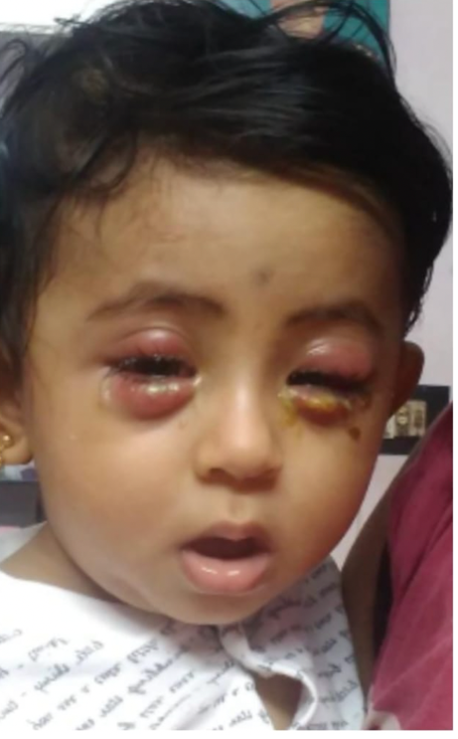
Image 2. Timeline of events
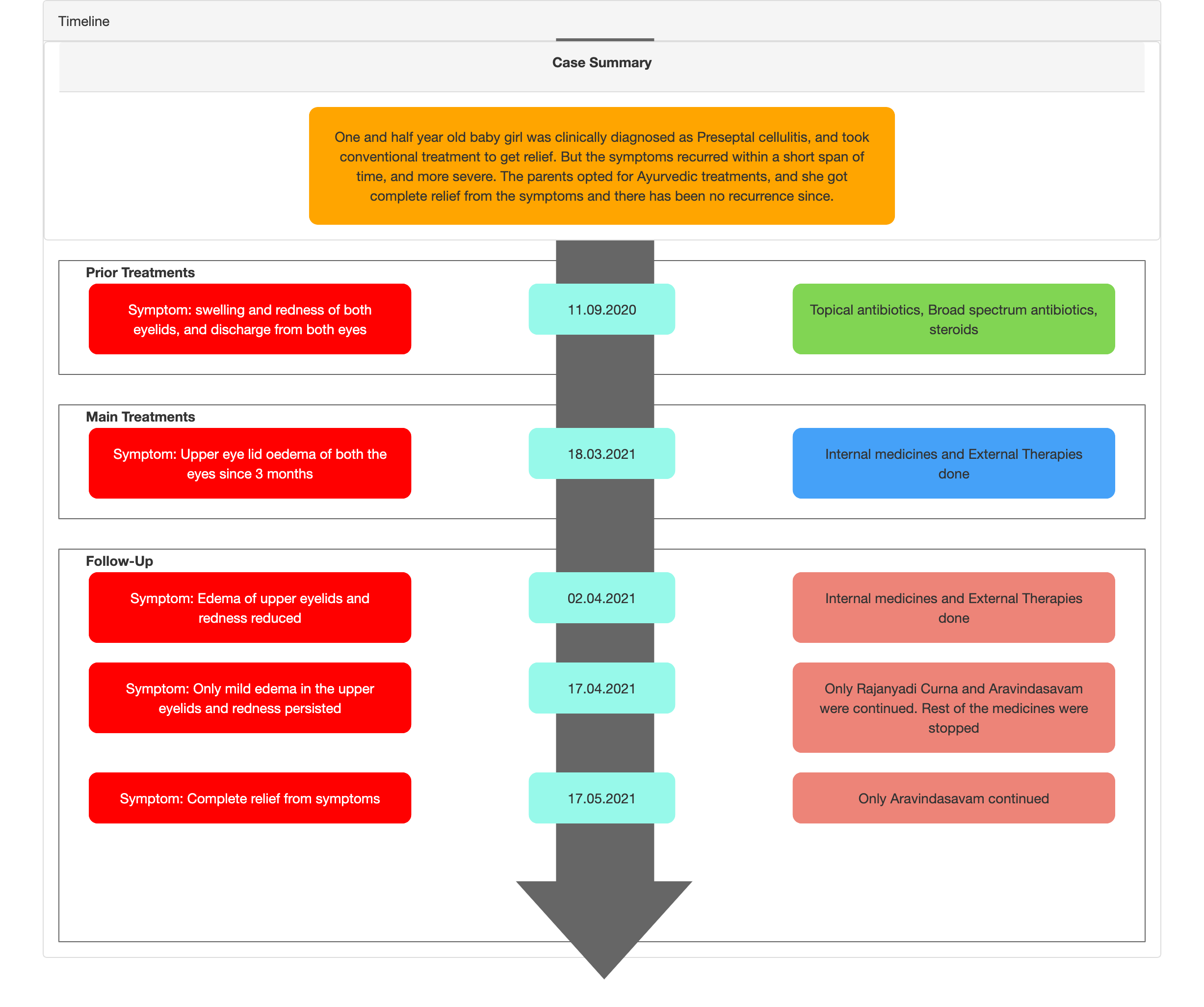
Image 3. Image 3. Documents Confirming Diagnosis & previous medicines; (11.9.2020-18.9.2020)
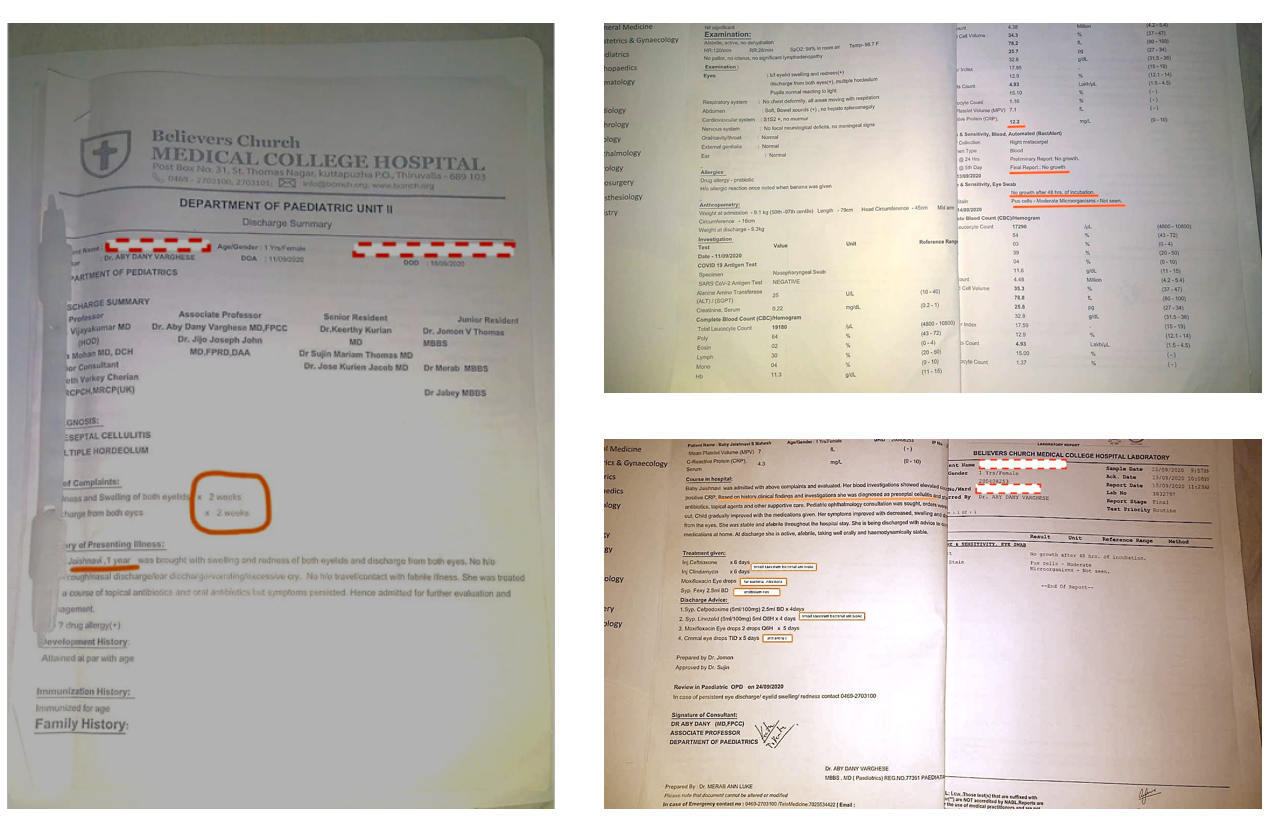
Image 4. Images taken during and after treatment.
-
Immersive Learning
-
Modern Diagnosis
MODERN DIAGNOSIS; PRESEPTAL CELLULITIS (RECURRENT)
ABOUT THE DISEASE;
Skin and soft tissue infection that develops around the eye anterior to the orbital septum is called as Presptal cellulitus. Though this can occur at any age, is a very common condition seen in children and complications arising out of this condition are very rare as the disease has a good prognosis. But if the treatment is not effective, then it can lead to severe damage and even blindness. The causative factor is an infection.
Diagnostic Criteria- There is no specific diagnostic criteria for this condition. Clinical evaluation and detailed case taking are the basis of diagnosis. To identify the intensity, computed tomography scan of the sinuses and orbits can be done.
In this case report, the patient was already diagnosed by Allopathic expert and took conventional medicines, both as an Out-patient and In-patient. Culture & sensitivity (blood & eye swab) did not identify any pathogens. Broad spectrum antibiotics were given and the patient started feeling better.
Image 1. Confirmed Diagnosis Documents & previous medicines; (11.9.2020-18.9.2020). Attached below.
The Ayurvedic Physician diagnosed the clinical condition as Shopha (amavastha) based on the clinical presentation.
Image 2. Baseline Image of the patient. 18.3.2021. Attached below.
Prognosis- Preseptal cellulitis has a good prognosis, and responds well to a short course of antibiotics. If the treatment is not effective, then this cause orbital cellulitis and loss of vision. In extreme cases, it can extend further to cause a sub periosteal abscess, orbital abscess, cavernous sinus thrombosis, and intracranial infection such as intracerebral abscess, meningitis, empyema or abscess of the epidural or subdural space. In this patient, though the diagnosis was confirmed, there were no pathogens detected in culture and sensitivity. She did not respond satisfactorily to the OP and IP modern medications. With Ayurvedic treatments for 3 months, her condition resolved completely without recurrence to date.
Treatment- Normally the infectious agent is identified and the appropriate antibiotic will be prescribed, Eg - Infectious agents like S. aureus, the Streptococcus species, and anaerobes. If the patients is above one year with mild presentation, then treatment on an Out-patient basis will suffice. If the condition is severe or the child is less than one year then In-Patient treatment is recommended for better management of the condition.
Image 1. Documents confirming previous treatments
Image 2. Baseline Image. 18.3.2021
-
Ayurveda Diagnosis
AYURVEDIC DIAGNOSIS: Shopham (Amavastha)
ABOUT THE DISEASE:
Shopha is also called as shotha, shvayathu etc.., According to Ayurveda, edema will have 3 stages. In first two stages, surgical measures are not advised and in this stage measures to ripen the edema are to be adopted like external application and hot fomentation. Once the edema ripens and there is pus collected, incision and drainage which is then followed by bandaging. In certain cases, medical management will suffice. The symptoms of Shopha are heaviness, unstable, a feeling of warmth, and is elevated with thinning of veins (SS.Su.17). Based on the causative factor, they can be either Nija or Agantu. Classifications of Shotha are explained in detail in Susruta Samhita, where Raktaja Shopha is also mentioned (SS.Su.17.4-5). The aggravated dosha causing the condition is identified based on the presenting symptoms. Shotha can also occur as a complication of another disease as in the case of diabetes.
In this patient, being a recurrent condition, there has to be lina dosha, and ama is also involved.
Prognosis; Krcchrasadhya. When the shotha is in the pakvavastha, it can be treated and resolved. If in the apakvavastha, it has to be made pakva and then treated.
Treatment & Rationale of treatment; In Ayurveda, the concept of shopha chikitsa (management of swellings) describes about edema. Edema undergoes 3 stages. Amavasta, pachyamanavasta and pakvavasta. Only in Pakvavasta, Shastra karma is advised. In earlier 2 stages, it has to be treated with external applications and internal medication. Considering, Preseptal cellulitis as a vartma shopha (edema of the eye lid), similar line of treatment was adopted. The patient was examined and the stage of edema was assessed as amavasta and similar treatment measures were adopted. As patient is a toddler, she becomes unfit to administer purificatory treatment.
Considering the age of the patient, external therapies with some internal medications were planned. On the first visit she was advised Krimihara cikitsa with Krimighnavati, Liv 52 syrup to improve the agni, Rajanyadi curna 1.25 gm with plain gritha, Mriduswedana with Tulasi and Haridra jala with Stanya Aschotana 2 drops in each eye thrice a day. After 15 days of treatment, the edema and redness reduced markedly and was advised to continue Rajanyadi curna for 1 month. In the next visit, mild redness and edema persisted. Patient was asked to continue Rajanyadi curna 1.25 gm with plain ghrta thrice a day along with that Aravindasavam 5 ml twice a day and Plain ghrta for external application. After 3 months of treatment, edema and redness reduced completely.
The patient report no remission upto date.
-
Treatment
Name of Medicine Dosage Form Dosage Mode of Administrtation From - To (Date) Medicine Reference Krimighnavati Vati 1/2 1?2 tab twice daily after food Oral, with warm water 2021-03-18 - 2021-04-02 Proprietary Medicine Haridra,Tulasi Svedana dravya Required quantity Mrdu svedanam done thrice daily 2021-03-18 - 2021-04-02 Anubhuta Yogam Stanyam Ashcyotana Drava 2 drops in each eye; thrice daily Eye drops 2021-03-18 - 2021-04-02 Anubhuta Yogam Liv 52 syrup Syrup 2.5ml Before food Oral, at bedtime 2021-03-18 - 2021-04-02 Proprietary Medicine Rajanyadi curna Curnam 1.25 gms after food, thrice a day Oral, with warm water 2021-03-18 - 2021-05-02 Ashtangahrdaya. Uttara.2.37-40 Aravindasavam Asavam 5ml after food Oral 2021-04-02 - 2021-07-02 Bhaishajyaratnavali. Balaroga Pratishedha 185-189. -
Outcome Measures
OUTCOMES:
The patient was a One and half year old baby girl clinically diagnosed with Preseptal cellulitis, 6 months back. When the symptoms of swelling in the upper eyelids first appeared, she took conventional medicines andgot relief. But the within 2 months, the symptoms relapsed and this tim eit was more severe. The clinical condition was diagnosed as Shopha (amavasta) by Dr Ashwini and the treatment was planned like wise.
The Outcomes were measured by Subjective parameters.
After 15 days of medicines, edema and redness reduced significantly. After 1 month, only mild edema and redness persisted. After another one more month, the edema and redness were completely relieved. The child has no recurrence to date.
Image 1. Images taken during and after treatment.
-