Featured Case
-
Abstract
A 54-year-old woman suffered from relapsing chronic Plantar psoriasis for a period of 35 years. Whenever she got the complaints, she took conventional medicine and would get relief. But after some time, the symptoms would relapse. When she approached Dr Jyoti Joshi, she presented with silvery white flakes in both soles of the feet. Pain was constantly present with occasional bleeding. This was diagnosed as Vipadika by Dr Jyoti Joshi and to address the Dusta lakshanas, the management included Snehapanam, Virecanam, Avagaham and external applications along with a strict diet restriction and modified regimen.
With one year and four months of Ayurvedic treatment as an Outpatient, she got complete relief from the symptoms. There has been no recurrence since then.
-
Summaries
-
Listen
-
Watch
-
View
-
Read
Psoriasis is a chronic skin condition that can affect various parts of the body. If it affects the soles of feet, then it is called plantar psoriasis. Causes: Though the exact cause of the disease is not known, a major role is attributed to the Immune system. The risk factors that can trigger the infection are family history, the presence of human leukocyte antigen-Cw6 (HLA-Cw6), also a variation of a gene, smoking, skin friction, skin trauma such as infections and cuts on your palms or soles and suffering from other skin conditions like dermatitis etc. Common symptoms are silvery scales, dry and cracked skin, bleeding, an itchy, burning sensation, soreness, thickened, ridged nails, depressions, or pits in the nails.
Prognosis: The prognosis for patients with palmoplantar psoriasis is guarded. The treatments often take a long time to work, have adverse effects and are costly. The quality of life of most patients is poor. Most patients need combination therapy for many months before they see a response. In addition, patients also have other comorbidities that affect prognosis.
-
-
Timeline
-
Tabulated Summary
-
Narrative
TITLE OF CASE
Standalone Ayurvedic management of chronic plantar psoriasis - A Case report
Dr Jyoti Joshi
ABSTRACT
A 54-year-old woman with a 35-year history of plantar psoriasis[1] tried conventional medicine on & off but got only temporary relief, and the symptoms would recur. She consulted Dr Jyoti complaining of silvery flakes in the soles of both feet, severe pain in the feet while walking. Occasional bleeding through the cracks of the soles. She was diagnosed as Vipadika[2] and the management targeted addressing the chronicity and the Dusta Lakshana, along with pacifying the aggravated pitta. The treatments given were Sneha Panam, virecanam and local application. After 1 year and 4 months of ayurvedic treatment, she got complete relief from her symptoms and there has been no recurrence to date. In this case report, the chronicity of the condition makes it unique, as the patient was getting only temporary relief from conventional medicine and there was a recurrence.
KEYWORDS
Plantar Psoriasis, Vipadika, Ayurveda, Sneha panam, Virecanam, Standalone
INTRODUCTION
Psoriasis is a chronic skin condition that can affect various parts of the body. If it affects the soles of feet, then it is called plantar psoriasis. Causes: Though the exact cause of the disease is not known, a major role is attributed to the Immune system. The risk factors that can trigger the infection are family history, the presence of human leukocyte antigen-Cw6 (HLA-Cw6), also a variation of a gene, smoking, skin friction, skin trauma such as infections and cuts on your palms or soles and suffering from other skin conditions like dermatitis etc. Common symptoms are silvery scales, dry and cracked skin, bleeding, an itchy, burning sensation, soreness, thickened, ridged nails, depressions, or pits in the nails.
Prognosis: The prognosis for patients with palmoplantar psoriasis is guarded. The treatments often take a long time to work, have adverse effects and are costly. The quality of life of most patients is poor. Most patients need combination therapy for many months before they see a response. In addition, patients also have other comorbidities that affect prognosis.
PATIENT INFORMATION
A 54-year-old female, complained of silvery flakes in the soles of both feet. Severe pain in the feet while walking. Occasional bleeding through the cracks of the sole. Complaints persisting on and off for 35 years. No relevant family, surgical, genetic, or psychosocial history. No known addictions.
Medical History: The patient had consulted the Ayurvedic physician for joint complaints. Pain in bilateral knees, elbows, and shoulders for 5-6 years. She used to consult a general practitioner and was prescribed pain killers, vitamins, and calcium tablets. Would feel better for some time. Again, the complaints would start. Then she decided to consult Ayurveda Physician. She was given medicines based on V?tavy?dhi Cikits? and got complete relief in a short span of time. She did not intend to consult for Plantar Psoriasis as the complaint persisted for 35 years. She had tried different prescriptions over the years but to no avail. She had severe pain while walking with occasional bleeding through the cracks in the sole of the feet. She had learnt to live with the pain in the feet as there was no solution. But now that she got relief from her chronic joint pain, she requested to be treated for plantar psoriasis. No history of DM or HT.
CLINICAL FINDINGS
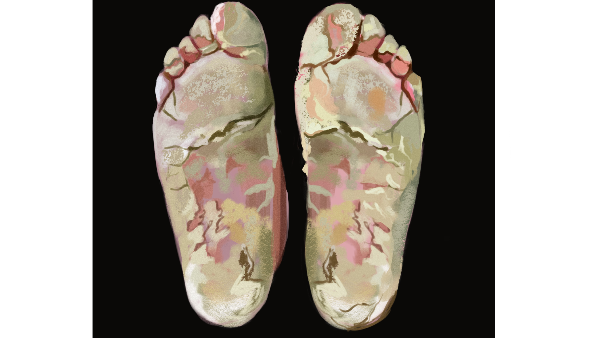
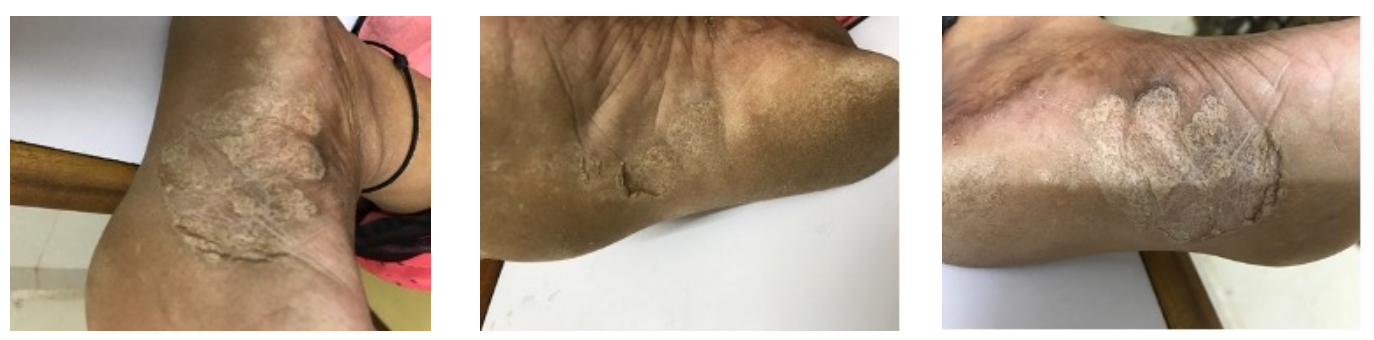
Silvery white thick flakes on the sole of both the feet. On examination, in psoriasis affected area, there were silvery white patches and dryness with the presence of cracks. Tenderness is also present. Mild bleeding present.
TIMELINE
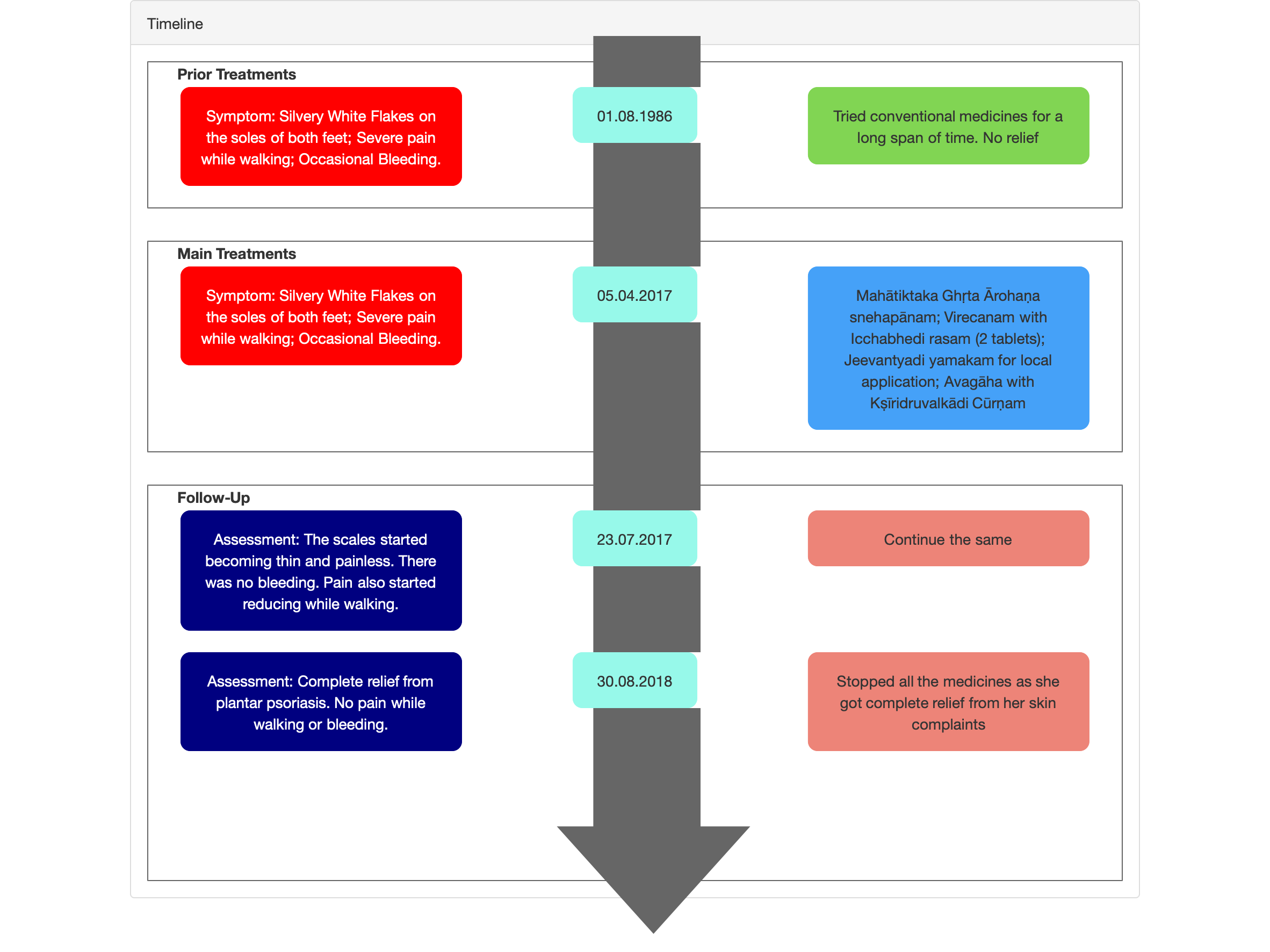
Image 1. Attached below
DIAGNOSTIC ASSESSMENT
The case was diagnosed clinically by the physician based on the clinical presentation.
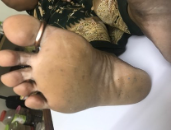
Image 2- Baseline images of the patient dated 5.4.2017 attached below
Biomedical Diagnosis- Plantar Psoriasis
Ayurvedic Diagnosis- Vipadika
Differential Diagnosis- No other diagnosis was considered as the clinical presentation was typical of Plantar psoriasis.
Prognosis- The prognosis for patients with palmoplantar psoriasis is guarded. The treatments often take a long time to work, have adverse effects and are costly. The quality of life of most patients is poor. Most patients need combination therapy for many months before they see a response. In addition, patients also have other comorbidities that affect prognosis.
In this patient, the condition was very chronic with a history of more than 35 years. This was a challenging condition. In spite of taking conventional medicine on & off, she did not get permanent relief. She had given up hope and had stopped modern consultation for this condition.
THERAPEUTIC INTERVENTION
See the tab 'Treatment Details'
FOLLOW-UP AND OUTCOMES
The medicines were taken from 5th April 2017 to 11th August 2018. The treatment was scheduled and was followed as instructed by the physician.
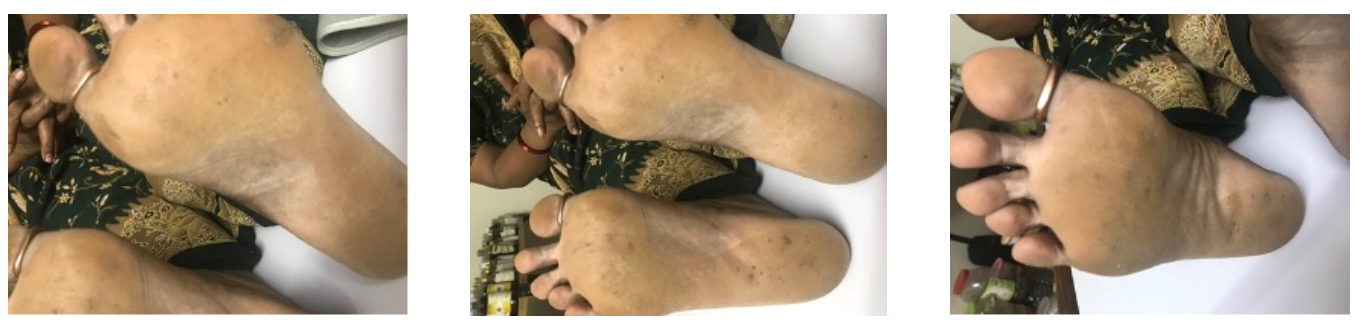
Clinician-based assessment; The chronic skin lesion in the feet got completely cured. No pain while walking. No bleeding. No recurrence to date.
Image 3. Endpoint images dated 11.8.2018 attached below
Patient-assessed; Not relevant
Intervention adherence and tolerability – The patient adhered to the prescribed treatments and tolerated the treatments well.
Method of assessment- By monitoring the patient.
Adverse and unanticipated events; None reported
DISCUSSION:
The disease was diagnosed as Vipadika, which is actually a sadhya vyadhi. But as this patient had a 35-year history, this is kricchrasadhya according to the treating physician. As the Du??a lak?a?as were present, and this is a chronic case, shodhana was the primary choice of treatment. In this condition, shamana cikitsa alone may not help. As there is a pitta involvement, virecana was decided. Hence Sadyovirecana was done after administering ghrtapanam. The local application was given as a supportive treatment. The treatment target is to pacify the aggravated pitta and address the dushta lakshana.
PATIENT’S PERSPECTIVE
Not available.
LEARNING POINTS/TAKE-HOME MESSAGES
Complete relief from plantar psoriasis, which had a 35-year history. The conventional treatments over the years for psoriasis gave her only temporary relief and the condition would relapse. This made her give up hope in that matter and she accepted it as a part of her life. With simple ayurvedic interventions and a modified lifestyle and diet, for just a period of 1 year and 4 months, she got complete relief from the chronic plantar psoriasis with no recurrence to date.
INFORMED CONSENT
Written consent was obtained from the patient, fpr publishing this case report.
CONFLICT OF INTEREST
None declared.
FUNDING
None
REFERENCE
- Romani M, Biela G, Farr K, Lazar R, Duval M, Trovillion V, Vlahovic TC. Plantar Psoriasis: A Review of the Literature. Clin Podiatr Med Surg. 2021 Oct;38(4):541-552. doi: 10.1016/j.cpm.2021.06.009. PMID: 34538432.
- Bhushan et al. A Literature review study on Vipadika Kushtha. World Journal of Pharmaceutical Research. Vol 9, Issue 14, 2020.
Image 1. Timeline of events
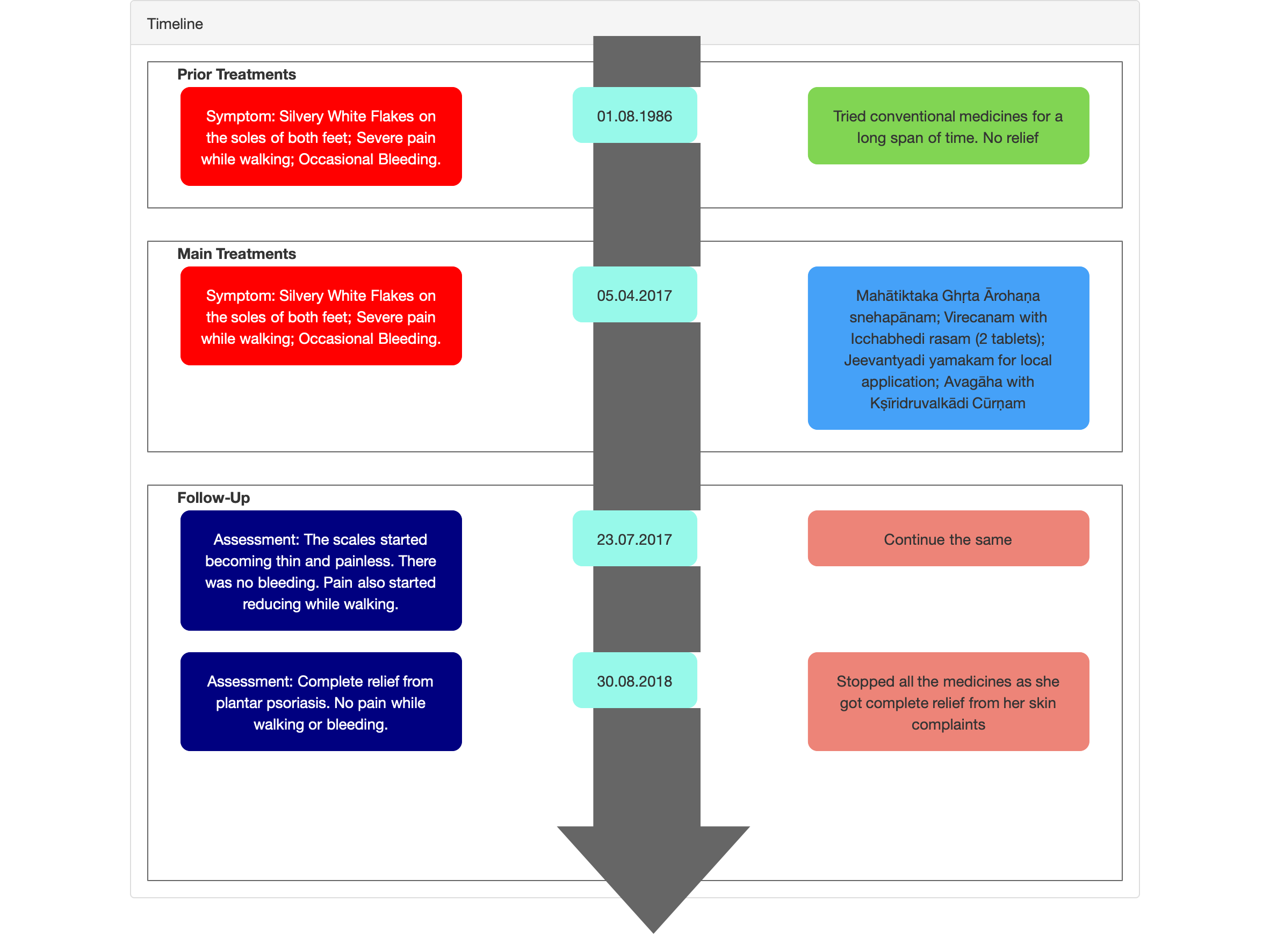
Image 2. Baseline images 5.4.2017
3. Endpoint Images. 11.8.2018
-
Immersive Learning
-
Modern Diagnosis
MODERN DIAGNOSIS- PLANTAR PSORIASIS
About the Disease:
Definition- Psoriasis is a chronic skin condition that affects various parts of the body. If it affects the soles of feet, then it is called plantar psoriasis.
Causes:
Though the exact cause of the disease is not known, a major role is attributed to the Immune system. The risk factors that can trigger the infection are family history, the presence of human leukocyte antigen-Cw6 (HLA-Cw6), also a variation of a gene, smoking, skin friction, skin trauma such as infections and cuts on your palms or soles and suffering from other skin conditions like dermatitis etc.
Common symptoms of include:
- silvery scales
- dry, cracked skin
- bleeding
- an itchy, burning sensation
- soreness
- thickened, ridged nails
- depressions or pits in the nails
This patient is a 54-year-old woman, who had had severe pain while walking and occasional bleeding from the soles of the feet on and off for 35 years. Silvery white flakes could be seen on both soles of the feet. She got temporary relief by taking conventional medicines and then again there would be a relapse. At some point, she stopped taking medicines for this and was struggling with the symptoms. She consulted Dr Jyoti Joshi for another complaint and eventually took treatment for this condition also.
Diagnostic Criteria: Clinical examination is the main diagnostic criterion. Additional tests are prescribed only when any associated illness or infection or malignancies are suspected. A thorough history-taking and physical examination, also understanding the triggers and exposures that are crucial to confirm the diagnosis.
Differential Diagnosis: The clinical conditions like Eczema, Fungal infection, Xerosis and Dermatitis must be ruled out before confirming the diagnosis
In this patient also, the diagnosis was done based on the clinical presentation, which was confirmed by the patient as having been diagnosed earlier with Plantar psoriasis by a dermatologist.
Prognosis: The prognosis for patients with palmoplantar psoriasis is guarded. The treatments often take a long time to work, have adverse effects and are costly. The quality of life of most patients is poor. Most patients need combination therapy for many months before they see a response. In addition, patients also have other comorbidities that affect prognosis.
In this patient, the condition was very chronic with a history of more than 35 years. This was a challenging condition. In spite of taking conventional medicine on & off, she did not get permanent relief. She had given up hope and was living with the condition.
Image 1. Taken before starting Ayurvedic Treatment : 5.4.2017
-
Ayurveda Diagnosis
AYURVEDIC DIAGNOSIS: Vipadika
About the Disease:
All skin diseases in Ayurveda are generally referred to as Kushta. Vipadika is one among Kushta, belonging to a minor category of skin disease called Kshudra Kushta. Texts mention the symptom as ‘Sphutanam’ either in palms or soles or in both with tivra vedana. Palmar plantar Psoriasis which is a chronic skin disease can be correlated to Vipadika, mainly affecting the soles of the palm and feet.
Acharya Sushruta has mentioned the term Vipadika, in Nidana sthana, but Commentator Dalhana has clearly stated that Vicarchika that occurs in pada is termed as Vipadika. Padadari has been explained under the Kshudra roga adhikara. Acharya Vagbhata has mentioned it among Ekadasha kshudra kustha. Along with Pratyatma lakshanas, pani and padasphutana- teevra vedana, kandu, raga, and pidaka have been added to the symptoms.
Prognosis: According to Caraka, the Kushtha having all the symptoms along with complications like trshna, daha, agnimandya and krimi tend to be Asadhya hence should be avoided by a wise physician. If the patient suffers from Vata-Kaphaja Kushtha or only one Dosha is involved, then it is easily curable. But Kushtha with deranged Kapha-Pitta or Vata-Pitta is difficult to cure. (Agnivesha, Charak, Dridhabala, Charaka Samhita, Chikitsa Sthana, Kustha Chikitsa Adhyaya, 7/37-38) According to Madhava Nidana, those which are located in the Tvak, Rakta, or Mamsa; in which Vata and kapha are aggravated are Sadhya. The Kushta affecting the medodhatu, and dvidoshaja are yapya. Those located in the Asthi or Majja Dhatu are Asadhya. As vipadika is vatakaphaja and it is located in tvak, rakta, and mamsa it is sadhya.
In this patient, the condition persisted for more than 35 years. In spite of trying conventional medicine over the years, she got only temporary relief, again the condition would relapse. So in this patient it can be considered as Krcchrasadhya.
Diagnostic criteria: The diagnosis is based on clinical evaluation.
According to Ayurveda, the general line of treatment for Kushta is siramok?a (once in 6 months), virecanam (once every month), and vamanam (once in 15 days) along with suitable external applications. Further by taking into consideration, the do?a and dusya, shodhana or shamana can be done depending upon the Yukti of the Vaidya. As vipadika has vata predominance, snehana will definitely help in managing the condition. In this patient snehapanam and virecanam with external applications were the line of treatment adapted.
-
Treatment
Name of Medicine Dosage Form Dosage Mode of Administrtation From - To (Date) Medicine Reference Mahatiktaka Ghrtam Arohana Oral- Done as a sequence 11 times over a period of 1 year and 4 months 2017-04-01 - 2018-08-01 Bhaisajyaratnavali. Icchabhedi Rasa Tablet Sadyovirecanam Oral-Done as a sequence 11 times following Snehapanam over a period of 1 year and 4 months 2017-04-01 - 2018-08-01 Bhaishajya Ratnavali Udara Rogadhikara. 13 – 105 Jeevantyadi Yamakam Ointment Required External- 2017-04-06 - 2017-08-01 Ashtanga Hrdayam. Cikitsa Sthana.19/77-78 Ksiridruvalkadi Curna Curnam Required External 2017-04-06 - 2019-08-01 Arogyakalpadrumam -
Outcome Measures
OUTCOMES
The 54 year old female patient was suffering with Plantar Psoriasis since 35 years. Whenever she had the symptoms like silvery white flakes on the soles of both the feet, with occassional bleeding and severe pain, she would take conventional medicines. Though she got complete relief, the symptoms would relapse again after a short time. Thus she was suffering from relapsing and remitting Plantar Psoriasis.
Assessment:
Objective Parameters: With Ayurvedic treatment, over a period of 1 year and 4 months, from 5th April 2017 to 11th August 2018, the skin of the soles of the feet became completely normal. There was no pain while walking or bleeding. There has been no recurrence to date.
Image 1. Endpoint images dated 11.8.2018
-