Featured Case
-
Abstract
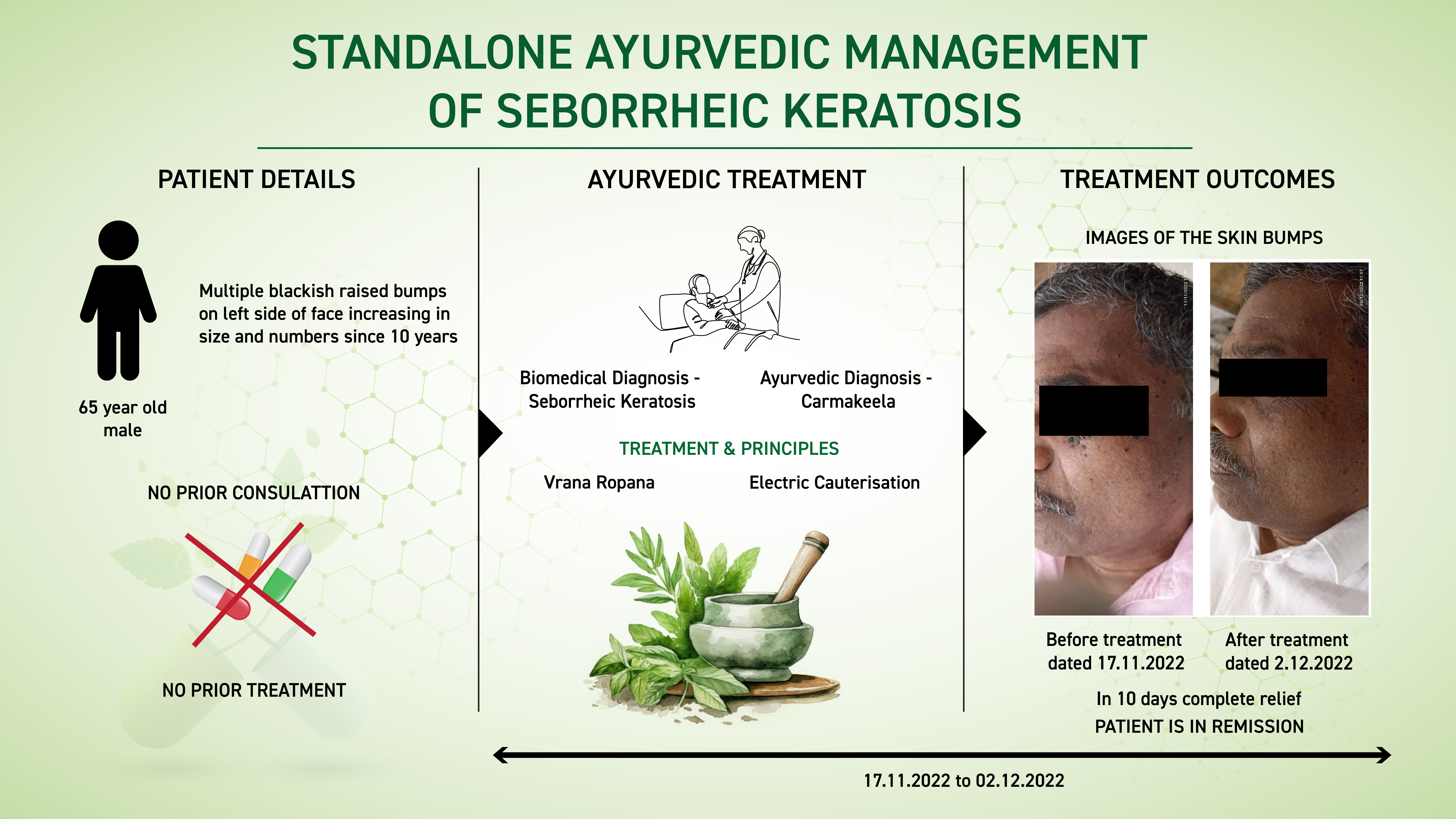
A 65-year-old male patient presented with multiple blackish raised bumps on left side of the face increasing in size and numbers since 10 years. There was no prior consultation or treatment for these complaints. He opted for Ayurvedic management and approached Dr Soumya. Based on clinical evaluation, the biomedical diagnosis was made as Seborrheic keratosis and the Ayurvedic diagnosis as Carmakila. Electric cauterisation was the primary treatment, followed by by Vrana ropana. Tridosahara and Jvarahara aushadha were also included in the treatment. In 10 days, the skin bumps fell off and the ulcer healed completely without any scar. This case demonstrates the efficacy of ayurveda in treating a chronic case of Seborrheic keratosis in its removal without causing any pain or discomfort to the patient.
-
Summaries
-
Listen
-
Watch
-
View
-
Read
A 65-year-old male patient presented with multiple blackish raised bumps on left side of the face increasing in size and numbers since 10 years. There was no prior consultation or treatment for these complaints. He opted for Ayurvedic management and approached Dr Soumya. Based on clinical evaluation, the biomedical diagnosis was made as Seborrheic keratosis and the Ayurvedic diagnosis as Carmakila. Electric cauterisation was the primary treatment, followed by by Vrana ropana. Tridosahara and Jvarahara aushadha were also included in the treatment. In 10 days, the skin bumps fell off and the ulcer healed completely without any scar. This case demonstrates the efficacy of ayurveda in treating a chronic case of Seborrheic keratosis in its removal without causing any pain or discomfort to the patient.
-
-
Timeline
-
Tabulated Summary
-
Narrative
TITLE OF CASE
Standalone successful ayurvedic management of seborrheic keratosis - a case report
Dr Soumya
ABSTRACT
A 65 year old male patient presented with multiple blackish raised bumps on left side of the face increasing in size and numbers since 10 years. There was no prior consultation or treatment for these complaints. He opted for Ayurvedic management and approached Dr Soumya. Based on clinical evaluation, the biomedical diagnosis was made as Seborrheic keratosis and the Ayurvedic diagnosis as Carmakila. Electric cauterisation was the primary treatment, followed by by Vrana ropana. Tridosahara and Jvarahara aushadha were also included in the treatment. In 10 days, the skin bumps fell off and the ulcer healed completely without any scar. This case demonstrates the efficacy of ayurveda in treating a chronic case of Seborrheic keratosis in its removal without causing any pain or discomfort to the patient.
KEYWORDS
Seborrheic keratosis, keratosis, carmakila, cauterisation, case report, standalone
INTRODUCTION
A seborrheic keratosis is a common noncancerous skin growth. People tend to get more of them as they get older.
Seborrheic keratoses are usually brown, black or light tan. The growths look waxy or scaly and slightly raised. They appear gradually, usually on the face, neck, chest or back.
Seborrheic keratosis are very common on the back. They appear as waxy light tan, brown or black growths that look as if they were dripped onto the skin by a candle. Some can grow large, more than 1 inch across.
Seborrheic keratosis are harmless and not contagious. They don't need treatment, but you may decide to have them removed if they become irritated by clothing or you don't like how they look.
Symptoms:
A seborrheic keratosis grows gradually. Signs and symptoms might include:
- A round or oval-shaped waxy or rough bump, typically on the face, chest, a shoulder or the back
- A flat growth or a slightly raised bump with a scaly surface, with a characteristic "pasted on" look
- Varied size, from very small to more than 1 inch across
- Varied number, ranging from a single growth to multiple growths
- Very small growths clustered around the eyes or elsewhere on the face, sometimes called flesh moles or dermatosis papulosa nigra, common on Black or brown skin
- Varied in color, ranging from light tan to brown or black
- Itchiness
Cause: The exact reason is not known.
Diagnosis: Medical history taking and clinical evaluation are the primary diagnostic criteria. But in case the doctor suspects any anomaly, then investigations may be done.
Prognosis & Treatment: A seborrheic keratosis typically doesn't go away on its own, but treatment isn't needed. You might choose to have it removed if it becomes irritated or bleeds, or if you don't like how it looks or feels. Seborrheic keratosis removal can be achieved with one or a combination of the following methods:
- Freezing the growth.
- Scraping (curettage) or shaving the skin's surface.
- Electro-cauterisation
PATIENT INFORMATION
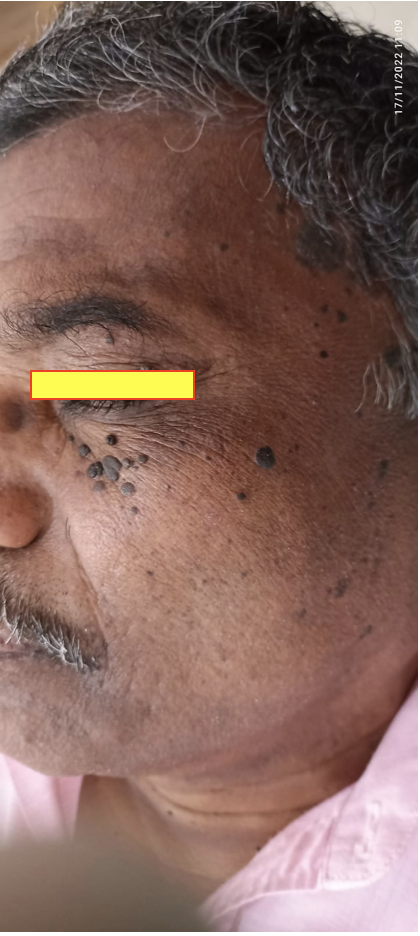
In this case report, a 65 year old male patient presented with multiple blackish raised bumps on left side of the face increasing in size and numbers since 10 years. There was no prior consultation or treatment for these complaints. He opted for Ayurvedic management and approached Dr Soumya. Based on clinical evaluation, the biomedical diagnosis was made as Seborrheic keratosis and the Ayurvedic diagnosis as Carmakila.
No relevant family/genetic/surgical/psychosocial history.
CLINICAL FINDINGS
General examination- Vitals are normal
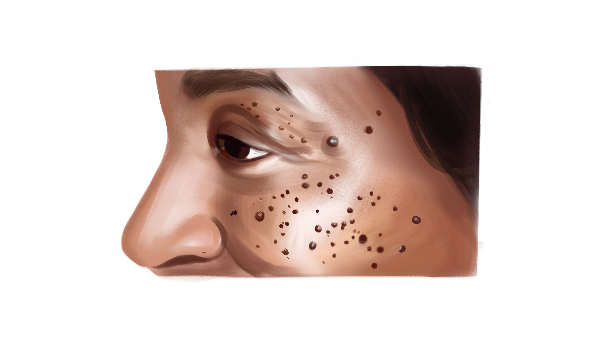
Physical examination of bumps- raised, dark with waxy surface
TIMELINE
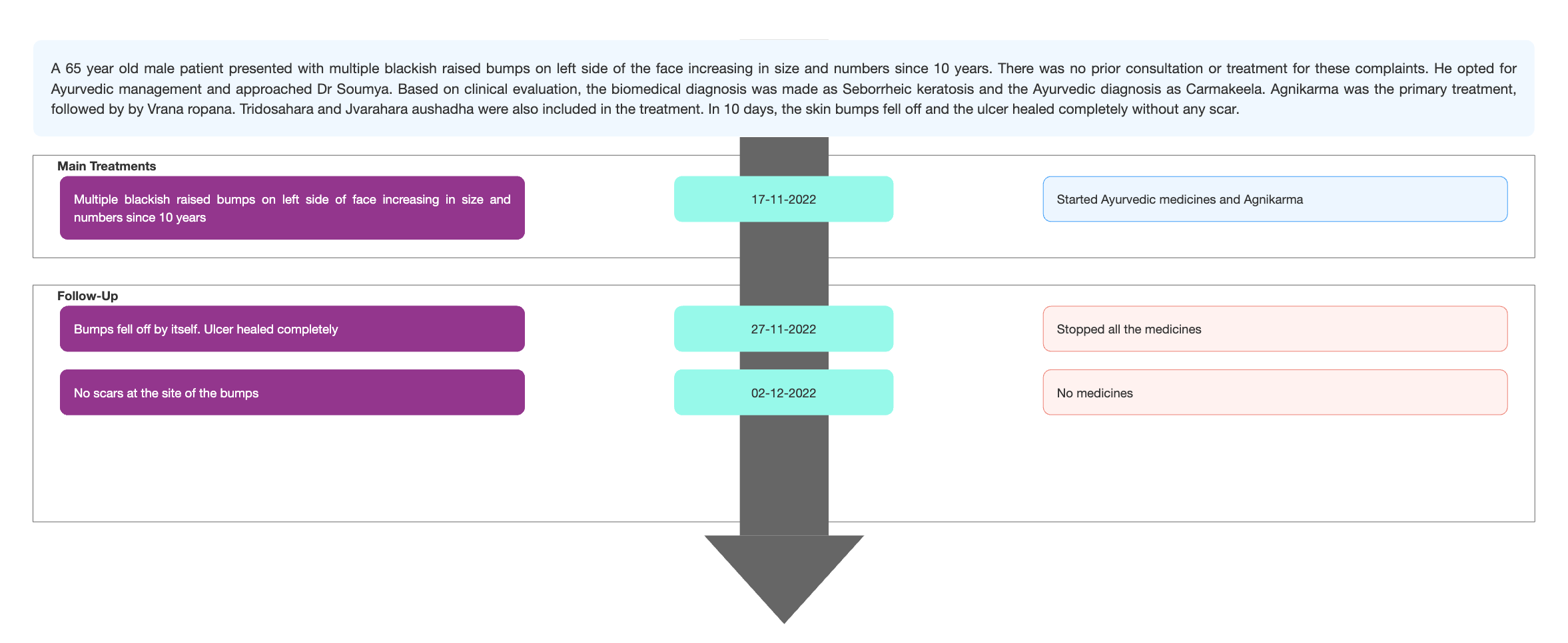
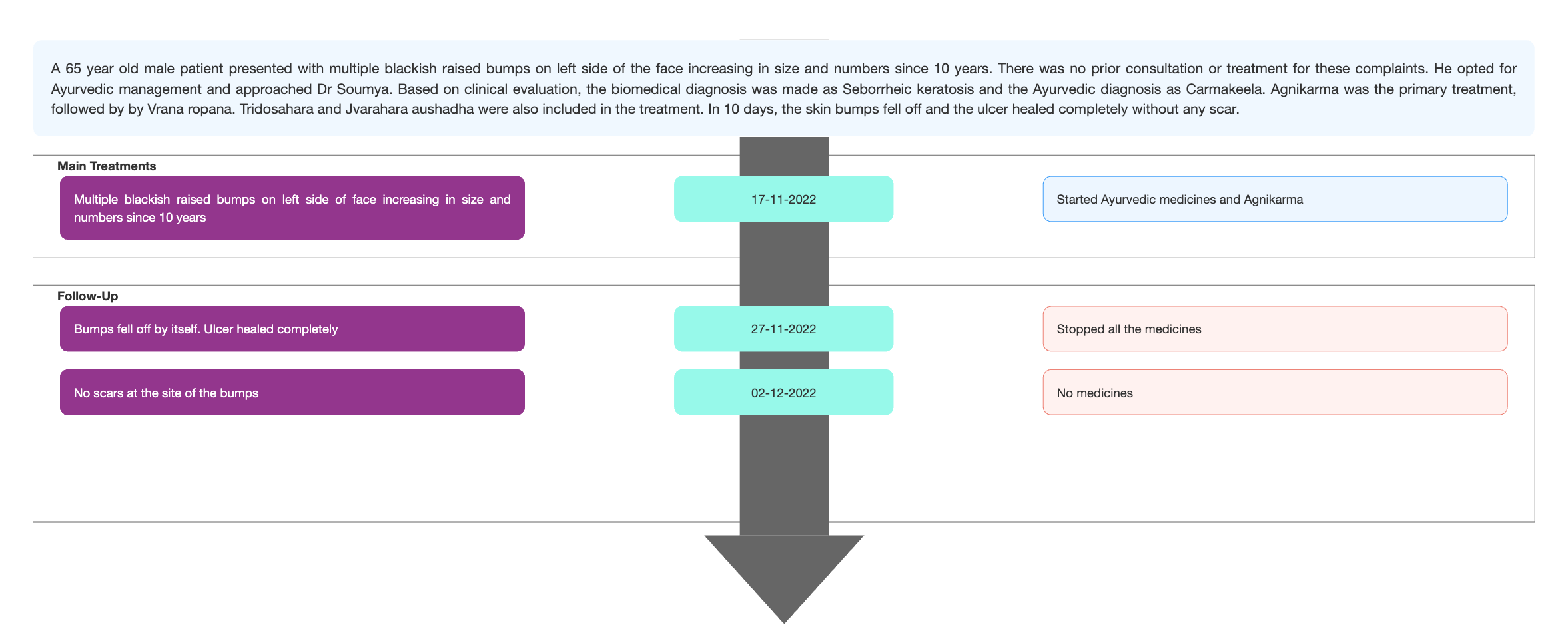
Image 1. Timeline of events added below
DIAGNOSTIC ASSESSMENT
Modern Diagnostic parameter; Based on the clinical evaluation, the biomedical diagnosis was confirmed as Seborrheic keratosis by the Ayurvedic physician.
Image 1. Image of the skin bumps before treatment dated 17.11.2022
Ayurvedic Assessment was done based on the presenting complaints and clinical evaluation. The treating physician confirmed the Ayurvedic diagnosis as Carmakila
Differential Diagnosis-
Malignant melanoma
Actinic keratosis
Lentigo maligna
Melanocytic nevus
Squamous cell carcinoma
Pigmented basal cell carcinoma
Based on clinical evaluation, the treating physician made the biomedical diagnosis as seborrheic keratosis
Prognosis- Seborrheic keratosis are benign lesions and have a good overall prognosis. They grow slowly, and they can become thicker over time. In this case report, the patient presented with seborrheic keratosis, which was increasing in size and number since 10 years. By administering Electric cauterisation followed by Ayurvedic treatments for 10 days, the skin bumps fell off and the ulcer healed completely without any scar.
THERAPEUTIC INTERVENTION
Refer the tab ‘Treatment’ in the Portal.
FOLLOW-UP AND OUTCOMES
The patient had 2 follow ups in total, over a period of 2 weeks.
Subjective parameters:
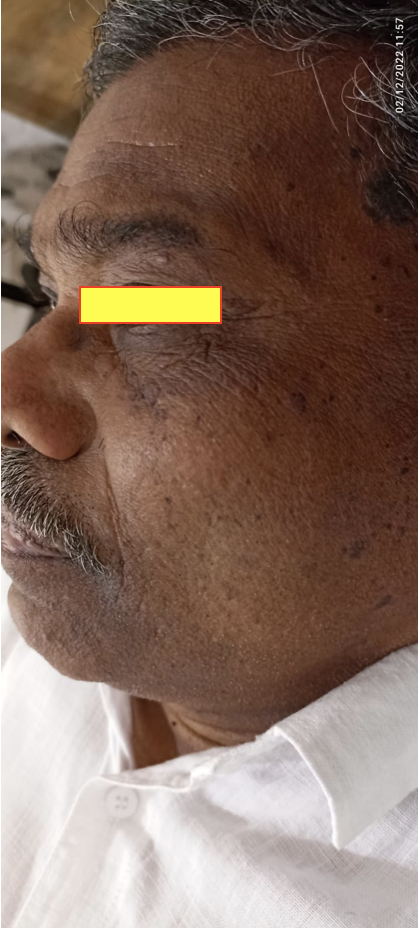
Clinician-based assessment; By administering electric cautery followed by Ayurvedic treatments for 10 days, the skin bumps fell off and the ulcer healed completely without any scar.
Image 1. Image of the skin bumps after treatment dated 2.12.2022
Patient-assessed; Not relevant.
Intervention adherence and tolerability – The patient adhered to the prescribed treatments and tolerated the treatments well.
Method of assessment- Subjective and objective parameters were the main assessment tools.
Adverse and unanticipated events; None reported
DISCUSSION:
Seborrheic keratoses are benign lesions and have a good overall prognosis. They grow slowly, and they can become thicker over time. In this patient, the symptoms started 10 years back. It gradually increased in number and size over the years. The ayurvedic diagnosis was made as Carmakila. With electric cautery as the primary treatment and medicines targeting vrana ropana, the bumps fell off in 10 days. The wound healed completely without any scars and causing any discomfort to the patient.
PATIENT’S PERSPECTIVE
Not available.
LEARNING POINTS/TAKE HOME MESSAGES
This case report demonstrates the successful standalone ayurvedic management of chronic seborrheic keratosis within a short duration and without causing any scars or discomfort to the patient.
INFORMED CONSENT
Written consent obtained from patient for publishing of the case report in the Portal
ACKNOWLEDGEMENTS
None
CONFLICT OF INTEREST
None declared.
FUNDING
None
REFERENCE
- https://www.mayoclinic.org/diseases-conditions/seborrheic-keratosis/symptoms-causes/syc-20353878
-
Immersive Learning
-
Modern Diagnosis
MODERN DIAGNOSIS: Seborrheic keratosis
ABOUT THE DISEASE:
A seborrheic keratosis is a common noncancerous skin growth. People tend to get more of them as they get older.
Seborrheic keratoses are usually brown, black or light tan. The growths look waxy or scaly and slightly raised. They appear gradually, usually on the face, neck, chest or back.
Seborrheic keratosis are very common on the back. They appear as waxy light tan, brown or black growths that look as if they were dripped onto the skin by a candle. Some can grow large, more than 1 inch across.
Seborrheic keratosis are harmless and not contagious. They don't need treatment, but you may decide to have them removed if they become irritated by clothing or you don't like how they look.
Symptoms:
A seborrheic keratosis grows gradually. Signs and symptoms might include:
- A round or oval-shaped waxy or rough bump, typically on the face, chest, a shoulder or the back
- A flat growth or a slightly raised bump with a scaly surface, with a characteristic "pasted on" look
- Varied size, from very small to more than 1 inch across
- Varied number, ranging from a single growth to multiple growths
- Very small growths clustered around the eyes or elsewhere on the face, sometimes called flesh moles or dermatosis papulosa nigra, common on Black or brown skin
- Varied in color, ranging from light tan to brown or black
- Itchiness
Cause: The exact reason is not known.
In this case report, a 65 year old male patient presented with multiple blackish raised bumps on left side of the face increasing in size and numbers since 10 years. There was no prior consultation or treatment for these complaints. He opted for Ayurvedic management and approached Dr Soumya. Based on clinical evaluation, the biomedical diagnosis was made as Seborrheic keratosis and the Ayurvedic diagnosis as Carmakila.
Image 1. Image of the skin bumps before treatment dated 17.11.2022
Diagnosis: Medical history taking and clinical evaluation are the primary diagnostic criteria. But in case the doctor suspects any anomaly, then investigations may be done.
Prognosis & Treatment: A seborrheic keratosis typically doesn't go away on its own, but treatment isn't needed. You might choose to have it removed if it becomes irritated or bleeds, or if you don't like how it looks or feels. Seborrheic keratosis removal can be achieved with one or a combination of the following methods:
- Freezing the growth.
- Scraping (curettage) or shaving the skin's surface.
- Electro-cauterisation
Reference
-
Ayurveda Diagnosis
AYURVEDA DIAGNOSIS: Carmakila
ABOUT THE DISEASE:
Ayurveda mentions about carmakila briefly. The manifestation is brought about by the provoked vyāna vāyu taking along the kapha dosha producing firm and nail-like growths externally which are known as carmakila arsha. Few commentators mention the site as outside the anal verge and few opine it to be in other places also. Carmakila is classified into three types. The pricking pain is due to vata; similar color and knottiness are due to kapha, while roughness, blackness, and glossiness are due to pitta and rakta. The outstanding feature of carmakila is pronounced roughness. Other authors however do not make any classification.
In this case report, a 65 year old male patient presented with multiple blackish raised bumps on left side of the face increasing in size and numbers since 10 years. There was no prior consultation or treatment for these complaints. He opted for Ayurvedic management and approached Dr Soumya. Based on clinical evaluation, the biomedical diagnosis was made as Seborrheic keratosis and the Ayurvedic diagnosis as Carmakila.
Prognosis & Treatment: Sushruta recommends chedana (excision), Electric cauterisation (cauterization), kshara karma (applying caustic alkali) in the management of carmakila. Further, there is direct indication of pratisaraneeya (to be applied) kshara for carmakila
Rationale for specific selection of medicines as explained by the physician:
Sathadhoutha ghrita- Vrana ropanartham
Guggulu panchapalam tablet- It helps to heal wound quickly.
Sudarshanam tablet- Jwarahara, tridosha shamaka.Reference
- Nārāyaṇa Rama ācārya kāvyatīrtha., editor. Arśonidānopakramaḥ. Chap. 2, Verse 18-20. Varanasi: Chaukambha Orientalia; 2009. (Reprint Ed.). Suśruta saṁhitā of Suśruta, nidāna sthāna; p. 275.
- Vaidya yādavji trikamji ācārya., editor. Kṣudraroga cikitsopakramaḥ. Chap. 20, Verse 31-32. Varanasi: Chaukambha Orientalia; 2009. (Reprint Ed.). Suśruta samṁhitā of Suśruta, cikitsā sthāna; p. 480.
- Nārāyanṇa Rama ācārya kāvyatīrtha., editor. Kṣārapākavidhyad hyāyopakramaḥ. Chap. 11, Verse 7. Varanasi: Chaukambha Orientalia; 2009. (Reprint Ed.). Suśruta saṁhita of Suśruta, sūtra sthāna; p. 46.
- Shindhe P, Kiran M. Carmakila: An effective management by kshara karma. J Ayurveda Integr Med. 2013 Jul;4(3):181-3.
-
Treatment
Name of Medicine Dosage Form Dosage Mode of Administrtation From - To (Date) Medicine Reference Guggulu panchapalam Tablet Tablet 1 Oral- with warm water twice daily after food 2022-11-17 - 2022-11-27 Ayurvedic Patent & Proprietary Medicine Sudarshanam Tablet Tablet 1 Oral- with warm water twice daily after food 2022-11-17 - 2022-11-27 Ayurvedic Patent & Proprietary Medicine Electric Cautery Not applicable 1 sitting On the affected area 2022-11-17 - 2022-11-17 Improvised treatment application Shathadhouta Ghrta Ghrtam Required Quantity For External application 2022-11-17 - 2022-11-27 AH.Utt.25.28 -
Outcome Measures
In this case report, a 65 year old male patient presented with multiple blackish raised bumps on left side of the face increasing in size and numbers since 10 years. There was no prior consultation or treatment for these complaints. He opted for Ayurvedic management and approached Dr Soumya. Based on clinical evaluation, the biomedical diagnosis was made as Seborrheic keratosis and the Ayurvedic diagnosis as Carmakila.
Assessment: Subjective parameters were assessed to analyse the outcome of the treatment.
Subjective parameters: In 10 days, the skin bumps completely fell off. The wound healed completely without any scars.
Image 1. Image of the skin bumps after treatment dated 2.12.2022
-