Featured Case
-
Abstract
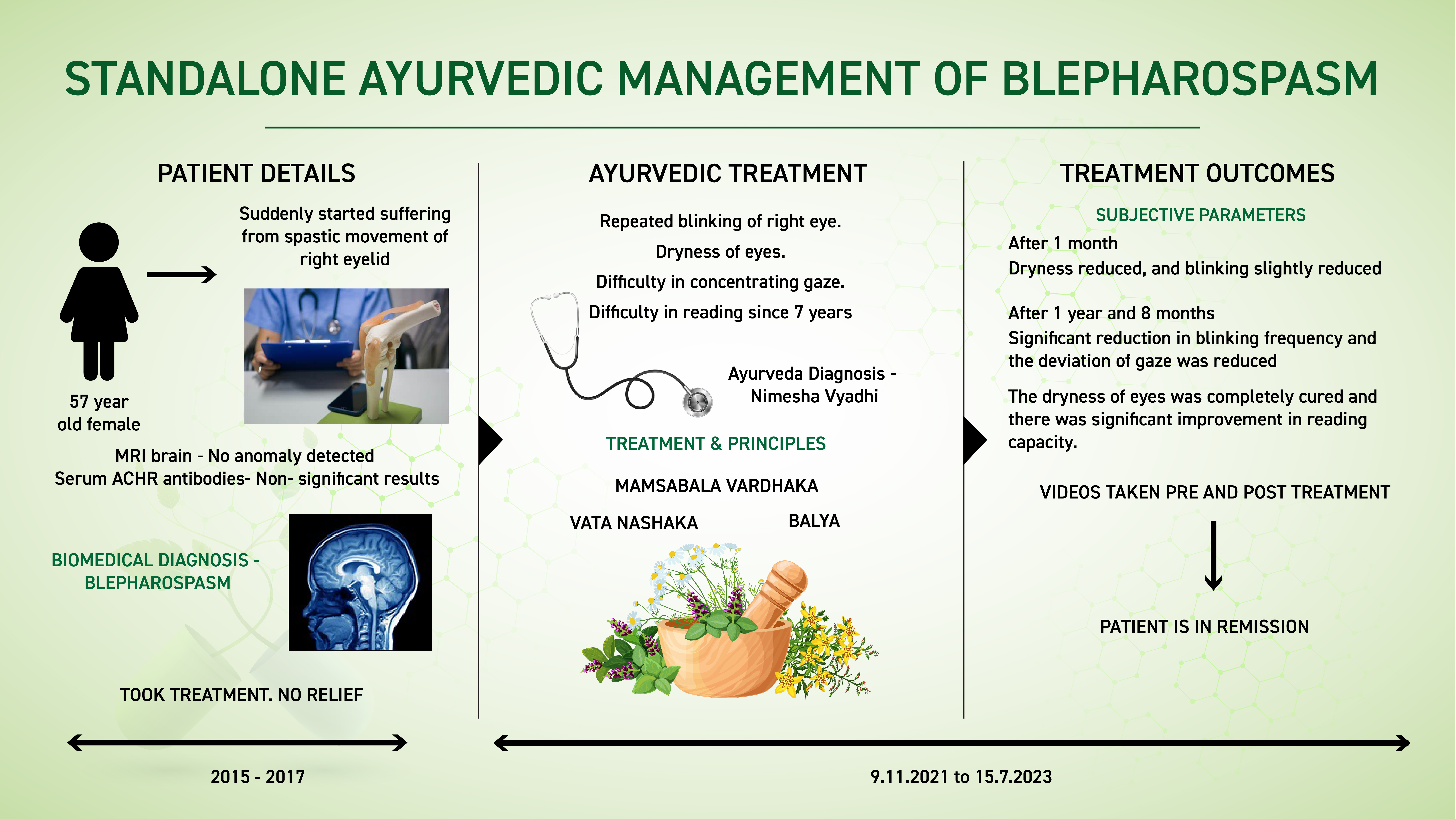
A 57 year old female patient complained of repeated blinking of the right eye associated with dryness of the eye, difficulty in concentrating gaze and difficulty in reading since 7 years. At the onset of symptoms, she had consulted an allopathic doctor. As suggested by the allopathic doctor, an MRI Brain was done that did not reveal any anomaly and Acetylcholine Aeceptor Antibody test yielded non-significant results. The biomedical diagnosis was made as Blepharospasm based on the clinical evaluation. She underwent standard of care for 2 years, but the condition persisted. After another 5 years, she decided to try Ayurvedic treatment. She approached Dr Anupama Deopujari. Based on clinical evaluation, the biomedical diagnosis was confirmed as Blepharospasm, and the ayurvedic diagnosis as Nimesha vyadhi. The line of treatment followed was vatanashaka, mamsabalavardhaka and balya. Formulations to strengthen the mamsa dhatu were included in the treatment. With one month of treatment, the complaint of dryness reduced, and blinking slightly reduced. With one month of treatment, the complaints of dryness reduced, and blinking slightly reduced. After 1 year and 8 months of treatment, there was a significant reduction in blinking frequency and the deviation of gaze was reduced. The dryness of eyes was completely cured and there was significant improvement in reading capacity. This case report demonstrates the successful ayurvedic management of a chronic case of blepharospasm in a 57 year old female, who did not get relief inspite of taking standard of care for 2 years.
-
Summaries
-
Listen
-
Watch
-
View
-
Read
A 57 year old female patient complained of repeated blinking of the right eye associated with dryness of the eye, difficulty in concentrating gaze and difficulty in reading since 7 years. At the onset of symptoms, she had consulted an allopathic doctor. As suggested by the allopathic doctor, an MRI Brain was done that did not reveal any anomaly and Acetylcholine Aeceptor Antibody test yielded non-significant results. The biomedical diagnosis was made as Blepharospasm based on the clinical evaluation. She underwent standard of care for 2 years, but the condition persisted. After another 5 years, she decided to try Ayurvedic treatment. She approached Dr Anupama Deopujari. Based on clinical evaluation, the biomedical diagnosis was confirmed as Blepharospasm, and the ayurvedic diagnosis as Nimesha vyadhi. The line of treatment followed was vatanashaka, mamsabalavardhaka and balya. Formulations to strengthen the mamsa dhatu were included in the treatment. With one month of treatment, the complaint of dryness reduced, and blinking slightly reduced. With one month of treatment, the complaints of dryness reduced, and blinking slightly reduced. After 1 year and 8 months of treatment, there was a significant reduction in blinking frequency and the deviation of gaze was reduced. The dryness of eyes was completely cured and there was significant improvement in reading capacity. This case report demonstrates the successful ayurvedic management of a chronic case of blepharospasm in a 57 year old female, who did not get relief inspite of taking standard of care for 2 years.
-
-
Timeline
-
Tabulated Summary
-
Narrative
TITLE OF CASE
Standalone successful ayurvedic management of blepharospasm - a case report
Dr Anupama Deopujari
ABSTRACT
A 57-year-old female patient complained of repeated blinking of the right eye associated with dryness of the eye, difficulty in concentrating gaze and difficulty in reading since 7 years. At the onset of symptoms, she had consulted an allopathic doctor. As suggested by the allopathic doctor, an MRI Brain was done that did not reveal any anomaly and Acetylcholine Aeceptor Antibody test yielded non-significant results. The biomedical diagnosis was made as Blepharospasm based on the clinical evaluation. She underwent standard of care for 2 years, but the condition persisted. After a gap of 5 years, she decided to try Ayurvedic treatment. She approached Dr Anupama Deopujari. Based on clinical evaluation, the biomedical diagnosis was confirmed as Blepharospasm, and the ayurvedic diagnosis as Nimesha vyadhi. The line of treatment followed was vatanashaka, mamsabalavardhaka and balya. Formulations to strengthen the mamsa dhatu were included in the treatment. With one month of treatment, the complaint of dryness reduced, and blinking slightly reduced. With one month of treatment, the complaints of dryness reduced, and blinking slightly reduced. After 1 year and 8 months of treatment, there was a significant reduction in blinking frequency and the deviation of gaze was reduced. The dryness of eyes was completely cured and there was significant improvement in reading capacity. This case report demonstrates the successful ayurvedic management of a chronic case of blepharospasm in a 57-year-old female, who did not get relief inspite of taking standard of care for 2 years.
KEYWORDS
Blepharospasm, nimesha vyadhi, blinking, akshitarpana, case report, Standalone
INTRODUCTION
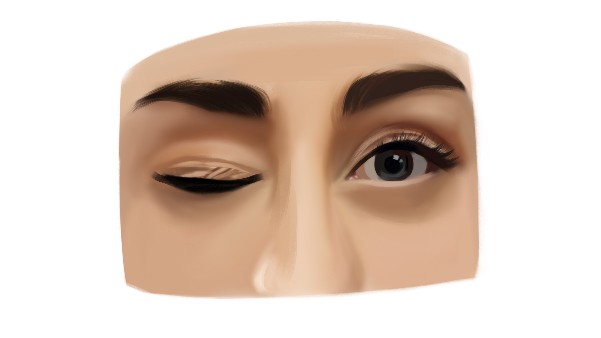
Blepharospasm is a neurologic disorder that causes uncontrollable muscle movements that causes the eyelids to close or have difficulty opening (dystonia). This can affect patients’ ability to see. It's a rare disease and can be difficult to diagnose. Approximately 2,000 people are diagnosed with it each year.
Symptoms and causes: Researchers are still working to confirm its cause. Blepharospasm may be due to abnormal electrical activity in the basal ganglia, structures deep within the brain that help control movement. Usually people get blepharospasm in middle age, but it can occur at any age. Sometimes dry eye may look like blepharospasm so it is important to get medical advise. Certain medications can cause blepharospasm. People with certain medical conditions can get blepharospasm. These conditions include:
General dystonia.
Meige syndrome.
Tardive dyskinesia.
Wilson's disease.
In the early stages, you may have frequent blinking and the symptoms come and go. You’ll experience them during the day, and they’ll go away while you are sleeping. As the disease progresses, they become more severe with fewer periods of relief.
The general symptoms are as follows: Constant blinking, Dry eyes, Eye narrowing, Tired, Irritated eyes and Difficulty keeping your eyes open.
Diagnosis; Medical history and clinical evaluation are the main diagnostic criteria. There are no laboratory tests to confirm the diagnosis of Blepharospasm.
Treatment: Oral medications including drugs that block involuntary muscle movements (anticholinergics), but their effect is usually limited.
Botulinum toxin injections, which weaken the eye muscles’ ability to twitch. Botulinum toxin is one of the most effective treatments for blepharospasm. There are several variations available. Surgery (myectomy), a procedure to remove part or all of the overactive eye muscles. The most common and most effective treatment is botulinum toxin. Medications are effective in a small number of people. But they often cause side effects such as memory problems, drowsiness and dry mouth.
Prognosis: It depends on the severity of your symptoms and response to therapy. When blepharospasm is not improved with medical therapy, surgery may be indicated.
PATIENT INFORMATION
In this case report, a 57-year-old female patient complained of repeated blinking of the right eye associated with dryness of the eye, difficulty in concentrating gaze and difficulty in reading since 7 years. In spite of taking standard of care for 2 years, the condition persisted.
No relevant family/genetic/surgical/psychosocial history.
CLINICAL FINDINGS
Samanya pariksha, sroto pariksha were done.
Samanya Parikshana
Nadi - Vata Pitta Pradhan
Mala - Samanya
Mutra - Samanya
Jihwa - Niram
Sparsha – Koshna
Druk – Vartma chalan aniyantrit, Using Spects.
Akruti - Krush
Prakruti – Vata Pittaja
Sara - Asara
Samhanana – Madhyam
Satva – Madhyam
Abhyavaharana – Prakrut
Sharira Bala – Madhyam
Srotas Parikshana
Majjavaha Strotas and Netra Indriya – Repeated involuntary movements of right eyelid
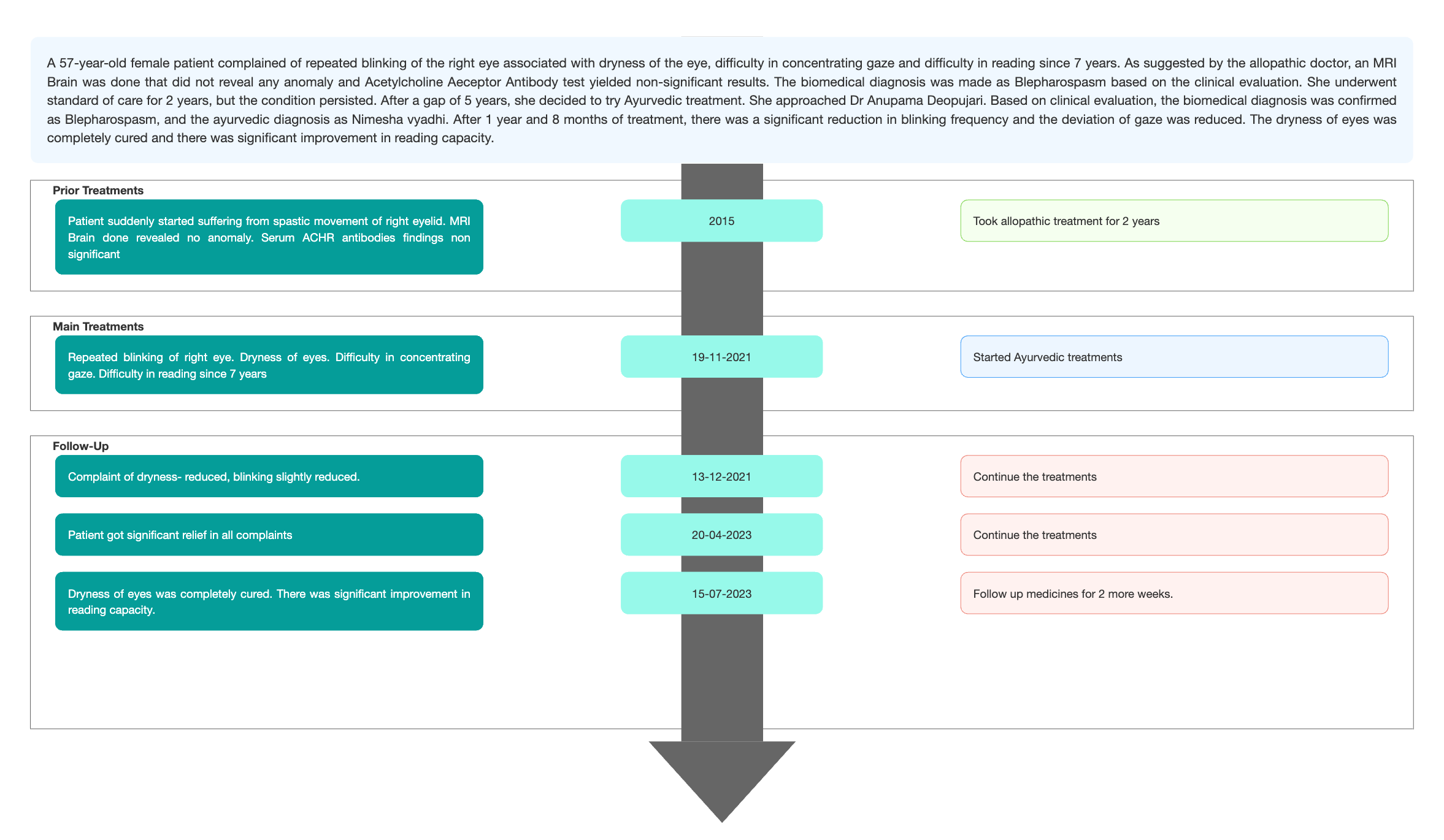
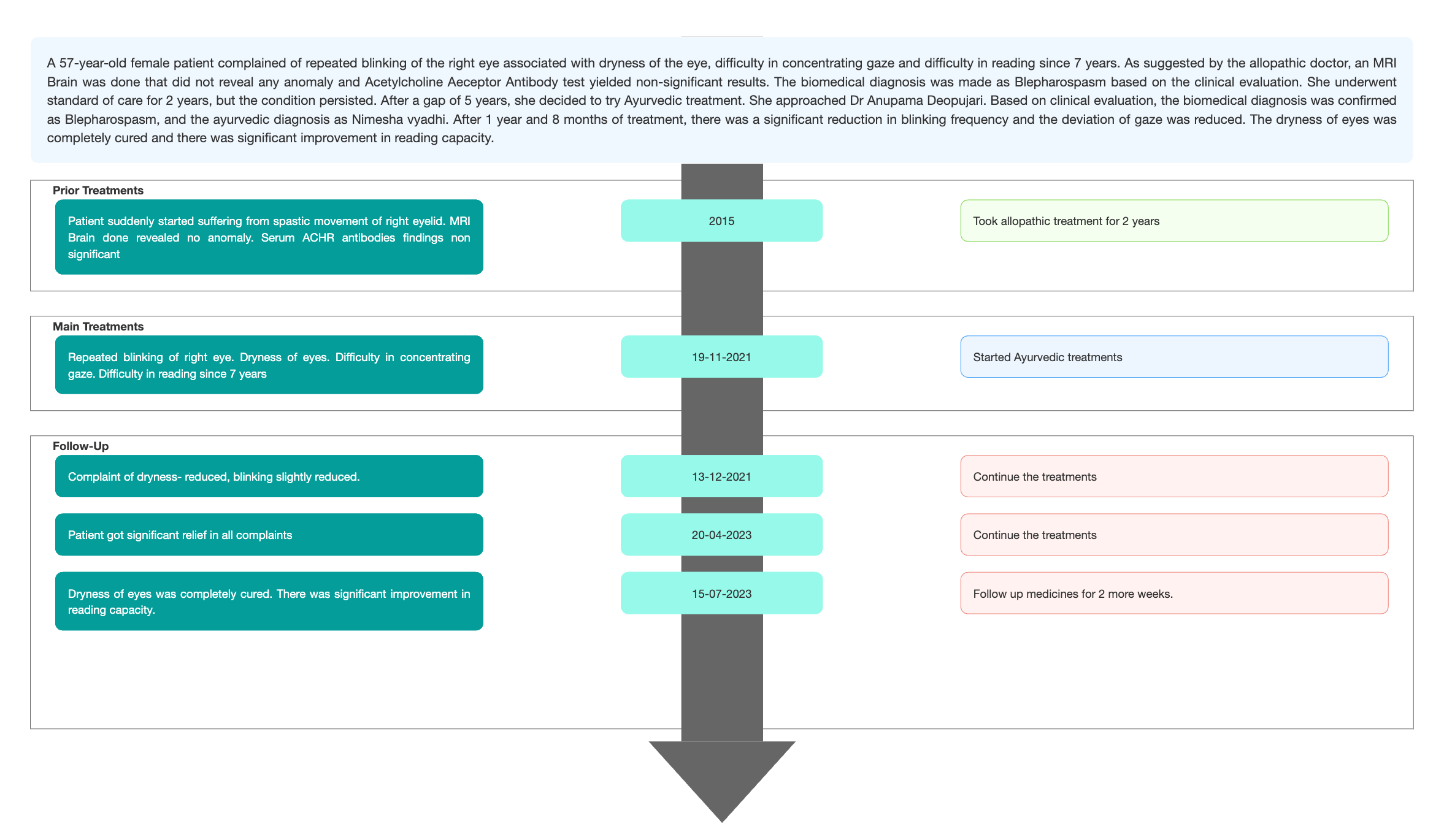
TIMELINE
Image 1. Timeline of events added below
DIAGNOSTIC ASSESSMENT
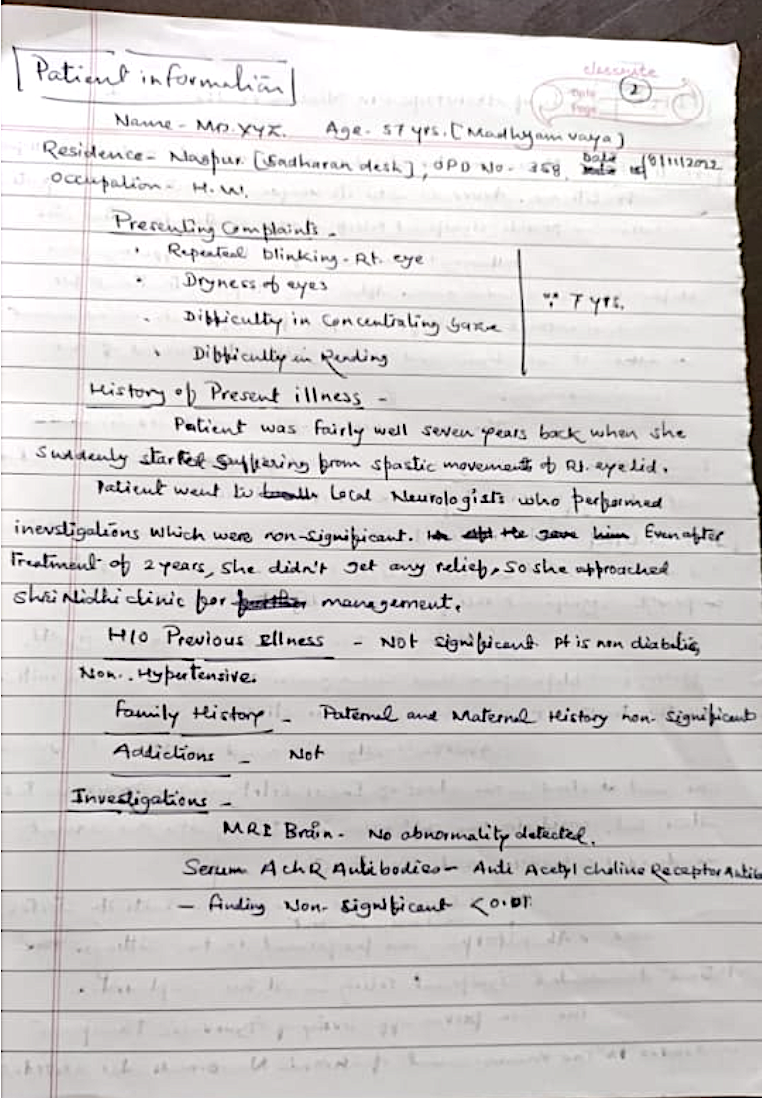
Modern Diagnostic parameter; Based on the clinical examination, previous MRI and ACHR reports (not submitted, but obtained from the Doctor’s notes), the biomedical diagnosis was confirmed as Blepharospasm.
Video 1. Video of the patient before treatment dated 19.11.2021
https://youtube.com/shorts/-Ul4T_tdHPs
Image 2. MRI Brain and Serum ACHR report findings from Doctor’s Notes
Ayurvedic Assessment was done based on the presenting complaints and clinical evaluation. The treating physician confirmed the Ayurvedic diagnosis as Nimesha Vyadhi.
Differential Diagnosis- Eyelid myokymia, Secondary to ocular irritation, Secondary to meningeal irritation, Tardive dyskinesia, Meige syndrome, Facial tics, Hemifacial spasm, Cerebral palsy, Focal seizures. In this case report, based on the previous treatment records and clinical findings the physician diagnosed the condition as blepharospasm
Prognosis- 90% of the patients improve symptomatically with botulinum injections, although continued injections are necessary. In this patient, in spite of taking the standard of care, the condition progressed in such a way that, the patient is unable to temporarily open his eyelids. With Ayurvedic treatment, frequent and rapid blinking reduced. After 6 months of treatment, the patient could fully open his eyelids and noted
THERAPEUTIC INTERVENTION
Refer the tab ‘Treatment’ in the Portal.
FOLLOW-UP AND OUTCOMES
The patient had 4 follow ups in total, with a time gap of 1 year and 8 months.
Subjective parameters:
Clinician-based assessment; With one month of treatment, the complaint of dryness reduced, and blinking slightly reduced. After 1 year and 8 months of treatment, there was a significant reduction in blinking frequency and the deviation of gaze was reduced. The dryness of eyes was completely cured and there was significant improvement in reading capacity.
Video 1. Video of the patient, after treatment dated 15.7.2023
https://youtu.be/Shs5cbetB_4?si=tqPNMItwoaves5QI
Patient-assessed; Not relevant.
Intervention adherence and tolerability – The patient adhered to the prescribed treatments and tolerated the treatments well.
Method of assessment- Subjective and objective parameters were the main assessment tools.
Adverse and unanticipated events; None reported
DISCUSSION:
Blepharospasm is a neurologic disorder that causes uncontrollable muscle movements that causes the eyelids to close or have difficulty opening (dystonia). This can affect patients’ ability to see. It's a rare disease and can be difficult to diagnose. 90% of the patients improve symptomatically with botulinum injections, although continued injections are necessary. In this patient, the disease had a history of 7 years, out of 2 years, the patient had taken allopathic medicines. She did not get relief. The next five years, she did not take any treatment, and after this gap of time, she decided to try Ayurveda. The line of treatment followed was vatanashaka, mamsabalavardhaka and balya. Formulations to strengthen the mamsa dhatu were included in the treatment.
PATIENT’S PERSPECTIVE
Not available.
LEARNING POINTS/TAKE HOME MESSAGES
This case report demonstrates the successful standalone ayurvedic management of chronic Blepharospasm in a patient who was not getting satisfactory relief inspite of standard of care for 2 years.
INFORMED CONSENT
Written consent obtained from patient for publishing of the case report in the Portal
ACKNOWLEDGEMENTS
None
CONFLICT OF INTEREST
None declared.
FUNDING
None
REFERENCE
- https://my.clevelandclinic.org/health/diseases/21546-blepharospasm
-
Immersive Learning
-
Modern Diagnosis
MODERN DIAGNOSIS: Blepharospasm
ABOUT THE DISEASE:
Blepharospasm is a neurologic disorder that causes uncontrollable muscle movements that causes the eyelids to close or have difficulty opening (dystonia). This can affect patients’ ability to see. It's a rare disease and can be difficult to diagnose. Approximately 2,000 people are diagnosed with it each year.
Symptoms and causes: Researchers are still working to confirm its cause. Blepharospasm may be due to abnormal electrical activity in the basal ganglia, structures deep within the brain that help control movement. Usually people get blepharospasm in middle age, but it can occur at any age. Sometimes dry eye may look like blepharospasm so it is important to get medical advise. Certain medications can cause blepharospasm. People with certain medical conditions can get blepharospasm. These conditions include:
General dystonia.
Meige syndrome.
Tardive dyskinesia.
Wilson's disease.
In the early stages, you may have frequent blinking and the symptoms come and go. You’ll experience them during the day, and they’ll go away while you are sleeping. As the disease progresses, they become more severe with fewer periods of relief.
The general symptoms are as follows: Constant blinking, Dry eyes, Eye narrowing, Tired, Irritated eyes and Difficulty keeping your eyes open.
Diagnosis; Medical history and clinical evaluation are the main diagnostic criteria. There are no laboratory tests to confirm the diagnosis of Blepharospasm.
In this case report, a 57-year-old female patient complained of repeated blinking of the right eye associated with dryness of the eye, difficulty in concentrating gaze and difficulty in reading since 7 years. As suggested by the allopathic doctor, an MRI Brain was done that did not reveal any anomaly and Acetylcholine Aeceptor Antibody test yielded non-significant results. The biomedical diagnosis was made as Blepharospasm based on the clinical evaluation. She underwent standard of care for 2 years, but the condition persisted. After a gap of 5 years, she decided to try Ayurvedic treatment. She approached Dr Anupama Deopujari. Based on clinical evaluation, the biomedical diagnosis was confirmed as Blepharospasm, and the ayurvedic diagnosis as Nimesha vyadhi.
Image 1. Video of the patient before treatment dated 19.11.2021
https://youtube.com/shorts/-Ul4T_tdHPs
Image 2. MRI Brain and Serum ACHR report findings from Doctor’s Notes
Treatment: Oral medications including drugs that block involuntary muscle movements (anticholinergics), but their effect is usually limited.
Botulinum toxin injections, which weaken the eye muscles’ ability to twitch. Botulinum toxin is one of the most effective treatments for blepharospasm. There are several variations available. Surgery (myectomy), a procedure to remove part or all of the overactive eye muscles. The most common and most effective treatment is botulinum toxin. Medications are effective in a small number of people. But they often cause side effects such as memory problems, drowsiness and dry mouth.
Prognosis: It depends on the severity of your symptoms and response to therapy. When blepharospasm is not improved with medical therapy, surgery may be indicated.
Reference
- https://my.clevelandclinic.org/health/diseases/21546-blepharospasm
-
Ayurveda Diagnosis
AYURVEDA DIAGNOSIS: Nimesha Vyadhi
ABOUT THE DISEASE:
Nimesha vyadhi is classified under the category of vartmagata rogas.The entire motion of the of the eyelid is controlled by vyana vayu and the vartma is a muscular and vascular structure that suggests predominance of pitta and kapha dosha as well as pruthvi and vayu mahabhutas (Santhakumari, 2009). Acharya Sushruta discussed about the samprapti of vartmagata roga as a result of nidana sevana vata dosha becoming worse, it reaches the nimesani sira which is located in Netra sandhi amplifying the motion of the eyelid (Ambikadutta, 2019). In terms of modern medicine, it can be linked to involuntary blinking of the eyelids. Skin, subcutaneous areolar tissue, and a layer of striated muscle, including the orbicularis and levator palpebrae superioris muscles (present in the upper eyelid only), make up the eyelid. The levator palpebral superioris muscle raises the upper lid and maintains the position of the upper eyelid in addition to the orbicularis muscle, which closes the eyelid and is supplied by the zygomatic branch of the facial nerve. The oculomotor nerve is responsible for the levator palpebral superioris action (Khurana, 2022).
In this case report, a 57-year-old female patient complained of repeated blinking of the right eye associated with dryness of the eye, difficulty in concentrating gaze and difficulty in reading since 7 years. As suggested by the allopathic doctor, an MRI Brain was done that did not reveal any anomaly and Acetylcholine Aeceptor Antibody test yielded non-significant results. The biomedical diagnosis was made as Blepharospasm based on the clinical evaluation. She underwent standard of care for 2 years, but the condition persisted. After a gap of 5 years, she decided to try Ayurvedic treatment. She approached Dr Anupama Deopujari. Based on clinical evaluation, the biomedical diagnosis was confirmed as Blepharospasm, and the ayurvedic diagnosis as Nimesha vyadhi.
Prognosis & Treatment: Nimesha vyadhi is classified as an Asadhya vyadhi (Ambikadutta, 2019). However, a disease can never develop without the vitiation of dosha and dushya. Therefore, the success to treatment is to determine the dosha dushya sammurchhana and basic samprapti to treat the disease (Ambikadutta, 2019). Though Nimesha is Asadhya Vyadhi according to Ayurveda the Ayurvedic line of treatment can be helpful for such type of condition if we will treat is as Yapya Vyadhi.
Rationale for specific selection of medicines as explained by the physician: Most of the medicines advised like Ashwagandha, Dashamoola are vatanashak, mamsabalavardhaka and balya. Mamsapachaka yoga was given to strengthen the muscles of the eyelids.
Reference
1. Effective Role of Ayurvedic Management in Left Eye Blepharospasm and Hemifacial Spasm W.S.R. to Nimesha: A Case Study. Journal of Advanced Zoology. ISSN: 0253-7214. Volume 44 Issue 03 Year 2023 Page 87:92
-
Treatment
Name of Medicine Dosage Form Dosage Mode of Administrtation From - To (Date) Medicine Reference Tab. NP Vati Tablet 2 Oral, twice daily after food 2021-11-19 - 2022-04-01 Ayurvedic Patent & Proprietary Medicine Tab. Mamsapachak yoga Tablet 1 Oral, twice daily after food 2021-11-19 - 2022-04-01 Ayurvedic Patent & Proprietary Medicine Tab. NP Vati Tablet 2 Oral, twice daily after food 2023-04-10 - 2023-07-25 Ayurvedic Patent & Proprietary Medicine Tab. Dashamoola ghanavati Tablet 2 Oral, twice daily after food 2021-11-19 - 2022-04-01 Ayurvedic Patent & Proprietary Medicine Cap. Triphala Ghritam Capsule 1 Oral, twice daily after food 2021-12-13 - 2022-04-01 Ayurvedic Patent & Proprietary Medicine Tab. Tenstrim Tablet 1 Oral, twice daily after food 2021-12-13 - 2022-07-15 Ayurvedic Patent & Proprietary Medicine Tab. Saptamrut Loha Tablet 2 Oral, twice daily after food 2023-04-02 - 2023-07-25 Bhaishajya Ratnavali. Netrarog. 64. 232 to 236 Opcap Capsule Tablet 1 Oral, twice daily after food 2023-07-16 - 2023-07-25 Ayurvedic Patent & Proprietary Medicine Tab. Ashwagandha Tablet 1 Oral, twice daily after food 2022-07-30 - 2023-07-25 Ayurvedic Patent & Proprietary Medicine Ashvagandha Ghrtam Ghrtam Required Quantity Akshitarpana 2023-04-10 - 2023-04-20 Rasaratna Samucchaya. Pg -
Outcome Measures
In this case report, a 57-year-old female patient complained of repeated blinking of the right eye associated with dryness of the eye, difficulty in concentrating gaze and difficulty in reading since 7 years. As suggested by the allopathic doctor, an MRI Brain was done that did not reveal any anomaly and Acetylcholine Aeceptor Antibody test yielded non-significant results. The biomedical diagnosis was made as Blepharospasm based on the clinical evaluation. She underwent standard of care for 2 years, but the condition persisted. After a gap of 5 years, she decided to try Ayurvedic treatment. She approached Dr Anupama Deopujari. Based on clinical evaluation, the biomedical diagnosis was confirmed as Blepharospasm, and the ayurvedic diagnosis as Nimesha vyadhi.
Assessment: Subjective parameters were assessed to analyse the outcome of the treatment.
Subjective parameters: With one month of treatment, the complaint of dryness reduced, and blinking slightly reduced. With one month of treatment, the complaints of dryness reduced, and blinking slightly reduced. After 1 year and 8 months of treatment, there was a significant reduction in blinking frequency and the deviation of gaze was reduced. The dryness of eyes was completely cured and there was significant improvement in reading capacity.
Video 1. Video of the patient, after treatment dated 15.7.2023
https://youtu.be/Shs5cbetB_4?si=tqPNMItwoaves5QI
-