Featured Case
-
Abstract
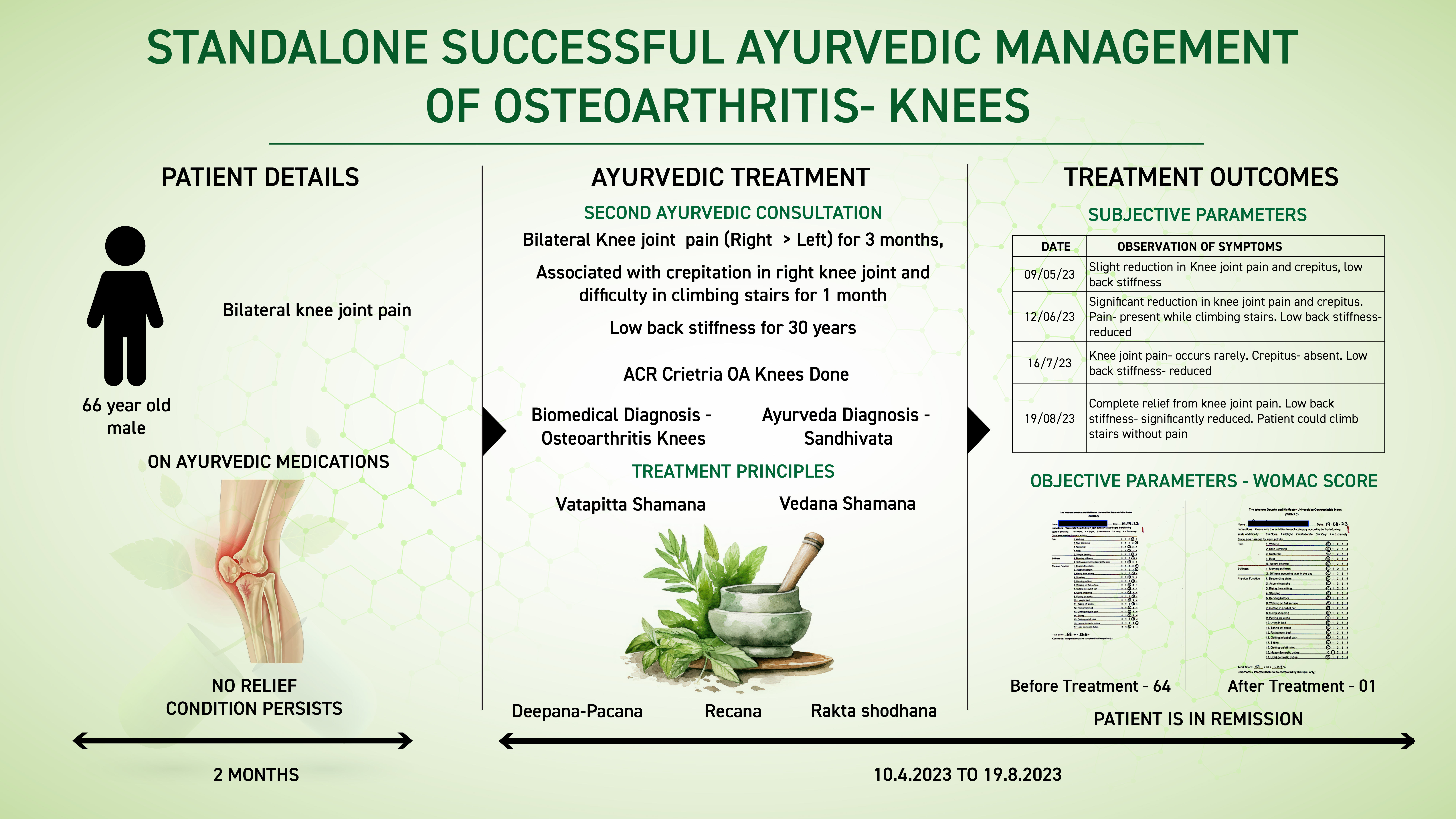
A 66 year old male patient presented with bilateral knee joint pain, right greater than left since 3 months associated with crepitation in right knee joint and difficulty in climbing stairs since 1 month . Patient also had low back stiffness since 30 years. He had tried ayurvedic medicines for 2 months. As there was no relief, the patient approached Dr Partap Chauhan for a second ayurvedic consultation. Based on the ACR criteria for early diagnosis of Osteoarthritis of the knee, the treating physician made the biomedical diagnosis as osteoarthritis of knee and Ayurveda diagnosis as Sandhivata. The line of treatment planned was to pacify the primary vitiated vata dosa and primary symptom- vedana. Apart from this, rakta shodhana, deepana, pacana, and recana dravya were included in the treatment. the After 4 months of Ayurvedic treatment, the patient attained complete relief from the knee joint pain and crepitus. He could climb the stairs without any pain. The persisting low back stiffness since 30 years had significantly reduced after the treatment. The WOMAC scale assessment score before treatment was 64, which was reduced to 1 after treatment. This case report demonstrates the successful standalone ayurvedic management of osteoarthritis of knees in an elderly male, who did not get relief with conventional medicines.
-
Summaries
-
Listen
-
Watch
-
View
-
Read
A 66 year old male patient presented with bilateral knee joint pain, right greater than left since 3 months associated with crepitation in right knee joint and difficulty in climbing stairs since 1 month . Patient also had low back stiffness since 30 years. He had tried ayurvedic medicines for 2 months. As there was no relief, the patient approached Dr Partap Chauhan for a second ayurvedic consultation. Based on the ACR criteria for early diagnosis of Osteoarthritis of the knee, the treating physician made the biomedical diagnosis as osteoarthritis of knee and Ayurveda diagnosis as Sandhivata. The line of treatment planned was to pacify the primary vitiated vata dosa and primary symptom- vedana. Apart from this, rakta shodhana, deepana, pacana, and recana dravya were included in the treatment. the After 4 months of Ayurvedic treatment, the patient attained complete relief from the knee joint pain and crepitus. He could climb the stairs without any pain. The persisting low back stiffness since 30 years had significantly reduced after the treatment. The WOMAC scale assessment score before treatment was 64, which was reduced to 1 after treatment. This case report demonstrates the successful standalone ayurvedic management of osteoarthritis of knees in an elderly male, who did not get relief with conventional medicines.
-
-
Timeline
-
Tabulated Summary
-
Narrative
TITLE OF CASE
Successful Standalone Ayurvedic management of Osteoarthritis of bilateral knees- a case report
Dr Partap Chauhan
ABSTRACT
A 66 year old male patient presented with bilateral knee joint pain, right greater than left since 3 months associated with crepitation in right knee joint and difficulty in climbing stairs since 1 month . Patient also had low back stiffness since 30 years. He had tried ayurvedic medicines for 2 months. As there was no relief, the patient approached Dr Partap Chauhan for a second ayurvedic consultation. Based on the ACR criteria for early diagnosis of Osteoarthritis of the knee, the treating physician made the biomedical diagnosis as osteoarthritis of knee and Ayurveda diagnosis as Sandhivata. The line of treatment planned was to pacify the primary vitiated dosa- vata and primary symptom- vedana. Apart from this, rakta shodhana, deepana, pacana, and recana dravya were included in the treatment. the After 4 months of Ayurvedic treatment, the patient attained complete relief from the knee joint pain and crepitus. He could climb the stairs without any pain. The persisting low back stiffness since 30 years had significantly reduced after the treatment. The WOMAC scale assessment score before treatment was 64, which was reduced to 1 after treatment. This case report demonstrates the successful standalone ayurvedic management of osteoarthritis – knees in an elderly male, who did not get relief with conventional medicines.
KEYWORDS
Osteoarthritis, sandhivata, sandhigat vata, bilateral knees, standalone, case report, janu
INTRODUCTION
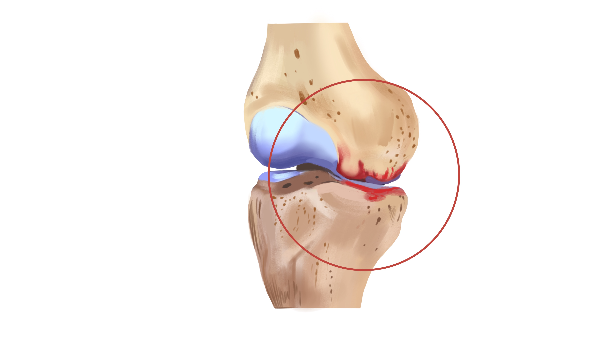
Osteoarthritis (OA) is a common form of arthritis that often affects the knee. In the early stages, there may not be any symptoms. In the later stages, however, they experience pain, stiffness and even restricted movements. Grating sensation, bone spur, tenderness and swelling are also common symptoms of OA knee. If left untreated, the symptoms worsen over time.
OA of the knee affects the bones, cartilage, and synovium in the knee joint. Though the knee is reported to be the most common condition, OA can also affect other joints like the pelvis, shoulder etc..,
Diagnosis; Medical history and clinical evaluation are the main diagnostic criteria. But imaging like Xray, and MRI may be suggested to assess the intensity of the damage. Blood tests may be suggested to rule out conditions like gout or rheumatoid arthritis.
Treatment: In a mild presentation, acetaminophen or over-the-counter medicines may be sufficient to relieve the pain. In moderate to severe presentation, prescription painkillers, corticosteroid injections, physical therapy or even surgery may be required.
Prognosis:The effect of osteoarthritis of the knee can’t be reversed. But treatment and self-care can help relieve the symptoms and slow the condition’s progress. Medications may be always required to manage the pain. Exercise and physical therapy help in improving the quality of life.
PATIENT INFORMATION
The patient is a 66 year old male patient presented with bilateral knee joint pain, right greater than left since 3 months associated with crepitation in right knee joint and difficulty in climbing stairs since 1 month . Patient also had low back stiffness since 30 years. He had tried ayurvedic medicines for 2 months. As there was no relief, the patient approached Dr Partap Chauhan for a second ayurvedic consultation. Based on the ACR criteria for early diagnosis of Osteoarthritis of the knee, the treating physician made the biomedical diagnosis as osteoarthritis of knee and Ayurveda diagnosis as Sandhivata.
No relevant family/genetic/surgical or psychosocial history.
CLINICAL FINDINGS
General examination
Locomotor system examination
Important clinical findings:
Vitals- Normal (GALS assessment)
(i) Gait (G): Patient feels pain during walking at ankle joints and no pain at turning back.
(ii) Arms (A): Patient feels no pain in arm swinging and other movements.
(iii) Legs (L): Patient feels pain and stiffness at knees during bending and walking movements and at ankle joints during walking.
(iv) Spine (S): Patient feels stiffness in the lower back during tilting forward movements.TIMELINE
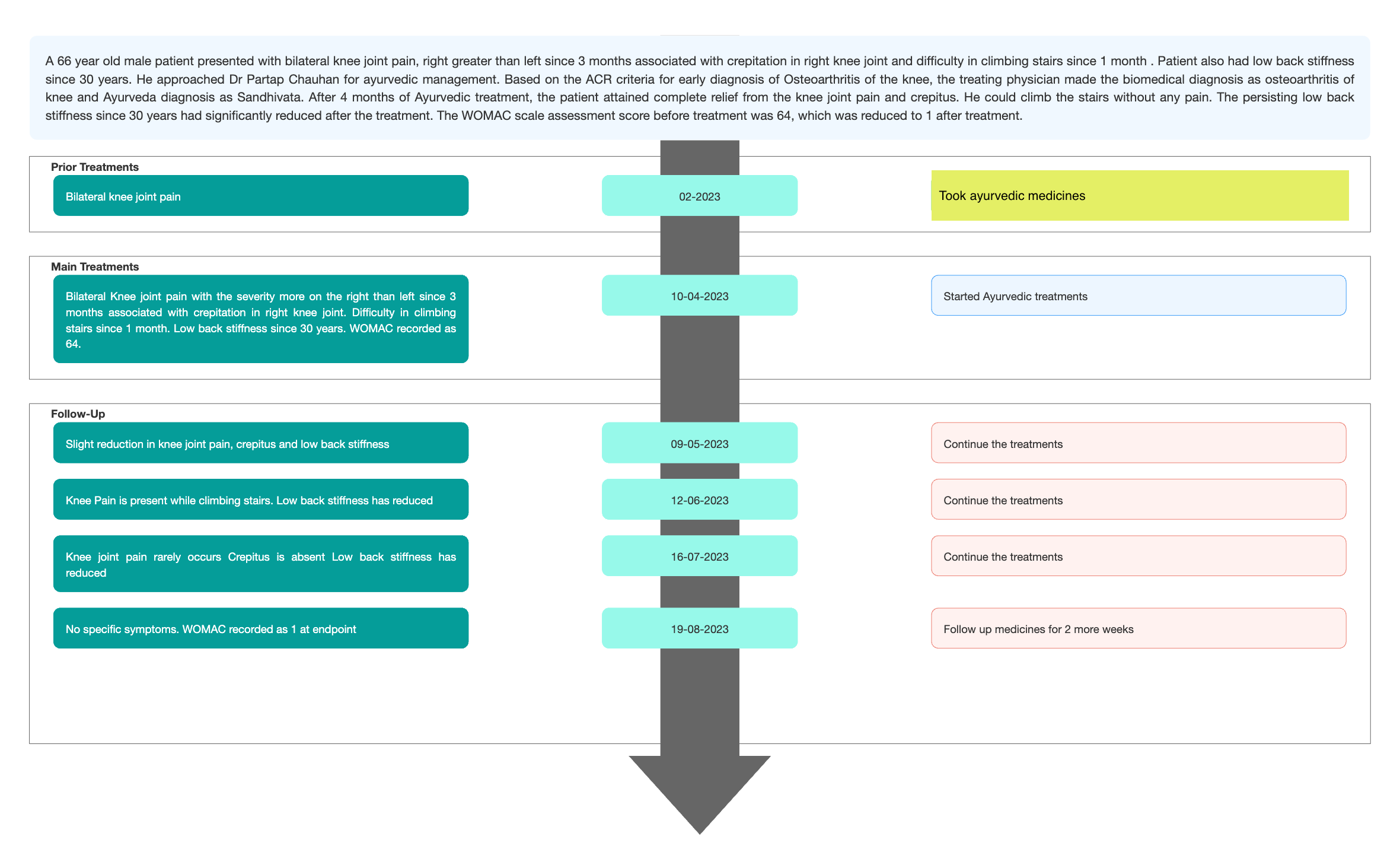
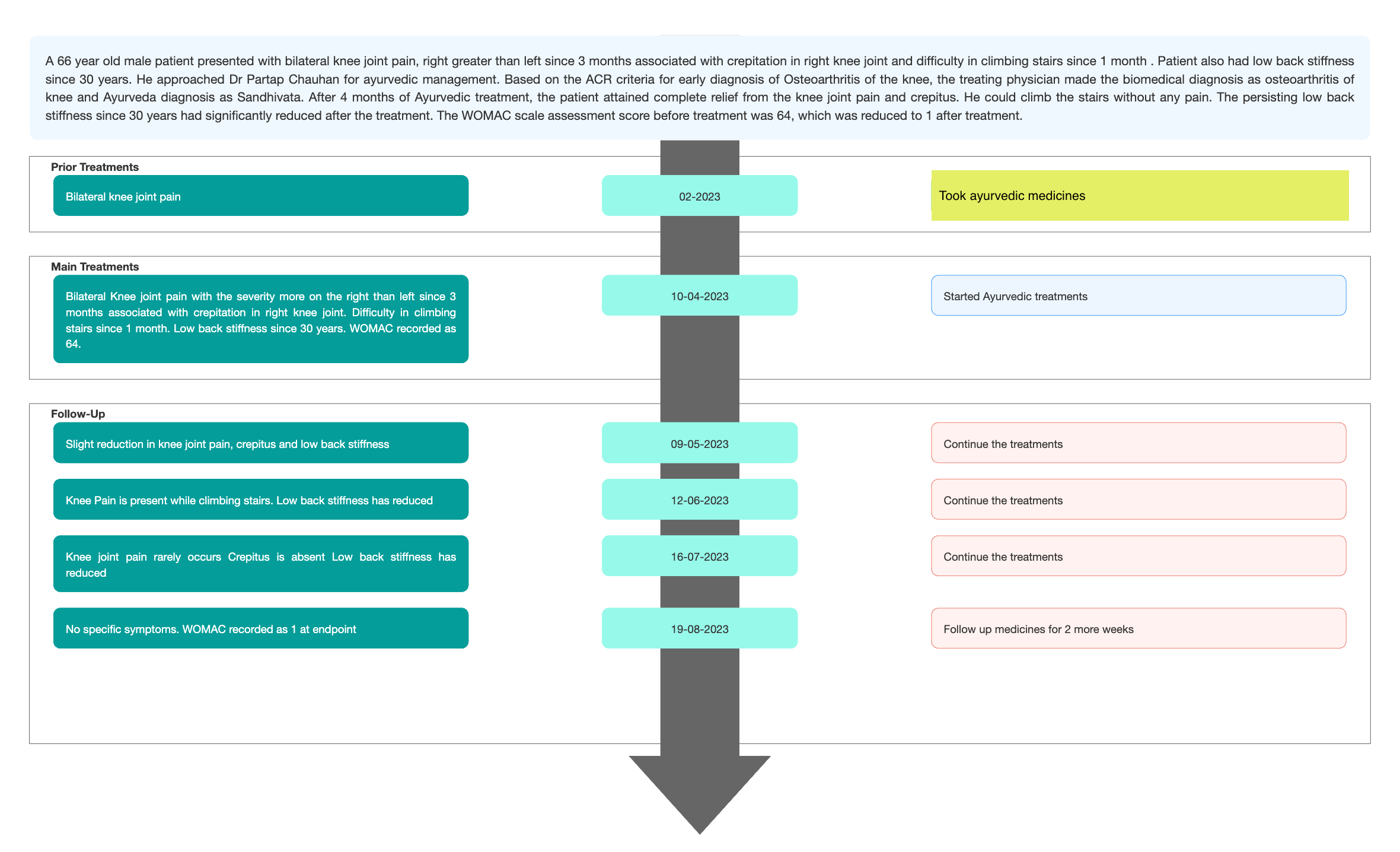
Image 1. Timeline of events added below
DIAGNOSTIC ASSESSMENT
Modern Diagnostic parameter; Based on the clinical examination and X-Ray findings, the biomedical diagnosis was made as Osteoarthritis.
Image 2. Diagnosis proof ACR Criteria for Osteoarthritis Knee at baseline
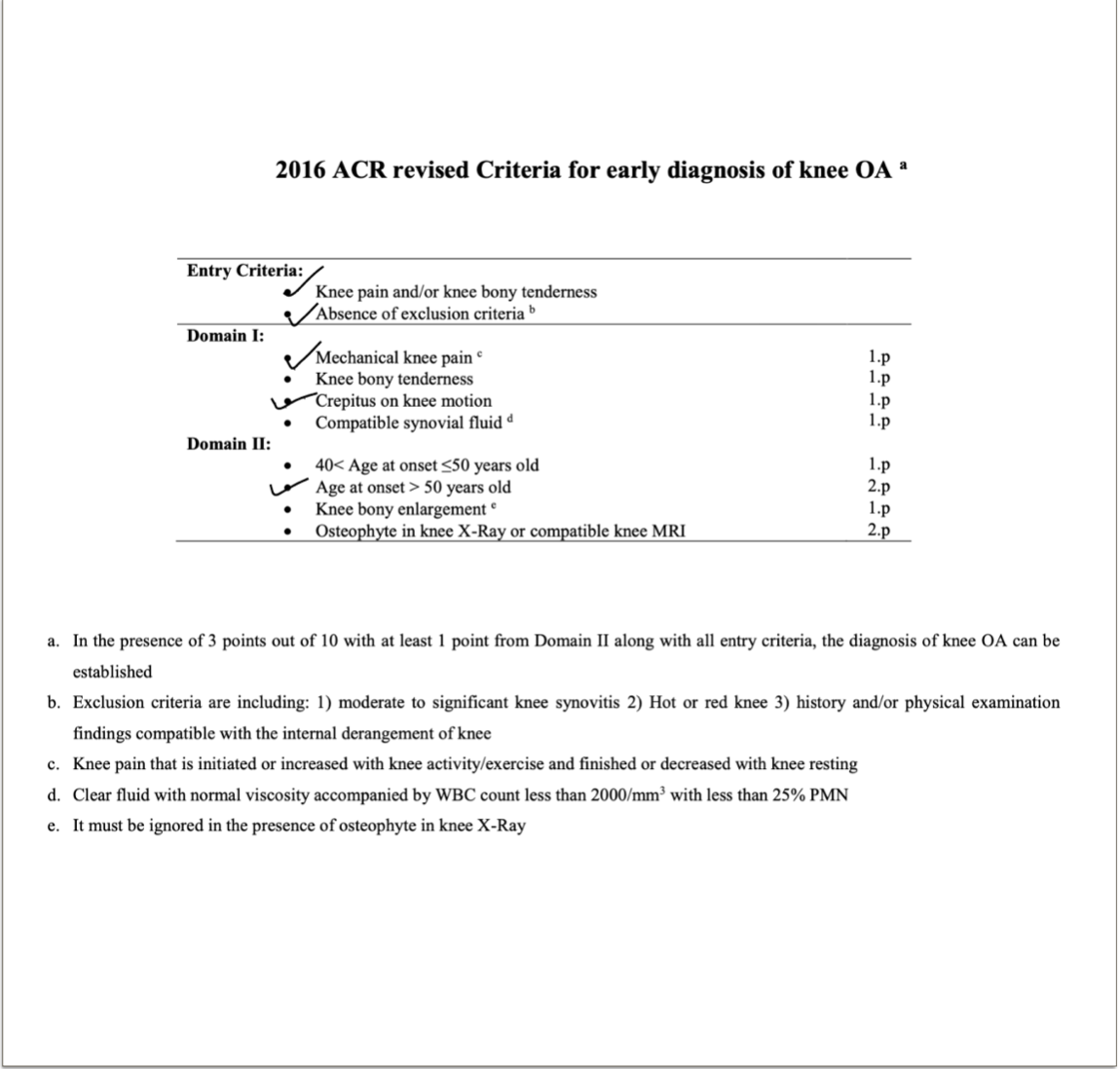
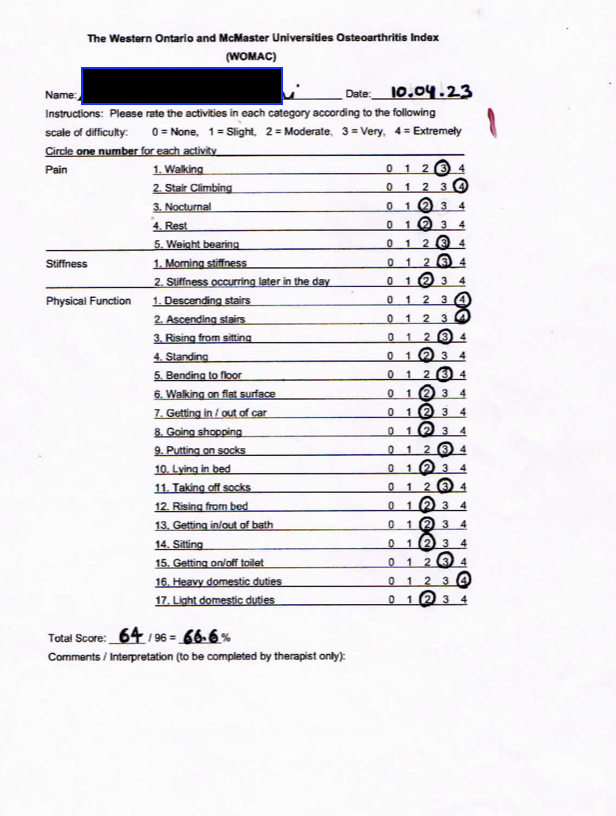
Image 3. WOMAC Scale documented at baseline
Ayurvedic Assessment was done based on the presenting complaints and clinical evaluation. The treating physician confirmed the Ayurvedic diagnosis as Sandhivata.
Differential Diagnosis-
Rheumatoid arthritis
Psoriatic arthritis
Crystalline arthritis
Bursitis
Tendinitis
Based on the clinical examination and X-Ray findings, the condition was diagnosed as Osteoarthritis and Ayurvedic diagnosis as sandhivata.
Prognosis- The prognosis for osteoarthritis patients depends on the joint involved, how many joints are involved, and the severity. There is no cure for osteoarthritis, and all the currently available treatments are directed towards reducing symptoms. In this case report, after 4 months of treatment, the patient got complete relief from the knee joint pain and crepitus. The persisting low back stiffness since 30 years had significantly reduced after the treatment.
THERAPEUTIC INTERVENTION
Refer the tab ‘Treatment’ in the Portal.
FOLLOW-UP AND OUTCOMES
The patient had 6 follow ups in total. Each follow up, the symptoms of joint pain, stiffness, bloatedess, constipation and sleep were assessed and tabulated.
Subjective parameters: The changes observed in the symptoms were noted date wise, and tabulated.
Table 1. Symptoms tabulated throughout the ayurvedic treatment
DATE
OBSERVATION OF SYMPTOMS
09/05/23
Slight reduction in Knee joint pain and crepitus, low back stiffness
12/06/23
Significant reduction in knee joint pain and crepitus. Pain- present while climbing stairs. Low back stiffness- reduced
16/7/23
Knee joint pain- occurs rarely. Crepitus- absent. Low back stiffness- reduced
19/08/23
Completely relief from knee joint pain Low back stiffness- significantly reduced. Patient could climb stairs without pain
Clinician-based assessment; After 4 months of treatment, the patient got complete relief from the knee joint pain and crepitus. He could climb the stairs without any pain. The persisting low back stiffness since 30 years had significantly reduced after the treatment.
Patient-assessed; WOMAC Scale was recorded at endpoint
Image 4. WOMAC Scale documented at endpoint
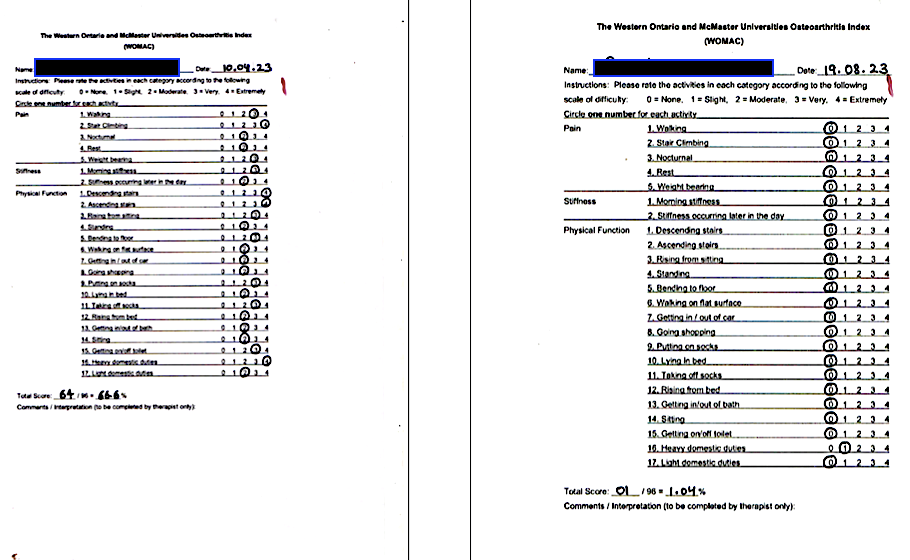
WOMAC Scale was recorded as 64 at baseline became 1 at endpoint.
Intervention adherence and tolerability – The patient adhered to the prescribed treatments and tolerated the treatments well.
Method of assessment- Subjective and objective parameters were the main assessment tools.
Adverse and unanticipated events; None reported
DISCUSSION:
Osteoarthritis (OA) is a common form of arthritis that often affects the knee. In the early stages, there may not be any symptoms. In the later stages, however, they experience pain, stiffness and even restricted movements. Grating sensation, bone spur, tenderness and swelling are also common symptoms of OA knee. If left untreated, the symptoms worsen over time. The effect of osteoarthritis of the knee can’t be reversed. But treatment and self-care can help relieve the symptoms and slow the condition’s progress. Medications may be always required to manage the pain. Exercise and physical therapy help in improving the quality of life. Here the ayurvedic diagnosis was Sandhivata, and the line of treatment followed was vata shamana and vedan shamana. Apart from this, rakta shodhana, deepana, pacana, and recana dravya were included in the treatment.
PATIENT’S PERSPECTIVE
Not available.
LEARNING POINTS/TAKE HOME MESSAGES
This case highlights the efficacy of ayurveda in treating osteoarthritis in a patient who had been suffering from this condition with restricted mobility in day-to-day life. The patient attained a symptom-free condition with the standalone ayurveda treatment.
INFORMED CONSENT
Written consent obtained from patient for publishing of the case report in the Portal
ACKNOWLEDGEMENTS
None
CONFLICT OF INTEREST
None declared.
FUNDING
None
REFERENCE
1. https://www.medicalnewstoday.com/articles/310579
-
Immersive Learning
-
Modern Diagnosis
MODERN DIAGNOSIS: Osteoarthritis- Knees
ABOUT THE DISEASE:
Osteoarthritis (OA) is a common form of arthritis that often affects the knee. In the early stages, there may not be any symptoms. In the later stages, however, they experience pain, stiffness and even restricted movements. Grating sensation, bone spur, tenderness and swelling are also common symptoms of OA knee. If left untreated, the symptoms worsen over time.
OA of the knee affects the bones, cartilage, and synovium in the knee joint. Though the knee is reported to be the most common condition, OA can also affect other joints like the pelvis, shoulder etc..,
Diagnosis; Medical history and clinical evaluation are the main diagnostic criteria. But imaging like Xray, and MRI may be suggested to assess the intensity of the damage. Blood tests may be suggested to rule out conditions like gout or rheumatoid arthritis.
In this case report, a 66 year old male patient presented with bilateral knee joint pain, right greater than left since 3 months associated with crepitation in right knee joint and difficulty in climbing stairs since 1 month . Patient also had low back stiffness since 30 years. He tried ayurvedic medicines for 2 months, but did not get relief. So he approached Dr Partap Chauhan for a second ayurvedic consultation. Based on the ACR criteria for early diagnosis of Osteoarthritis of the knee, the treating physician made the biomedical diagnosis as osteoarthritis of knee and Ayurveda diagnosis as Sandhivata.
Based on the clinical examination and ACR criteria for diagnosis of Osteoarthritis of knees, the biomedical diagnosis was confirmed by the treating physician.
Image 1. ACR Criteria for diagnosis of Osteoarthritis of Knees at baseline
Image 2. WOMAC SCALE documented at baseline
Bilateral genu valgus deformity seen with reduction of bilateral tibio-fernoral joint space more prominent in the lateral compartment. Impression- Bilateral knee osteoarthritis.
Treatment: In a mild presentation, acetaminophen or over-the-counter medicines may be sufficient to relieve the pain. In moderate to severe presentation, prescription painkillers, corticosteroid injections, physical therapy or even surgery may be required.
Prognosis:The effect of osteoarthritis of the knee can’t be reversed. But treatment and self-care can help relieve the symptoms and slow the condition’s progress. Medications may be always required to manage the pain. Exercise and physical therapy help in improving the quality of life.
Reference
-
Ayurveda Diagnosis
AYURVEDA DIAGNOSIS: Sandhivata
ABOUT THE DISEASE:
The classical term 'Sandhigata Vata' is also referred to as Sandhivata in Ayurveda can be correlated with Osteoarthritis (OA) taking into consideration the similarity of symptoms. It is one such chronic, degenerative, inflammatory disease which has a great impact on the quality of life of an individual. Present day activities are prone to cause many life deteriorating conditions. Food, lifestyle and environment are three important determinants related to the cause of disease. Sandhigatavata is one among the vatavyadhi. This is highlighted as a degenerative disease under the concepts of dhatu saithilya and dhatu kshaya. Acarya Charaka has used the term Sandhigata anila in Vatavyadhi Ciiktsadhyaya.
The word 'Gata' denotes movement or carrying something along with or to reach a particular site through any particular pathway. The knees are the most weight-bearing joint, and hence get affected very fast. The presentation of this pathogenesis is seen as Janu Sandhigata Vata.
Symptoms: The disease has no specific purvaroopa. But the clinical signs and symptoms include joint pain (Sandhi vedana), Sandhi Shotha (Swelling), Vatapurna druti sparsha, pain and tenderness during the movements of the joints (Prasarana akunchana pravrutisavedana), cracking sounds (Atopa) and degeneration of the joint (Hanti sandhi).
In this case report, a 66 year old male patient presented with bilateral knee joint pain, right greater than left since 3 months associated with crepitation in right knee joint and difficulty in climbing stairs since 1 month . Patient also had low back stiffness since 30 years. He tried ayurvedic medicines for 2 months, but did not get relief. So he approached Dr Partap Chauhan for a second ayurvedic consultation. Based on the ACR criteria for early diagnosis of Osteoarthritis of the knee, the treating physician made the biomedical diagnosis as osteoarthritis of knee and Ayurveda diagnosis as Sandhivata.
Samprapti: No direct references for samprapti of janusandhigatavata is found. The general Samprapti of Sandhivata – Vatavyadhi can be applied for Janusandhigata vata. When vitiated Vata dosha gets Sthana Samshraya in Janusandhi, it causes pain and inflammation in the knee joints and in later stages dislocation and loss of function of the joint of the knee.
Treatments: The treatment of Janusandhigata vata is aimed at reducing the Vata dosha and balancing the shleshaka kapha so that the joint spaces are adequately lubricated for the free movement of the knee joints. For this many procedures have been mentioned like snehana, swedana, mridu samshodhana, Basti and vatahara aushadha prayoga, Ahara and Vihara. In some texts, practices of upanaha, agnikarma, bandhana, mardana etc are also described. Different Ghritas, Guggulu, Shallaki preparations are used for Internal medicines.
Rationale of treatment as explained by the physician is tabulated below:
Medicines/ Procedures
Rationale
Sandhi dosh har Rasayana +
Rasna vishesh curna +
Erand mool curna +
Peedantak Curna +
Amlapittantak rasayan
Vataghna, vedana shamana, balya
Vataghna, vedana shamana
Vataghna, vedana shamana, balya
Vataghna, vedana shamana, pachana, deepana
Pitta shamana, pachana, rechana
Sandhi rog har guggulu
Kaphavataghna, vedana shamana, balya
Gokshuradi guggulu
Kaphavataghna, shothaghna, rasayana
Peedantak guggulu
Vataghna, vedana shamana, balya
Raktashodhak vati
Vata pitta shamana, rakta shodhana
Punaroday vati
Kaphavataghna, shothahara, pachana
Rasnadi Guggulu
Kaphavataghna, vedana shamana
Leela vilas ras
Pitta shamana, pachana
Maharasnadi Kwatha
Kaphavataghna, vedana shamana
Pain Calm Oil
Vataghna, vedana shamana, snehana
Arjun Vati
Rakta prasadana, balya
Punarnavadi kwath
Shothahara
Reference
1. Janu sandhigatavata: a comprehensive review of the ayurvedic literature. Biswajit and rabindranath. International journal of scientific research. Volume - 9 | issue - 11 | November - 2020 | print ISSN no. 2277 - 8179 | doi : 10.36106/ijsr
-
Treatment
Name of Medicine Dosage Form Dosage Mode of Administrtation From - To (Date) Medicine Reference Sandhi dosh har Rasayana + Rasna vishesh curna + Erand mool curna + Peedantak Curna + Amlapittantak rasayan Samyoga 0.75gm of each curna mixed Oral twice daily 2023-04-10 - 2023-09-03 Anubhuta Yoga Prayoga Sandhi rog har guggulu Tablet 1-0-1 Oral, thrice daily after food 2023-04-10 - 2023-09-03 Ayurvedic Patent & Proprietary Medicine Gokshuradi guggulu Tablet 1-0-1 Oral, twice daily after food 2023-07-16 - 2023-09-03 Sharangdhara Samhita Madhyamakhanda 7.84-87 Sandhi rog har guggulu Tablet 1-0-1 Oral, twice daily after food 2023-04-10 - 2023-09-03 Ayurvedic Patent & Proprietary Medicine Peedantak guggulu Tablet 1-0-1 Oral, twice daily after food 2023-06-12 - 2023-09-03 Ayurvedic Patent & Proprietary Medicine Peedantak guggulu Tablet 1-0-1 Oral, twice daily after food 2023-06-12 - 2023-09-03 Ayurvedic Patent & Proprietary Medicine Raktashodhak vati Tablet 1-0-1 Oral, twice daily after food 2023-06-12 - 2023-07-13 Ayurvedic Patent & Proprietary Medicine Punaroday vati Tablet 1-0-1 Oral, twice daily after food 2023-07-03 - 2023-09-03 Ayurvedic Patent & Proprietary Medicine Rasnadi Guggulu Tablet 1-0-1 Oral, twice daily after food 2023-04-12 - 2023-07-12 Yogaratnakara, Vata vyadhi. Leela vilas ras Tablet 1-0-1 Oral, twice daily after food 2023-04-10 - 2023-06-09 Yogaratnakara Amlapitta Cikitsa Maharasnadi kwatha Kvatha 15 ml Oral on empty stomach morning and evening 2023-04-10 - 2023-09-03 Sharangdhara Samhita Madhyamakhanda 2.89 - 95 Pain Calm Oil Taila Required Quantity For External application 2023-04-10 - 2023-05-10 Ayurvedic Patent & Proprietary Medicine Arjun Vati Tablet 1-0-1 Oral, twice daily after food 2023-06-12 - 2023-09-03 Ayurvedic Patent & Proprietary Medicine Punarnavadi kwath Kvatha 15 ml Oral on empty stomach morning and evening 2023-05-09 - 2023-09-03 Bhaishajya Ratnavali Udararoga 43-44 -
Outcome Measures
In this case report, a 66 year old male patient presented with bilateral knee joint pain, right greater than left since 3 months associated with crepitation in right knee joint and difficulty in climbing stairs since 1 month . Patient also had low back stiffness since 30 years. He tried ayurvedic medicines for 2 months, but did not get relief. So he approached Dr Partap Chauhan for a second ayurvedic consultation. Based on the ACR criteria for early diagnosis of Osteoarthritis of the knee, the treating physician made the biomedical diagnosis as osteoarthritis of knee and Ayurveda diagnosis as Sandhivata.
Assessment: Subjective and objective parameters were assessed to analyse the outcome of the treatment.
Subjective parameters: The changes observed in the symptoms were noted date wise, and tabulated.
Table 1. Symptoms tabulated throughout the treatment
DATE
OBSERVATION OF SYMPTOMS
09/05/23
Slight reduction in Knee joint pain and crepitus, low back stiffness
12/06/23
Significant reduction in knee joint pain and crepitus. Pain- present while climbing stairs. Low back stiffness- reduced
16/7/23
Knee joint pain- occurs rarely. Crepitus- absent. Low back stiffness- reduced
19/08/23
Completely relief from knee joint pain Low back stiffness- significantly reduced. Patient could climb stairs without pain
Objective parameters:
WOMAC Scale was recorded at baseline as 64 became 1 at endpoint
Image 1.WOMAC SCALE AT BASELINE AND ENDPOINT
-