Featured Case
-
Abstract
A 25-year-old female patient presented with dry skin patches with itching and redness over the scalp, right knee, right hand and chest region associated with irregular menstruation and excessive weight gain since 3 years. There was a temporary relief in the itching, but the patches kept on increasing in size over time despite taking alternative treatments, and hence she opted for Ayurvedic management. She approached Dr Partap Chauhan for better management. Based on the clinical evaluation, the biomedical diagnosis was made as Plaque psoriasis and Ayurvedic diagnosis as Eka kushta. The line of treatment followed was tridosa shamana, rakta shodhana and prasadana, sroto shodhana and shothaghna cikitsa. After 6 months of ayurvedic treatment, there was a significant reduction in symptoms, and in 7 months, she was completely relieved from all the associated symptoms. PASI documented as 4.4 at midpoint reduced to 0.1 at endpoint. This case report demonstrates the successful ayurvedic management of a chronic case of plaque psoriasis in a patient who was not getting relief with conventional medicines.
-
Summaries
-
Listen
-
Watch
-
View
-
Read
A 25-year-old female patient presented with dry skin patches with itching and redness over the scalp, right knee, right hand and chest region associated with irregular menstruation and excessive weight gain since 3 years. There was a temporary relief in the itching, but the patches kept on increasing in size over time despite taking alternative treatments, and hence she opted for Ayurvedic management. She approached Dr Partap Chauhan for better management. Based on the clinical evaluation, the biomedical diagnosis was made as Plaque psoriasis and Ayurvedic diagnosis as Eka kushta. The line of treatment followed was tridosa shamana, rakta shodhana and prasadana, sroto shodhana and shothaghna cikitsa. After 6 months of ayurvedic treatment, there was a significant reduction in symptoms, and in 7 months, she was completely relieved from all the associated symptoms. PASI documented as 4.4 at midpoint reduced to 0.1 at endpoint. This case report demonstrates the successful ayurvedic management of a chronic case of plaque psoriasis in a patient who was not getting relief with conventional medicines.
-
-
Timeline
-
Tabulated Summary
-
Narrative
TITLE OF CASE
Standalone Ayurvedic management of plaque psoriasis- a case report
Dr Partap Chauhan
ABSTRACT
A 25-year-old female patient presented with dry skin patches with itching and redness over the scalp, right knee, right hand and chest region associated with irregular menstruation and excessive weight gain since 3 years. There was a temporary relief in the itching, but the patches kept on increasing in size over time despite taking alternative treatments, and hence she opted for Ayurvedic management. She approached Dr Partap Chauhan for better management. Based on the clinical evaluation, the biomedical diagnosis was made as Plaque psoriasis and Ayurvedic diagnosis as Eka kushta. The line of treatment followed was tridosa shamana, rakta shodhana and prasadana, sroto shodhana and shothaghna cikitsa. After 6 months of ayurvedic treatment, there was a significant reduction in symptoms, and in 7 months, she was completely relieved from all the associated symptoms. PASI documented as 4.4 at midpoint was recorded as 0.1 at endpoint. This case report demonstrates the successful ayurvedic management of a chronic case of plaque psoriasis in a patient who was not getting relief with conventional medicines.
KEYWORDS
Plaque Psoriasis, psoriasis, eka kushta, kushta, scalp, case report, PASI
INTRODUCTION
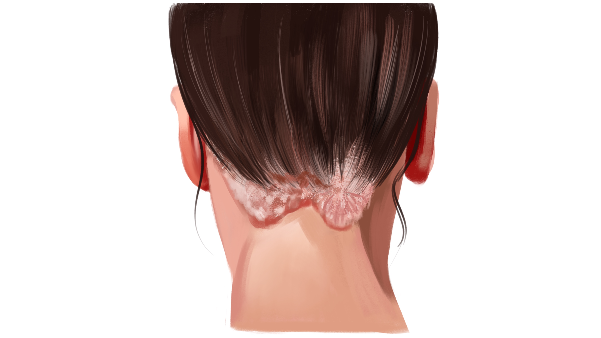
Plaque psoriasis also called psoriasis vulgaris is a long-lasting autoimmune disease that causes your cells to reproduce very quickly. It’s a type of psoriasis that causes thick, scaly patches called plaques on your skin. It most commonly affects elbows, back, knees, and scalp. In severe cases of plaque psoriasis, the face, feet, genitals (penis, vagina, vulva), hands and legs also may be affected.
Symptoms:
Raised, discoloured (red, brown, grey or purple) plaques with a white or silvery surface.
Cracks (fissures).
Bleeding.
Itchiness.
Irritation or pain.
Diagnostic criteria: Medical history and clinical evaluation are the basic diagnostic criteria used. Apart from this allergy tests, biopsy and blood tests to rule out infections are also done.
Treatment: The treatments given in Plaque psoriasis are Injections, oral medicines, and photo therapy.
Prognosis: There is no cure for Plaque psoriasis. There are flare-ups and remissions, and only temporary relief is predicted.
PATIENT INFORMATION
A 25-year-old female patient presented with dry skin patches with itching and redness over the scalp, right knee, right hand and chest region associated with irregular menstruation and excessive weight gain since 3 years. There was a temporary relief in the itching, but the patches kept on increasing in size over time despite taking alternative treatments, and hence she opted for Ayurvedic management. She approached Dr Partap Chauhan for better management. Based on the clinical evaluation, the biomedical diagnosis was made as Plaque psoriasis and Ayurvedic diagnosis as Eka kushta.
CLINICAL FINDINGS
General and systemic examinations were done.
Vitals- Normal
Body weight- 61.6 Kg
Physical examination- Dry skin rashes with severe scaling and redness.
Itching +++++
Body weight- 61.6 KgTIMELINE
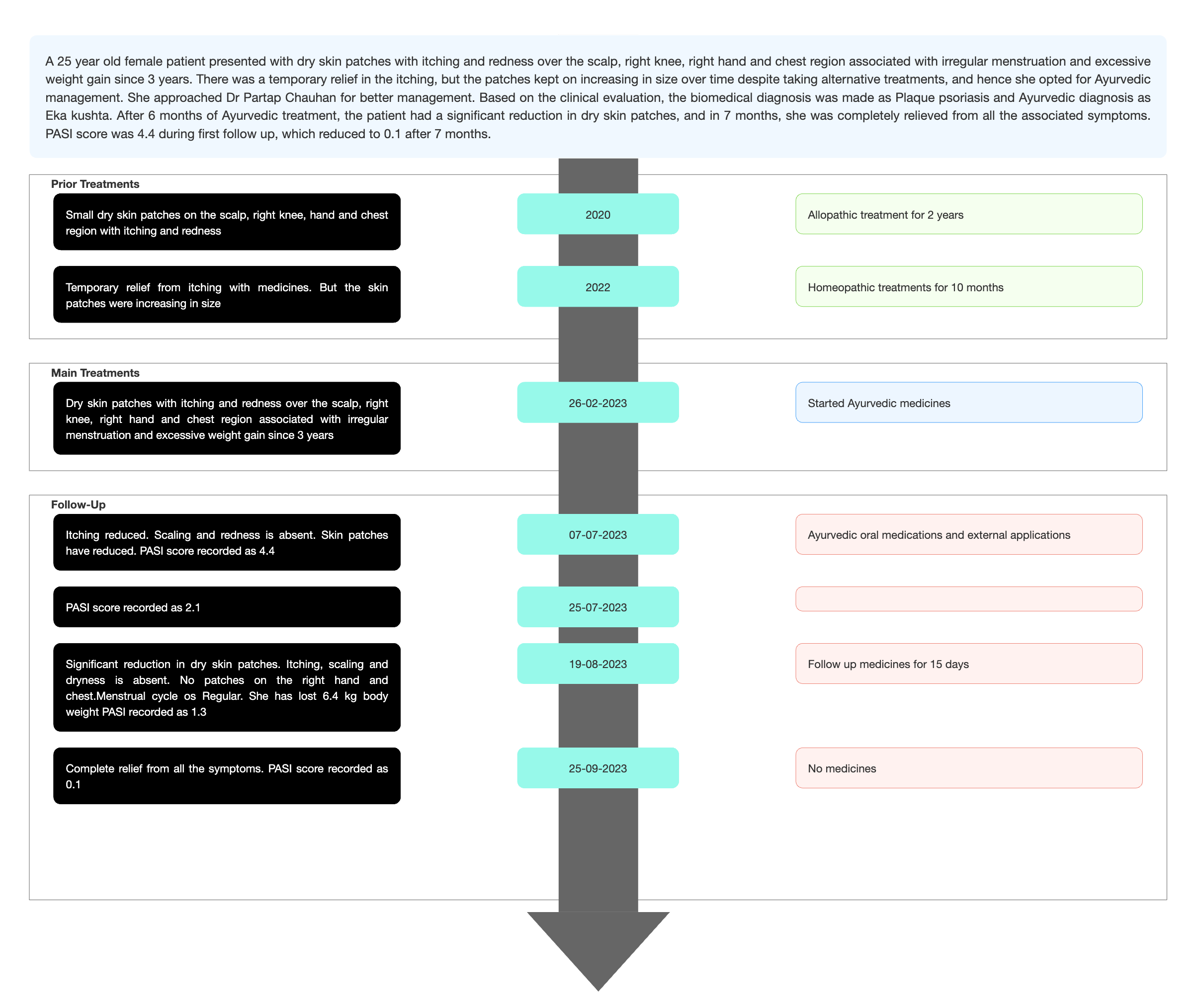
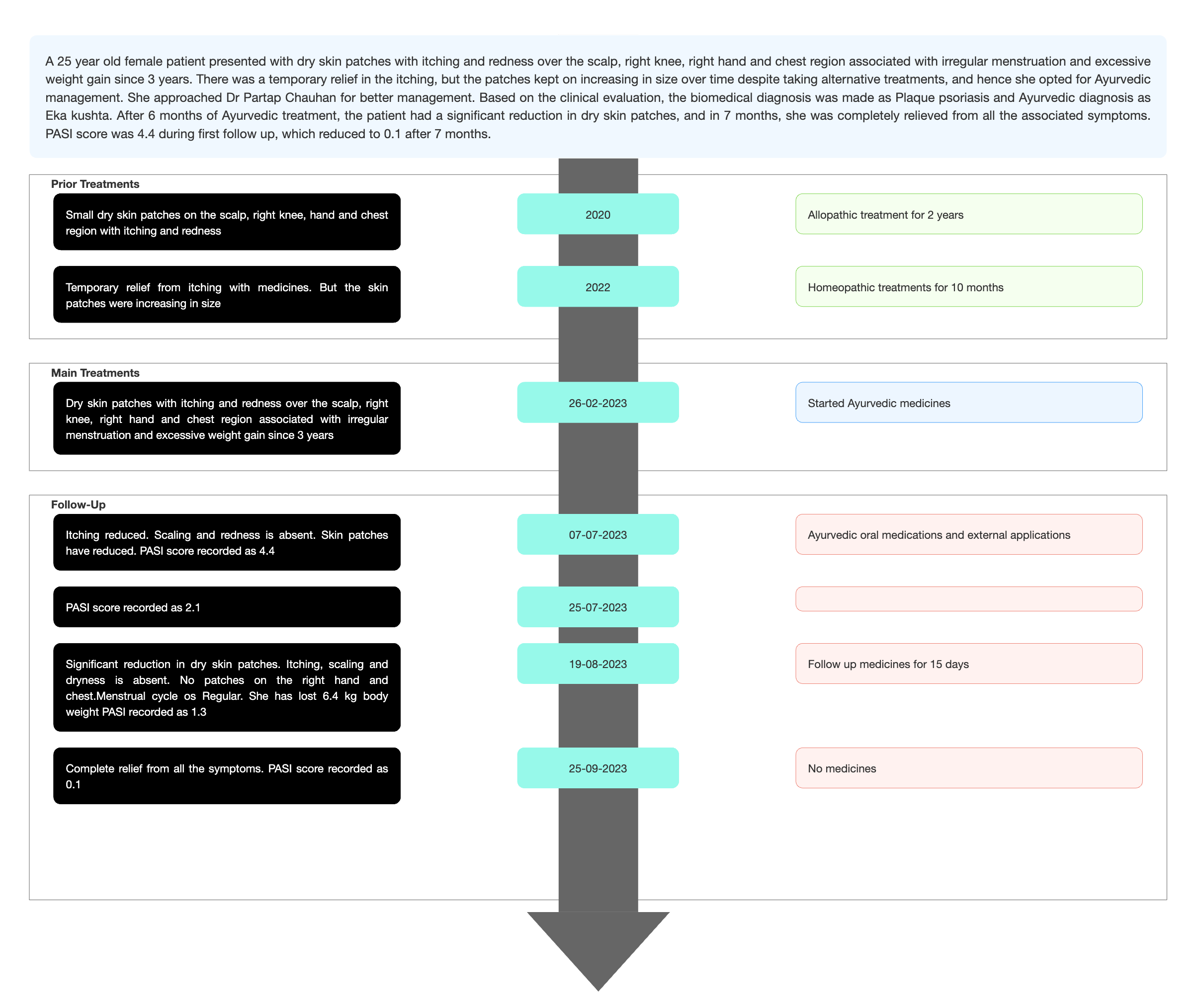
Image 1. Timeline of events added below
DIAGNOSTIC ASSESSMENT
Modern Diagnostic parameter; The biomedical diagnosis was confirmed as Plaque psoriasis by the treating physician based on the clinical evaluation.
Table 1. Symptoms tabulated at Baseline
Chief complaints
Feb/ 23
Itching
+++++
Scaling
+++++
Redness
++++
Patches
+++++
Ayurvedic Assessment was done based on the presenting complaints and clinical evaluation. The treating physician made the Ayurvedic diagnosis as Ekakushta.
Differential Diagnosis- The different conditions are as follows
DADRU - Ruled out as Pidaka, Daha were absent
SIDDHMA - Ruled out as the twak tanuta was absent
The physician diagnosed the case as Eka kushta based on the clinical examination and presenting complaints .
Prognosis- Psoriasis is an unpredictable disorder. There is no cure, for this condition and also it is difficult to know who will relapse, how long the active disease will last or how frequently the patient will have remissions. In addition, all treatments have major adverse effects including skin cancers, liver damage and susceptibility to infections. In this case report, the patient is suffering from the persisting symptoms even with medications. Hence she opted for Ayurvedic management. After 7 months of Ayurvedic treatment, the patient got complete relief from all the symptoms.
THERAPEUTIC INTERVENTION
Refer the tab ‘Treatment’ in the Portal.
FOLLOW-UP AND OUTCOMES
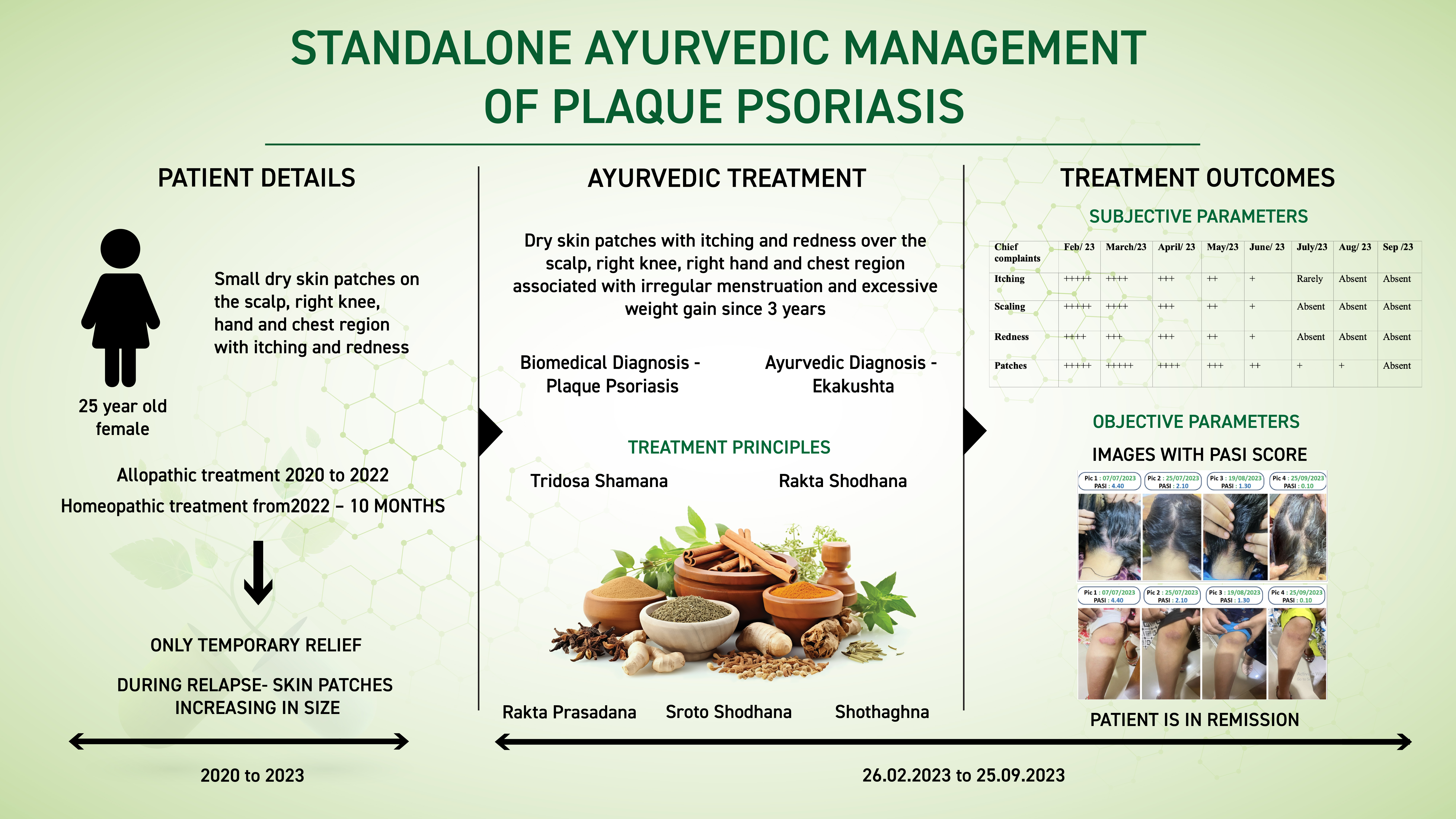
The patient had 4 follow ups in total. The images were taken throughout the treatment and the PASI Score was also done.
Clinician-based assessment; After 5 months of treatment, itching reduced, scaling and redness- absent. Skin patches have reduced. In 6 months, there was a significant reduction in all the symptoms, and in 7 months she got complete relief from all the symptoms. She had a regular menstrual cycle and had a weight loss of 6.4 kg. In further follow-up done after 1 month, the patient had no specific symptoms. PASI score was 4.4 during the first follow-up after 5 months of treatment, which dropped to 0.1 after 7 months.
Image 2. Images of the lesions in the back of the head with the PASI score
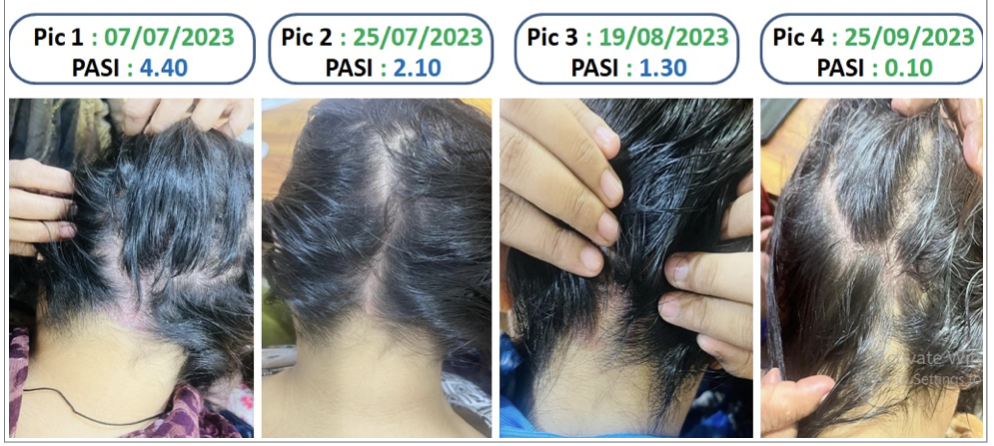
Image 3. Images of the lesions in the right knee with the PASI Score
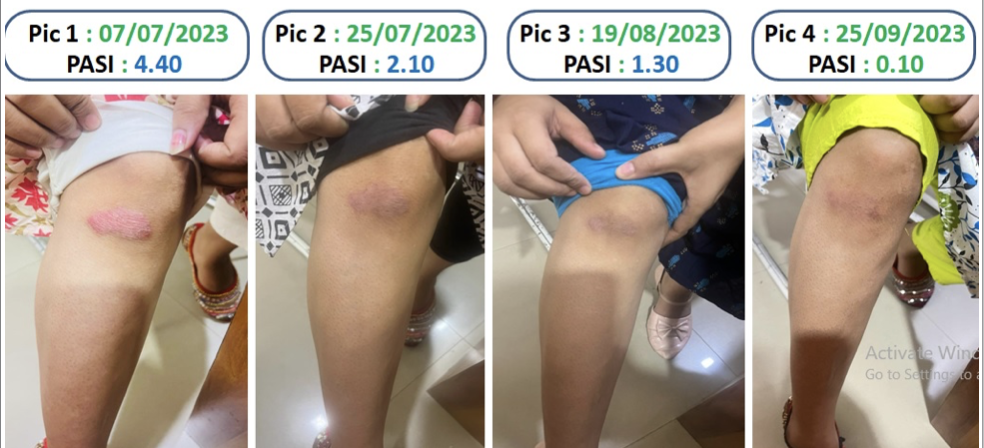
Image 4. Online PASI Score calculator at endpoint

Patient-assessed; Not relevant
Table 2. Symptoms charted throughout treatment
Chief complaints
Feb/ 23
March/23
April/ 23
May/23
June/ 23
July/23
Aug/ 23
Sep /23
Itching
+++++
++++
+++
++
+
Rarely
Absent
Absent
Scaling
+++++
++++
+++
++
+
Absent
Absent
Absent
Redness
++++
+++
+++
++
+
Absent
Absent
Absent
Patches
+++++
+++++
++++
+++
++
+
+
Absent
Intervention adherence and tolerability– The patient adhered to the prescribed treatments and tolerated the treatments well.
Method of assessment- Images were taken before and after treatment.
Adverse and unanticipated events; None reported
DISCUSSION ;
The patient had been suffering from the skin complaints past 3 years. She tried allopathic and homeopathic medicines, but the skin patch was continuously increasing in size. The Ayurvedic diagnosis was Eka kushta, and the line of treatment followed was tridosa shamana, rakta shodhana and prasadana, sroto shodhana and shothaghna cikitsa. She got complete relief from all the symptoms in 7 months.
PATIENT’S PERSPECTIVE
Not available.
LEARNING POINTS/TAKE HOME MESSAGES
This case report highlights the efficacy of Ayurveda in successfully treating a chronic case of plaque psoriasis where the patient had been trying alternative standard of care over a period of 3 years, but did not get relief.
INFORMED CONSENT
Written consent obtained from patient for publishing the case report.
ACKNOWLEDGEMENTS
None
CONFLICT OF INTEREST
None declared.
FUNDING
None
REFERENCE
- Taken from - https://my.clevelandclinic.org/health/diseases/22842-plaque-psoriasis
- Caraka Samhita. Cikitsa Sthana. Chapter 7. Kushtha Cikitsadhyayam
-
Immersive Learning
-
Modern Diagnosis
MODERN DIAGNOSIS: Plaque Psoriasis
ABOUT THE DISEASE:
Plaque psoriasis is an autoimmune condition. It causes thick patches (plaques) on your skin, including your scalp. There isn’t a cure, but treatments can alleviate related symptoms.
Plaque psoriasis also called psoriasis vulgaris is a long-lasting autoimmune disease that causes your cells to reproduce very quickly. It’s a type of psoriasis that causes thick, scaly patches called plaques on your skin. It most commonly affects elbows, back, knees, and scalp. In severe cases of plaque psoriasis, the face, feet, genitals (penis, vagina, vulva), hands and legs also may be affected.
Symptoms:
Raised, discoloured (red, brown, grey or purple) plaques with a white or silvery surface.
Cracks (fissures).
Bleeding.
Itchiness.
Irritation or pain.
Diagnostic criteria: Medical history and clinical evaluation are the basic diagnostic criteria used. Apart from this allergy tests, biopsy and blood tests to rule out infections are also done. In this patient, the biomedical diagnosis was made by the Ayurvedic physician based on the clinical evaluation and medical history.
A 25-year-old female patient presented with dry skin patches with itching and redness over the scalp, right knee, right hand and chest region associated with irregular menstruation and excessive weight gain since 3 years. There was a temporary relief in the itching, but the patches kept on increasing in size over time despite taking alternative treatments, and hence she opted for Ayurvedic management. She approached Dr Partap Chauhan for better management. Based on the clinical evaluation, the biomedical diagnosis was made as Plaque psoriasis and Ayurvedic diagnosis as Eka kushta.
Note- PASI score was documented only from Midpoint. The reduction in the PASI to the endpoint indicates that the treatment was definitely effective. But as the baseline PASI was not recorded, we cannot claim about the severity that persisted at baseline.
Table 1. Symptoms tabulated at Baseline
Chief complaints
Feb/ 23
Itching
+++++
Scaling
+++++
Redness
++++
Patches
+++++
Treatment: The treatments given in Plaque psoriasis are Injections, oral medicines, and photo therapy.
Prognosis: There is no cure for Plaque psoriasis. There are flare-ups and remissions, and only temporary relief is predicted. In this patient, after 6 months of ayurvedic treatment, there was a significant reduction in symptoms, and in 7 months, she was completely relieved from all the associated symptoms. PASI documented as 4.4 at midpoint was recorded as 0.1 at endpoint.
Reference
-
Ayurveda Diagnosis
AYURVEDA DIAGNOSIS: Eka kushta
ABOUT THE DISEASE:
Eka kushta is the general term used to describe psoriasis. The symptoms of Eka kushta resemble psoriasis, and hence it is correlated to this clinical condition.
अस्वेदनं महावास्तु यन्मत्स्यशकलोपमम्|
तदेककुष्टं चर्माख्यं बहलं हस्तिचर्मवत्||२१|| CS. Ci. 7.21The lesions formed are like the scales of the fish. The scales are deep, hard, rough resembling the skin of an elephant. There is no sweating in the skin surrounding the lesions. Eka kushta can enter deep into the dhatu and cause damage to them. The bones, muscles and joints are affected. Ekakushta has a stage of asthigata, where the joints are affected. This can be correlated to psoriatic arthritis that manifests along with psoriasis.
Treatment: The line of treatment followed in Kushta can also be applied to Ekakushta. The progression of arthritis can be prevented. Shodhana therapies like Vamana, virecana, and raktamokshana can be planned according to the avastha of the patient.
Vamana followed by virecana is the best-recommended line of treatment in Ekakushta. Snehapana can be administered as a purvakarma, which helps reduce dryness and scaling. When ekakushta is associated with arthritis, then vasti is very beneficial.
In this case report, a 25-year-old female patient presented with dry skin patches with itching and redness over the scalp, right knee, right hand and chest region associated with irregular menstruation and excessive weight gain since 3 years. There was a temporary relief in the itching, but the patches kept on increasing in size over time despite taking alternative treatments, and hence she opted for Ayurvedic management. She approached Dr Partap Chauhan for better management. Based on the clinical evaluation, the biomedical diagnosis was made as Plaque psoriasis and Ayurvedic diagnosis as Eka kushta.
Rationale of treatment as explained by the treating physician: The line of treatment followed was tridosa shamana, rakta shodhana and prasadana, sroto shodhana and shothaghna cikitsa.
Table 2. The medicines/therapies and the rationale behind choosing them
Medicines/ Procedure
Rationale
Twakrogahara churna
Rakta shodhaka, kapha pittaghna
Arishta panchaka churna
Rakta shodhak, pittaghna
Guduchi churna
Tridoshaghna, pachana, rakta shodhana, strotoshodhana, rasayana
Chopchinyadi churna
Vatakaphaghna, raktashodhana
Striroghara churna
Tridoshaghna, acts as uterine tonic
Raktashodhaka tablet
Raktashodhaka, tridoshaghna
Virusol tablet
Krimighna, kandughna, kaphaghna, rakta shodhaka
Arogyadayni vati
Vata kaphaghna, rakta shodhana, pitta rechana
Yakrada vati
Vata kaphaghna, rakta shodhana, pitta rechana
Rajapravartini vati
Rajapravartani, rakta prasadana
Aristhadi oil
Vata kaphaghna, snehana
Jatyadi taila
Vata pitta shamana, snehana, vrana ropana
Panchatikta ghrita
Snehana, pitta shamana, rakta shodhana
Ashokarishta
Pitta shamana, deepana, ruchikara, shothaghna, acts as uterine tonic.
Punarnavarishta
Vatakaphaghna, shothahara, strotoshodhana
Sarivadyasava
Pitta shamana, rakta prasadaka
Skin fit tablet
Kapha pitta shamana, rakta shodhana, rakta prasadana
Mukti churna
Rechana
Saaf saaf tablet
Rechana, vatanulomana
Slim tea
Kapha pitta shamana, rakta shodhana, rakta prasadana
Neem soap
Cleansing
Neem shampoo
Cleansing
Table 2. The therapies and the rationale for administering them
Therapy
Rationale
Snehapana with Triphala ghrita for 2 days
Detoxification
Abhyanga with Tila taila
Detoxification
Virechana with Trvrit avalehya on the 3rd day
Detoxification
Reference:
1. Caraka Samhita. Kushta Cikitsa
-
Treatment
Name of Medicine Dosage Form Dosage Mode of Administrtation From - To (Date) Medicine Reference Twakrogahara curna+ Arishta panchaka curna+ Guduchi curna+ Chopchinyadi curna+ Striroghara curna Curna Samyoga 3.5gms Oral- with warm water twice daily 2023-02-26 - 2023-09-02 Twakrogahara, Arishtapanchaka and Striroghara curna- Ayurvedic patent & proprietary medicines. Guduchi curna- Bhavaprakasha nighantu. Guduchyadi varga. Chopchinyadi curna- Yogaratnakara. Upadamsha cikitsa 1-5 Raktashodhaka tablet Tablet 1 -0-1 Oral- with warm water twice daily 2023-02-26 - 2023-09-04 Ayurvedic Patent & Proprietary Medicine Virusol tablet Tablet 1 -0-1 Oral- with warm water twice daily 2023-02-26 - 2023-09-04 Ayurvedic Patent & Proprietary Medicine Arogya dayini vati Tablet 1 -0-1 Oral- with warm water twice daily 2023-05-01 - 2023-05-28 Ayurvedic Patent & Proprietary Medicine Yakrada vati Tablet 1 -0-1 Oral- with warm water twice daily 2023-02-26 - 2023-09-04 Ayurvedic Patent & Proprietary Medicine Rajapravartini vati Tablet 1 -0-1 Oral- with warm water twice daily 2023-03-25 - 2023-06-02 Bhaishajya Ratnavali. Strirogadhikara 233- 235 Aristhadi Oil Taila Required Quantity For External application 2023-02-26 - 2023-07-26 Ayurvedic Patent & Proprietary Medicine Jatyadi taila Taila Required Quantity For External application 2023-07-11 - 2023-07-26 Sharangadhara Samhita Madhyamakhanda 9.168 Panchatikta ghrita Ghrtam Required Quantity For External application 2023-03-25 - 2023-06-30 Bhaishajya Ratnavali.VisphotaCikitsa Prakarana. 58. 20 Asokarishta Arishta 15 ml Oral twice daily 2023-03-25 - 2023-06-30 Bhaishajya Ratnavali 66.114-118 Punarnavarishta Arishta 15 ml Oral twice daily 2023-02-26 - 2023-06-02 CS. Ci.12.34 Sarivadyasava Asava 15 ml Oral twice daily 2023-05-29 - 2023-09-04 Bhaishajya Ratnavali. Pramehapidaka adhikara. 22-27 Skin fit tablet Tablet 1-0-1 Oral twice daily 2023-02-26 - 2023-06-30 Ayurvedic Patent & Proprietary Medicine Mukti curna Curna 1 tsp Oral with warm water at bedtime 2023-05-01 - 2023-05-30 Ayurvedic Patent & Proprietary Medicine Saaf saaf tablet Tablet 1 Oral with warm water at bedtime 2023-05-29 - 2023-06-01 Ayurvedic Patent & Proprietary Medicine Slim tea Powder Required Quantity Oral, twice daily 2023-05-01 - 2023-05-30 Ayurvedic Patent & Proprietary Medicine Neem soap Soap Required Quantity For External application 2023-07-25 - 2023-08-10 Ayurvedic Patent & Proprietary Medicine Neem shampoo Shampoo Required Quantity For External application 2023-07-25 - 2023-08-10 Ayurvedic Patent & Proprietary Medicine Triphala ghrita Ghrtam 25 ml Snehapanam, on empty stomach 2023-07-07 - 2023-07-08 Bhaishajya Ratnavali. Netraroga adhikara 181-186 Triphala ghrita Ghrtam 25 ml Snehapanam, on empty stomach 2023-08-11 - 2023-08-12 Bhaishajya Ratnavali. Netraroga adhikara 181-186 Trivrit avalehya Lehya 25 gms Virecana. Oral, morning on empty stomach. 2023-07-09 - 2023-07-09 AH.Ka. 2.9 -
Outcome Measures
OUTCOME MEASURES
In this case report, a 25-year-old female patient presented with dry skin patches with itching and redness over the scalp, right knee, right hand and chest region associated with irregular menstruation and excessive weight gain since 3 years. There was a temporary relief in the itching, but the patches kept on increasing in size over time despite taking alternative treatments, and hence she opted for Ayurvedic management. She approached Dr Partap Chauhan for better management. Based on the clinical evaluation, the biomedical diagnosis was made as Plaque psoriasis and Ayurvedic diagnosis as Eka kushta.
Assessment: The subjective assessment done were the Images taken throughout the treatments and the simultaneous objective assessment was the PASI score documented throughout the treatment.
Table 1. The symptoms tabulated throughout the treatment
Note: The PASI was not documented at baseline, so the severity cannot be exactly determined. But after 5 months, of starting the ayurvedic treatment, in the first follow up, the PASI was documented. And subsequently there was a reduction in the score in the follow ups, indicating that the treatment was very effective. The patient is in remission.Chief complaints
Feb/ 23
March/23
April/ 23
May/23
June/ 23
July/23
Aug/ 23
Sep /23
Itching
+++++
++++
+++
++
+
Rarely
Absent
Absent
Scaling
+++++
++++
+++
++
+
Absent
Absent
Absent
Redness
++++
+++
+++
++
+
Absent
Absent
Absent
Patches
+++++
+++++
++++
+++
++
+
+
Absent
Image 1. Images of the lesions in the back of the head with the PASI score
Image 2. Images of the lesions in the right knee with the PASI Score
Image 3. Online PASI Score calculator at endpoint
-