Featured Case
-
Abstract
An 8-year-old male patient presented with white patches on the chest region, right side armpit and right side of the waist since 6 months. In spite of taking standard of care for 2 months, the condition persisted. His parents opted for Ayurvedic treatment for further management and approached Dr Partap Chauhan. Based on the clinical examination, the biomedical diagnosis was vitiligo and Ayurvedic diagnosis was made as shvitra. The line of treatment adopted was Vata-pitta shamana and Vata- kapha shamana. Rakta shodhana, krimighna and kushtaghna were also the targets of the treatment planned. After 1 month of treatment, significant improvement was noted. No formation of new patches and the re-pigmentation of white patches started. With 2 and a half months of treatment, white patches in the chest, armpit and waist region were completely resolved. The colour of the skin became normal due to re-pigmentation. This case report demonstrates the successful standalone ayurvedic management of vitiligo in a boy, who was not getting any relief with conventional medicines.
-
Summaries
-
Listen
-
Watch
-
View

-
Read
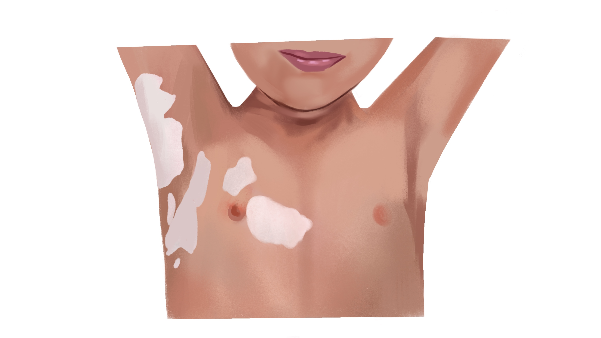
An 8-year-old male patient presented with white patches on the chest region, right side armpit and right side of the waist since 6 months. In spite of taking standard of care for 2 months, the condition persisted. His parents opted for Ayurvedic treatment for further management and approached Dr Partap Chauhan. Based on the clinical examination, the biomedical diagnosis was vitiligo and Ayurvedic diagnosis was made as shvitra. The line of treatment adopted was Vata-pitta shamana and Vata- kapha shamana. Rakta shodhana, krimighna and kushtaghna were also the targets of the treatment planned. After 1 month of treatment, significant improvement was noted. No formation of new patches and the re-pigmentation of white patches started. With 2 and a half months of treatment, white patches in the chest, armpit and waist region were completely resolved. The colour of the skin became normal due to re-pigmentation. This case report demonstrates the successful standalone ayurvedic management of vitiligo in a boy, who was not getting any relief with conventional medicines.
-
-
Timeline
-
Tabulated Summary
-
Narrative
TITLE OF CASE
Standalone successful Ayurvedic management of vitiligo- a case report
Dr Partap Chauhan
ABSTRACT
An 8-year-old male patient presented with white patches on the chest region, right side armpit and right side of the waist since 6 months. In spite of taking standard of care for 2 months, the condition persisted. His parents opted for Ayurvedic treatment for further management and approached Dr Partap Chauhan. Based on the clinical examination, the biomedical diagnosis was vitiligo and Ayurvedic diagnosis was made as shwitra. The line of treatment adopted was Vata-pitta shamana and Vata- kapha shamana. Rakta shodhana, krimighna and kushtaghna were also the targets of the treatment planned. After 1 month of treatment, significant improvement was noted. No formation of new patches and the re-pigmentation of white patches started. With 2 and a half months of treatment, white patches in the chest, armpit and waist region were completely resolved. The colour of the skin became normal due to re-pigmentation. This case report demonstrates the successful standalone ayurvedic management of vitiligo in a boy, who was not getting any relief with conventional medicines.
KEYWORDS
Vitiligo, Leucoderma, Shvitra, Ayurveda, Case report, Standalone
INTRODUCTION
Papilledema Vitiligo is a disease that causes loss of skin color in patches. This is also called as Leucoderma. The discolored areas usually get bigger with time. The condition can affect the skin on any part of the body. It can also affect hair and the inside of the mouth.
Normally, the color of hair and skin is determined by melanin. Vitiligo occurs when cells that produce melanin die or stop functioning. Vitiligo affects people of all skin types, but it may be more noticeable in people with brown or Black skin. The condition is not life-threatening or contagious. It can be stressful or make you feel bad about yourself.
Causes: Vitiligo occurs when pigment-producing cells (melanocytes) die or stop producing melanin — the pigment that gives your skin, hair and eyes color. The involved patches of skin become lighter or white. It's unclear exactly what causes these pigment cells to fail or die. It may be related to:
- A disorder of the immune system (autoimmune condition)
- Family history (heredity)
- A trigger event, such as stress, severe sunburn or skin trauma, such as contact with a chemical
Symptoms: These include
- Patchy loss of skin color, which usually first appears on the hands, face, and areas around body openings and the genitals
- Premature whitening or graying of the hair on your scalp, eyelashes, eyebrows or beard
- Loss of color in the tissues that line the inside of the mouth and nose (mucous membranes)
Vitiligo can start at any age, but usually appears before age 30.
Depending on the type of vitiligo it may affect:
- Nearly all skin surfaces. With this type, called universal vitiligo, the discoloration affects nearly all skin surfaces.
- Many parts of the body. With this most common type, called generalized vitiligo, the discolored patches often progress similarly on corresponding body parts (symmetrically).
- Only one side or part of the body. This type, called segmental vitiligo, tends to occur at a younger age, progress for a year or two, then stop.
- One or only a few areas of the body. This type is called localized (focal) vitiligo.
- The face and hands. With this type, called acrofacial vitiligo, the affected skin is on the face and hands, and around body openings, such as the eyes, nose and ears.
Diagnosis: A physical examination and clinical evaluation are the primary diagnostic tools. If required, the blood tests and skin biopsy may be recommended.
Treatment & prognosis: The choice of treatment depends on your age, how much skin is involved and where, how quickly the disease is progressing, and how it's affecting your life. Medications and light-based therapies are available to help restore skin color or even out skin tone, though results vary and are unpredictable. And some treatments have serious side effects. So the health care provider might suggest that you first try changing the appearance of your skin by applying a self-tanning product or makeup. If you and your health care provider decide to treat your condition with a drug, surgery or therapy, the process may take many months to judge its effectiveness. And you may have to try more than one approach or a combination of approaches before you find the treatment that works best for you. Medications that control the inflammation and affect the immune system are normally resorted to. Some therapies done are Light, Psoralen and Depigmentation. Surgical options available are Skin and Blister grafting, and Cellular Suspension Transplant.
It's difficult to predict how this disease will progress. Sometimes the patches stop forming without treatment. In most cases, pigment loss spreads and eventually involves most of the skin. Occasionally, the skin gets its color back. But in this patient, inspite of taking conventional medicines for 2 months, there was no improvement at all.
PATIENT INFORMATION
In this case report, In this case report, an 8-year-old male patient presented with white patches on the chest region, right side armpit and right side of the waist since 6 months. In spite of taking standard of care for 2 months, the condition persisted. His parents opted for Ayurvedic treatment for further management and approached Dr Partap Chauhan. Based on the clinical examination, the biomedical diagnosis was vitiligo and Ayurvedic diagnosis was made as shvitra.
No relevant genetic/surgical or psychosocial history.
Family History- Father and grandfather have vitiligo
No Addictions
CLINICAL FINDINGS
General examination done. Vitals are normal.
White patches- on chest region, right arm pit and on right side of waist
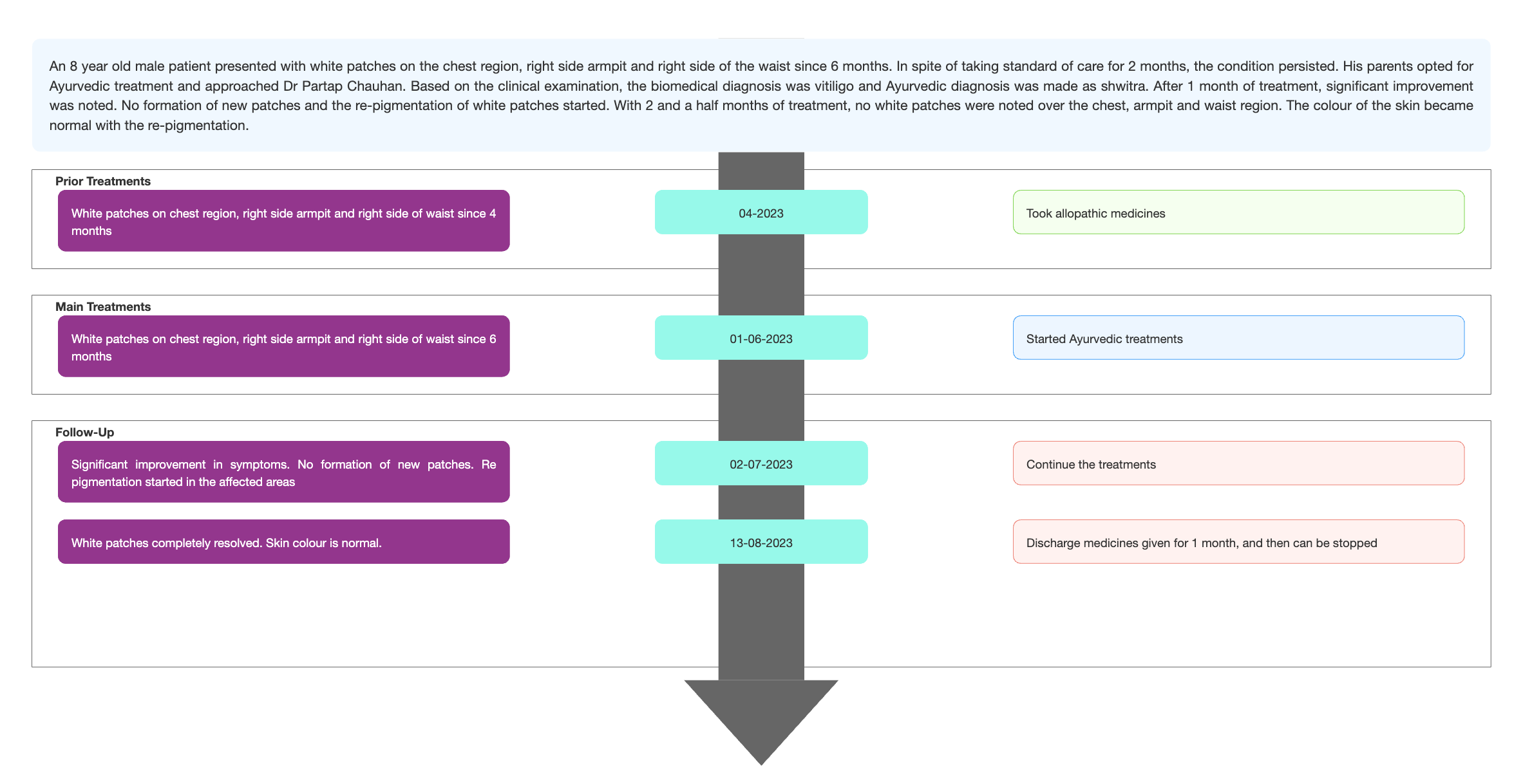
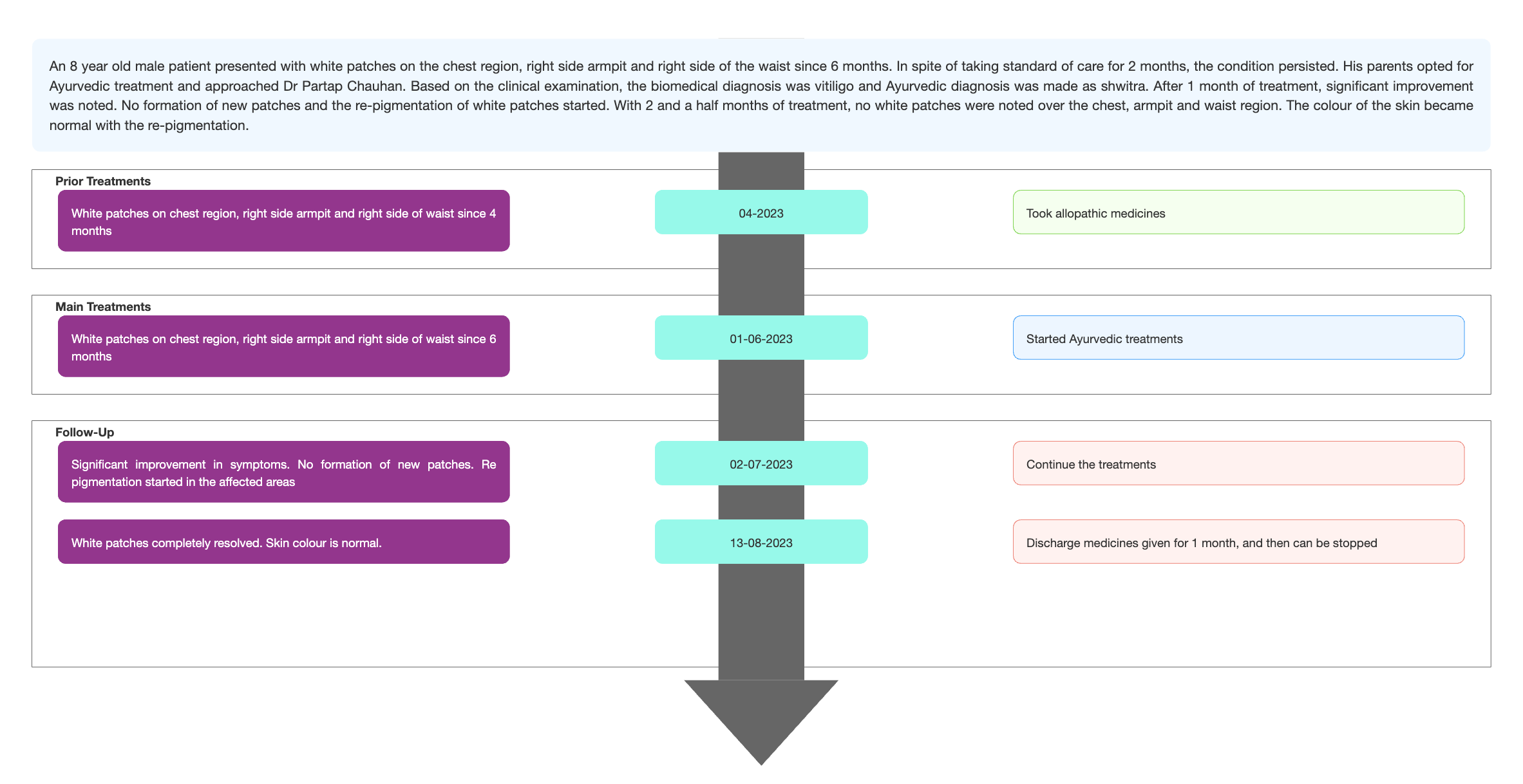
TIMELINE
Image 1. Timeline of events added below
DIAGNOSTIC ASSESSMENT
Modern Diagnostic parameter; Based on the clinical examination, the biomedical diagnosis was made as Vitiligo.
Image 2. Photographs of the lesion at baseline dated 1.6.2023

Ayurvedic Assessment was done based on the presenting complaints and clinical evaluation. The treating physician confirmed the Ayurvedic diagnosis as Shvitra.
Differential Diagnosis-
- Nevus depigmentosus
Idiopathic guttate hypomelanosis
Pityriasis alba
Progressive macular hypomelanosis.
Based on the clinical findings, the physician confirmed the biomedical diagnosis as vitiligo.
Prognosis- It is a chronic skin condition with an unpredictable disease course and some patients may notice spontaneous repigmentation over the depigmented areas. In this case, the patient underwent standard of care for 2 months which did not show any improvement in the condition. With Ayurveda treatment, the patient attained a significant result in 2 and half months.
THERAPEUTIC INTERVENTION
Refer the tab ‘Treatment’ in the Portal.
FOLLOW-UP AND OUTCOMES
The patient had 3 follow ups in total. Each follow up, the symptoms were assessed and documented.
Subjective parameters: After 1 month of treatment, significant improvement was noted. No formation of new patches and the re-pigmentation of white patches started. With 2 and a half months of treatment, no white patches were noted over the chest, armpit and waist region. The colour of the skin became normal with the re-pigmentation.
Objective parameters: Images were taken throughout the treatment to assess the outcome.
Image 2. Photographs taken throughout treatment of the lesions
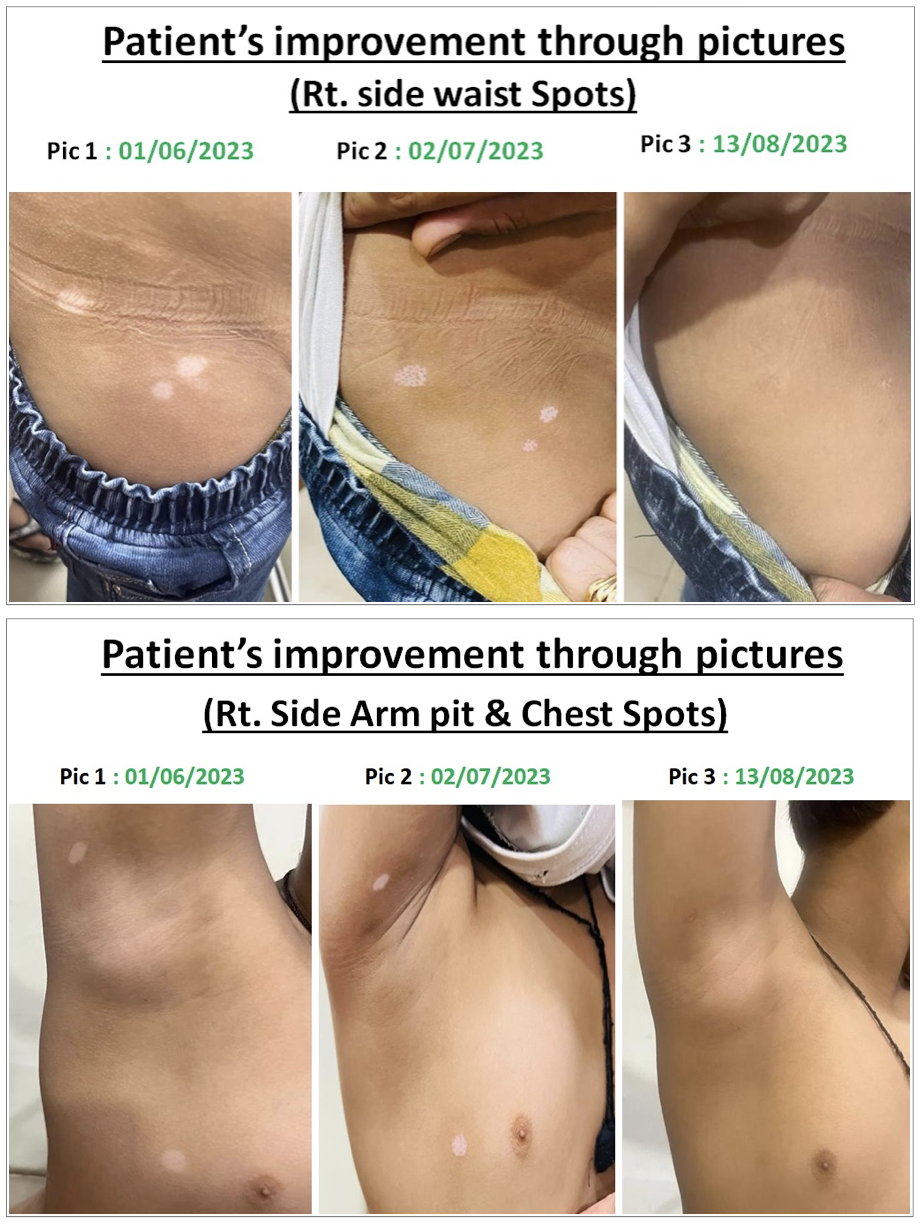
Clinician-based assessment; After 1 month of treatment, significant improvement was noted. No formation of new patches and the re-pigmentation of white patches started. With 2 and a half months of treatment, no white patches were noted over the chest, armpit and waist region. The colour of the skin became normal with the re-pigmentation.
Patient-assessed; Not relevant
Intervention adherence and tolerability – The patient adhered to the prescribed treatments and tolerated the treatments well.
Method of assessment- Subjective and objective parameters were the main assessment tools.
Adverse and unanticipated events; None reported
DISCUSSION:
Vitiligo is a chronic skin condition with an unpredictable disease course and some patients may notice spontaneous repigmentation over the depigmented areas. In this case, the patient underwent standard of care for 2 months which did not show any improvement in the condition. The ayurvedic diagnosis was Shvitra and the treatment was planned at Vata-pitta and Vata-kapha shamana. Rakta shodhana, krimighna and kushtaghna cikitsa were adopted. With Ayurveda treatment, the patient got complete relief in 2 and half months.
PATIENT’S PERSPECTIVE
Not available.
LEARNING POINTS/TAKE HOME MESSAGES
This case highlights the efficacy of Ayurveda in treating vitiligo in a patient who had undergone standard of care with no improvements. Ayurvedic approach can be utilised to manage Shvitra permanently in less duration.
INFORMED CONSENT
Written consent obtained from patient for publishing of the case report in the Portal
ACKNOWLEDGEMENTS
None
CONFLICT OF INTEREST
None declared.
FUNDING
None
REFERENCE
1. https://www.mayoclinic.org/diseases-conditions/vitiligo/diagnosis-treatment/drc-20355916
-
Immersive Learning
-
Modern Diagnosis
MODERN DIAGNOSIS: Vitiligo
ABOUT THE DISEASE:
Vitiligo is a disease that causes loss of skin color in patches. This is also called as Leucoderma. The discolored areas usually get bigger with time. The condition can affect the skin on any part of the body. It can also affect hair and the inside of the mouth.
Normally, the color of hair and skin is determined by melanin. Vitiligo occurs when cells that produce melanin die or stop functioning. Vitiligo affects people of all skin types, but it may be more noticeable in people with brown or Black skin. The condition is not life-threatening or contagious. It can be stressful or make you feel bad about yourself.
Causes: Vitiligo occurs when pigment-producing cells (melanocytes) die or stop producing melanin — the pigment that gives your skin, hair and eyes color. The involved patches of skin become lighter or white. It's unclear exactly what causes these pigment cells to fail or die. It may be related to:
- A disorder of the immune system (autoimmune condition)
- Family history (heredity)
- A trigger event, such as stress, severe sunburn or skin trauma, such as contact with a chemical
In this case report, an 8-year-old male patient presented with white patches on the chest region, right side armpit and right side of the waist since 6 months. In spite of taking standard of care for 2 months, the condition persisted. His parents opted for Ayurvedic treatment for further management and approached Dr Partap Chauhan. Based on the clinical examination, the biomedical diagnosis was vitiligo and Ayurvedic diagnosis was made as shvitra.
Symptoms: These include
- Patchy loss of skin color, which usually first appears on the hands, face, and areas around body openings and the genitals
- Premature whitening or graying of the hair on your scalp, eyelashes, eyebrows or beard
- Loss of color in the tissues that line the inside of the mouth and nose (mucous membranes)
Vitiligo can start at any age, but usually appears before age 30.
Depending on the type of vitiligo it may affect:
- Nearly all skin surfaces. With this type, called universal vitiligo, the discoloration affects nearly all skin surfaces.
- Many parts of the body. With this most common type, called generalized vitiligo, the discolored patches often progress similarly on corresponding body parts (symmetrically).
- Only one side or part of the body. This type, called segmental vitiligo, tends to occur at a younger age, progress for a year or two, then stop.
- One or only a few areas of the body. This type is called localized (focal) vitiligo.
- The face and hands. With this type, called acrofacial vitiligo, the affected skin is on the face and hands, and around body openings, such as the eyes, nose and ears.
Diagnosis: A physical examination and clinical evaluation are the primary diagnostic tools. If required, the blood tests and skin biopsy may be recommended.
Image 1. Photographs of the lesion at baseline dated 1.6.2023
Treatment & prognosis: The choice of treatment depends on your age, how much skin is involved and where, how quickly the disease is progressing, and how it's affecting your life. Medications and light-based therapies are available to help restore skin color or even out skin tone, though results vary and are unpredictable. And some treatments have serious side effects. So the health care provider might suggest that you first try changing the appearance of your skin by applying a self-tanning product or makeup. If you and your health care provider decide to treat your condition with a drug, surgery or therapy, the process may take many months to judge its effectiveness. And you may have to try more than one approach or a combination of approaches before you find the treatment that works best for you. Medications that control the inflammation and affect the immune system are normally resorted to. Some therapies done are Light, Psoralen and Depigmentation. Surgical options available are Skin and Blister grafting, and Cellular Suspension Transplant.
It's difficult to predict how this disease will progress. Sometimes the patches stop forming without treatment. In most cases, pigment loss spreads and eventually involves most of the skin. Occasionally, the skin gets its color back. But in this patient, inspite of taking conventional medicines for 2 months, there was no improvement at all.
Reference
-
Ayurveda Diagnosis
AYURVEDA DIAGNOSIS: Shvitra
ABOUT THE DISEASE:
Shvitra is correlated to Vitiligo in biomedicine bearing similarity in the presentation of symptoms. This is a common problem associated with an intense social stigma in the society.
According to Ayurveda, the skin is an essential sense organ. Basic energy principles like vata and one of the five heat-producing activities similar to metabolism (bhrajaka pitta) reside in the skin (called twak in sanskrit). As the skin covers the whole body bhrajaka pitta should be maintained in a proper state and it needs continuous care.
Shvitra and Kilasa are synonymous. But there are opinions that there are two subtypes. Sushruta explains that Kilasa is a variety that affects only the skin. Supporting his opinion, Madhava and Vagbhata view that Kilasa is nirdista as it remains at skin level (called the twakgata condition in Ayurveda). Caraka explains that Shvitra becomes firmly established when the dosha enters different levels of dhatu, indicated by a change in the colour of the lesions. When dosha enters dhatu, the disease shows a poor prognosis (asadhya). Bhoja identified more subcategories on the basis of nidana; originating from the dosha and from vrana. Sub-classifications in the doshaja variety are Daruna, Aruna, and Kilasa. Depending on the presentation of symptoms, shvitra can be classified as vata, pitta and kapha type.
In this case report, an 8-year-old male patient presented with white patches on the chest region, right side armpit and right side of the waist since 6 months. In spite of taking standard of care for 2 months, the condition persisted. His parents opted for Ayurvedic treatment for further management and approached Dr Partap Chauhan. Based on the clinical examination, the biomedical diagnosis was vitiligo and Ayurvedic diagnosis was made as shvitra.
Etiology
The causative factors for Kusta and Shvitra are the same and affect the same dhatu. Shvitra differs from other skin disorders by the normal functioning of all but the twak resulting in discolouration of the skin (twak vaivarnyata), without discharge (aparisravi). The dietary factors are also discussed in the causation of vitiligo. Seventeen ways of dietary intake are labelled as virudha diet. Excessive consumption of food that takes a longer time to digest (guru) and non-vegetarian and spicy foods are also associated with etiology.
Sadhyasadhyata
Good prognosis (sadhya) patients have lesions of recent onset (nava), are not thickened (thanu), and show pigmented hairs (ashukla roma). Patients who are likely to have poor prognosis exhibit lesions on the external genitalia, lips, and tips of fingers (Anthejatam), coalescing (samslista), and/or covering large areas of the body (bahala) or those that appears like burn wounds (agnidagdhaja).
Treatment: Classical textbooks of Ayurveda recommend four steps of treatment. The first step is shodhana karma using Psoralia corylifolia (bakuci kwatha) and Eurphorbia nerifolia (snuhi). This medicine is expected to induce multiple bouts of purgation. In the next step oil massage is advocated. The next step is the exposure of lesions to the sun rays as long as the patient can tolerate them (Soorya pada santhapam. The patient receives peya for the following three days. If bullae arise after a sun bath they must be punctured using a sterile needle. On these days, diet regulations should be strictly followed.
Ayurveda recommends several medicines alone or in combination, following the four steps of initial therapy mentioned earlier.
The rationale of treatment: The rationale of treatment as explained by the treating physician is tabulated below.
Table 1. The medicines prescribed and the rationale
Name of the medicine/ Procedure
Rationale
Panchanimbadi churna +
Bhringaraj churna +
Chopchinyadi churna +
Twakroghara churna
Vata pitta shamana, rakta shodhana
Ranjana, balances pitta production
Tridoshaghna, deepana, pachana, rakta shodhana
Pitta kapha shamana, rakta shodhana
Rakta shodhaka vati
Rakta shodhana, pitta kapha shamana
Virusol ras
Vata kaphaghna, krimighna, rakta shodhana
Ashta dashanga loha
Vata kapha shamana, deepana, pachana, ranjana
Sarivadyasava
Pitta shamana, rakta prasadana
Panchatikta ghrita
Vata pitta shamana, snehana, rakta shodhana
Bakuchi oil
Ranjana, kushtaghna, rasayana
Reference
- Narahari SR, Aggithaya MG, Suraj KR. A protocol for systematic reviews of Ayurveda treatments. Int J Ayurveda Res. 2010 Oct;1(4):254-67. doi: 10.4103/0974-7788.76791. PMID: 21455455; PMCID: PMC3059450.
-
Treatment
Name of Medicine Dosage Form Dosage Mode of Administrtation From - To (Date) Medicine Reference Panchanimbadi curna + Bhringaraj curna + Chopchinyadi curna + Twakroghara curna Curna 0.75gm of each curna mixed Oral- with warm water twice daily 2023-06-01 - 2023-09-13 Panchanimbadi curna- Bhaishajya ratnavali. Kushta rogadhikara.86-91; Bhringaraj curna - Bhavaprakasha nighantu. Guduchyadi Varga; Chopchinyadi curna - Yogaratnakara, Upadamsha Ciktisa; Twakroghara curna - Ayurvedic Patent and Proprietary Medicine Rakta shodhaka vati Tablet 1-0-1 Oral- with warm water twice daily 2023-06-01 - 2023-09-13 Ayurvedic Patent & Proprietary Medicine Virusol ras Tablet 1-0-1 Oral- with warm water twice daily 2023-06-01 - 2023-09-13 Ayurvedic Patent & Proprietary Medicine Ashta dashanga loha Tablet 1-0-1 Oral- with warm water twice daily 2023-06-01 - 2023-09-13 Ayurvedic Patent & Proprietary Medicine Sarivadyasava Asava 10 ml Twice daily after food 2023-06-01 - 2023-09-13 Bhaishajya Ratnavali. Prameha Pidaka Adhikara. 22-27 Panchatikta ghrita Ghrtam 1 tsp On empty stomach in the morning 2023-06-01 - 2023-09-13 Bhaishajya Ratnavali Kushta adhikara 114-117 Bakuci oil Taila Required Quantity External application on the affected site 2023-06-01 - 2023-09-13 Anubhuta Dravya Prayoga -
Outcome Measures
In this case report, an 8-year-old male patient presented with white patches on the chest region, right side armpit and right side of the waist since 6 months. In spite of taking standard of care for 2 months, the condition persisted. His parents opted for Ayurvedic treatment for further management and approached Dr Partap Chauhan. Based on the clinical examination, the biomedical diagnosis was vitiligo and Ayurvedic diagnosis was made as shvitra.
Assessment: Subjective and objective parameters were assessed to analyse the outcome of the treatment.
Subjective parameters: After 1 month of treatment, significant improvement was noted. No formation of new patches and the re-pigmentation of white patches started. With 2 and a half months of treatment, no white patches were noted over the chest, armpit and waist region. The colour of the skin became normal with the re-pigmentation.
Objective parameters: Photographs were taken and documented
Image 1.Photographs taken throughout treatment of the lesions
-