Featured Case
-
Abstract
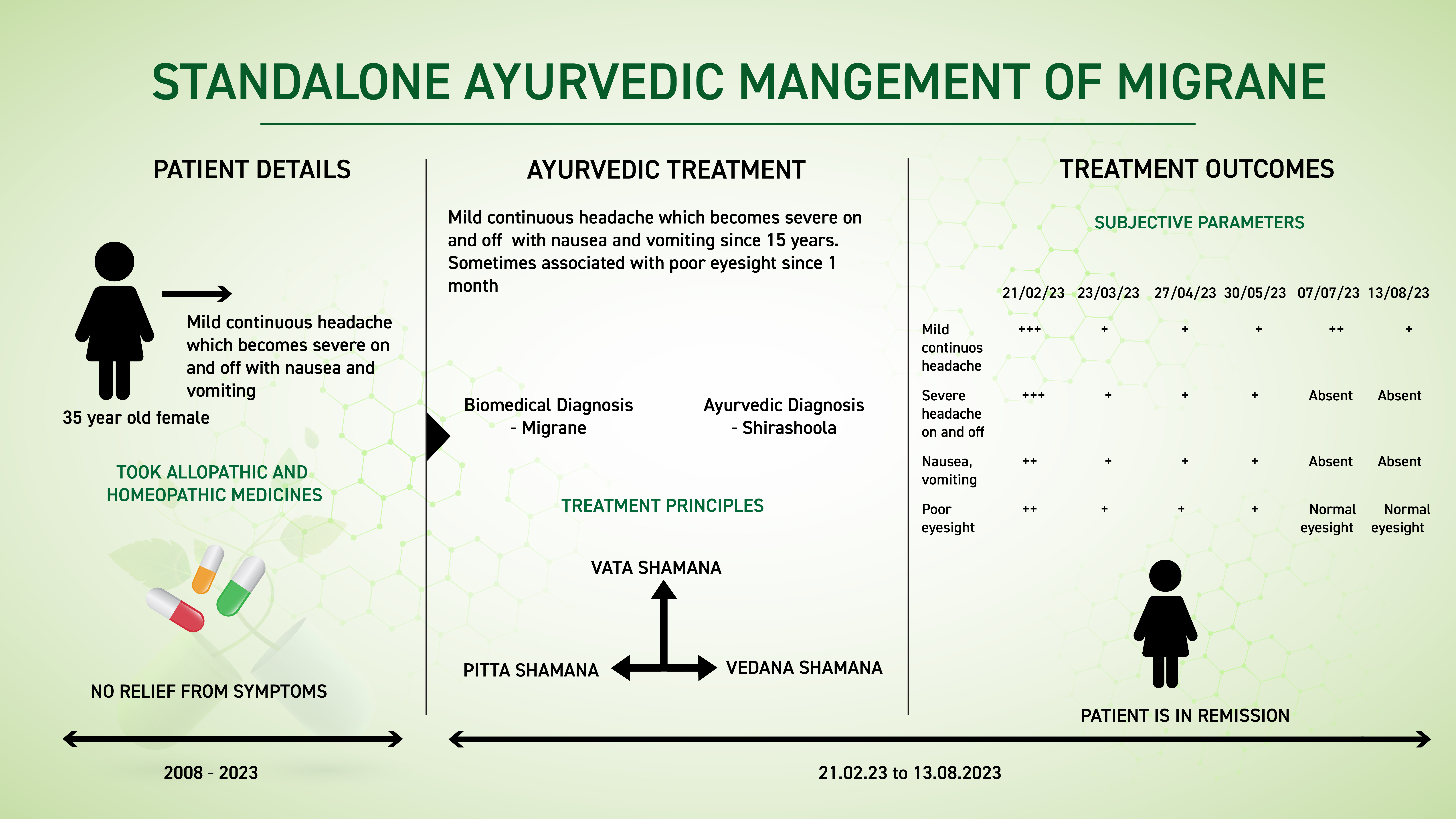
A 35-year-old female patient presented with mild continuous headaches which became severe on and off with nausea, vomiting and irritation for 15 years. Sometimes associated with poor eyesight since 1 month. In spite of taking other standard of care, the condition persisted and hence she opted for Ayurvedic treatments and approached Dr Partap Chauhan. Based on the clinical evaluation, the physician diagnosed the condition as migraine and Ayurvedic diagnosis as Shirashoola. The line of treatment followed was Vata, pitta and vedana shamaka. Medhya and rasayana cikitsa was also incorporated. In 1 month, there was a significant relief from mild continuous headache, severe on and off headache. The nausea and vomiting during headache, also reduced. With 5 months of treatment, the patient got complete relief from all the symptoms. This case report demonstrates the successful standalone ayurvedic management of a chronic case of migrane, that was not responsive to standard of care in allopathy and homeopathy.
-
Summaries
-
Listen
-
Watch
-
View
-
Read
A 35-year-old female patient presented with mild continuous headaches which became severe on and off with nausea, vomiting and irritation for 15 years. Sometimes associated with poor eyesight since 1 month. In spite of taking other standard of care, the condition persisted and hence she opted for Ayurvedic treatments and approached Dr Partap Chauhan. Based on the clinical evaluation, the physician diagnosed the condition as migraine and Ayurvedic diagnosis as Shirashoola. The line of treatment followed was Vata, pitta and vedana shamaka. Medhya and rasayana cikitsa was also incorporated. In 1 month, there was a significant relief from mild continuous headache, severe on and off headache. The nausea and vomiting during headache, also reduced. With 5 months of treatment, the patient got complete relief from all the symptoms. This case report demonstrates the successful standalone ayurvedic management of a chronic case of migrane, that was not responsive to standard of care in allopathy and homeopathy.
-
-
Timeline
-
Tabulated Summary
-
Narrative
TITLE OF CASE
Standalone successful Ayurvedic management of Migrane- A case report
Dr Partap Chauhan
ABSTRACT
A 35-year-old female patient presented with mild continuous headaches which became severe on and off with nausea, vomiting and irritation for 15 years. Sometimes associated with poor eyesight since 1 month. In spite of taking other standard of care, the condition persisted and hence she opted for Ayurvedic treatments and approached Dr Partap Chauhan. Based on the clinical evaluation, the physician diagnosed the condition as migraine and Ayurvedic diagnosis as Shirashoola. The line of treatment followed was Vata, pitta and vedana shamaka. Medhya and rasayana cikitsa was also incorporated. In 1 month, there was a significant relief from mild continuous headache, severe on and off headache. The nausea and vomiting during headache, also reduced. With 5 months of treatment, the patient got complete relief from all the symptoms. This case report demonstrates the successful standalone ayurvedic management of a chronic case of migrane, that was not responsive to standard of care in allopathy and homeopathy.
KEYWORDS
Migrane, Shirashoola, Ayurveda, Case report, Standalone
INTRODUCTION
The Migraine is a neurological condition that typically causes painful headache attacks that occur with additional symptoms, such as sensitivity to light, sound, smell, or touch.
Causes: There are many migraine triggers that are continually reported, including:
- bright lights
- severe heat, or other extremes in weather
- dehydration
- changes in barometric pressure
- hormone changes in people assigned female at birth, like estrogen and progesterone fluctuations during menstruation, pregnancy, or menopause
- excess stress
- loud sounds
- intense physical activity
- skipping meals
- changes in sleep patterns
- use of certain medications, like oral contraceptives or nitroglycerin
- unusual smells
- certain foods
- smoking
- alcohol use
- traveling
Signs & Symptoms: The common symptoms are as follows-
- nausea
- vomiting
- difficulty speaking
- numbness or tingling
- sensitivity to light and sound
The condition often runs in families and can affect all ages. People assigned female at birth are more likely than people assigned male at birth to be diagnosed with migraine.
People describe migraine pain as:
- pulsating
- throbbing
- perforating
- pounding
- debilitating
It can also feel like a severe, dull, steady ache. The pain may start out as mild. But without treatment, it can become moderate to severe. Migraine pain most commonly affects the forehead area. It’s usually on one side of the head, but it can occur on both sides or shift.
Diagnosis & Treatment: The diagnosis of migraine is determined based on clinical history, reported symptoms, and by ruling out other causes. The most common categories of migraine headaches (or attacks) are episodic versus chronic, and then those without aura and those with aura.The cause is identified, and then the apt treatment is given. Migraine can’t be cured, but your doctor can help you manage migraine attacks by treating the symptoms when they occur, which may lead to fewer attacks in general. Treatment can also help make migraine less severe.
PATIENT INFORMATION
A A 35-year-old female patient presented with mild continuous headaches which became severe on and off with nausea, vomiting and irritation for 15 years. Sometimes associated with poor eyesight since 1 month. In spite of taking other standard of care, the condition persisted and hence she opted for Ayurvedic treatments and approached Dr Partap Chauhan. Based on the clinical evaluation, the physician diagnosed the condition as migraine and Ayurvedic diagnosis as Shirashoola.
Family History- her mother also had migrane
Surgical history- Underwent 2 LSCS
Psychosocial history- Stressed since 6 months, Sleep - disturbed. In general, irritation is present
CLINICAL FINDINGS
General examination was done. Vitals are normal.
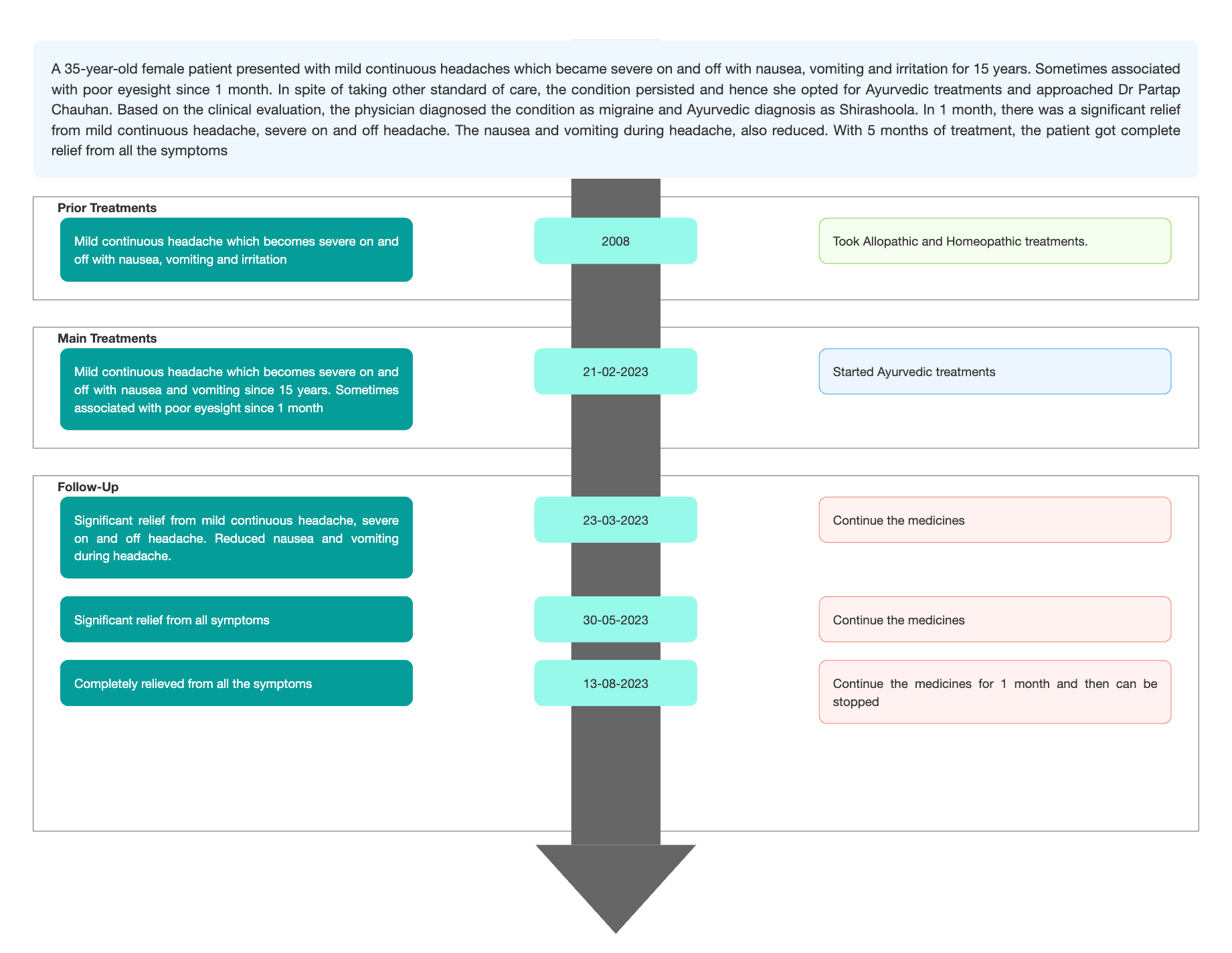
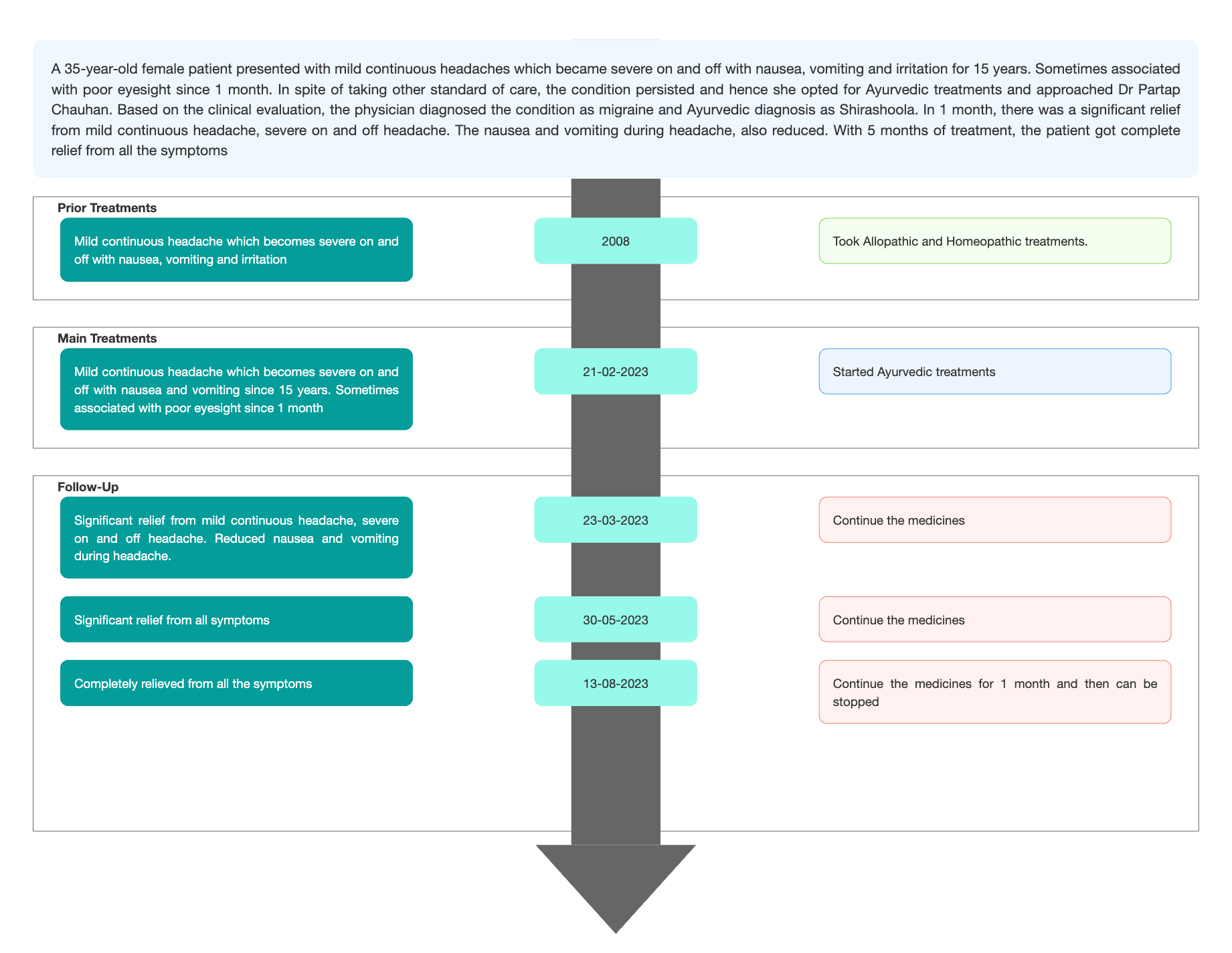
TIMELINE
Image 1. Timeline of events added below
DIAGNOSTIC ASSESSMENT
Modern Diagnostic parameter; The biomedical diagnosis was confirmed by the Ayurvedic physician based on the clinical evaluation. The patient has been trying allopathic and homeopathic medicines past 15 years.
Table 1. Symptoms tabulated at baseline
Symptoms
21/02/23
Mild continuous headache
+++
Severe headache on and off
+++
Nausea, vomiting
++
Poor eyesight
++
Ayurvedic Assessment was done based on the presenting complaints and clinical evaluation. The treating physician confirmed the Ayurvedic diagnosis as Shirashoola.
Differential Diagnosis-
Tension-type headache
Cluster headache
Encephalitis
Subarachnoid/intracranial haemorrhage
Meningitis
Based on the clinical examination and previous treatment history, the treating physician clinically diagnosed the condition as migraine.
Prognosis- A migraine is a chronic condition that can revert to episodic migraine in 26 to 70% of patients. Prolonged remissions are common; In this case report, the condition is chronic and in spite of taking alternative standard of care the patient has been suffering from persisting symptoms since 15 years. With 5 months of Ayurvedic treatment, the patient got significant relief from her chronic condition and its associated symptoms.
THERAPEUTIC INTERVENTION
Refer the tab ‘Treatment’ in the Portal.
FOLLOW-UP AND OUTCOMES
The patient had 5 follow ups in total over a time period of 5 months. The last follow up done was in August 2023.
Clinician-based assessment; With 5 months of treatment, the patient has shown significant improvement in mild continuous headaches. The patient got complete relief from the severe on-and-off headaches, nausea and vomiting. No further episodes of poor eyesight due to headache.
Table 2. Symptoms tabulated from baseline throughout the treatment date wise
Symptoms
21/02/23
23/03/23
27/04/23
30/05/23
07/07/23
13/08/23
Mild continuous headache
+++
+
+
+
++
+
Severe headache on and off
+++
+
+
+
Absent
Absent
Nausea, vomiting
++
+
+
+
Absent
Absent
Poor eyesight
++
+
+
+
Normal eyesight
Normal eyesight
Patient- based assessment: Not relevant
Intervention adherence and tolerability – The patient adhered to the prescribed treatments and tolerated the treatments well.
Method of assessment- Subjective parameters were the main assessment tools.
Adverse and unanticipated events; None reported
DISCUSSION:
In this case report, the patient has been suffering from the condition since 15 years. She was not getting relief inspite of taking allopathic and homeopathic medicines. When she consulted Ayurvedic physician, he made the diagnosis as Shirashoola, and the line of treatment targeted at Vata shamana, Pitta shamana and Vedana shamana. Apart from this, medhya and rasayana chikitsa were also incorporated to address the condition.
PATIENT’S PERSPECTIVE
Not available.
LEARNING POINTS/TAKE HOME MESSAGES
This case highlights the efficacy of ayurveda in successfully treating a chronic case of migraine with a 15 year history, in just 5 months.
INFORMED CONSENT
Written consent obtained from patient for publishing of the case report in the Portal
ACKNOWLEDGEMENTS
None
CONFLICT OF INTEREST
None declared.
FUNDING
None
REFERENCE
Reference
-
Immersive Learning
-
Modern Diagnosis
MODERN DIAGNOSIS: Migrane
ABOUT THE DISEASE:
Migraine is a neurological condition that typically causes painful headache attacks that occur with additional symptoms, such as sensitivity to light, sound, smell, or touch.
Causes: There are many migraine triggers that are continually reported, including:
- bright lights
- severe heat, or other extremes in weather
- dehydration
- changes in barometric pressure
- hormone changes in people assigned female at birth, like estrogen and progesterone fluctuations during menstruation, pregnancy, or menopause
- excess stress
- loud sounds
- intense physical activity
- skipping meals
- changes in sleep patterns
- use of certain medications, like oral contraceptives or nitroglycerin
- unusual smells
- certain foods
- smoking
- alcohol use
- traveling
Signs & Symptoms: The common symptoms are as follows-
- nausea
- vomiting
- difficulty speaking
- numbness or tingling
- sensitivity to light and sound
The condition often runs in families and can affect all ages. People assigned female at birth are more likely than people assigned male at birth to be diagnosed with migraine.
People describe migraine pain as:
- pulsating
- throbbing
- perforating
- pounding
- debilitating
It can also feel like a severe, dull, steady ache. The pain may start out as mild. But without treatment, it can become moderate to severe. Migraine pain most commonly affects the forehead area. It’s usually on one side of the head, but it can occur on both sides or shift.
In this case report, a 35-year-old female patient presented with mild continuous headaches which became severe on and off with nausea, vomiting and irritation for 15 years. Sometimes associated with poor eyesight since 1 month. In spite of taking other standard of care, the condition persisted and hence she opted for Ayurvedic treatments and approached Dr Partap Chauhan. Based on the clinical evaluation, the physician diagnosed the condition as migraine and Ayurvedic diagnosis as Shirashoola.
Table 1. Symptoms tabulated at baseline
Symptoms
21/02/23
Mild continuous headache
+++
Severe headache on and off
+++
Nausea, vomiting
++
Poor eyesight
++
Diagnosis & Treatment: The diagnosis of migraine is determined based on clinical history, reported symptoms, and by ruling out other causes. The most common categories of migraine headaches (or attacks) are episodic versus chronic, and then those without aura and those with aura.The cause is identified, and then the apt treatment is given. Migraine can’t be cured, but your doctor can help you manage migraine attacks by treating the symptoms when they occur, which may lead to fewer attacks in general. Treatment can also help make migraine less severe.
Treatments generally resorted to in Migranes are as follows:
Your treatment plan may include a combination of:
- lifestyle adjustments, including stress management and avoiding migraine triggers
- OTC pain or migraine medications, like Nonsteroidal anti-inflammatory drugs (NSAIDs) or acetaminophen (Tylenol)
- prescription migraine medications that you take every day to help prevent migraine headaches and reduce how often you have headaches
- prescription migraine medications that you take as soon as an attack starts to keep it from becoming severe and to ease symptoms
- prescription medications to help with nausea or vomiting
- hormone therapy if migraines seem to occur in relation to your menstrual cycle
- counseling
- alternative care, which may include meditation, acupressure, or acupuncture
Prognosis: Most migraine attacks last about 4 hours. If they’re not treated or don’t respond to treatment, they can last for as long as 72 hours to a week. In migraine with aura, pain may overlap with an aura or may never occur at all.
Reference
-
Ayurveda Diagnosis
AYURVEDA DIAGNOSIS: Shirashoola
ABOUT THE DISEASE:
In this case report, a 35-year-old female patient presented with mild continuous headaches which became severe on and off with nausea, vomiting and irritation for 15 years. Sometimes associated with poor eyesight since 1 month. In spite of taking other standard of care, the condition persisted and hence she opted for Ayurvedic treatments and approached Dr Partap Chauhan. Based on the clinical evaluation, the physician diagnosed the condition as migraine and Ayurvedic diagnosis as Shirashoola.
The word ‘Shira’ stands for head and ‘shoola’ means pain. This is also called as Shiroruk, Shiropida or Shirovedana. Headache, also known as shirashoola in Ayurveda, is a type of shiroroga (diseases of the head). It may occur as a symptom of some underlying disease or as a problem in itself. Shirashoola is classified into eight types based upon the cause and the dosha involved.
Causes:
Ahara- Excessive eating, preferring ruksha ahara, liquids - alcohol in excess, food which aggravates dosha altogether and individually are causative factors.
Vihara- Exposure to smoke, frost, breeze, dew, vishamashana, adyashana, ratri jagarana, diva swapna, atapa dhuma sevan, asatmya gandha sevana, exposure to bright and high intensity light, light stimuli, placing pillows in wrong height, aversion to abyanga, indulging in water sport, chinta, krodha, shoka, lamenting, weeping, bhaya, Vega dharana of mutra, mala, kshavatu and nidra, weight lifting, talking too much and too loudly.
Environmental factors
Ayogya upchara - genetic, hereditary, or other diseases
Abhighataja
Types of Shirashoola and their lakshanas:
Ayurveda classifies a headache into the following types:
Vataja: This type of headache occurs due to an imbalance in the vata dosha. It usually causes loss of balance while walking.
Pittaja: It originates in pitta dosha and leads to a burning sensation along with headache.
Kaphaja: It is caused due to kapha and occurs with cold and cough.
Sannipatika: The vitiation of tridoshas causes a sannipatika headache, and it could show symptoms from any or all of the types of headaches mentioned above.
Ananta vata: In this type of headache, pain is felt all over the head with accompanying nausea and giddiness.
Ardhavabhedaka: It involves pain in half of the head.
Samkhaka: In this type of headache, pain is confined to the left and right sides of the head, which swells and become red.
Suryavarta: This type of headache follows the path of the sun – it starts in the morning, increases till midday, and decreases as the sun goes down.
But in this case report, the treating physician has not specified the type of headache.
Treatment & rationale of treatment as specified by the treating physician:
In general the treatments given for Shirashoola are as follows:
Basti karma
Nasya karma
Lepa
Virechana (purgation) karma
Seka
Snehana
Shirodhara
The treating physician explains that the line of treatment he has adopted is Vata shamana, Pitta shamana and Vedana shamana. Medhya and Rasayana chikitsa is also incorporated in the treatment.
Sadhyasadhyata: The cause of the shirashoola plays an important role in determining the sadhyasadhyata. If the cause can be addressed, then there is curability. But if the cause persists, then the condition is not curable.
Reference:
- Caraka Samhita. Su. 17
- Sushruta Samhita. Utt.25
-
Treatment
Name of Medicine Dosage Form Dosage Mode of Administrtation From - To (Date) Medicine Reference Brahmi curna+ Jatamansi curna+ Shiva Rasayana + Shatavaryadi curna+ Go amrit bhasma Samyoga 1 gm each of the curna and 200 gms of bhasma Oral, Mix all together and take 1 tsp with lukewarm water twice daily after lunch and dinner 2023-02-21 - 2023-09-14 Brahmi curna- CS.Su. 4.9: Jatamansi Curna- CS.Ci.26.234. The rest are patent ayurvedic medicines Amlapittantaka rasayana Curna 1 tsp Oral, before food twice daily 2023-02-21 - 2023-03-22 Ayurvedic Patent & Proprietary Medicine Migraine vati Tablet 1-0-1 Oral, twice daily after food 2023-02-21 - 2023-09-14 Ayurvedic Patent & Proprietary Medicine Brahmi 60 tablet Tablet 1 tsp Oral, before food twice daily 2023-02-21 - 2023-04-24 Ayurvedic Patent & Proprietary Medicine Shankhpushpi tablet Tablet 1-0-1 Oral, twice daily before food 2023-02-21 - 2023-03-22 Ayurvedic Patent & Proprietary Medicine Sutasekhara ras Tablet 1-0-1 Oral, twice daily after food 2023-02-21 - 2023-06-30 Ayurvedic Patent & Proprietary Medicine Pragya vati Tablet 1-0-1 Oral, twice daily after food 2023-03-23 - 2023-06-30 Ayurvedic Patent & Proprietary Medicine Rasnadi guggulu Tablet 1-0-1 Oral, twice daily before food 2023-03-23 - 2023-06-30 Bruhat nighantu ratnakara. Vata vyadhi Arogyadayini vati Tablet 1-0-1 Oral, twice daily before food 2023-07-07 - 2023-09-14 Ayurvedic Patent & Proprietary Medicine Punroday vati Tablet 1-0-1 Oral, twice daily after food 2023-07-07 - 2023-09-14 Ayurvedic Patent & Proprietary Medicine Shirashoola vajradi ras Tablet 1-0-1 Oral, twice daily after food 2023-07-07 - 2023-09-14 Bhaishajya ratnavali. Shirorogadhikara.140 - 144 Saraswatharista Arishta 15 ml Oral, twice daily after food 2023-02-21 - 2023-09-14 Bhaishajya ratnavali, Rasayana.178-191 Ashokarishta Arishta 15 ml Oral, twice daily after food 2023-03-23 - 2023-04-26 Bhaishajya ratnavali. Streeroga adhikara 114-116 Punarnavadi kwatha Kashayam 15 ml Oral, before food twice daily 2023-04-27 - 2023-05-28 Bhaishajya ratnavali. Udararoga 43-44 Maharasnadi kwatha Kashayam 15 ml Oral, before food twice daily 2023-05-30 - 2023-09-14 Sharangdhara samhita. Madhyamakhanda 2. 89 - 95 Nari sakhi cap Capsule 1-0-1 Oral, twice daily after food 2023-05-30 - 2023-06-30 Ayurvedic Patent & Proprietary Medicine Prawala panchamritha rasa Tablet 1-0-0 Oral, on an empty stomach in the morning. 2023-02-21 - 2023-09-14 Bhaishajya ratnavali. Gulma rogadhikara. 139 - 143 Anutaila Taila 2 drops Nasya 2023-02-21 - 2023-06-30 AH.Su. 20.37- 38 -
Outcome Measures
In this case report, a 35-year-old female patient presented with mild continuous headaches which became severe on and off with nausea, vomiting and irritation for 15 years. Sometimes associated with poor eyesight since 1 month. In spite of taking other standard of care, the condition persisted and hence she opted for Ayurvedic treatments and approached Dr Partap Chauhan. Based on the clinical evaluation, the physician diagnosed the condition as migraine and Ayurvedic diagnosis as Shirashoola.
Assessment: Only subjective parameters were assessed to analyse the outcome of the ayurvedic treatment.
Subjective parameters: The symptoms are tabulated date wise, to assess the outcome of the treatment.
Table 1. Date-wise documentation of symptoms
Symptoms
21/02/23
23/03/23
27/04/23
30/05/23
07/07/23
13/08/23
Mild continuous headache
+++
+
+
+
++
+
Severe headache on and off
+++
+
+
+
Absent
Absent
Nausea, vomiting
++
+
+
+
Absent
Absent
Poor eyesight
++
+
+
+
Normal eyesight
Normal eyesight
-