Featured Case
-
Abstract
A 30-year-old female patient presented with recurrent episodes of regurgitation and abdominal pain for 2 years. The pain is unbearable and associated with vomiting for 1 year for which she took analgesics and would get temporary relief. The USG done revealed a gall bladder calculi of size 24 mm. Based on the USG report, the biomedical diagnosis was made as Cholelithiasis. She opted for Ayurvedic management and approached Dr Jyoti Joshi. The ayurvedic diagnosis was made as Pittashmari. The line of treatment followed was Virecana to induce pitta shamana and to dissolve the ashmari. With 3 weeks of Ayurvedic treatments, the patient could get significant relief from the abdominal pain and regurgitation. With 4 months of treatment, the patient was relieved from all the symptoms and the repeat USG revealed normal gall bladder with no calculi. This case report demonstrates the successful standalone ayurvedic management of a chronic case of Cholelithiasis in a patient who was not getting relief from symptoms despite taking conventional medicines.
-
Summaries
-
Listen
-
Watch
-
View
-
Read
A 30-year-old female patient presented with recurrent episodes of regurgitation and abdominal pain for 2 years. The pain is unbearable and associated with vomiting for 1 year for which she took analgesics and would get temporary relief. The USG done revealed a gall bladder calculi of size 24 mm. Based on the USG report, the biomedical diagnosis was made as Cholelithiasis. She opted for Ayurvedic management and approached Dr Jyoti Joshi. The ayurvedic diagnosis was made as Pittashmari. The line of treatment followed was Virecana to induce pitta shamana and to dissolve the ashmari. With 3 weeks of Ayurvedic treatments, the patient could get significant relief from the abdominal pain and regurgitation. With 4 months of treatment, the patient was relieved from all the symptoms and the repeat USG revealed normal gall bladder with no calculi. This case report demonstrates the successful standalone ayurvedic management of a chronic case of Cholelithiasis in a patient who was not getting relief from symptoms despite taking conventional medicines.
-
-
Timeline
-
Tabulated Summary
-
Narrative
TITLE OF CASE
Standalone Ayurvedic management of cholelithiasis- a case report
Dr Jyoti Joshi
ABSTRACT
A 30-year-old female patient presented with recurrent episodes of regurgitation and abdominal pain for 2 years. The pain is unbearable and associated with vomiting for 1 year for which she took analgesics and would get temporary relief. The USG done revealed a gall bladder calculi of size 24 mm. Based on the USG report, the biomedical diagnosis was made as Cholelithiasis. She opted for Ayurvedic management and approached Dr Jyoti Joshi. The ayurvedic diagnosis was made as Pittashmari. The line of treatment followed was Virecana to induce pitta shamana and to dissolve the ashmari. With 3 weeks of Ayurvedic treatments, the patient could get significant relief from the abdominal pain and regurgitation. With 4 months of treatment, the patient was relieved from all the symptoms and the repeat USG revealed normal gall bladder with no calculi. This case report demonstrates the successful standalone ayurvedic management of a chronic case of Cholelithiasis in a patient who was not getting relief from symptoms despite taking conventional medicines.
KEYWORDS
Cholelithiasis, Pittashmari, Ayurveda, Case report, Standalone
INTRODUCTION
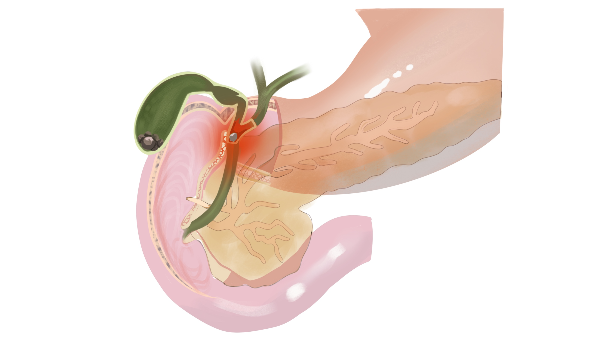
Gallstones are hardened deposits of digestive fluid that can form in your gallbladder. Your gallbladder is a small, pear-shaped organ on the right side of your abdomen, just beneath your liver. The gallbladder holds a digestive fluid called bile that's released into your small intestine. Gallstones are hardened deposits of bile that can form in the gallbladder. Bile is a digestive fluid produced in the liver and stored in gallbladder. When we eat, the gallbladder contracts and empties bile into the small intestine (duodenum). Gallstones range in size from as small as a grain of sand to as large as a golf ball. Some people develop just one gallstone, while others develop many gallstones at the same time.
Symptoms- Gallstones may cause no signs or symptoms. If a gallstone lodges in a duct and causes a blockage, the resulting signs and symptoms may include:
Sudden and rapidly intensifying pain in the upper right portion of your abdomen
Sudden and rapidly intensifying pain in the centre of your abdomen, just below your breastbone
Back pain between your shoulder blades
Pain in your right shoulder
Nausea or vomiting
Gallstone pain may last several minutes to a few hours.
Causes: An exact cause is not being defined. But, some factors identified are when the bile contains too much cholesterol or bilirubin, or when the bladder does not empty the contents correctly.
Types of gallstones: There are different type of gall stones depending on the depending on the appearance and the composition.
Cholesterol gallstones. The most common type of gallstone, called a cholesterol gallstone, often appears yellow in colour. These gallstones are composed mainly of undissolved cholesterol, but may contain other components.
Pigment gallstones. These dark brown or black stones form when your bile contains too much bilirubin.
Complications: Complications may include
- Inflammation of the gallbladder.
- Blockage of the common bile duct.
- Blockage of the pancreatic duct.
- Gallbladder cancer.
Diagnostic criteria- Medical history taking and clinical evaluation are the basic diagnostic criteria, followed. Apart from this the general technique followed are Abdominal and Endoscopic Ultrasound, Imaging like HIDA, CT, MRCP, ERCP, are used two understand the intensity of the problem. Blood tests are done to identify or rule out any infections.
Prognosis & Treatment available: Most people with gallstones that don't cause symptoms will never need treatment. Your doctor will determine if treatment for gallstones is indicated based on your symptoms and the results of diagnostic testing. The doctor may recommend that you be alert for symptoms of gallstone complications, such as intensifying pain in your upper right abdomen. If gallstone signs and symptoms occur in the future, you can have treatment.
Treatment options for gallstones include:
- Surgery to remove the gallbladder (cholecystectomy).
- Medications to dissolve gallstones.
- Laparoscopic cholecystectomy
PATIENT INFORMATION
In this case report, a 30-year-old female patient presented with recurrent episodes of regurgitation and abdominal pain for 2 years. The pain is unbearable and associated with vomiting for 1 year for which she took analgesics and would get temporary relief. The USG done revealed a gall bladder calculi of size 24 mm. Based on the USG report, the biomedical diagnosis was made as Cholelithiasis. She opted for Ayurvedic management and approached Dr Jyoti Joshi.
No relevant family/surgical/psychosocial/genetic history.
Addictions- Nil
CLINICAL FINDINGS
Per abdominal examination and general examination were done.
Vitals- Normal
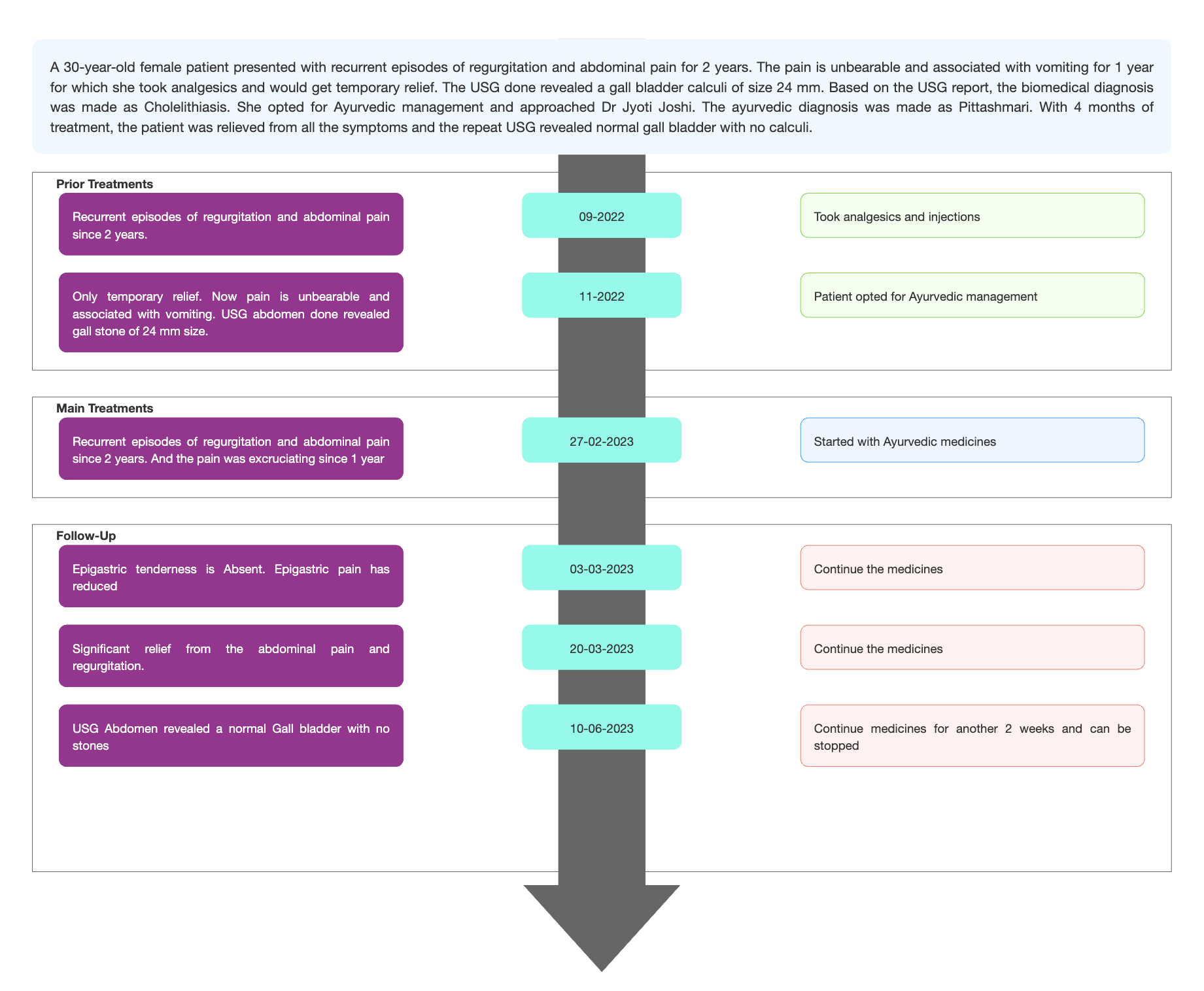
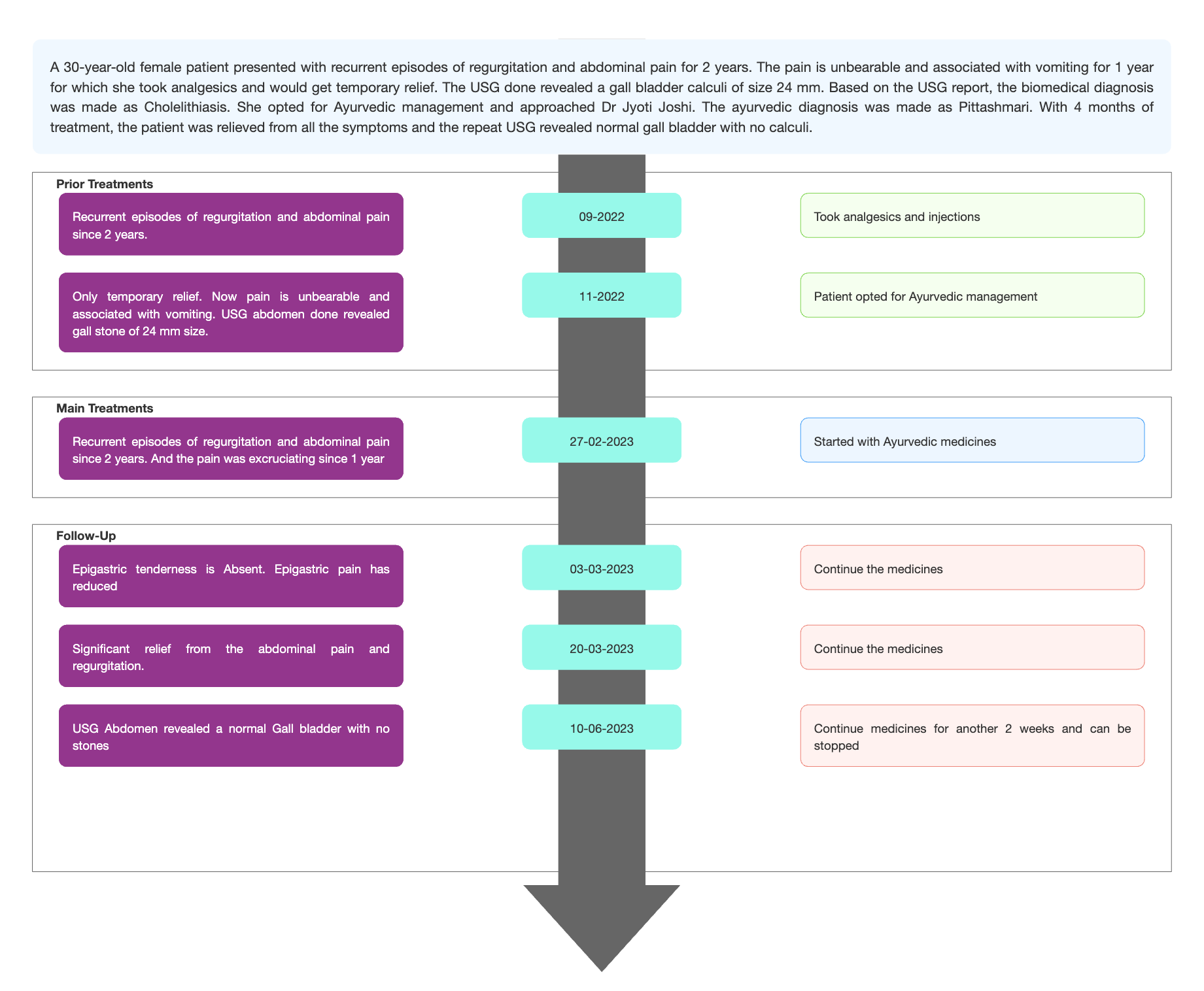
Tenderness - +++ in epigastric region and around the navel regionTIMELINE
Image 1. Timeline of events added below
DIAGNOSTIC ASSESSMENT
Modern Diagnostic parameter; The condition was pre diagnosed as Cholelithiasis based on the presenting complaints and the USG report.
Image 2. USG done at Baseline dated 2.11.2022
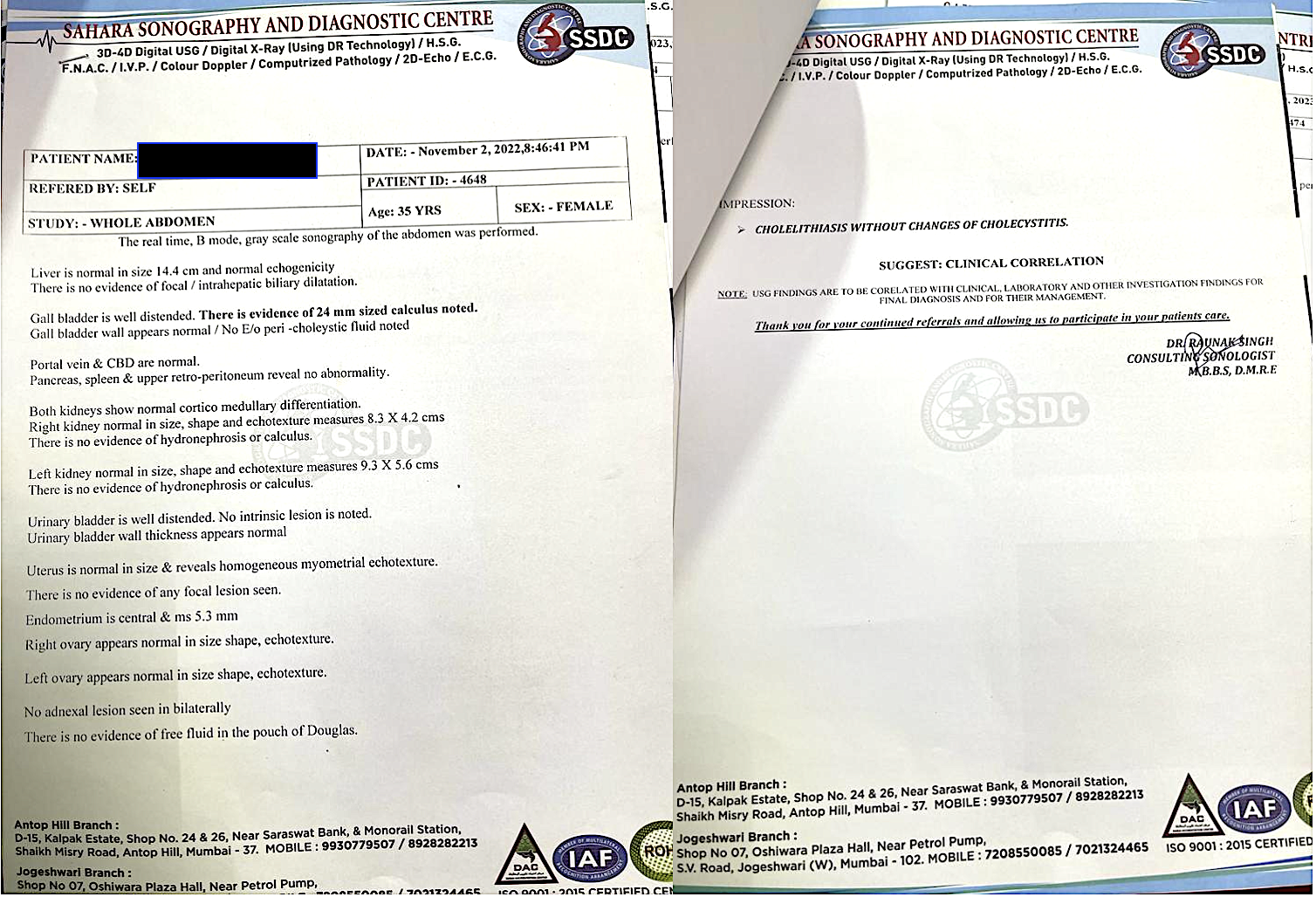
Ayurvedic Assessment was done based on the presenting complaints, and the clinical evaluation.
Differential Diagnosis-
Acute Pancreatitis
Appendicitis
Bile Duct Strictures
Peptic Ulcer Disease
Gallbladder Cancer
Irritable bowel syndrome
Based on the USG report and clinical evaluation, the the diagnosis was confirmed as Cholelithiasis.Prognosis & Treatment available: Treatment of gallstones usually depends on the size and type of stone and symptoms of the patient. However, it may take months or years of medication to completely dissolve the stone. This option is not generally recommended and is only suggested to people who cannot undergo surgery for some reason. In this patient, initially symptomatic management was done with analgesics and injections, but the pain was becoming unbearable and associated with vomiting. So she opted for Ayurvedic management. With 4 months of treatment, the patient was relieved from all the symptoms and the repeat USG study revealed a normal gall bladder with no calculi.
THERAPEUTIC INTERVENTION
Please refer the tab ‘Treatment’ in the Portal.
FOLLOW-UP AND OUTCOMES
Both objective and subjective parameters were assessed to analyse the outcome of the ayurvedic treatment.
Subjective parameters: With 3 weeks of Ayurvedic treatments, the patient could get significant relief from the abdominal pain and regurgitation. After 4 months of treatment, the patient was relieved from all the symptoms and the repeated USG study revealed a normal gall bladder with no calculi.
Objective parameters: Repeat USG was done at endpoint, detected no cholelithiasis.
Clinician-based assessment; Symptoms during the treatment were assessed to analyse the outcome of the treatment.
Table 1. Date-wise documentation of symptoms
DATE
SYMPTOMS
3.3.23
Epigastric pain reduced.
20.3.23
Significant relief from the abdominal pain and regurgitation.
10.6.23
Patient completely relieved from all symptoms
Patient-assessed; Not relevant
Endpoint Evaluation:
Image 3. USG at endpoint dated 10.6.2023
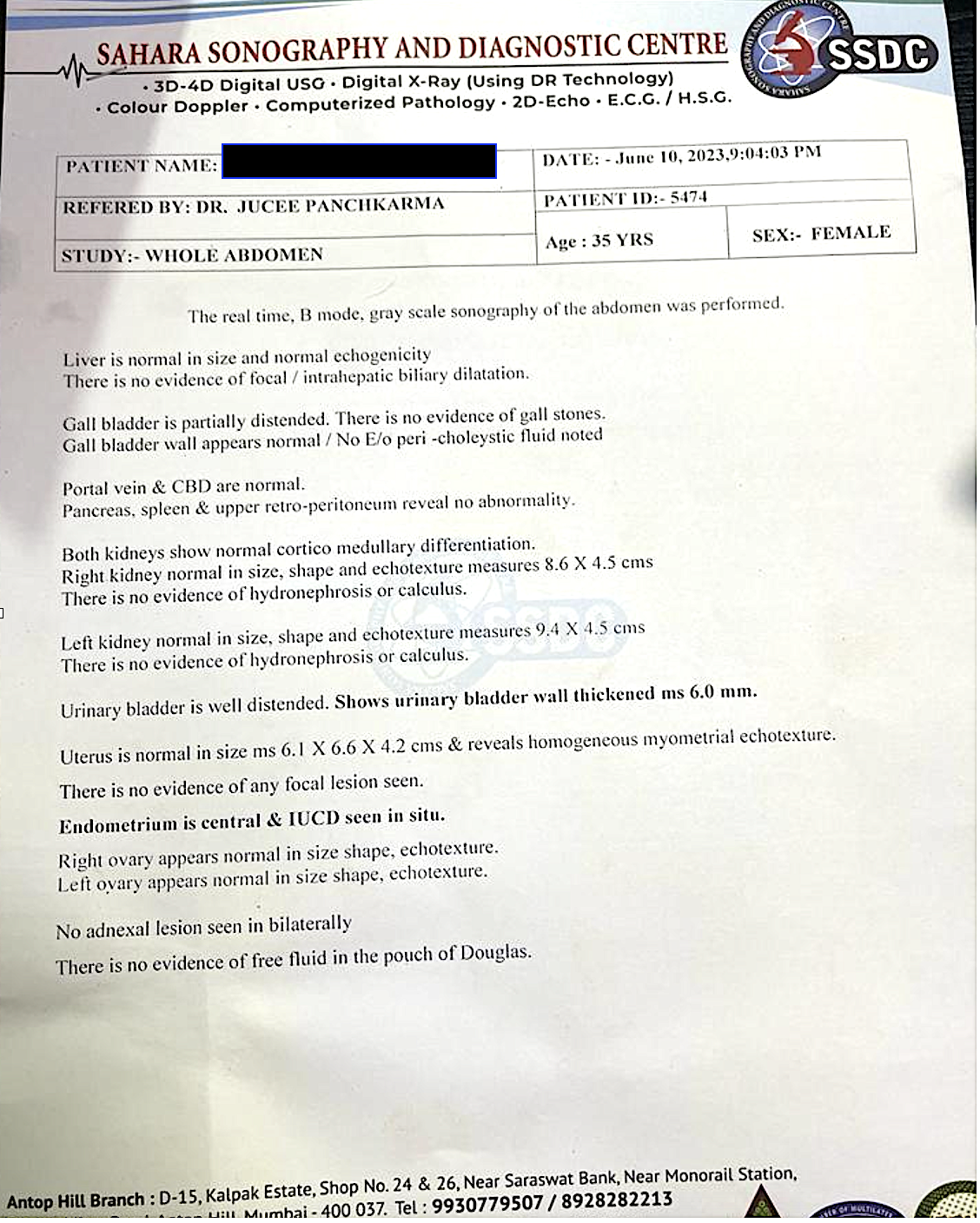
Intervention adherence and tolerability – The patient adhered to the prescribed treatments and tolerated the treatments well.
Method of assessment- By monitoring the patient.
Adverse and unanticipated events; None reported
DISCUSSION:
Management of gallstones depends on the symptoms and the age of the patient. This patient had tried analgesics for 2 years, when the symptoms persisted and got temporary relief. But since 1 year, the pain is unbearable and associated with vomiting. The ayurvedic diagnosis was Pittashmari and the main treatment given was Virecana to pacify the vitiated pitta, and also to dissolve the ashmari.
PATIENT’S PERSPECTIVE
Not available.
LEARNING POINTS/TAKE HOME MESSAGES
This case report showcases the effectiveness of Ayurveda in treating chronic cholelithiasis, underscores its potential in achieving remarkable results within a short timeframe, emphasising the value of Ayurveda in successfully managing such conditions.
INFORMED CONSENT
Written consent obtained from patient for publishing of the case report in the Portal
ACKNOWLEDGEMENTS
None specified
CONFLICT OF INTEREST
None declared.
FUNDING
None
REFERENCE
- https://www.mayoclinic.org/diseases-conditions/gallstones/diagnosis-treatment/drc-20354220
-
Immersive Learning
-
Modern Diagnosis
BIOMEDICAL DIAGNOSIS: Cholelithiasis
ABOUT THE DISEASE:
Gallstones are hardened deposits of digestive fluid that can form in your gallbladder. Your gallbladder is a small, pear-shaped organ on the right side of your abdomen, just beneath your liver. The gallbladder holds a digestive fluid called bile that's released into your small intestine. Gallstones are hardened deposits of bile that can form in the gallbladder. Bile is a digestive fluid produced in the liver and stored in gallbladder. When we eat, the gallbladder contracts and empties bile into the small intestine (duodenum). Gallstones range in size from as small as a grain of sand to as large as a golf ball. Some people develop just one gallstone, while others develop many gallstones at the same time.
Symptoms- Gallstones may cause no signs or symptoms. If a gallstone lodges in a duct and causes a blockage, the resulting signs and symptoms may include:
Sudden and rapidly intensifying pain in the upper right portion of your abdomen
Sudden and rapidly intensifying pain in the centre of your abdomen, just below your breastbone
Back pain between your shoulder blades
Pain in your right shoulder
Nausea or vomiting
Gallstone pain may last several minutes to a few hours.
Causes: An exact cause is not being defined. But, some factors identified are when the bile contains too much cholesterol or bilirubin, or when the bladder does not empty the contents correctly.
Types of gallstones: There are different type of gall stones depending on the depending on the appearance and the composition.
Cholesterol gallstones. The most common type of gallstone, called a cholesterol gallstone, often appears yellow in color. These gallstones are composed mainly of undissolved cholesterol, but may contain other components.
Pigment gallstones. These dark brown or black stones form when your bile contains too much bilirubin.
Complications: Complications may include
Inflammation of the gallbladder.
Blockage of the common bile duct.
Blockage of the pancreatic duct.
Gallbladder cancer.
Diagnostic criteria- Medical history taking and clinical evaluation are the basic diagnostic criteria, followed. Apart from this the general technique followed are Abdominal and Endoscopic Ultrasound, Imaging like HIDA, CT, MRCP, ERCP, are used two understand the intensity of the problem. Blood tests are done to identify or rule out any infections.
In this case report, a 30-year-old female patient presented with recurrent episodes of regurgitation and abdominal pain for 2 years. The pain is unbearable and associated with vomiting since 1 year for which she took analgesics and would get temporary relief. The USG done revealed a gall bladder calculi of size 24 mm. Based on the USG report, the biomedical diagnosis was made as Cholelithiasis. She opted for Ayurvedic management and approached Dr Jyoti Joshi. The ayurvedic diagnosis was made as Pittashmari.
Image 1. USG report at baseline dated 2.11.2022
Prognosis & Treatment available: Most people with gallstones that don't cause symptoms will never need treatment. Your doctor will determine if treatment for gallstones is indicated based on your symptoms and the results of diagnostic testing. The doctor may recommend that you be alert for symptoms of gallstone complications, such as intensifying pain in your upper right abdomen. If gallstone signs and symptoms occur in the future, you can have treatment.
Treatment options for gallstones include:
Surgery to remove the gallbladder (cholecystectomy).
Medications to dissolve gallstones.
Laparoscopic cholecystectomy
Reference
-
Ayurveda Diagnosis
AYURVEDIC DIAGNOSIS: Pittashmari
About Ashmari:
The term ‘ashmari’ stands for Calculi. In the classical textbooks of Ayurveda, the explanation of ashmari is about the calculus that is found in the kidney. The nidan, purvarupa, lakshana and chikitsa are all explained pertaining to the renal calculi. There is no direct correlation with gall stones in the classical textbooks. Hence when there is a biomedical diagnosis of Gall stones also called as Cholelithiasis, the clinicians have extended the term ‘ashmari’ here also.
The purvarupa, and lakshana mentioned in the classical textbooks is specific to the mutrashmari.
सामान्यलिङ्गं रुङ् नाभि सीवनिवस्तिमूर्धसु । विशीर्णधारं मूत्रं स्यात्तया मार्गे निरोधिते ॥
तद्व्यापायात्सुखं मेहेदच्छं गोमेदकोपमं । तड् सङ्क्षोभात् क्षते सास्रमायाच्चातिरुग्भवेत् ॥ (Va.Ni.A.9)
So they cannot be taken into consideration here. But pain is a key factor, that can be seen in calculus.
Regarding Pittashaya: Liver is generally referred to as Pittashaya. Yakrt is the Mula for raktavaha srotas. Here, pitta is the predominant dosa, and as far as gall stones are concerned as the sthana is yakrt ie…pittashaya the treating physician has confirmed the diagnosis as Pittashaya ashmari.
In this case report, a 30-year-old female patient presented with recurrent episodes of regurgitation and abdominal pain for 2 years. The pain is unbearable and associated with vomiting since 1 year for which she took analgesics and would get temporary relief. The USG done revealed a gall bladder calculi of size 24 mm. Based on the USG report, the biomedical diagnosis was made as Cholelithiasis. She opted for Ayurvedic management and approached Dr Jyoti Joshi. The ayurvedic diagnosis was made as Pittashmari.
The line of treatment mentioned by Sushruta for Ashmari is as follows:
Apakarshana –Shasta karma (Surgical intervention)
Prakrutivighatana – Shodhana and Shamana
Nidana parivarjana – Avoidance of causative factors
Shamanoushadhis: which are selected in Ashmari should have the following properties- Kaphahara , Mutra virechana and Apana vayu anulomana.
Treatment & rationale for treatment: This disease being a correlation by the treating physician depending on the presenting complaints, and the confirmed Biomedical diagnosis, a treatment was planned by the physician according to her yukti and the rationale has been explained as follows.
Table 1. Medicines/therapies and the rationale of the treatment
Medicines/ Procedures
Rationale
Gandharva hareetaki tablet
Laxative
Suvarnamakshika bhasma
Vanga bhasma
Apamarga kshara
Sariva
Manjishta
Amalaki
Haridra
Pittasamanam
To dissolve ashmari
Sadhyasadhyata: The sadhyasadhyata of Ashmari has been explained in the classical textbooks, they cannot be applied here to Pittashaya Ashmari. Hence the treatment to be done to pacify the condition.
Reference
- Madhava Nidana. Chapter 32. Ashmari Nidanam.
-
Treatment
Name of Medicine Dosage Form Dosage Mode of Administrtation From - To (Date) Medicine Reference Gandharva hareetaki tablet Tablet 2-0-2 Oral, with warm water after food 2022-02-27 - 2023-06-25 Ayurvedic Patent & Proprietary Medicine Suvarnamakshika bhasma (2mg) + Vanga bhasma (2mg) + Apamarga kshara (2mg) + ?Sariva + Manjishta + Amalaki + Haridra Samyoga 1 tsp -0-1 tsp (Mixed) Oral, with honey after food 2022-02-27 - 2023-06-25 Suvarnamakshika bhasma- Rasa Tarangini 21/19-20 : ?Vanga bhasma- Rasamrita 3/88 - 94: ?Apamarga kshara- Rasatarangini 14/59-61: ?Sariva, Manjishta, Amalaki, Haridra (Eka dravya prayoga) -
Outcome Measures
In this case report, a 30-year-old female patient presented with recurrent episodes of regurgitation and abdominal pain for 2 years. The pain is unbearable and associated with vomiting since 1 year for which she took analgesics and would get temporary relief. The USG done revealed a gall bladder calculi of size 24 mm. Based on the USG report, the biomedical diagnosis was made as Cholelithiasis. She opted for Ayurvedic management and approached Dr Jyoti Joshi. The ayurvedic diagnosis was made as Pittashmari.
Assessment: Both objective and subjective parameters were assessed to analyse the outcome of the ayurvedic treatment.
Subjective parameters: The symptoms are tabulated date wise, to assess the outcome of the treatment.
Table 1. Date-wise documentation of symptoms
DATE
SYMPTOMS
3.3.23
Epigastric pain reduced.
20.3.23
Significant relief from the abdominal pain and regurgitation.
10.6.23
Patient completely relieved from all symptoms
Objective parameters: Repeat USG done at endpoint did not detect Cholelithiasis.
Image 1. USG at endpoint dated 10.6.2023
-