Featured Case
-
Abstract
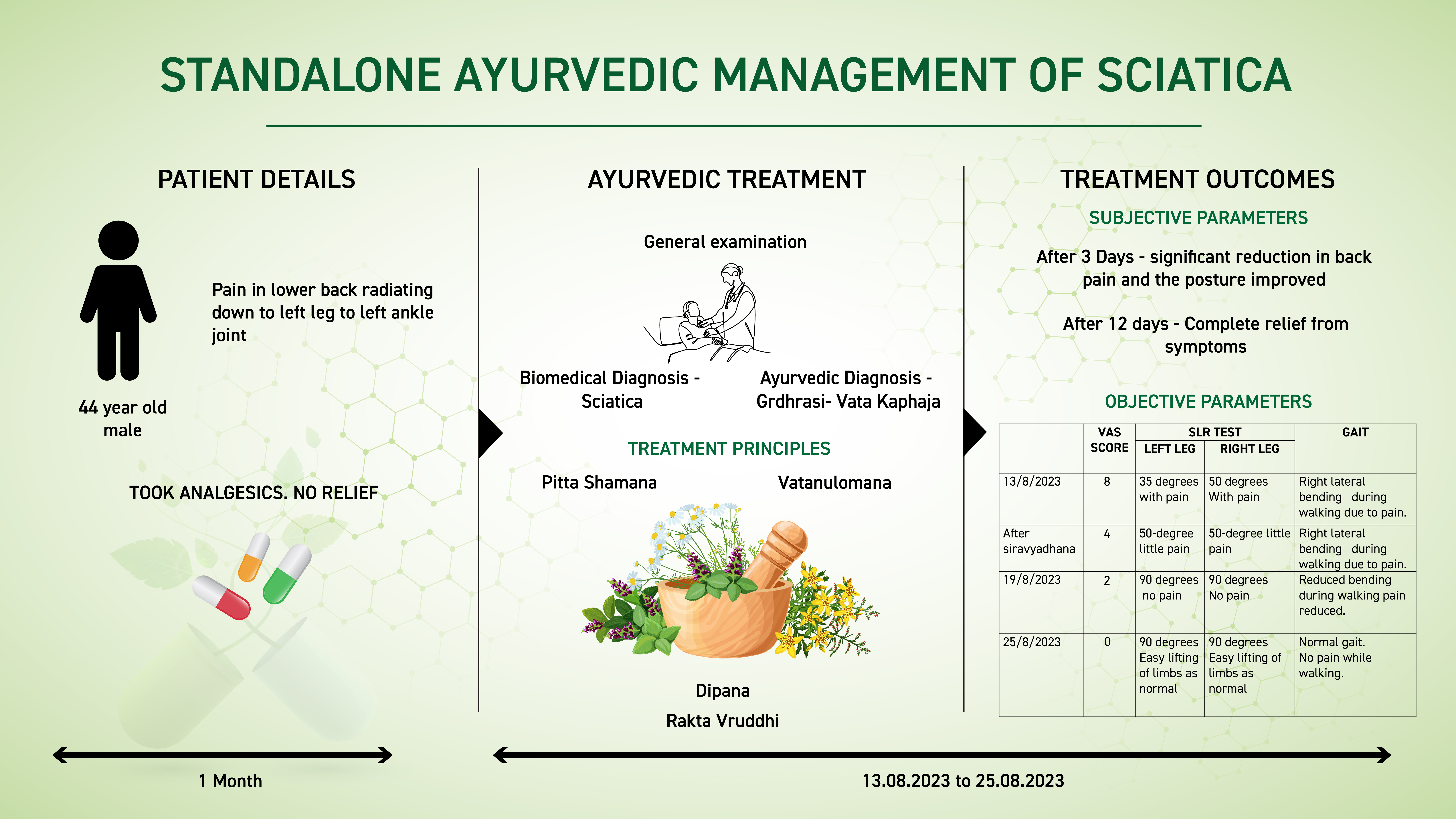
A 44-year-old male patient presented with severe pain in lower back radiating to left leg till ankle joint since 1 month. He took some analgesics for pain management. As the condition persisted, he opted for Ayurvedic management and approached Dr Ravisankar Pervaje. Based on the investigation reports and clinical examination, the physician confirmed the biomedical diagnosis as Sciatica and Ayurvedic diagnosis as Vata kaphaja gridhrasi. The line of treatment followed was pitta shamana, vatanulomana, agni dipana and rakta vriddhi. After 3 days of treatment, the patient had a significant reduction in back pain and the posture improved. With 12 days of Ayurvedic treatment, the patient got complete relief from all the symptoms and the quality of life improved. VAS was recorded as 8 at baseline became 0 at endpoint. There was a significant improvement in SLR, and no pain while walking. This case report demonstrates the successful standalone ayurvedic management of a sciatica in a patient who did not get relief from pain in spite of taking pain killers.
-
Summaries
-
Listen
-
Watch
-
View
-
Read
A 44-year-old male patient presented with severe pain in lower back radiating to left leg till ankle joint since 1 month. He took some analgesics for pain management. As the condition persisted, he opted for Ayurvedic management and approached Dr Ravisankar Pervaje. Based on the investigation reports and clinical examination, the physician confirmed the biomedical diagnosis as Sciatica and Ayurvedic diagnosis as Vata kaphaja gridhrasi. The line of treatment followed was pitta shamana, vatanulomana, agni dipana and rakta vriddhi. After 3 days of treatment, the patient had a significant reduction in back pain and the posture improved. With 12 days of Ayurvedic treatment, the patient got complete relief from all the symptoms and the quality of life improved. VAS was recorded as 8 at baseline became 0 at endpoint. There was a significant improvement in SLR, and no pain while walking. This case report demonstrates the successful standalone ayurvedic management of a sciatica in a patient who did not get relief from pain in spite of taking pain killers.
-
-
Timeline
-
Tabulated Summary
-
Narrative
TITLE OF CASE
Successful standalone ayurvedic management of sciatica - a case report.
Dr Ravisankar Pervaje
ABSTRACT
A 44 year old male patient presented with severe pain in lower back radiating to left leg till ankle joint since 1 month. He took some analgesics for pain management. As the condition persisted, he opted for Ayurvedic management and approached Dr Ravisankar Pervaje. Based on the investigation reports and clinical examination, the physician confirmed the biomedical diagnosis as Sciatica and Ayurvedic diagnosis as Vata kaphaja gridhrasi. The line of treatment followed was pitta shamana, vatanulomana, agni dipana and rakta vriddhi. After 3 days of treatment, the patient had a significant reduction in back pain and the posture improved. With 12 days of Ayurvedic treatment, the patient got complete relief from all the symptoms and the quality of life improved. VAS was recorded as 8 at baseline became 0 at endpoint. There was a significant improvement in SLR, and no pain while walking. This case report demonstrates the successful standalone ayurvedic management of a sciatica in a patient who did not get relief from pain in spite of taking pain killers.
KEYWORDS
Gridhrasi, raktamokshana, sciatica, case report, ayurveda, standalone
INTRODUCTION
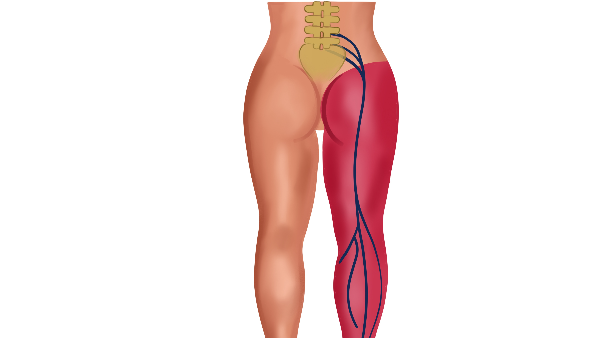
Sciatica is pain experienced due to an injury or irritation to the sciatic nerve that has its origin in the buttock/gluteal area. The sciatic nerve is the longest and thickest (almost finger-width) nerve in the body. Compression or pinching of the nerve can also cause this type of pain. The most common cause of nerve compression or pinching can be caused by a slipped disc or a herniated disc.
Diagnostic Criteria: History taking and physical examination are the basis for diagnosis. Subjective and objective assessments are the primary diagnostic criteria. In the subjective assessment, SLR with clinical presentations is considered. In the objective assessment, Imaging may be advised to assess the severity of the damage.
Prognosis & Treatment: A recent systematic review found that conservative treatments do not clearly improve the natural course of sciatica in most patients or reduce symptoms. Strong evidence of effectiveness is lacking for most of the available interventions. There is a little difference in the effect on pain and functional status, between bed rest and staying active. As a result of this finding, bed rest—for a long time the mainstay of treatment for sciatica—is no longer widely recommended. Analgesics, non-steroidal anti-inflammatory drugs, and muscle relaxants do not seem to be more effective than placebo in reducing symptoms. Evidence for opioids and various compound drugs is lacking. (Diagnosis and treatment of Sciatica; BW Koes et al.Clinical Review)
PATIENT INFORMATION
In this case report, a 44 year old male patient presented with severe pain in lower back radiating to left leg till ankle joint since 1 month. He took some analgesics for pain management. As the condition persisted, he opted for Ayurvedic management and approached Dr Ravisankar Pervaje. Based on the investigation reports and clinical examination, the physician confirmed the biomedical diagnosis as Sciatica and Ayurvedic diagnosis as Vata kaphaja gridhrasi.
No relevant family, genetic or surgical history
Psychosocial History- Stressed - disturbed sleep due to pain.
Addiction- Nil
CLINICAL FINDINGS
General and systemic examinations were done.
General appearance-Normal
Weight-67.4 kg
Vital Signs:
BP- 140/90 mmHg
PULSE- 100 bpm
SpO2- 98%
RR- 18/min
SYSTEMIC EXAMINATION-CNS abnormality detected.
CVS- No abnormality detected
RESPIRATORY SYSTEM-No abnormality detected
GI system- No abnormality detected
LOCOMOTOR SYSTEM-
LUMBOSACRAL JOINT
Inspection-right lateral bending was observed.
Palpation- tenderness++
RANGE OF MOVEMENTS:
Flexion-Painful
Extension- Painful
SLR Test- Left leg-Painful at 30 Degree.
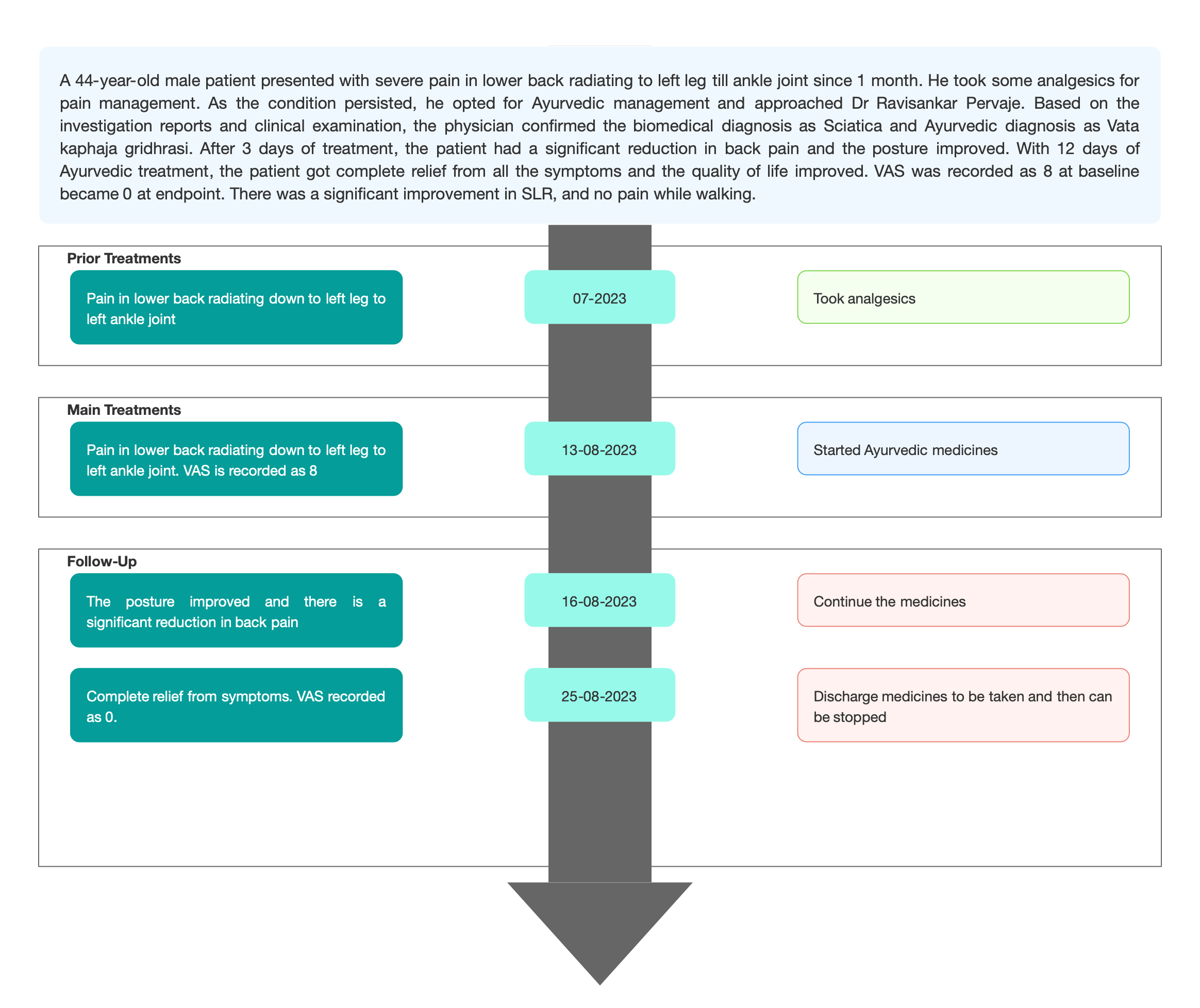
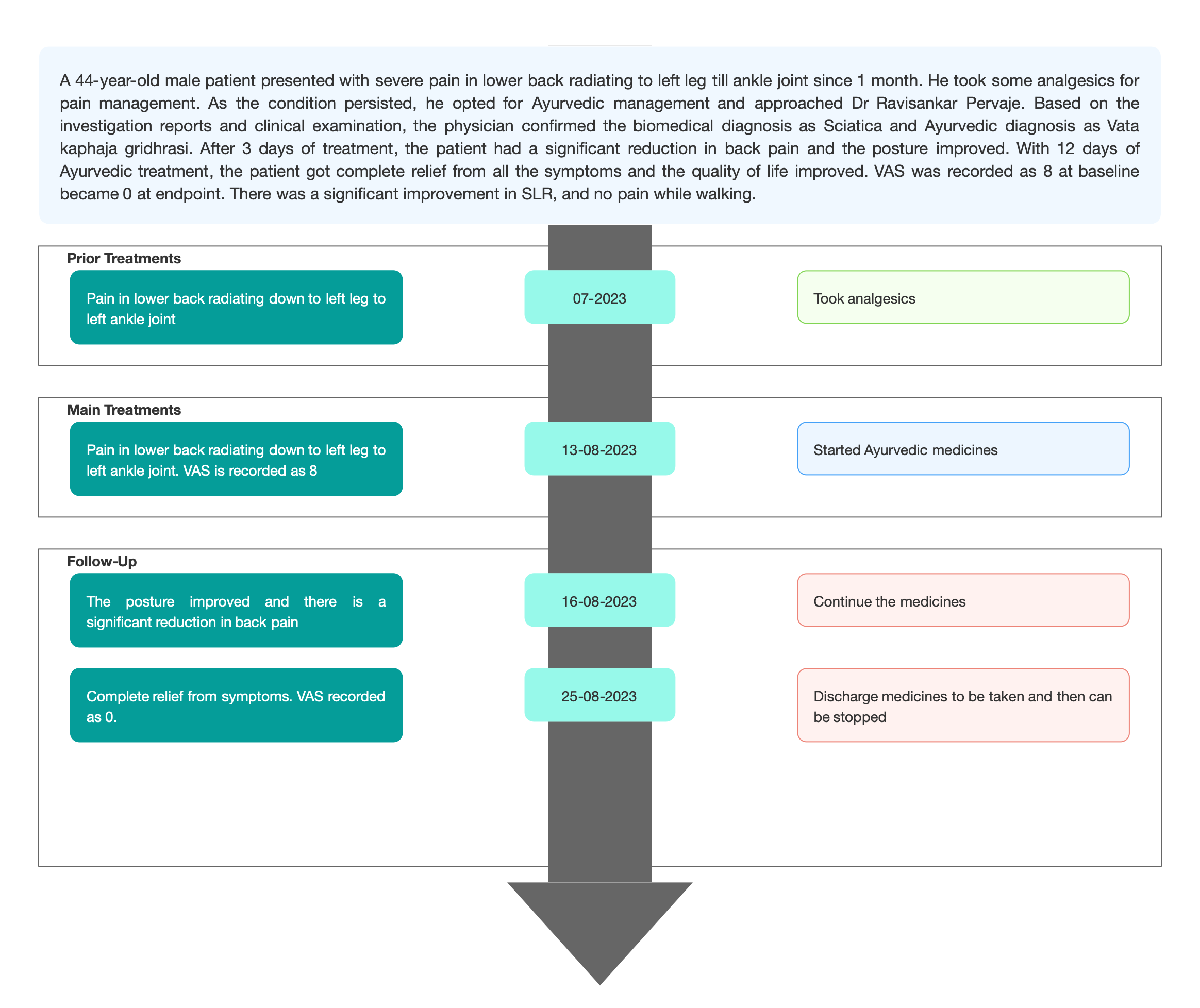
TIMELINE
Image 1. Timeline of events added below
DIAGNOSTIC ASSESSMENT
Modern Diagnostic parameter; Based on the clinical evaluation and the MRI report, the treating physician confirmed the biomedical diagnosis as Sciatica.
Image 2. MRI report at baseline dated 13.8.2023

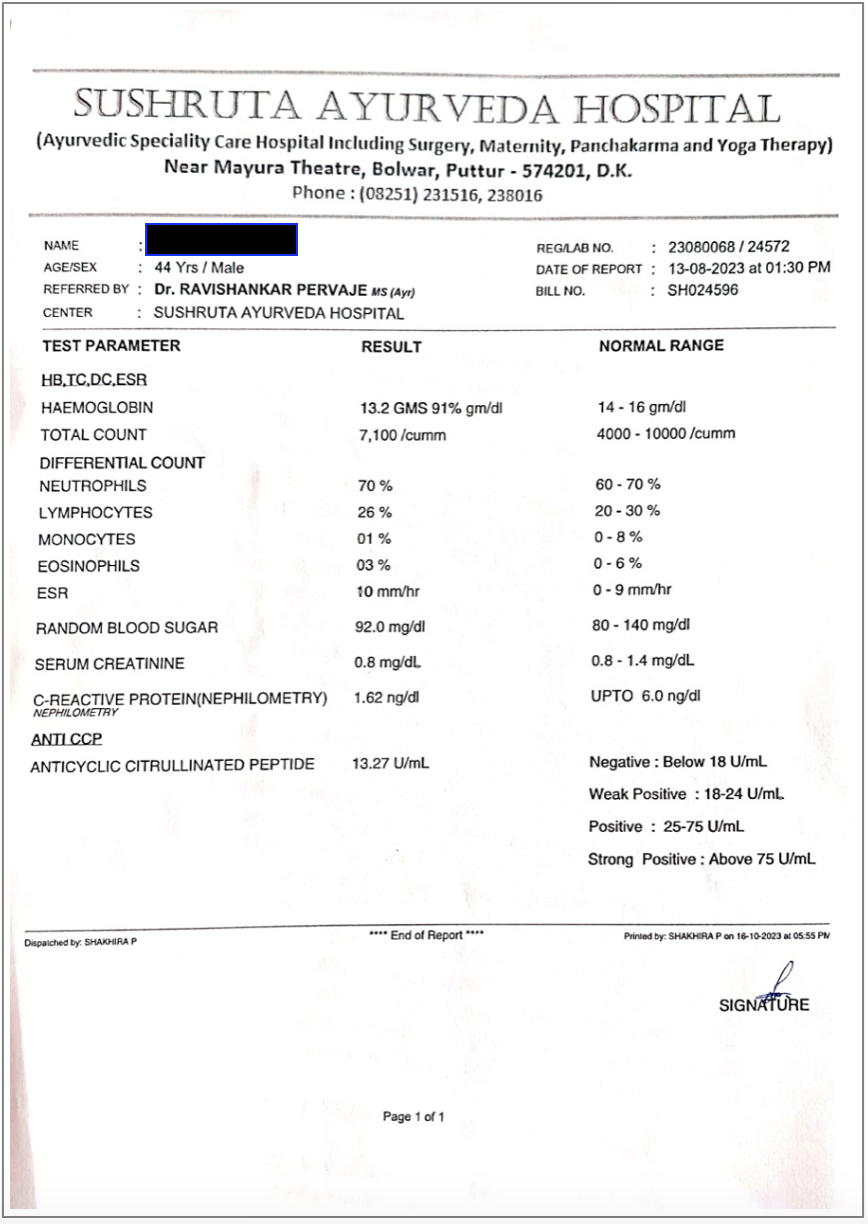
Image 3. Blood investigation at baseline dated 13.8.2023
Ayurvedic Assessment was done based on the presenting complaints, clinical evaluation and the MRI report.
Differential Diagnosis-
Herniated lumbosacral disc
Muscle spasm
Nerve root impingement
Epidural abscess
Epidural hematoma
Based on the investigation reports and clinical findings, the physician confirmed the diagnosis as sciatica.Prognosis & Treatment available: Most cases of sciatica resolve in less than 4 to 6 weeks with no long-term complications even if no medical therapy is sought. In more severe cases or cases where the neurologic deficit is present, the patient may have a more prolonged course of recovery. In this case report, in spite of taking analgesics, the patient presented with persistent severe pain in the lower back radiating to the left leg to ankle joint since 1 month. With 12 days of Ayurvedic treatment, the pain completely resolved.
THERAPEUTIC INTERVENTION
Please refer the tab ‘Treatment’ in the Portal.
FOLLOW-UP AND OUTCOMES
Both objective and subjective parameters were assessed to analyse the outcome of the ayurvedic treatment.
Subjective parameters: The symptoms were assessed through out the treatment.
Objective parameters: VAS was documented at baseline and endpoint
Table 1. Observations and clinical findings recorded throughout the treatment
VAS SCORE
SLR TEST
GAIT
LEFT LEG
RIGHT LEG
13/8/2023
8
35 degrees with pain
50 degrees
With pain
Right lateral bending during walking due to pain.
After siravyadhana
4
50-degree little pain
50-degree little pain
Right lateral bending during walking due to pain.
19/8/2023
2
90 degrees
no pain
90 degrees
No pain
Reduced bending during walking pain reduced.
25/8/2023
0
90 degrees
Easy lifting of limbs as normal
90 degrees
Easy lifting of limbs as normal
Normal gait.
No pain while walking.
Clinician-based assessment; After 3 days of starting ayurvedic treatment, there was a significant reduction in back pain and the posture improved. After 12 days of ayurvedic treatment, the patient got complete relief from pain.
Patient-assessed; VAS was 8 at baseline and at endpoint it became 0.
Intervention adherence and tolerability – The patient adhered to the prescribed treatments and tolerated the treatments well.
Method of assessment- By monitoring the patient.
Adverse and unanticipated events; None reported
DISCUSSION ;
The patient tried analgesics for relief from pain, but did to no avail. Hence, he decided to try Ayurvedic treatment. The ayurvedic diagnosis was Grdhrasi- Vata kaphaja and the line of treatment followed was pitta shamana, vatanulomana, agni dipana and rakta vriddhi.
PATIENT’S PERSPECTIVE
Not available.
LEARNING POINTS/TAKE HOME MESSAGES
This case demonstrates the effectiveness of Ayurveda in successfully treating a patient with sciatica, who had been experiencing debilitating radiating low back pain and disrupted sleep for several weeks. Through Ayurvedic treatment, the patient achieved complete relief from all symptoms and experienced a significant improvement in his overall quality of life.
INFORMED CONSENT
Written consent obtained from patient for publishing of the case report in the Portal
ACKNOWLEDGEMENTS
None specified
CONFLICT OF INTEREST
None declared.
FUNDING
None
REFERENCE
1. Koes BW, van Tulder MW, Peul WC. Diagnosis and treatment of sciatica. BMJ. 2007 Jun 23;334(7607):1313-7. doi: 10.1136/bmj.39223.428495.BE. PMID: 17585160; PMCID: PMC1895638.
-
Immersive Learning
-
Modern Diagnosis
MODERN DIAGNOSIS: SCIATICA
About The Disease:
Sciatica is pain experienced due to an injury or irritation to the sciatic nerve that has its origin in the buttock/gluteal area. The sciatic nerve is the longest and thickest (almost finger-width) nerve in the body. Compression or pinching of the nerve can also cause this type of pain. The most common cause of nerve compression or pinching can be caused by a slipped disc or a herniated disc.
Diagnostic Criteria: History taking and physical examination are the basis for diagnosis. Subjective and objective assessments are the primary diagnostic criteria. In the subjective assessment, SLR with clinical presentations is considered. In the objective assessment, Imaging may be advised to assess the severity of the damage.
Prognosis & Treatment: A recent systematic review found that conservative treatments do not clearly improve the natural course of sciatica in most patients or reduce symptoms. Strong evidence of effectiveness is lacking for most of the available interventions. There is a little difference in the effect on pain and functional status, between bed rest and staying active. As a result of this finding, bed rest—for a long time the mainstay of treatment for sciatica—is no longer widely recommended. Analgesics, non-steroidal anti-inflammatory drugs, and muscle relaxants do not seem to be more effective than placebo in reducing symptoms. Evidence for opioids and various compound drugs is lacking. (Diagnosis and treatment of Sciatica; BW Koes et al.Clinical Review)
In this case report, a 44 year old male patient presented with severe pain in lower back radiating to left leg till ankle joint since 1 month. He took some analgesics for pain management. As the condition persisted, he opted for Ayurvedic management and approached Dr Ravisankar Pervaje. Based on the investigation reports and clinical examination, the physician confirmed the biomedical diagnosis as Sciatica and Ayurvedic diagnosis as Vata kaphaja gridhrasi.
Image 1. MRI scan of LS Spine at baseline dated 13.8.2023
Image 2. Blood reports at baseline dated 13.8.2023
Table 1. The clinical findings at baseline
-
Ayurveda Diagnosis
AYURVEDA DIAGNOSIS: Gridhrasi- Vata kaphaja
ABOUT THE DISEASE:
Gridhrasi is Vata Nanatmaja Vyadhi.
पार्ष्णिप्रत्यङ्गुलीनांतुकण्डरायाऽनिलार्दिता|
सक्थ्नःक्षेपंनिगृह्णीयाद्गृध्रसीतिहिसास्मृता||७४||(Su. Ni 1/74)The condition in which Vata invades the Kandaras (tendons) of the ankles and toes produces kshepam (decreased movement)in the thighs is known as Gridhrasi.
Adhishtana of the disease; According to Cakradatta, kati and sphik are the initial sites of manifestation. According to Susruta, kandara of parshni, pada and anguli are affected.
Symptoms of Gridhrasi:
स्फिक्पूर्वाकटिपृष्ठोरुजानुजङ्घापदंक्रमात्|
गृध्रसीस्तम्भरुक्तोदैर्गृह्णातिस्पन्दतेमुहुः||५६||
वाताद्वातकफात्तन्द्रागौरवारोचकान्विता| (CS. Ci 28.56-57)The common symptoms of Grdhrasi are–pain radiating from Sphik (buttock) the to kati, prsta, uru, janu, jangha and pada associated with stambha (stiffness), toda (pricking pain), spandana (twitching) and causes the Sakti utksepanigraha(restricted movement of the lifting of the leg). Commentator Arunadatta mentions the inability of the patient to lift his leg when affected with this condition. Specific symtpoms like ‘dehasya vakrata’ and kati- janusandhi sphuranam are mentioned as symptoms in vataja grdhrasi. Depending upon the dosa responsible for the pathology, the respective symptoms will be produced.
In this case report, a 44 year old male patient presented with severe pain in lower back radiating to left leg till ankle joint since 1 month. He took some analgesics for pain management. As the condition persisted, he opted for Ayurvedic management and approached Dr Ravisankar Pervaje. Based on the investigation reports and clinical examination, the physician confirmed the biomedical diagnosis as Sciatica and Ayurvedic diagnosis as Vata kaphaja gridhrasi.
Generally there are 2 presentations of Grdhrasi- kevala vata or vata kapha. Here Vata kapha has been specifically mentioned by the treating physician. In Vataja type, the symptoms are curved posture (altered gait) due to pain, severe stiffness, pulsation in back, hip, thigh, knee and foreleg. In Vata kaphaja type, along with the above mentioned symptoms, indigestion, drowsiness, nausea, anorexia, heaviness of the leg and freezing sensation in the lower limbs are complained. Hence the symptoms in this patient can be correlated with the presentation mentioned in Vatakaphaja type.
Sadyasadhyata
A separate prognosis has not been mentioned for Gridhrasi. It may be said that gridhrasi, in which the vitiated vata is seated in majjadhatu or if gridhrasi is accompanied with khuddavata, angasosha and stambha may or may not be cured even after appropriate management. But if this condition occurs in a strong person and is of recent origin and without any associated disease, then it is curable. Sushruta mentions that a patient of vatavyadhi, if developed the complications like shuna, suptatvacha, bhagna, kampa, and pain in internal organs, then he will not survive.
नवान्बलवतस्त्वेतान्साधयेन्निरुपद्रवान्||७४|| (CS.Ci. 28/74)
Cikitsa of Gridhrasi
Gridhrasi being a Vata vyadhi, the general treatment followed is that of pacifying Vata. The first and foremost principle to be adopted in treatment is to avoid the nidana that causes gridhrasi.
According to the Dosha Kopa, Gridhrasi can be divided into three stages. It should be studied carefully before starting the treatment as the stage varies from time to time.
Stages of Dosha prakopa Treatment- Mild (vata) prakopa- Langhana
- Moderate- Langhana-Pachana
- Severe- (ama/vata kapha) Shodhana.
In all stages of Gridhrasi, except in Amavastha, oil preparations are suggested by all Acaryas, both externally and internally. The stage of gridhrasi in the patient was not specified by the treating physician.
In Charaka Samhita Bastikarma (Niruha and Anuvasana basti), Siravedha and Agnikarma (between kandara and gulpha) have been advised. Sushruta has advised Siravedha at janu after flexion. Astanga sangraha and Astanga Hrdaya have also advised Siravedha four angula above the janu. Yogaratnakara has recommended siravedha in the area of four angula around vasti and mutrendriya; if this fails, agnikarma in the little finger of the leg is advised.
Treatment & Rationale of treatment; Vangasena mentions Dipana, pacana, vamana, virecana, vasti and siravyadha as the line of treatment. This being a vatavyadhi, the basic treatment target is to pacify vata.
Table 1. The medicines/therapies chosen and their specific rationales explained by the physician
Medicines
Rationale
Punarnava mandoora
For agni dipana and rakta vruddhi.
Madiphala Rasayana
To increase agni that got reduced by
raktamokshana.
Trailokya vijaya vati
To reduce the pain.
Sutashekhar rasa
For amaswaroopa pitta shamanartha .
Hingvastak pills
For vatanulomana
Apart form this, specific Pancakarma procedures were also planned, targeting the symptoms and pacification of Dosas.
Table 2. The medicines/therapies chosen and their specific rationales explained by the physician
Procedures
Details
Date
Raktamokshana by siravyadhana
Sarvanga abhyanga, bashpa sweda was done and drava snigdha yavagu was given to drink.
After 48 min of snigdha yavagupaana, sthanika abhyanga and sweda done to the affected limb to localize the doshas after which utthita sira is selected and siravyadha was done immediately with 18 gauge needle on the left ankle joint.
13/8/23
Sadyovamana
Sadyovamana was done with yashhtimadhu phanta, in the early morning (kapha kaala), for the purpose of koshtashudhi and langhana. After vamana, dhumapana and kavalagraha is given as paschat karma.
14/8/23
Sadyovirechana
Virechana was done with Gandharva hastadi eranda taila: 30 ml + pancha mootrasava: 25 ml with milk. In pitta kala (around 8: 30am) which was also meant for koshtashudhi and for langhana.
15/8/23
Sarvanga abhyanga
Sarvanga abhyanga done with Vishagarbha taila.
16/8/2023- 24/08/23
Kati Basti
Kati basti with Vishagarbha taila
16/8/2023 - 24/8/2023
Sthanika patra
pinda sweda
This was done after abhyanga
16/8/2023 - 24/8/2023
Agnikarma
Snigdha agnikarma
16/08/2023- 24/08/2023
Basti karma
Anuvasana basti: Panchatikta
eranda taila with Siddha
Makaradwaja
16/8/2023- 24/08/2023
Niruha basti: Erandamula kshara basti
17/08/2023- 19/08/2023
Niruha basti: Dasamoola panchatikta ksheera kashaya
20/08/2023- 22/08/2023
Yoga
Ekapada pavanamuktasana and ekpaada uthana asana were advised to patient for muscle strengthening.
19/08/2023- 24/08/2023
-
Treatment
Name of Medicine Dosage Form Dosage Mode of Administrtation From - To (Date) Medicine Reference Punarnava Mandoora Tablet 1 Oral- with warm water twice daily 2022-08-13 - 2022-08-20 CS.Ci.16.93-95 Madiphala Rasayana Syrup 2 Teaspoon Oral, thrice daily after food 2022-08-13 - 2022-08-20 Ayurvedic Patent & Proprietary Medicine Trailokya vijaya vati Vati 1 Oral, twice daily after food 2022-08-15 - 2022-08-24 Ayurveda Sara Sangraha Sutashekhar Rasa Vati 1 Oral, twice daily after food 2022-08-15 - 2022-09-08 Yogaratnakara, Amlapitta Cikitsa 705 Hingvastaka Pills Tablet 1 Oral, twice daily after food 2022-08-19 - 2022-08-24 Ayurvedic Patent & Proprietary Medicine Lashunadi Guggulu Tablet 1 Oral, twice daily after food 2022-08-25 - 2022-09-08 Ayurvedic Patent & Proprietary Medicine Agni Tundi Vati Vati 1 Oral, twice daily after food 2022-08-25 - 2022-09-08 Bhaishajya Ratnavali Agnimandhya rogadhikara 93-94 Balajeerakadi Kashaya Kashayam 3 tsp Oral- twice daily, before food 2022-08-25 - 2022-09-08 Sahasra yogam - Kashaya Prakarana Pinda Neelgiri Taila Taila Required Quantity For External application 2022-08-25 - 2022-09-08 Ayurvedic Patent & Proprietary Medicine -
Outcome Measures
OUTCOME MEASURES
In this case report, a 44 year old male patient presented with severe pain in lower back radiating to left leg till ankle joint since 1 month. He took some analgesics for pain management. As the condition persisted, he opted for Ayurvedic management and approached Dr Ravisankar Pervaje. Based on the investigation reports and clinical examination, the physician confirmed the biomedical diagnosis as Sciatica and Ayurvedic diagnosis as Vata kaphaja gridhrasi.
Assessment: Both objective and subjective parameters were assessed to analyse the outcome of the ayurvedic treatment.
Subjective parameters: After 3 days of starting ayurvedic treatment, there was a significant reduction in back pain and the posture improved. After 12 days of ayurvedic treatment, the patient got complete relief from pain.
Objective parameters: VAS was recorded at baseline and at endpoint
Table 1. Observations and clinical findings recorded throughout the treatment
VAS SCORE
SLR TEST
GAIT
LEFT LEG
RIGHT LEG
13/8/2023
8
35 degrees with pain
50 degrees
With pain
Right lateral bending during walking due to pain.
After siravyadhana
4
50-degree little pain
50-degree little pain
Right lateral bending during walking due to pain.
19/8/2023
2
90 degrees
no pain
90 degrees
No pain
Reduced bending during walking pain reduced.
25/8/2023
0
90 degrees
Easy lifting of limbs as normal
90 degrees
Easy lifting of limbs as normal
Normal gait.
No pain while walking.
-