Featured Case
-
Abstract
A 17-year-old male patient presented with a sudden onset of headache followed by blurring of vision of left eye since 14 days. He had consulted an allopathic doctor and based on the ONH and RNFL OU Analysis OD OS, the biomedical diagnosis was made as Neuro Myelitis Optica Syndrome disease. The serum sample tested very strongly positive MOG IgG antibodies and so he was prescribed steroids. The patient refused and opted for Ayurvedic management. He approached Dr Sreeja who made the Ayurvedic diagnosis as Timira- kapha pittotthara sannipataja. The line of treatment followed was Shopha hara and Kapha- pitta shamana. With one month of Ayurvedic treatment, the vision became normal and clear. Perimetry, ONH and RNFL OU Analysis OD OS done during and at endpoint indicated a significant improvement. This case report demonstrates the standalone successful ayurvedic management of papilledema, in a patient who was recommended steroids but was not willing to take them.
-
Summaries
-
Listen
-
Watch
-
View
-
Read
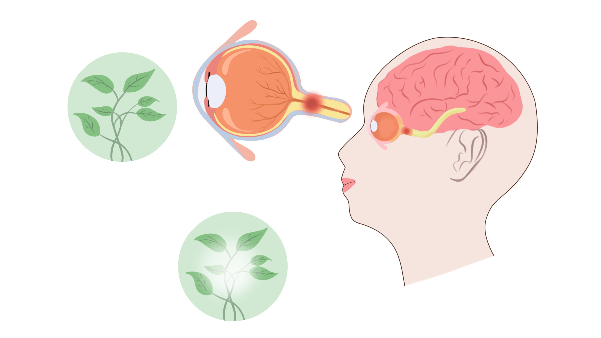
A 17-year-old male patient presented with a sudden onset of headache followed by blurring of vision of left eye since 14 days. He had consulted an allopathic doctor and based on the ONH and RNFL OU Analysis OD OS, the biomedical diagnosis was made as Neuro Myelitis Optica Syndrome disease. The serum sample tested very strongly positive MOG IgG antibodies and so he was prescribed steroids. The patient refused and opted for Ayurvedic management. He approached Dr Sreeja who made the Ayurvedic diagnosis as Timira- kapha pittotthara sannipataja. The line of treatment followed was Shopha hara and Kapha- pitta shamana. With one month of Ayurvedic treatment, the vision became normal and clear. Perimetry, ONH and RNFL OU Analysis OD OS done during and at endpoint indicated a significant improvement. This case report demonstrates the standalone successful ayurvedic management of papilledema, in a patient who was recommended steroids but was not willing to take them.
-
-
Timeline
-
Tabulated Summary
-
Narrative
TITLE OF CASE
Standalone Ayurvedic management of Neuro Myelitis Optica Syndrome disease (NMO) - a case report
Dr Sreeja Sukesh
ABSTRACT
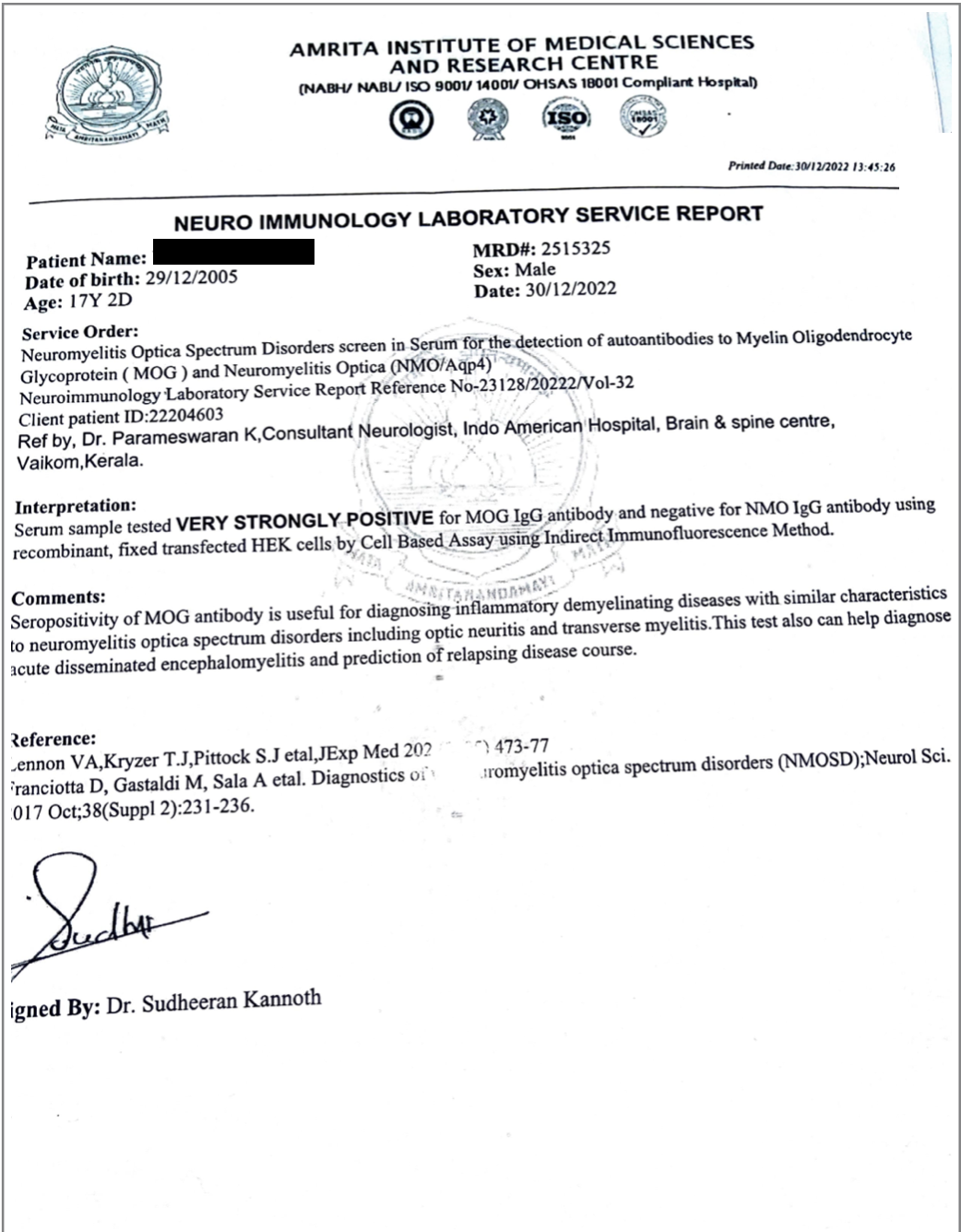
A 17-year-old male patient presented with a sudden onset of headache followed by blurring of vision of left eye since 14 days. He had consulted an allopathic doctor and based on the ONH and RNFL OU Analysis OD OS, the biomedical diagnosis was made as Neuro Myelitis Optica Syndrome disease. The serum sample tested very strongly positive MOG IgG antibodies and so he was prescribed steroids. The patient refused and opted for Ayurvedic management. He approached Dr Sreeja who made the Ayurvedic diagnosis as Timira- kapha pittotthara sannipataja. The line of treatment followed was Shopha hara and Kapha- pitta shamana. With one month of Ayurvedic treatment, the vision became normal and clear. Perimetry, ONH and RNFL OU Analysis OD OS done during and at endpoint indicated a significant improvement. This case report demonstrates the standalone successful ayurvedic management of Neuro Myelitis Optica Syndrome disease, in a patient who was recommended steroids but was not willing to take them.
KEYWORDS
Neuro Myelitis Optica Syndrome disease, timira, case report, standalone
INTRODUCTION
Neuromyelitis optica (NMO) is a central nervous system disorder that causes inflammation in nerves of the eye and the spinal cord. NMO is also called neuromyelitis optica spectrum disorder (NMOSD) and Devic disease. It occurs when the body's immune system reacts against its own cells. This happens mainly in the optic nerves that connect the retina of the eye with the brain and in the spinal cord. But it sometimes occurs in the brain. The disorder may appear after an infection. Or it can be associated with another autoimmune condition. Irregular antibodies bind to proteins in the central nervous system and cause damage. Neuromyelitis optica is often misdiagnosed as multiple sclerosis (MS) or seen as a type of MS. But NMO is a different condition. Neuromyelitis optica can cause blindness in one or both eyes, weakness or paralysis in the legs or arms, and painful spasms. It also can cause loss of sensation, uncontrollable vomiting and hiccups, and bladder or bowel problems from spinal cord damage. Children can have confusion, seizures or comas.
Relapses are common. Preventing recurrent attacks is a key to averting disability. Neuromyelitis optica flare-ups might be reversible, but they can be severe enough to cause permanent visual loss and problems with walking.
Diagnosis: A full physical examination to check the overall health and clinical evaluation is the primary diagnostic tool. Neurological exam, MRI, Blood tests, Lumbar puncture, Stimuli Response Test, Optical coherence tomography are some of the other diagnostic tools that will be used by the Opthalmologists to confirm the diagnosis.
Prognosis- NMO can't be cured, though long-term remission is sometimes possible with the right management. NMO treatment involves therapies to reverse recent symptoms and prevent future attacks.
Treatment: Some of the treatments adopted are as follows
- Reverse the recent symptoms
- Preventing future attacks
- Reducing relapses
PATIENT INFORMATION
In this case report, a 17-year-old male patient presented with a sudden onset of headache followed by blurring of vision of left eye since 14 days. He had consulted an allopathic doctor and based on the ONH and RNFL OU Analysis OD OS, the biomedical diagnosis was made as NMO.
Family History- Mother is myopic
No relevant genetic/surgical or psychosocial history.
No Addictions
CLINICAL FINDINGS
On examination
LPC- mild follicles (b/l)
UPC- follicles (rt)
BC- within normal limits (b/l)
PR- brisk (b/l)
Cornea- clear (b/l)
Visual Acquity
RE- 6/6 N6
LE- 6/6 N6TIMELINE
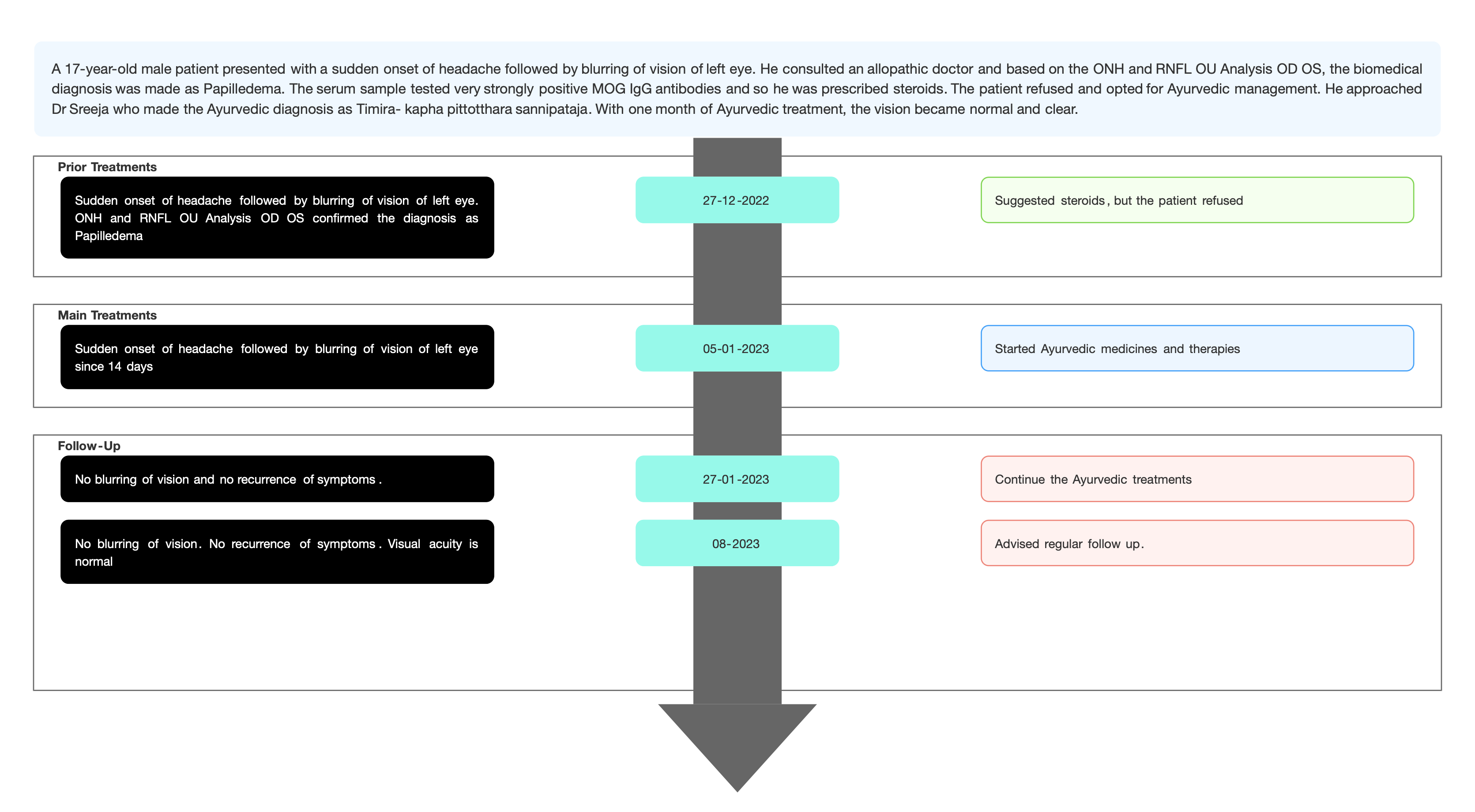
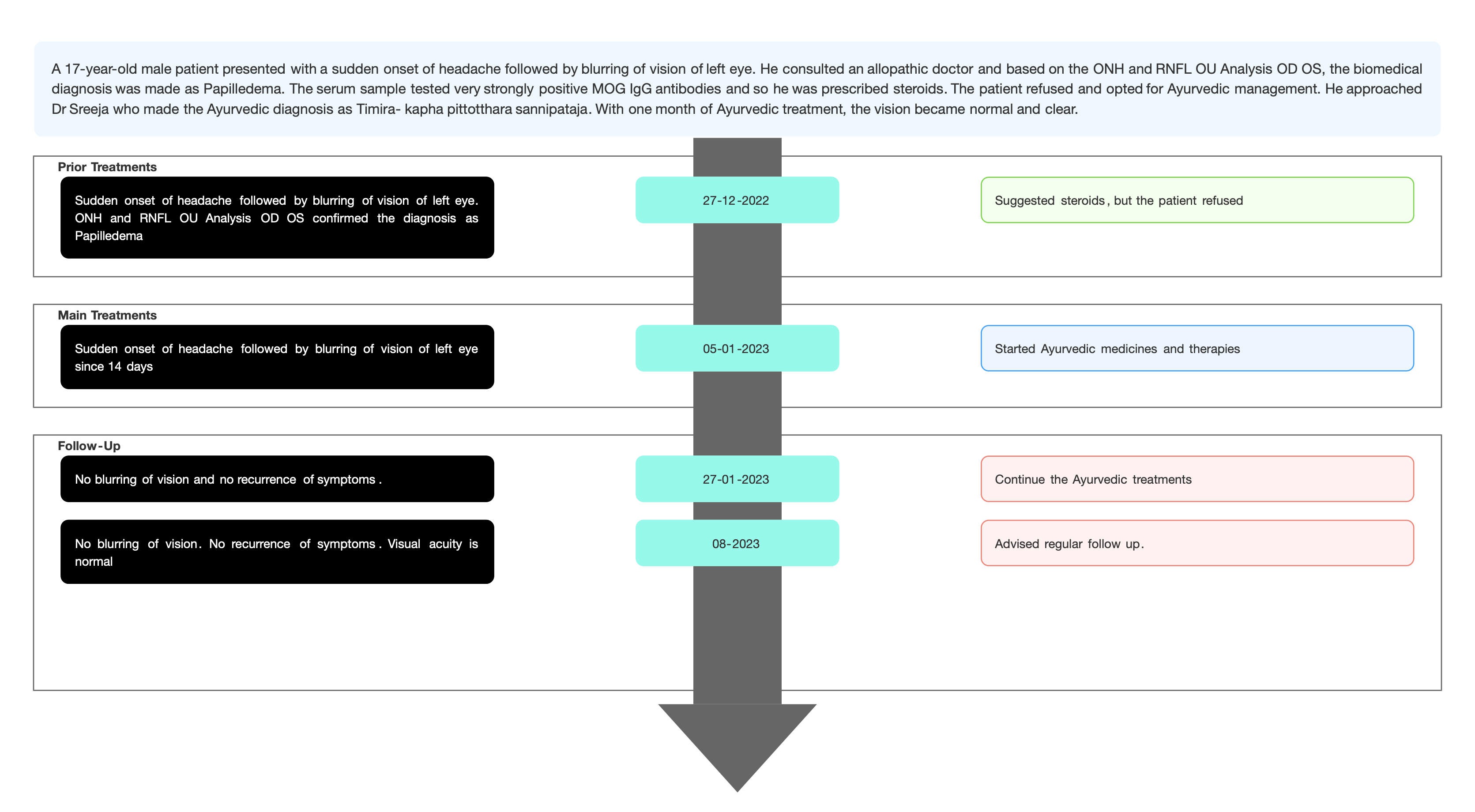
Image 1. Timeline of events added below
DIAGNOSTIC ASSESSMENT
Modern Diagnostic parameter; Based on the clinical examination and ONH and RNFL OU Analysis OD OS reports, the biomedical diagnosis was made as Neuro Myelitis Optica Syndrome disease.
OCT: Macular thickness 244 um(OD), 266um(OS)
ONH & RNFL:
Avg- RNFL RE- 103um, LE- 121um
Fundus: reveals media clear (OU)
Disc margin blurred (OD)
Blurred with odema(OS)
CDR- 0.3 (OU)
Vessels Tortuous (OV)
Macula - healthy
G.F- Mild tessellation
HFA done.
Analysis OD OS - 6/1/23Image 1. OHN and RNFL and OU Analysis dated 27.12.2022 (prior record)
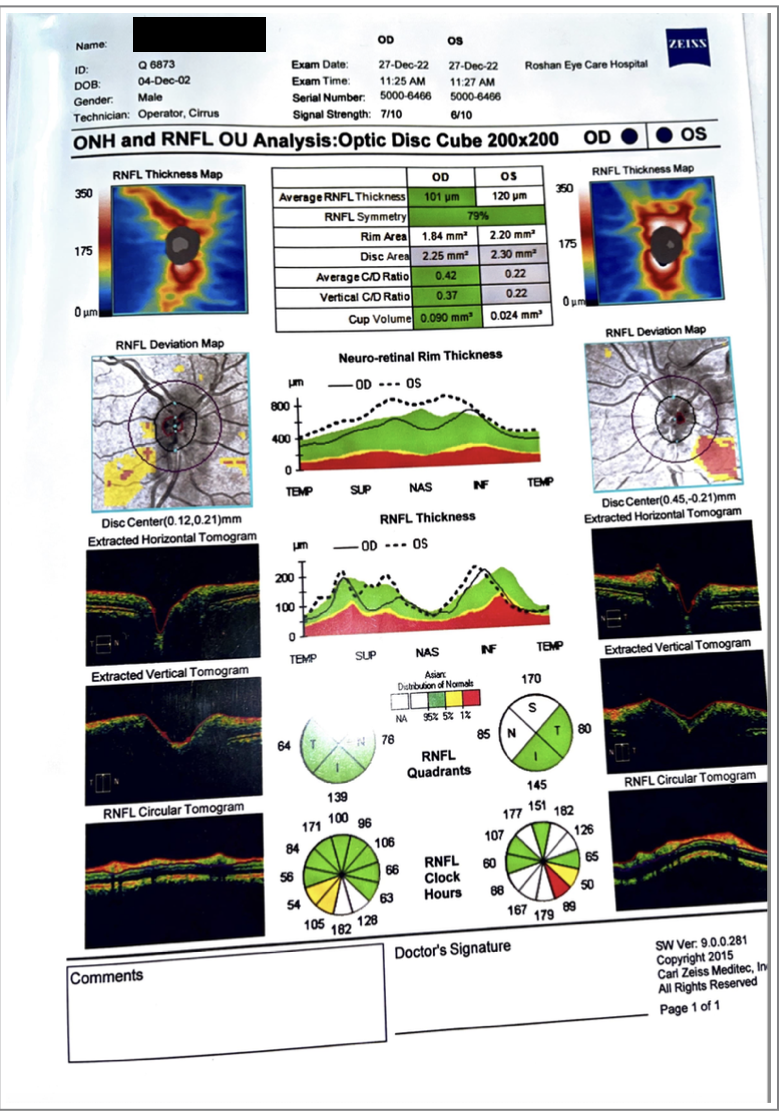
Image 2. OHN and RNFL and OU Analysis dated 6.1.2023 at baseline

Image 3. Perimetry test at baseline 28.12.2022
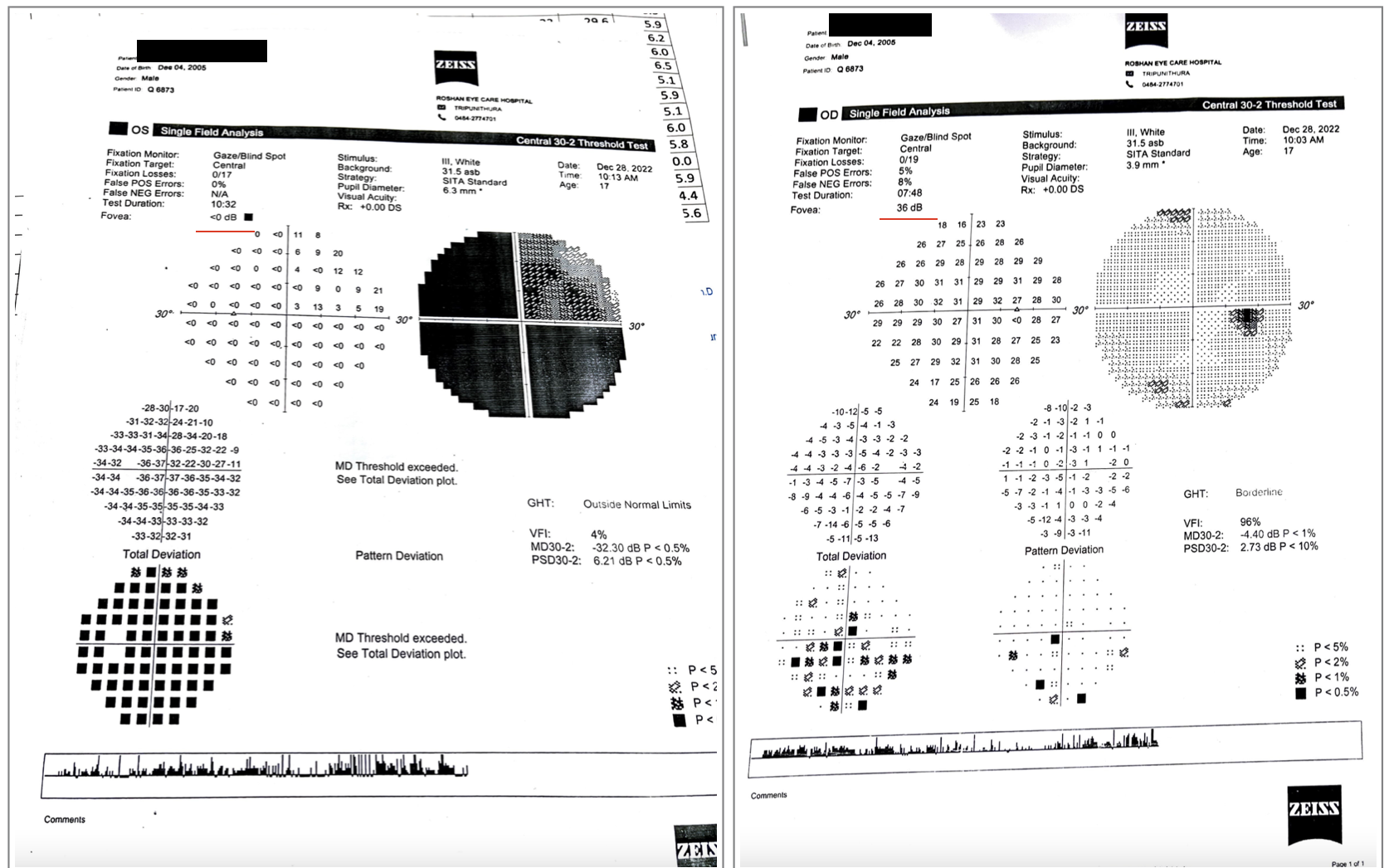
Image 4. Neuro immunology Report dated 30.12.2022
Ayurvedic Assessment was done based on the presenting complaints and clinical evaluation. The treating physician confirmed the Ayurvedic diagnosis as Timira- Kaphapittottara sannipataja
Differential Diagnosis-
Intraoccular inflammation, central retinal vein occlusion, compressive optic neuropathy, optic neuritis, diabetic papillopathy, and ischemic optic neuropathy.
Based on the previous treatment records and investigations, this diagnosis was confirmed as papilledema.
Prognosis- The prognosis for papilledema is related to the chronicity of the disease. Chronically high ICP can lead to permanent drop out of the nerve fiber layer which can result in progressive visual field loss and loss of central visual acuity. In this case report, the patient presented with blurred vision of left eye since 14 days. After one month of Ayurvedic treatment, the vision became clear and normal. In Perimetry test before treatment, the foveal sensitivity was 0 db in left eye , which becomes 30db after 1 month of treatment.
THERAPEUTIC INTERVENTION
Refer the tab ‘Treatment’ in the Portal.
FOLLOW-UP AND OUTCOMES
The patient had 3 follow ups in total. Each follow up, the symptoms were assessed and tests were done to analyse the outcome.
Subjective parameters: After one month of Ayurvedic treatment, the vision became clear and normal.
Clinician-based assessment; Patient presented with blurred vision of left eye since 14 days. In Perimetry test, the foveal sensitivity was 0 db in left eye, which becomes 30db after 1 month of treatment. The patient had a blurred vision before treatment and after the treatment, the vision became clear and normal.
Image 5. Perimetry Test dated 3.2.2023
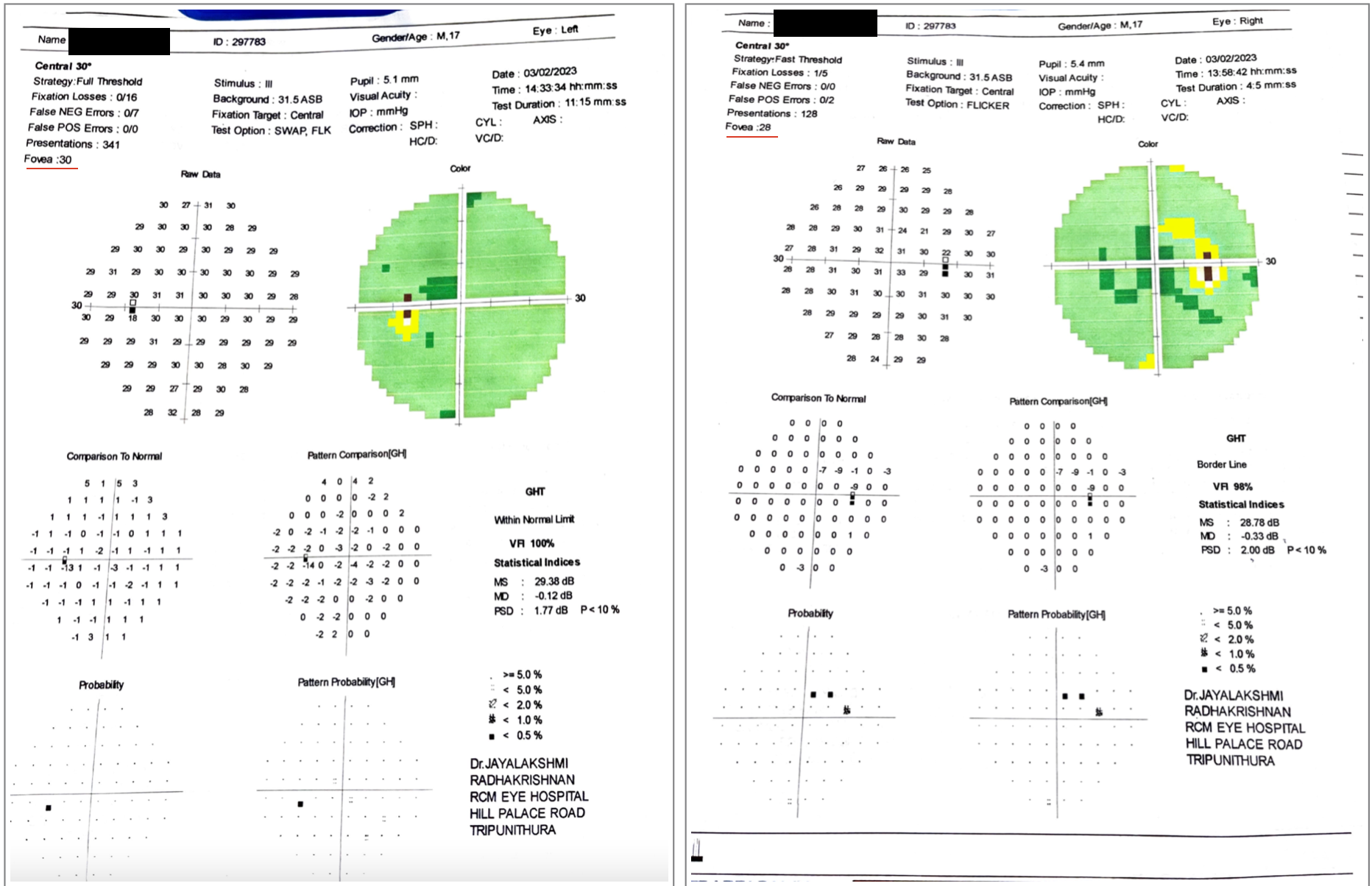
Image 6. ONH and RNFL OU Analysis OD OS during treatment dated 20.1.2023 and 27.1.2023

Patient-assessed; Not relevant
Intervention adherence and tolerability – The patient adhered to the prescribed treatments and tolerated the treatments well.
Method of assessment- Subjective and objective parameters were the main assessment tools.
Adverse and unanticipated events; None reported
DISCUSSION:
Neuro Myelitis Optica Syndrome disease is a central nervous system disorder that causes inflammation in nerves of the eye and the spinal cord. Neuromyelitis optica can cause blindness in one or both eyes, weakness or paralysis in the legs or arms, and painful spasms. It also can cause loss of sensation, uncontrollable vomiting and hiccups, and bladder or bowel problems from spinal cord damage. Children can have confusion, seizures or comas. Relapses are common. Preventing recurrent attacks is a key to averting disability. Neuromyelitis optica flare-ups might be reversible, but they can be severe enough to cause permanent visual loss and problems with walking. This patient was prescribed steroids to manage the condition but he refused and opted for Ayurveda. With medicines planned to pacify kapha and pitta and with a shothahara karma, in 1 month the patient’s vision became normal and clear.
PATIENT’S PERSPECTIVE
Not available.
LEARNING POINTS/TAKE HOME MESSAGES
This case report underscores the remarkable potential of Ayurvedic treatments in restoring vision impaired by Neuro Myelitis Optica Syndrome disease. The patient initially experienced blurred vision, but after Ayurvedic intervention, their vision made a remarkable turnaround, becoming clear and completely normal. It serves as a powerful testament to the efficacy of alternative therapies in healthcare.
INFORMED CONSENT
Written consent obtained from patient for publishing of the case report in the Portal
ACKNOWLEDGEMENTS
None
CONFLICT OF INTEREST
None declared.
FUNDING
None
REFERENCE
https://www.mayoclinic.org/diseases-conditions/neuromyelitis-optica/diagnosis-treatment/drc-20375655
-
Immersive Learning
-
Modern Diagnosis
MODERN DIAGNOSIS: Neuro Myelitis Optica Syndrome disease (NMO)
ABOUT THE DISEASE:
Neuromyelitis optica (NMO) is a central nervous system disorder that causes inflammation in nerves of the eye and the spinal cord. NMO is also called neuromyelitis optica spectrum disorder (NMOSD) and Devic disease. It occurs when the body's immune system reacts against its own cells. This happens mainly in the optic nerves that connect the retina of the eye with the brain and in the spinal cord. But it sometimes occurs in the brain. The disorder may appear after an infection. Or it can be associated with another autoimmune condition. Irregular antibodies bind to proteins in the central nervous system and cause damage. Neuromyelitis optica is often misdiagnosed as multiple sclerosis (MS) or seen as a type of MS. But NMO is a different condition.
Neuromyelitis optica can cause blindness in one or both eyes, weakness or paralysis in the legs or arms, and painful spasms. It also can cause loss of sensation, uncontrollable vomiting and hiccups, and bladder or bowel problems from spinal cord damage. Children can have confusion, seizures or comas.
Relapses are common. Preventing recurrent attacks is a key to averting disability. Neuromyelitis optica flare-ups might be reversible, but they can be severe enough to cause permanent visual loss and problems with walking.
Diagnosis: A full physical examination to check the overall health and clinical evaluation is the primary diagnostic tool. Neurological exam, MRI, Blood tests, Lumbar puncture, Stimuli Response Test, Optical coherence tomography are some of the other diagnostic tools that will be used by the Opthalmologists to confirm the diagnosis.
In this case report, the patient is a 17-year-old male patient who presented with a sudden onset of headache followed by blurring of vision of left eye. He consulted an allopathic doctor and based on the ONH and RNFL OU Analysis OD OS, the biomedical diagnosis was made as NMO. He was prescribed steroids, the patient refused and opted for Ayurvedic management.
Image 1. OHN and RNFL and OU Analysis dated 27.12.2022 (prior record)
Image 2. OHN and RNFL and OU Analysis dated 6.1.2023 at baseline
Image 3. Perimetry test at baseline 28.12.2022
Image 4. Neuro immunology Report dated 30.12.2022
Prognosis- NMO can't be cured, though long-term remission is sometimes possible with the right management. NMO treatment involves therapies to reverse recent symptoms and prevent future attacks.
Treatment: Some of the treatments adopted are as follows
- Reverse the recent symptoms
- Preventing future attacks
- Reducing relapses
Reference
-
Ayurveda Diagnosis
AYURVEDA DIAGNOSIS: Timira- Kaphapittotara sannipataja
ABOUT THE DISEASE:
Timira (derived from the word meaning ‘darkness’) involving the patalas – layers of the eye is considered to be the most important & serious as far as its prognosis and treatment are concerned. This is a ‘yapya’ vyadhi and timira is a disease of the anterior & posterior segments of the eye in which vision is hampered. If it is not treated in time it leads to Kaca & then Liṅganasha i.e. total blindness which simulates refractive errors, presbyopia, very early lenticular hydration, vitreous pathologies & diseases of the retina. Timira is a drishtigata roga which occurs in the inner four patalas of the eye. Tritiyagata Patala or Medo ashrita Patala can be taken as Vitreous humour, as vitreous is a jelly-like structure which resembles fat.
As netra is a pancabhautika entity and regulated by tridosha, saptadhatu and mala, the treatment of ocular disorders is in no way different from systemic disorders, except that kriyakalpas will be used. (Netra patala Vivechana- A scientific insight; Pasha SM. Indian Journal of Applied Research. Vo.9; Iss.4.2019). Timira can affect the Pratham, dvitiya or the tritiya patala, depending on which the symptoms and the treatment will vary. In this case report, the patient is a 17-year-old male patient who presented with a sudden onset of headache followed by blurring of vision of left eye. He consulted an allopathic doctor and based on the ONH and RNFL OU Analysis OD OS, the biomedical diagnosis was made as Neuro Myelitis Optica Syndrome disease. He was prescribed steroids, the patient refused and opted for Ayurvedic management.
The ayurvedic diagnosis is Timira, but the treating physician has not specified the patala that is affected. Hypothetically, the symptoms of blurred vision matches with that of the Prathama patala gata timira.
प्रथमे पटले दोषा यस्य दृष्ट्यां व्यवस्थिताः। अव्यक्तानि स रूपाणि कदाचिदथ पश्यति॥२९॥ (MN.59)
When timira manifests due to the increased doshas localized in the patala (layer) of the drsti (lens), the person sees things in an indistinct or unclear way (does not see the objects clearly). The dosa specified by the treating physician is Kaphapittotara sannipataja, which means there is an involvement of all the dosas indicating the complexity of presentation.
आविलान्यरुणाभानि व्याविद्धानीव मानवः। पित्तेनादित्यखद्योतशक्रचापतडिद्गुणान्॥४२॥
नृत्यतश्चैव शिखिनः सर्वं नीलं च पश्यति। कफेन पश्येद्रूपाणि स्निग्धानि च सितानि च।
पश्येद्सूक्ष्माण्यत्यर्थं व्यभ्रमेवाभ्रसम्प्लवम्॥४३॥
सलिलप्लावितानीव परिजाड्यानि मानवः। पश्येद्रक्तेन रक्तानितमाम्सि विविधानि च॥४४॥
स सितान्यपि कृष्णानि पीतान्यपि च मानवः। सन्निपातेन चित्राणि विप्लुतानीव पश्यति॥४५॥
बहुधा च द्विधा चापि सर्वाण्येव समन्ततः। हीनाधिकाङ्गान्यपि तु ज्योतीष्यपि च भूयसा॥४६॥ (MN.59)
The Lakshana of pittaja timira are, the patient sees the (shapes, forms of) sun, glow-worm, rainbow, and sparks of [re and dancing peacocks – all objects blue in colour.
The Lakshana of kaphaja timira are, the patient sees all objects as being unctuous and white in colour and very big in size. He sees a clear sky as if covered by clouds. He sees all the objects being drowned in the water and devoid of any movement (still and stagnant).The Lakshana of Sannipataja Timira are, the person sees different objects and also strange objects and in different forms (not in their actual form) with many colours and irregularities. He sees one object as many (all objects everywhere) or one object as two or many (many mingled into one). He sees people etc with absence of some body parts or with extra parts. He also sees the stars as being deformed.
In this case report, the patient is a 17-year-old male patient who presented with a sudden onset of headache followed by blurring of vision of left eye. He consulted an allopathic doctor and based on the ONH and RNFL OU Analysis OD OS, the biomedical diagnosis was made as Neuro Myelitis Optica Syndrome disease. He was prescribed steroids, the patient refused and opted for Ayurvedic management.
Treatment principles and the rationale of treatment of the physician; Tarpana, putapaka, seka, ascyotana, and anjana are examples of local interventions. Oleation, blood- letting purgation, nasal medication, collyrium application, Murdha Basti, Bastikriya, Tarpana, Lepa or paste and Seka application, administered many times suitable to the Doshas is the general treatment of Timira.
All treatments intended to relieve Sopha caused by kapha and pitta.
-
Treatment
Name of Medicine Dosage Form Dosage Mode of Administrtation From - To (Date) Medicine Reference Punarnavadi Kashayam Kashayam 90 ml With 60 ml of luke warm water on empty stomach twice daily 2023-01-06 - 2023-01-27 Sahasra yogam - Kashaya Prakarana Chandraprabha gulika Tablet 1-0-1 Oral with warm water before food 2023-01-06 - 2023-01-27 Sharangdhara samhita, Madhyamakhanda.7.40-42 Yashti + Triphala+ Manjishta + Dhanyamlam Samyoga Required Quantity Netra sekam 2023-01-06 - 2023-01-27 Anubhuta Yoga Triphala Arka Arka 2 drops Eye drops- Intraocular thrice daily 2023-01-06 - 2023-01-27 Arka Prakasha Karuttavattu + Mukkadi + Milk Samyoga Required Quantity Applied as Purampada 2023-01-06 - 2023-01-27 Karuttavattu-Sahasrayogam,Vatiprakaranam Mukkadi- Patent & Proprietary Medicine Chiruvilwadi Kashaya + Triphala Churna + Dhanyamlam + Satapushpa kalkam + Honey + Saindhavam Samyoga Required Quantity Kashaya Vasti 2023-01-22 - 2023-01-27 Chiruvilwadi kashaya - Sahasrayogm kashaya prakaranam. ?Triphala Curna - Sahasrayogam curna prakaranam. ?Satapushpa kalkam- Ekadravya prayoga Chukku chundadi Kashayam + Triphala Curnam Samyoga 90 ml- 0-90 ml Oral, twice daily before food 2023-01-28 - 2023-07-20 Triphala curnam - Sahasrayogam, curna prakaranam Kaishora Guggulu Tablet 1-0-1 Oral with Kashaya, before food 2023-01-28 - 2023-07-20 Sharangdhara Samhita. Madhyama Khanda. 7.70-81 Trivrt Curnam Curna 5 gms Oral, with honey at bedtime 2023-01-28 - 2023-07-20 CS.Kal. 1.5- 11 -
Outcome Measures
OUTCOME MEASURES
In this case report, the patient is a 17-year-old male patient who presented with a sudden onset of headache followed by blurring of vision of left eye. He consulted an allopathic doctor and based on the ONH and RNFL OU Analysis OD OS, the biomedical diagnosis was made as Neuro Myelitis Optica Syndrome disease. He was prescribed steroids, the patient refused and opted for Ayurvedic management.
Assessment: Subjective and objective parameters were assessed to analyse the outcome of the treatment.
Subjective parameters: After one month of Ayurvedic treatment, the vision became clear and normal.
Objective parameters: In Perimetry test before treatment, the foveal sensitivity was 0 db in left eye , which becomes 30db after 1 month of treatment.
Image 1. Perimetry Test dated 3.2.2023
Image 2. ONH and RNFL OU Analysis OD OS during treatment dated 20.1.2023 and 27.1.2023
-