Featured Case
-
Abstract
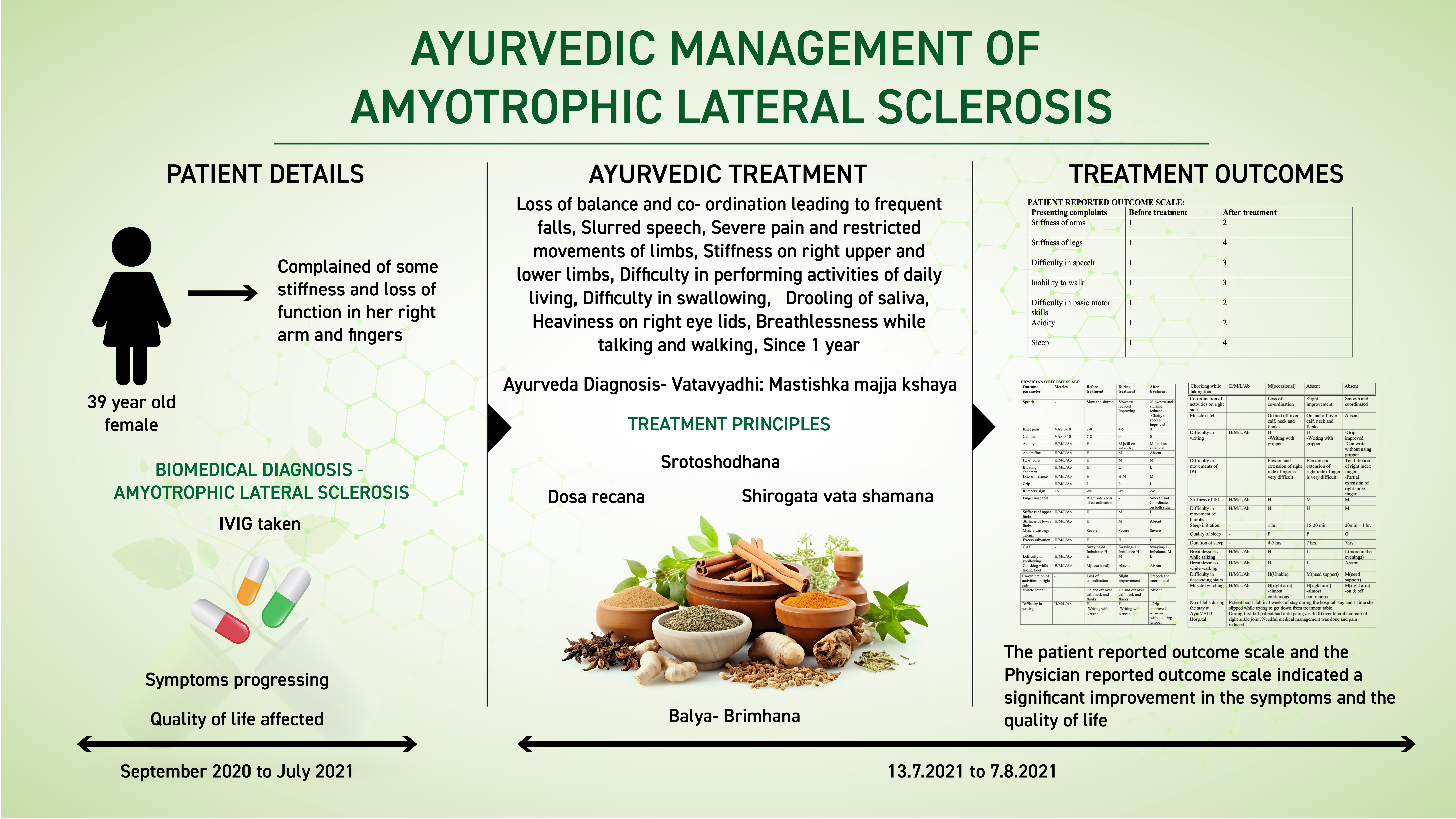
A 39-year-old female patient pre- diagnosed with ALS presented with severe pain associated with restricted movements of her right upper and lower limb which makes her day-to-day activities strenuous since 1 year. She feels like choking while swallowing food, has trouble eating, drooling of saliva and her food intake has reduced drastically. Her quality of life is badly affected as she is always disturbed by poor sleep due to her symptoms. She had tried conventional medicine but did not get relief. She now approached Dr Zankhana for ayurvedic management. The ayurvedic diagnosis was Vatavyadhi- Mastishka majja kshaya. The line of treatment followed was Sroto shodhana, dosa recana, shirogata vata shamana, balya and brmhana. After 15 days of Ayurvedic treatment, there was a noticeable reduction in her symptoms. Following 25 days of treatment, the patient experienced significant improvement in her clinical condition and overall quality of life. This case report demonstrates the successful ayurvedic management of ALS in a patient helping to improve the quality of life.
-
Summaries
-
Listen
-
Watch
-
View
-
Read
A 39-year-old female patient pre- diagnosed with ALS presented with severe pain associated with restricted movements of her right upper and lower limb which makes her day-to-day activities strenuous since 1 year. She feels like choking while swallowing food, has trouble eating, drooling of saliva and her food intake has reduced drastically. Her quality of life is badly affected as she is always disturbed by poor sleep due to her symptoms. She had tried conventional medicine but did not get relief. She now approached Dr Zankhana for ayurvedic management. The ayurvedic diagnosis was Vatavyadhi- Mastishka majja kshaya. The line of treatment followed was Sroto shodhana, dosa recana, shirogata vata shamana, balya and brmhana. After 15 days of Ayurvedic treatment, there was a noticeable reduction in her symptoms. Following 25 days of treatment, the patient experienced significant improvement in her clinical condition and overall quality of life. This case report demonstrates the successful ayurvedic management of ALS in a patient helping to improve the quality of life.
-
-
Timeline
-
Tabulated Summary
-
Narrative
TITLE OF CASE
A Successful ayurvedic management of Amyotrophic Lateral Sclerosis- A case report
Dr Zankhana Buch
ABSTRACT
A 39-year-old female patient pre- diagnosed with ALS presented with severe pain associated with restricted movements of her right upper and lower limb which makes her day-to-day activities strenuous since 1 year. She feels like choking while swallowing food, has trouble eating, drooling of saliva and her food intake has reduced drastically. Her quality of life is badly affected as she is always disturbed by poor sleep due to her symptoms. She had tried conventional medicine but did not get relief. She now approached Dr Zankhana who made the ayurvedic diagnosis as Vatavyadhi- Mastishka majja kshaya. The line of treatment followed was Sroto shodhana, dosa recana, shirogata vata shamana, balya and brimhana. After 15 days of Ayurvedic treatment, there was a noticeable reduction in her symptoms. Following 25 days of treatment, the patient experienced significant improvement in her clinical condition and overall quality of life.
KEYWORDS
ALS, vatavyadhi, majja kshaya, case report
INTRODUCTION
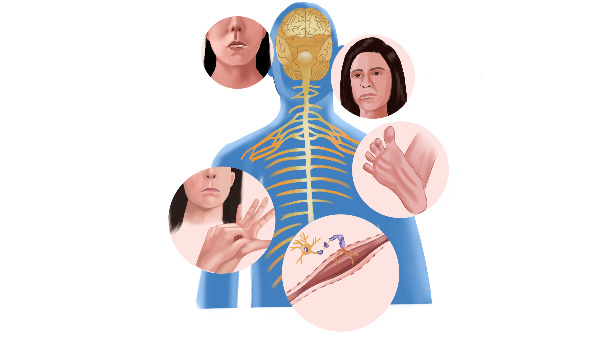
Amyotrophic lateral sclerosis (ALS), also known as Lou Gehrig’s disease, is a neurodegenerative condition affecting motor neurons — neurons responsible for voluntary muscle control — in the brain and spinal cord.It’s a progressive, terminal disease that ultimately leads to muscle wasting and paralysis. Most people experience limb onset ALS, in which symptoms begin your arms or legs. But 25 % of cases are bulbar onset ALS, in which symptoms start from affected neurons in the corticobulbar area of the brain stem.
- Trouble walking or doing usual daily activities.
- Tripping and falling.
- Weakness in the legs, feet or ankles.
- Hand weakness or clumsiness.
- Slurred speech or trouble swallowing.
- Weakness associated with muscle cramps and twitching in the arms, shoulders and tongue.
- Untimely crying, laughing or yawning.
- Thinking or behavioural changes.
Causes: The exact cause of bulbar onset ALS is unknown. In general, 90 % or more of ALS cases are sporadic, meaning they happen without the influence of hereditary or genetic factors. Approximately 10% of ALS cases can be traced to specific genetics.
Diagnostic criteria: Medical history and clinical evaluation is the basis of the diagnosis. Apart from this, EMG, nerve conduction study, MRI, blood and urine tests, spinal tap, muscle and nerve biopsy are some other options that are considered to confirm the diagnosis..
Progression of the disease: ALS is a progressive condition, but how rapidly motor neurons are affected can vary between people. Progression of this fatal disease will vary from one patient to the next. Research suggests symptoms in other areas of the body tend to appear an average of 7 months after onset of symptoms. Secondary areas affected earlier than 7 months are associated with shortened life expectancy.
Treatment & prognosis: There is no cure for ALS and no medication that can stop its progression. Though the average life expectancy upon diagnosis is two to five years, some patients succumb within six months while others are still alive 20 years later.
The medications that are generally prescribed are as follows:
- amitriptyline (Endep) for drooling
- dextromethorphan/quinidine (Nuedexta) for pseudobulbar affect
- analgesics for pain management
- antidepressants and anti-anxiety medications for mood symptoms
- riluzole (Rilutek) to potentially slow disease progression
Ultimately, treatment involves a focus on quality-of-life measures, like supporting breathing, improving communication, and managing pain. A speech pathologist can work with you to develop new ways to communicate and make speech understandable. As ALS progresses, gesture-based language and the use of technology help you continue to communicate. ALS often starts in the hands, feet, arms or legs. Then it spreads to other parts of the body. Muscles get weaker as more nerve cells die. This eventually affects chewing, swallowing, speaking and breathing.
There's generally no pain in the early stages of ALS. Pain also is not common in the later stages. ALS doesn't usually affect bladder control. It also usually doesn't affect the senses, including the ability to taste, smell, touch and hear. As ALS progresses, the risk of aspiration and weight loss increases, and the placement of a feeding tube becomes necessary.
PATIENT INFORMATION
In this case report, a 39 year old female patient pre diagnosed with ALS presented with severe pain associated with restricted movements of her right upper and lower limb which makes her day-to-day activities strenuous since 1year. She feels like choking while swallowing food, has trouble eating, drooling of saliva and her food intake has reduced drastically. Her quality of life is badly affected as she is always disturbed by poor sleep due to her symptoms. She had tried conventional medicine, but did not get relief. She now approached Dr Zankhana who made the ayurvedic diagnosis as Vatavyadhi- Mastishka majja kshaya.
No relevant Family/Surgical/Genetic History.
Psychosocial history: Highly stressed
Addictions- None
CLINICAL FINDINGS
General examination and systemic examinations done.
Speech – unclear and slurred
Loss of balance +
Drooling of saliva noted
Finger nose test- dysmetria
Heel to shin test- dysmetria
Dysdiadochokinesia- present
Romberg sign- NegativeTIMELINE
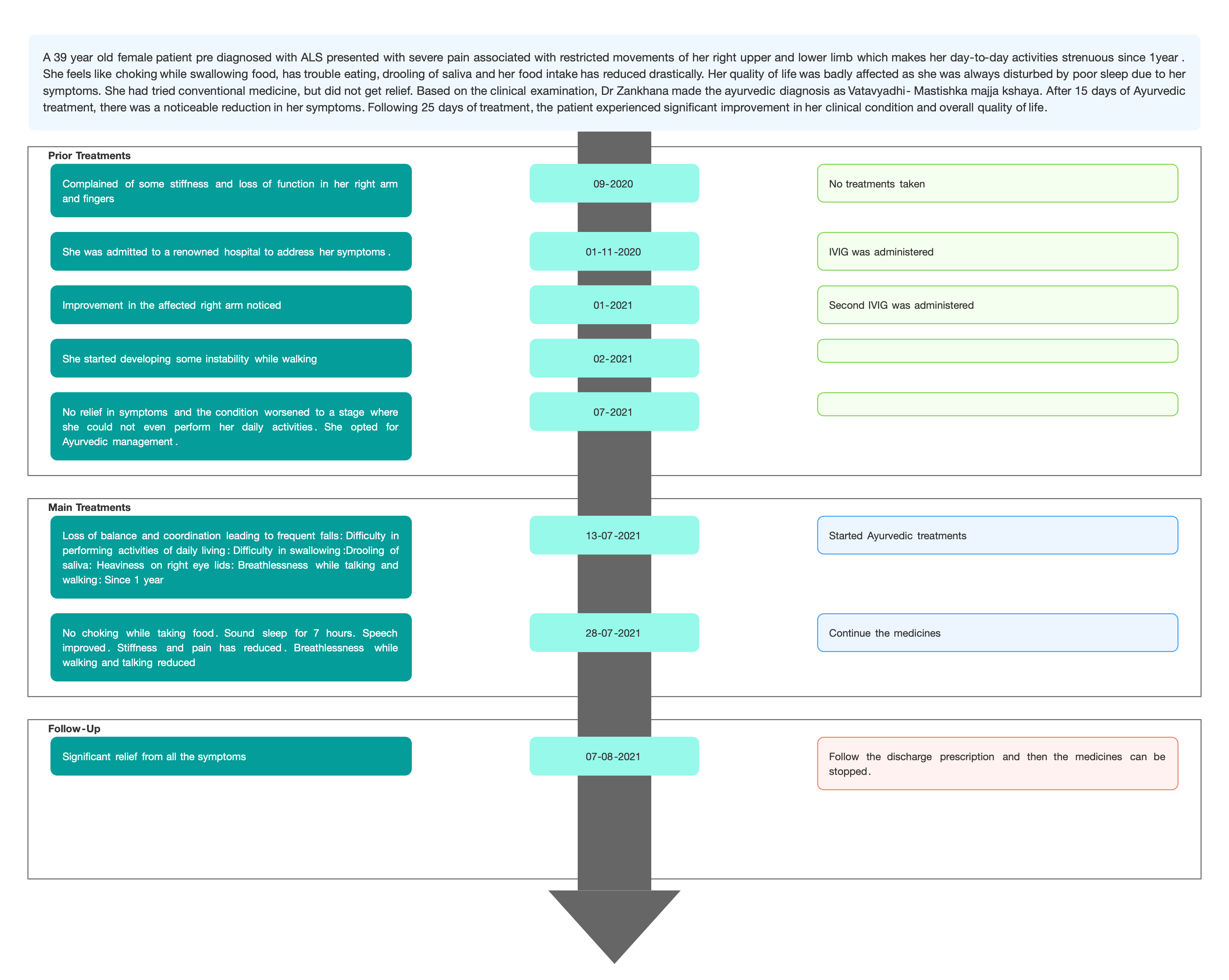
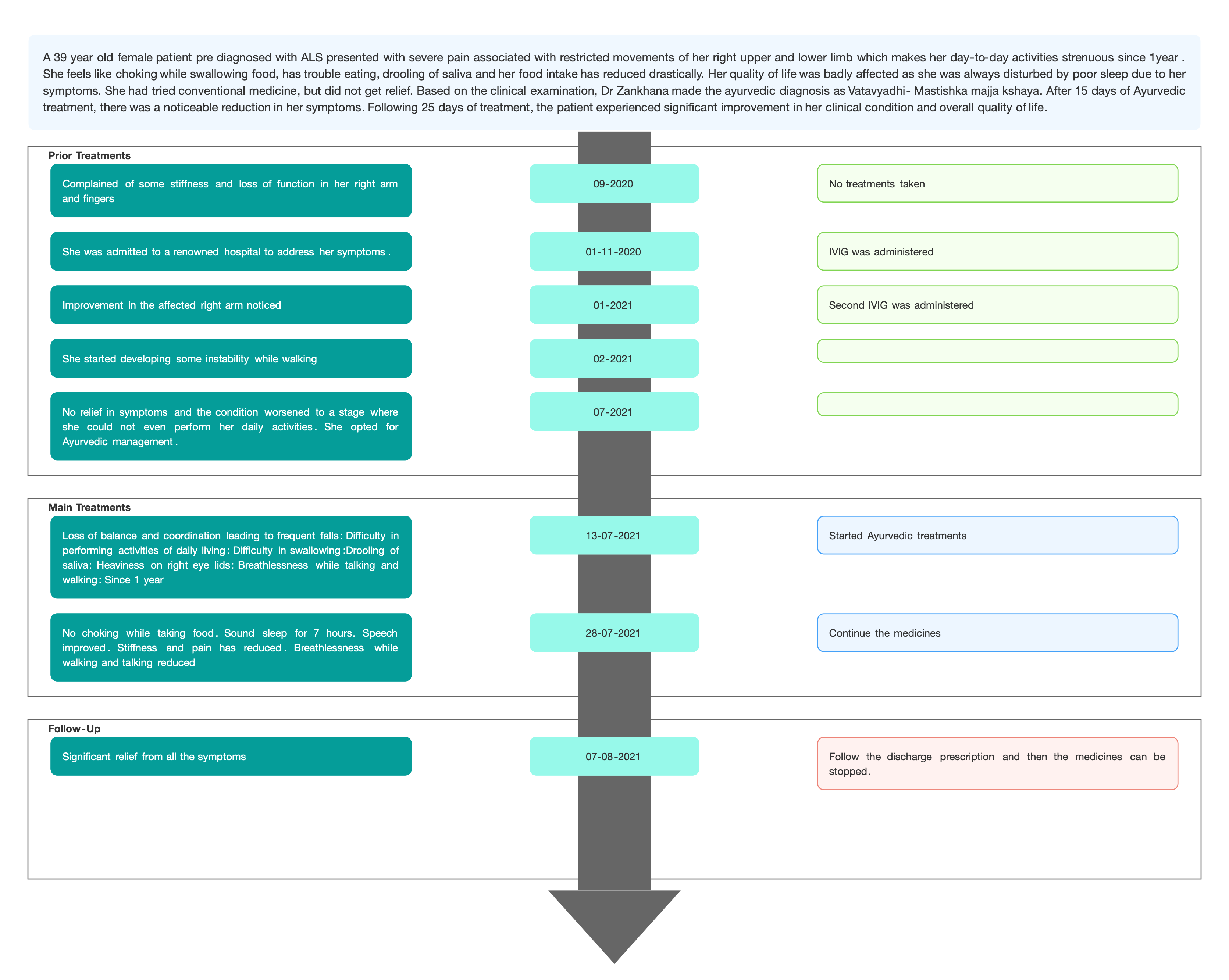
Image 1. Timeline of events added below
DIAGNOSTIC ASSESSMENT
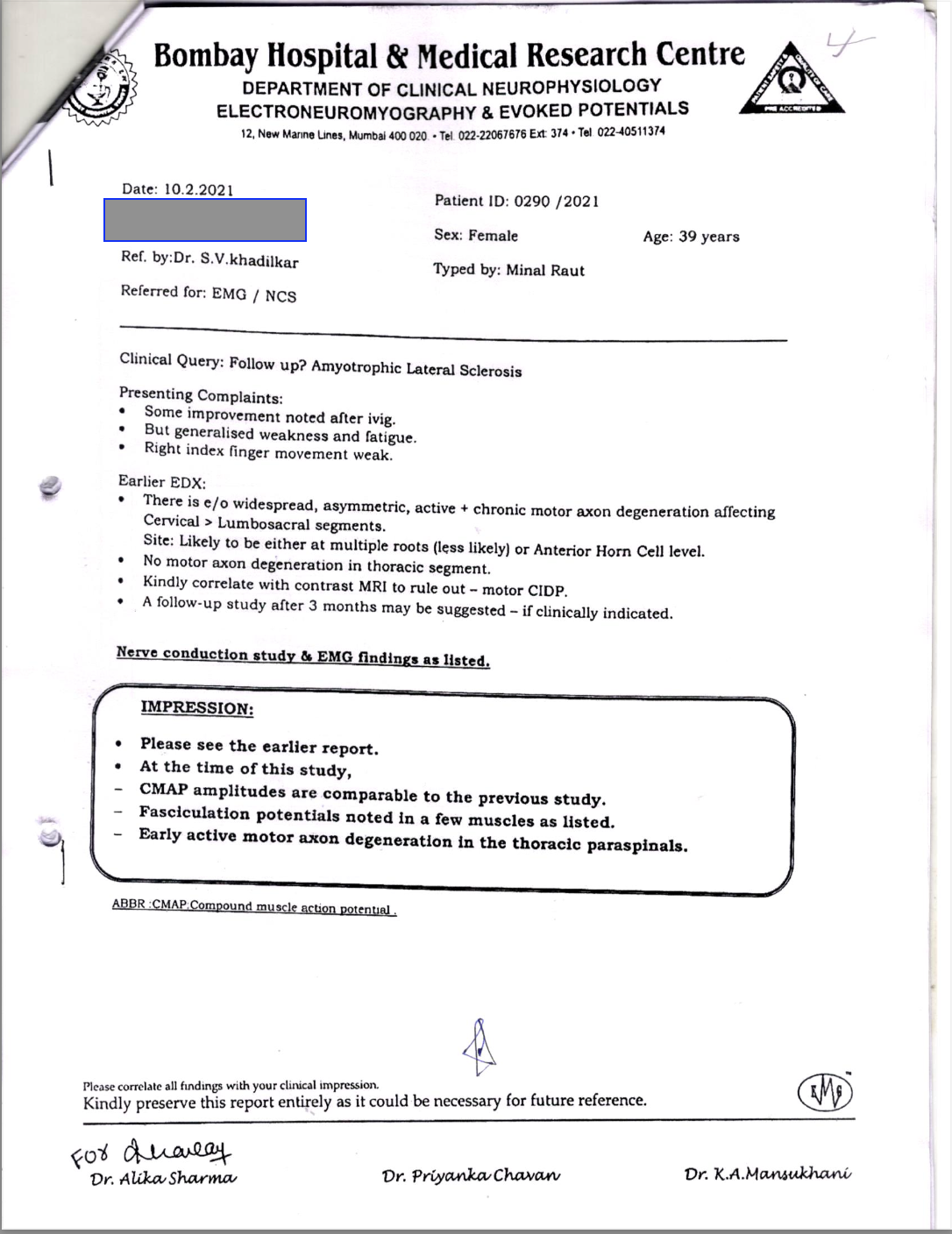
Modern Diagnostic parameter: The biomedical diagnosis was confirmed as ALS based on the EMG reports and the MRI Cervical and Lumbar spine.
Image 2. EMG dated 21.11.2020
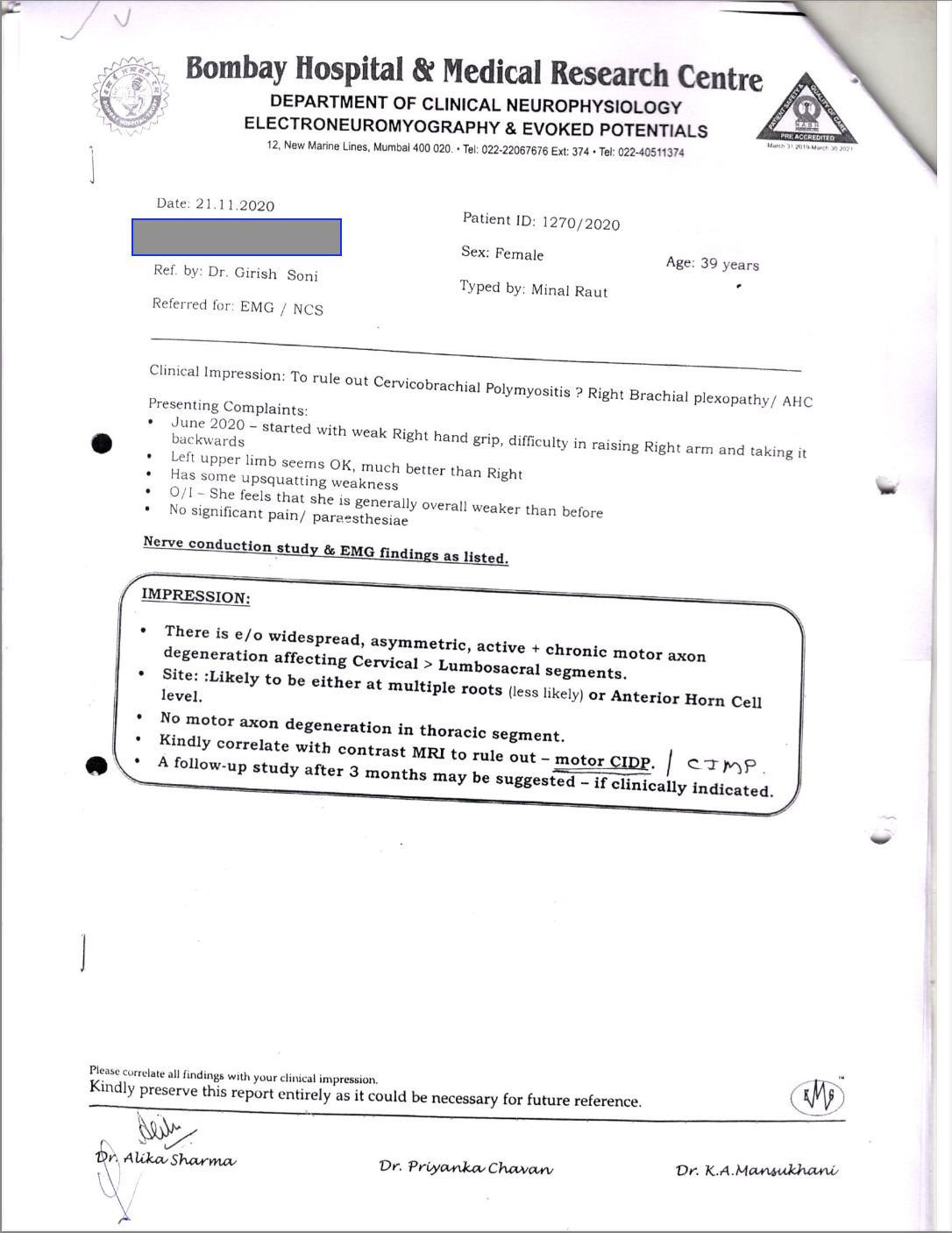
Image 3. MRI Cervical and Lumbar spine dated November 2020
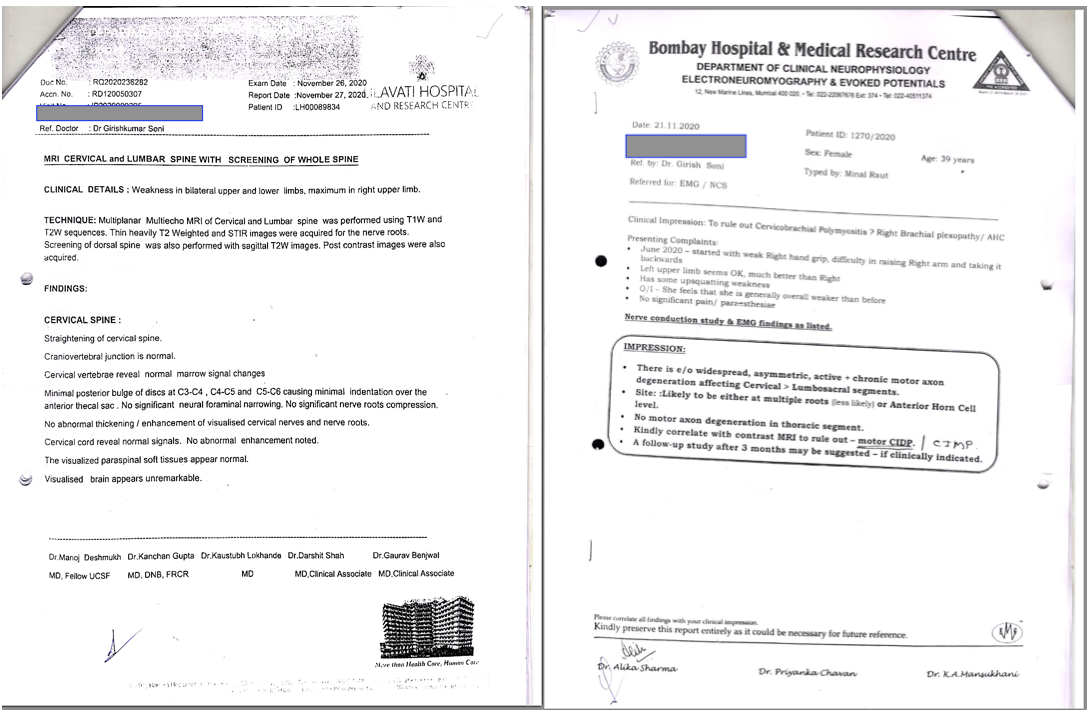
Image 4. Diagnosis proof document EMG dated 10.2.21
Ayurvedic Assessment was done based on the presenting complaints and clinical evaluation. The treating physician confirmed the Ayurvedic diagnosis as Vatavyadhi- Masthishka majja kshaya.
Baseline evaluation
Image 5. Physician outcome scale- at baseline
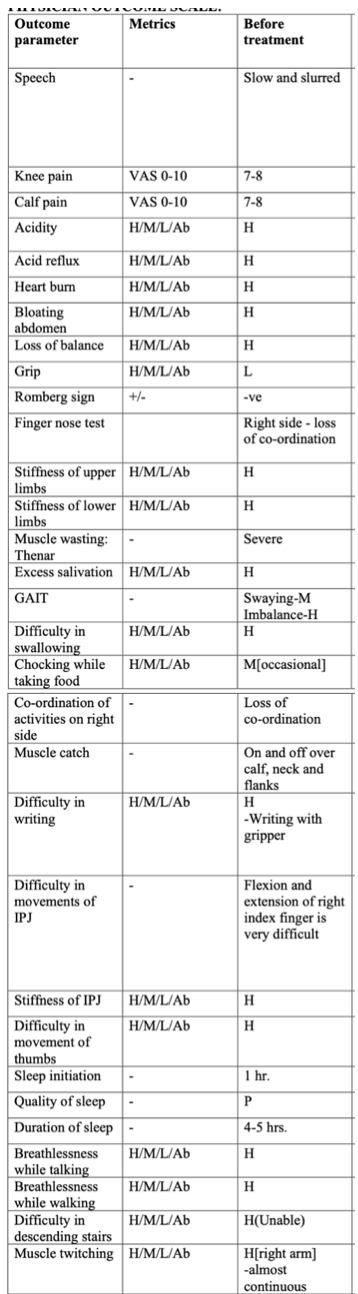
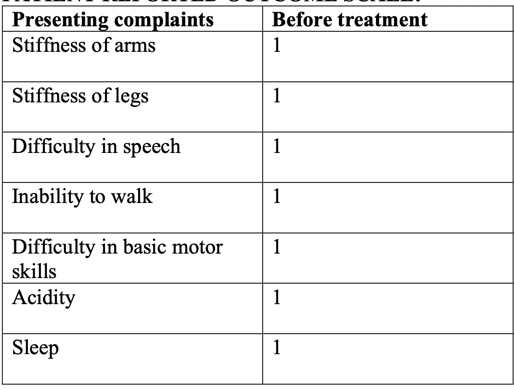
Image 6. Patient outcome scale- at baseline
Differential Diagnosis- Multifocal motor neuropathy, Neuromyotonia, Poliomyelitis, Radiation spinal myelopathy, Spinal bulbar muscular atrophy, Spinal muscular atrophy.
Based on previous treatment records investigation reports, the case was diagnosed as Amyotrophic lateral sclerosis.Prognosis: The median survival is of 3 to 5 years; however, around 30% of patients are alive after five years of diagnosis and 10% to 20% after ten years. Factors associated with better survival include increased weight at diagnosis (mild obesity by BMI), younger age at onset, higher ALS functional rating scale score, FVC at presentation, and limb rather than bulbar symptoms. In this case, inspite of taking standard of care patient did not get any relief in clinical condition. Moreover the condition worsened to a stage where she could not even perform her daily activities. After 15 days of Ayurvedic treatment reduction in the symptoms were observed. After 25 days of treatment the patient got significant improvement in the clinical condition and Quality of life.
THERAPEUTIC INTERVENTION
Refer the tab ‘Treatment’ in the Portal.
FOLLOW-UP AND OUTCOMES
The patient had 2 follow ups in total. The subjective parameters were the primary assessment modality.
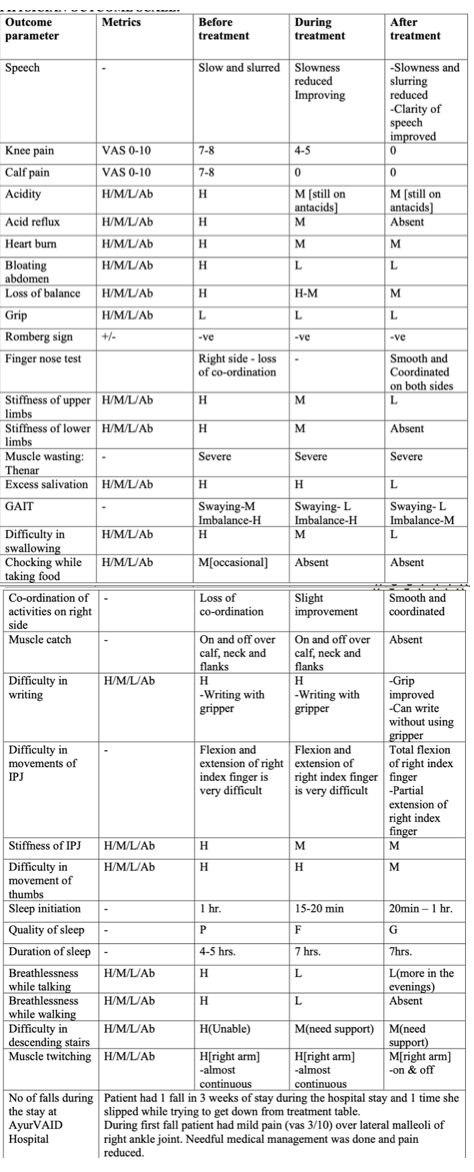
Clinician-based assessment; After 15 days of Ayurvedic treatments, speech improved, stiffness and pain in the limbs reduced. Patient had no chocking while taking food. Sleep initiation time reduced and the patient could sleep for 7 hours. Breathlessness while walking and talking also reduced. After 25 days of treatment, condition improved significantly. Slowness and slurring of speech reduced with improved clarity. Patient has no pain and stiffness in lower limbs, attained coordination of activities on right side and no breathlessness while walking. With Ayurvedic treatments, the QOL of the patient could be improved.
Physician reported outcome scale were documented before, during and after treatment to analyse the outcome of the treatments.
Image 7. Physician outcome scale before, during and after treatment charted
Patient-assessed; Patient assessed outcome was documented throughout the treatment.
Image 8. Patient outcome scale before, after treatment charted
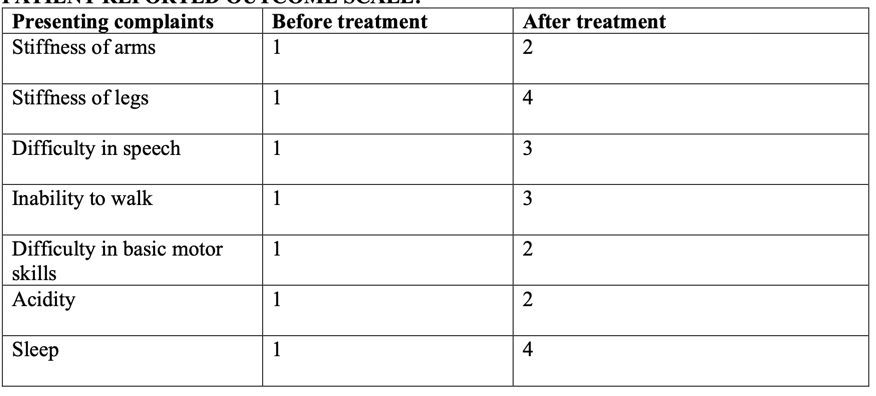
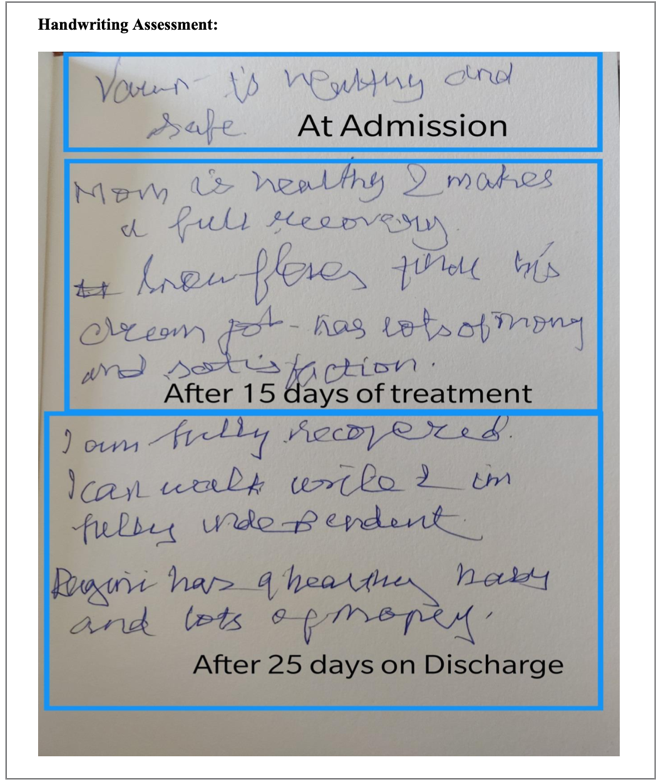
Image 9. Changes in handwriting before, during and after treatment.
Intervention adherence and tolerability – The patient adhered to the prescribed treatments and tolerated the treatments well.
Method of assessment- Lab investigations, images, questionnaire and symptom evaluation were the primary assessment criteria.
Adverse and unanticipated events; None reported
DISCUSSION:
The median survival of ALS, is of 3 to 5 years; however, around 30% of patients are alive after five years of diagnosis and 10% to 20% after ten years. Factors associated with better survival include increased weight at diagnosis (mild obesity by BMI), younger age at onset, higher ALS functional rating scale score, FVC at presentation, and limb rather than bulbar symptoms. In this case report, after 25 days of treatment, condition improved significantly. Slowness and slurring of speech reduced with improved clarity. Patient has no pain and stiffness in lower limbs, attained coordination of activities on right side and no breathlessness while walking. With Ayurvedic treatments, the QOL of the patient could be improved. The rationale of the treatment was as follows:
- Nasyam- Helps in removal of shirogata kapha avarana, assists sroto shodhana and for vata nirharana
- Sarvanga Choornapinda sweda- Overcoming stiffness, inducing muscle relaxation, improving flexibility and range of movement
- Dasamoola ksheeradhara- To aid in vata shamana, bring about mardavata
- Virechana- For utkleshana of doshas prior to virechana, as pre-OP procedure. For rechana of dushita doshas (metabolic wastes) and to bring about lightness in the body.
- Yoga vasti- Further vata shamana, to improve metabolic functions and to maintain proper gut health. For rasayana purpose
- Sarvanga Kayaseka and Nadi sweda- Vatashamana, brimhana, to increase muscle relaxation and improve flexibilty.
- Shirovasti- For shirogata vata shamana, induce relaxation of mind and to bring about calmness
- Shastikasali Pinda sweda- For balya and brimhana purposes, vata shamana and to induce muscle relaxation
- Balasairyekadi kashayam- To promote muscle strength, agni deepana
- 10.Saraswatarishtam- To promote calmness of mind, assist in undisturbed sleep
- 11.Kooshmandavaleha- Brimhana, agni deepana
PATIENT’S PERSPECTIVE
Not available.
LEARNING POINTS/TAKE HOME MESSAGES
ALS is one of the most devastating disorders that affects the function of nerves and muscles.Currently, there is no cure for this disease. The treatment aims at management of symptoms. This case highlights the efficacy of ayurveda in successfully managing Amyotrophic Lateral Sclerosis helping to improve the quality of life in the patient.
INFORMED CONSENT
Written consent obtained from patient for publishing of the case report in the Portal
ACKNOWLEDGEMENTS
None
CONFLICT OF INTEREST
None declared.
FUNDING
None
REFERENCE
-
Immersive Learning
-
Modern Diagnosis
MODERN DIAGNOSIS: Amyotrophic Lateral Sclerosis
ABOUT THE DISEASE:
Amyotrophic lateral sclerosis (ALS), also known as Lou Gehrig’s disease, is a neurodegenerative condition affecting motor neurons — neurons responsible for voluntary muscle control — in the brain and spinal cord.It’s a progressive, terminal disease that ultimately leads to muscle wasting and paralysis. Most people experience limb onset ALS, in which symptoms begin your arms or legs. But 25 % of cases are bulbar onset ALS, in which symptoms start from affected neurons in the corticobulbar area of the brain stem.
- Trouble walking or doing usual daily activities.
- Tripping and falling.
- Weakness in the legs, feet or ankles.
- Hand weakness or clumsiness.
- Slurred speech or trouble swallowing.
- Weakness associated with muscle cramps and twitching in the arms, shoulders and tongue.
- Untimely crying, laughing or yawning.
- Thinking or behavioural changes.
Causes: The exact cause of bulbar onset ALS is unknown. In general, 90 % or more of ALS cases are sporadic, meaning they happen without the influence of hereditary or genetic factors. Approximately 10% of ALS cases can be traced to specific genetics.
Diagnostic criteria: Medical history and clinical evaluation is the basis of the diagnosis. Apart from this, EMG, nerve conduction study, MRI, blood and urine tests, spinal tap, muscle and nerve biopsy are some other options that are considered to confirm the diagnosis.
Image 1. EMG dated 21.11.2020
Image 2. MRI Cervical and Lumbar spine dated November 2020
Image 3. Diagnosis proof document EMG dated 10.2.21
In this case report, a 39 year old female patient pre diagnosed with ALS presented with severe pain associated with restricted movements of her right upper and lower limb which makes her day-to-day activities strenuous since 1year . She feels like choking while swallowing food, has trouble eating, drooling of saliva and her food intake has reduced drastically. Her quality of life is badly affected as she is always disturbed by poor sleep due to her symptoms. She had tried conventional medicine, but did not get relief. She now approached Dr Zankhana who made the ayurvedic diagnosis as Vatavyadhi- Mastishka majja kshaya.
Baseline evaluation:
Image 4. Physician outcome scale documented at baseline
Image 5. Patient reported outcome scale documented at baseline
Progression of the disease: ALS is a progressive condition, but how rapidly motor neurons are affected can vary between people. Progression of this fatal disease will vary from one patient to the next. Research suggests symptoms in other areas of the body tend to appear an average of 7 months after onset of symptoms. Secondary areas affected earlier than 7 months are associated with shortened life expectancy.
Treatment & prognosis: There is no cure for ALS and no medication that can stop its progression. Though the average life expectancy upon diagnosis is two to five years, some patients succumb within six months while others are still alive 20 years later.
The medications that are generally prescribed are as follows:
- amitriptyline (Endep) for drooling
- dextromethorphan/quinidine (Nuedexta) for pseudobulbar affect
- analgesics for pain management
- antidepressants and anti-anxiety medications for mood symptoms
- riluzole (Rilutek) to potentially slow disease progression
Ultimately, treatment involves a focus on quality-of-life measures, like supporting breathing, improving communication, and managing pain. A speech pathologist can work with you to develop new ways to communicate and make speech understandable. As ALS progresses, gesture-based language and the use of technology help you continue to communicate. ALS often starts in the hands, feet, arms or legs. Then it spreads to other parts of the body. Muscles get weaker as more nerve cells die. This eventually affects chewing, swallowing, speaking and breathing.
There's generally no pain in the early stages of ALS. Pain also is not common in the later stages. ALS doesn't usually affect bladder control. It also usually doesn't affect the senses, including the ability to taste, smell, touch and hear. As ALS progresses, the risk of aspiration and weight loss increases, and the placement of a feeding tube becomes necessary.
Reference
- https://www.mayoclinic.org/diseases-conditions/amyotrophic-lateral-sclerosis/symptoms-causes/syc-20354022
- https://scarysymptoms.com/2017/01/slowest-als-can-progress/
-
Ayurveda Diagnosis
AYURVEDA DIAGNOSIS: Vatavyadhi: Masthishka Majja Kshaya
The biomedical diagnosis of Amyotrophic lateral sclerosis cannot be directly correlated to any specific condition mentioned in the classical textbooks of Ayurveda. There are diseases that can be directly linked to the diseases mentioned in the Ayurvedic texts. But sometimes, the diagnosis is such that the physician uses his yukti to create a term for the disease. Though the classical text clearly mentions that giving a name for a disease is not mandatory for treating a condition, here a terminology was given for the purpose of educating the reader. Based on the symptoms, the ayurvedic correlation is made to Vatavyadhi- Masthishka majja kshaya.
About Majja dhatu:
करोति तत्र सौशीर्यम् अस्थिनाम् मध्ये समीरणः
मेदसस्तानि पूरयन्ते स्नेहो मज्ज ततः स्मृतः||
During the formation of asthi dhatu or bone, vayu bhuta or air element (one of 5 basic elements or pancha mahabhuta) creates spaces in bones. These spaces are filled with nourishing tissues of medha or fat which help in the formation of majja or bone marrow.
Functions of majja dhatu:
मज्जा स्नेहं बलं शुक्रपुश्टिं पूरणम् अस्थिनां च करोति |
It nourishes the body and helps to maintain its functions. Majja dhatu strengthens the body, fills bones, and nourishes shukra dhatu. Majja vriddhi will cause netra- manga guarava and parva sthoulya. Majja kshaya will cause asthma shaushirya, bhrama and timira darshana. And the physician has specifically connected the majja kshaya to the brain.
In this case report, a 39 year old female patient pre diagnosed with ALS presented with severe pain associated with restricted movements of her right upper and lower limb which makes her day-to-day activities strenuous since 1year . She feels like choking while swallowing food, has trouble eating, drooling of saliva and her food intake has reduced drastically. Her quality of life is badly affected as she is always disturbed by poor sleep due to her symptoms. She had tried conventional medicine, but did not get relief. She now approached Dr Zankhana who made the ayurvedic diagnosis as Vatavyadhi- Mastishka majja kshaya.
About Vatavyadhi: Vayu gets aggravated by two factors –
Marga avarana and dhatu kshaya – depletion of essence of tissues. In this case report, dhatu kshaya has been identified as the primary cause. Vata is the deranged dosa basically.वात एव व्याधिः वात व्याधिः ॥(Ma.Ni.22)
Therefore Vata Vyadhi can be defined as a disease caused by vitiated Vata.
Causes & samprapti : The nidana are the vata prakopa hetu like excess intake of rukṣa, improper ahara and vihara. The vitiated vata occupies the Rikta Srotas or the empty, susceptible channels of the body thus causing many Ekanga (limited to particular parts of the body) or Sarvanga (afflicting the whole body) diseases. Such diseases which are manifested either in certain portions of the body or the whole body is called Vata Vyadhis.
देहे स्रोतांसि रिक्तानि पूरियत्वा अनलो बली।
करोत इविवतान् व्याधीन् सवर्वाङ्ग एकाङ्ग संश्रयान्॥(CS.Ci.28)
Symptoms:
एवं विधानि रूपाणि करोति कुपितो अनिलः। हेतुस्थान विषेषाञ्च भवेद् रोग विषेश कृत् ॥(CS.Ci.28)
Aatma Rupa or symptoms manifested in various forms of Vata Vyadhi are the symptoms of Vata Vyadhi. Vata Vyadhi manifests in several forms. The symptoms too will be identical to the manifestation of the disease. The symptoms of manifested condition are the symptoms of Vata Vyadhi. Swarupa (form, characteristic) – Apaaya (instability of symptoms i.e. extremes of manifestation, absent sometimes and appearing at other times, severe sometimes and feeble other times) and Laghuta (feeling of lightness or emptiness) are the characteristic features of all the Vata Vyadhis.
Treatment and rationale as explained by the physician: There is no line of treatment that can be proposed from the classical textbooks of Ayurveda. As this is a unique diagnosis, given by the physician according to her yukti. But as vata is very predominant in this condition, vata hara line of treatment would be ideal.
Table 1. Medicines/therapies and the rationale of treatment
Medicines/ Procedures
Rationale
Nasyam
Helps in removal of shirogata kapha avarana, assists sroto shodhana and for vata nirharana
Sarvanga Choornapinda sweda
Overcoming stiffness, inducing muscle relaxation, improving flexibility and range of movement
Dasamoola ksheeradhara
To aid in vata shamana, bring about mardavata
Virechana
For utkleshana of doshas prior to virechana, as pre-OP procedure
For rechana of dushita doshas (metabolic wastes) and to bring about lightness in the body
Yoga vasti
Further vata shamana, to improve metabolic functions and to maintain proper gut health. For rasayana purpose
Sarvanga Kayaseka and Nadi sweda
Vatashamana, brimhana, to increase muscle relaxation and improve flexibilty
Shirovasti
For shirogata vata shamana, induce relaxation of mind and to bring about calmness
Shastikasali Pinda sweda
For balya and brimhana purposes, vata shamana and to induce muscle relaxation
Balasairyekadi kashayam
To promote muscle strength, agni deepana
Saraswatarishtam
To promote calmness of mind, assist in undisturbed sleep
Kooshmandavaleha
Brimhana, agni deepana
Reference
-
Treatment
Name of Medicine Dosage Form Dosage Mode of Administrtation From - To (Date) Medicine Reference Anu Tailam Taila 7 Drops Intranasal, once a day 2021-07-14 - 2021-07-20 Sahasrayogam. Taila Prakarana Balaguloochyadi Taila, Karpasasthyadi Taila Taila Required Quantity Applying on the head. Karpasasthyadi on the face and neck 2021-07-14 - 2021-07-20 Sahasrayogam. Taila Prakarana Kolakulathadi Curna Curna Required Quantity Sarvanga Curnapinda sweda 2021-07-13 - 2021-07-19 CS.Su.3.18 Dhanwantaram Tailam Taila Required Quantity Prior to Pinda sweda 2021-07-13 - 2021-07-19 Sahasrayogam. Taila Prakarana Dasamoola ksheera Dhara Dravya Required Quantity Sarvanga Dhara 2021-07-13 - 2021-07-26 Anubhuta Yoga Shatpala ghrtam Ghrtam 30, 50, 80 and 100 ml respectively Snehapanam, on empty stomach, on alternate days 2021-07-21 - 2021-07-24 AH. Ci. 5.22 - 23 Avipatti Curna Curna 12 gms Virecana, on empty stomach 2021-07-26 - 2021-07-26 Sahasrayoga - Curna prakaranam Avipatti Curna Curna 12 gms Virecana, on empty stomach 2021-08-01 - 2021-08-01 Sahasrayoga - Curna prakaranam Pippalyadi taila + Dhanwantaram taila Taila 40 ml + 40 ml Yoga vasti 2021-08-02 - 2021-08-02 Pippalyadi taila- Bhaishajya ratnavali, Arshorogadhikara 115-118: Mustadi Rajayapana vasti Vasti drava Sufficient quantity Rajayapana vasti 2021-08-08 - 2021-08-08 CS.Si.12.16 Dhanwantaram Tailam + Balashwagandhadi Taila Taila Required Quantity Sarvanga abhyanga on 4, 6 and 7 2021-08-04 - 2021-08-07 Sahasrayogam. Taila Prakarana Brahmi taila Taila Required Quantity Sirovasti on 2, 3, 5 and 8th 2021-08-02 - 2021-08-08 Sahasrayogam. Taila Prakarana Shashtika pinda sweda Sweda dravya Required Quantity Sirovasti on 2, 3, 5 and 8th 2021-08-02 - 2021-08-08 Keraleeya Cikitsa Karma Balasairyekadi kashayam Kashayam 15 ml With 45 ml of luke warm water on empty stomach twice daily 2021-07-13 - 2021-08-08 Arogyakalpadruma Saraswatarishtam Arishta 15 ml Twice daily after food 2021-07-13 - 2021-08-23 Bhaishajya Ratnavali- Rasayana. 178-191 Kooshmandavaleha Lehya 1 tsp At 9 am and 5 pm 2021-07-13 - 2021-08-08 Bhaishajya Ratnavali, Raktapitta. 45-51 Ashtavargam kashayam Kashayam 15 ml With 45 ml of luke warm water on empty stomach twice daily 2021-08-09 - 2021-08-23 Sahasra yogam - Kashaya Prakarana Dhanwantaram gulika Gulika 1 Oral, With warm water twice daily after food. 2021-08-09 - 2021-08-23 Sahasra yogam - Gulika Prakarana Panchagavya Ghrtam Ghrtam 1/2tsp -0-1tsp Oral, with milk 9 am and 5 pm 2021-08-09 - 2021-08-23 Sahasra yogam - Ghrta Prakarana Dhanwantaram Tailam Taila Required Quantity Prior to Pinda sweda 2021-08-09 - 2021-08-23 Sahasrayogam. Taila Prakarana Ksheerbala 101 Taila 2 drops Nasya 2021-08-09 - 2021-08-23 Sahasrayogam. Taila Prakarana -
Outcome Measures
In this case report, a 39 year old female patient pre diagnosed with ALS presented with severe pain associated with restricted movements of her right upper and lower limb which makes her day-to-day activities strenuous since 1year . She feels like choking while swallowing food, has trouble eating, drooling of saliva and her food intake has reduced drastically. Her quality of life is badly affected as she is always disturbed by poor sleep due to her symptoms. She had tried conventional medicine, but did not get relief. She now approached Dr Zankhana who made the ayurvedic diagnosis as Vatavyadhi- Mastishka majja kshaya.
Assessment: Subjective parameters were assessed to analyse the outcome of the treatment.
Subjective parameters: In this case, after 15 days speech improved, stiffness and pain of limbs- reduced. There is no chocking while taking food. Sleep - 7 hours sound sleep. Breathlessness while walking and talking- reduced. After 35 days, patient got discharged.
Speech- slowness and slurring reduced with improved clarity.
No pain and stiffness in lower limbs.
Mild stiffness- in upper limbs
Attained coordination of activities on right side
No breathlessness while walkingImage 1. Physician outcome scale before, during and after treatment charted
Image 2. Patient outcome scale before, and after treatment charted
Image 3. Handwriting assessment before, during and after treatment documented
The ayurvedic treatments definitely helped in improving the quality of health. The disease progression was not seen after starting the Ayurvedic treatments.
-