Featured Case
-
Abstract
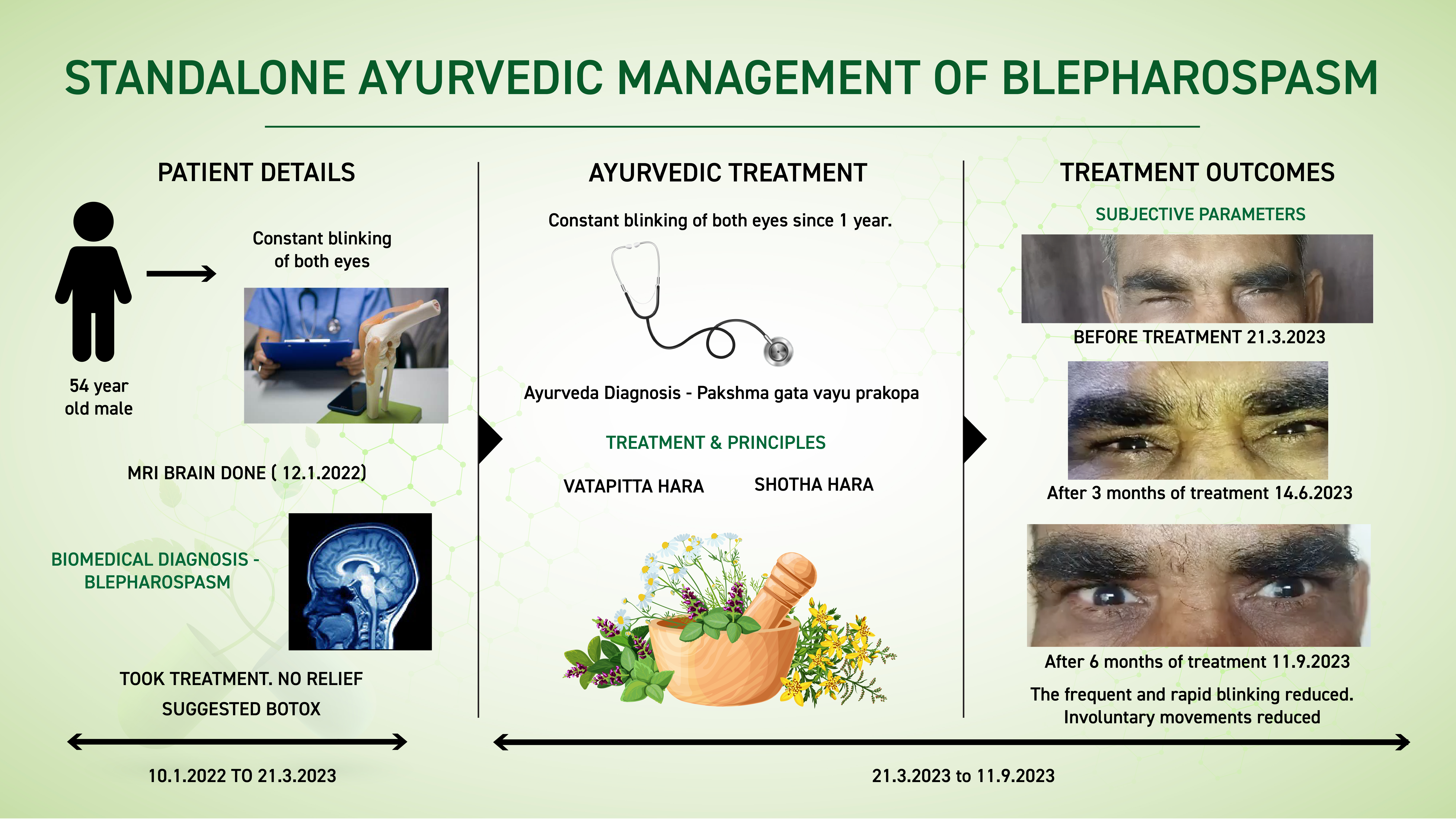
A 54-year-old male patient complained of constant blinking of both eyes since 1 year. Based on the MRI report, the condition was pre-diagnosed as Blepharospasm. Despite receiving standard of care, the condition continued to worsen, significantly impacting his daily life. He was recommended Botox therapy, which the patient refused and opted for Ayurveda. Dr Rajnikanth diagnosed this condition as Pakshma gata vayu prakopa. The line of treatment followed was Vatapitta hara and shotha hara. The medicines were picked targeting the relief from the symptoms and boosting the immunity and promoting the digestion. After six months of Ayurvedic treatment, the patient experienced substantial relief from the symptoms. This case report demonstrates the successful standalone ayurvedic management of Blepharospasm in a patient who was not getting satisfactory relief inspite of standard of care and was recommended Botox therapy as the solution.
-
Summaries
-
Listen
-
Watch
-
View
-
Read
A 54-year-old male patient complained of constant blinking of both eyes since 1 year. Based on the MRI report, the condition was pre-diagnosed as Blepharospasm. Despite receiving standard of care, the condition continued to worsen, significantly impacting his daily life. He was recommended Botox therapy, which the patient refused and opted for Ayurveda. Dr Rajnikanth diagnosed this condition as Pakshma gata vayu prakopa. The line of treatment followed was Vatapitta hara and shotha hara. The medicines were picked targeting the relief from the symptoms and boosting the immunity and promoting the digestion. After six months of Ayurvedic treatment, the patient experienced substantial relief from the symptoms. This case report demonstrates the successful standalone ayurvedic management of Blepharospasm in a patient who was not getting satisfactory relief inspite of standard of care and was recommended Botox therapy as the solution.
-
-
Timeline
-
Tabulated Summary
-
Narrative
TITLE OF CASE
Standalone Ayurvedic management of blepharospasm - a case report
Dr Rajnikanth
ABSTRACT
A 54-year-old male patient complained of constant blinking of both eyes since 1 year. Based on the MRI report, the condition was pre-diagnosed as Blepharospasm. Despite receiving standard of care, the condition continued to worsen, significantly impacting his daily life. He was recommended Botox therapy, which the patient refused and opted for Ayurveda. Dr Rajnikanth diagnosed this condition as Pakshma gata vayu prakopa. The line of treatment followed was Vatapitta hara and shotha hara. The medicines were picked targeting the relief from the symptoms and boosting the immunity and promoting the digestion. After six months of Ayurvedic treatment, the patient experienced substantial relief from the symptoms. This case report demonstrates the successful standalone ayurvedic management of Blepharospasm in a patient who was not getting satisfactory relief inspite of standard of care and was recommended Botox therapy as the solution.
KEYWORDS
Blepharospasm, pakshma, vayu kopa, blinking, case report, ayurveda
INTRODUCTION
Blepharospasm is a neurologic disorder that causes uncontrollable muscle movements that causes the eyelids to close or have difficulty opening (dystonia). This can affect patients’ ability to see. It's a rare disease and can be difficult to diagnose. Approximately 2,000 people are diagnosed with it each year.
Symptoms and causes: Researchers are still working to confirm its cause. Blepharospasm may be due to abnormal electrical activity in the basal ganglia, structures deep within the brain that help control movement. Usually people get blepharospasm in middle age, but it can occur at any age. Sometimes dry eye may look like blepharospasm so it is important to get medical advise. Certain medications can cause blepharospasm. People with certain medical conditions can get blepharospasm. These conditions include:
General dystonia.
Meige syndrome.
Tardive dyskinesia.
Wilson's disease.
In the early stages, you may have frequent blinking and the symptoms come and go. You’ll experience them during the day, and they’ll go away while you are sleeping. As the disease progresses, they become more severe with fewer periods of relief.
The general symptoms are as follows: Constant blinking, Dry eyes, Eye narrowing, Tired, Irritated eyes and Difficulty keeping your eyes open.
Diagnosis; Medical history and clinical evaluation are the main diagnostic criteria. There are no laboratory tests to confirm the diagnosis of Blepharospasm.
Treatment: Oral medications including drugs that block involuntary muscle movements (anticholinergics), but their effect is usually limited.
Botulinum toxin injections, which weaken the eye muscles’ ability to twitch. Botulinum toxin is one of the most effective treatments for blepharospasm. There are several variations available. Surgery (myectomy), a procedure to remove part or all of the overactive eye muscles. The most common and most effective treatment is botulinum toxin. Medications are effective in a small number of people. But they often cause side effects such as memory problems, drowsiness and dry mouth.
Prognosis: It depends on the severity of your symptoms and response to therapy. When blepharospasm is not improved with medical therapy, surgery may be indicated.
PATIENT INFORMATION
In this case report, a 54-year-old male patient complained of constant blinking of both eyes since 1 year. Based on the MRI report, the patient was pre-diagnosed as Blepharospasm. Despite receiving standard of care, the condition continued to worsen, significantly impacting his daily life. He was recommended Botox therapy, which the patient refused and opted for Ayurveda.
No relevant family/genetic/surgical/psychosocial history.
CLINICAL FINDINGS
General physical examination was done.
Vitals- Normal
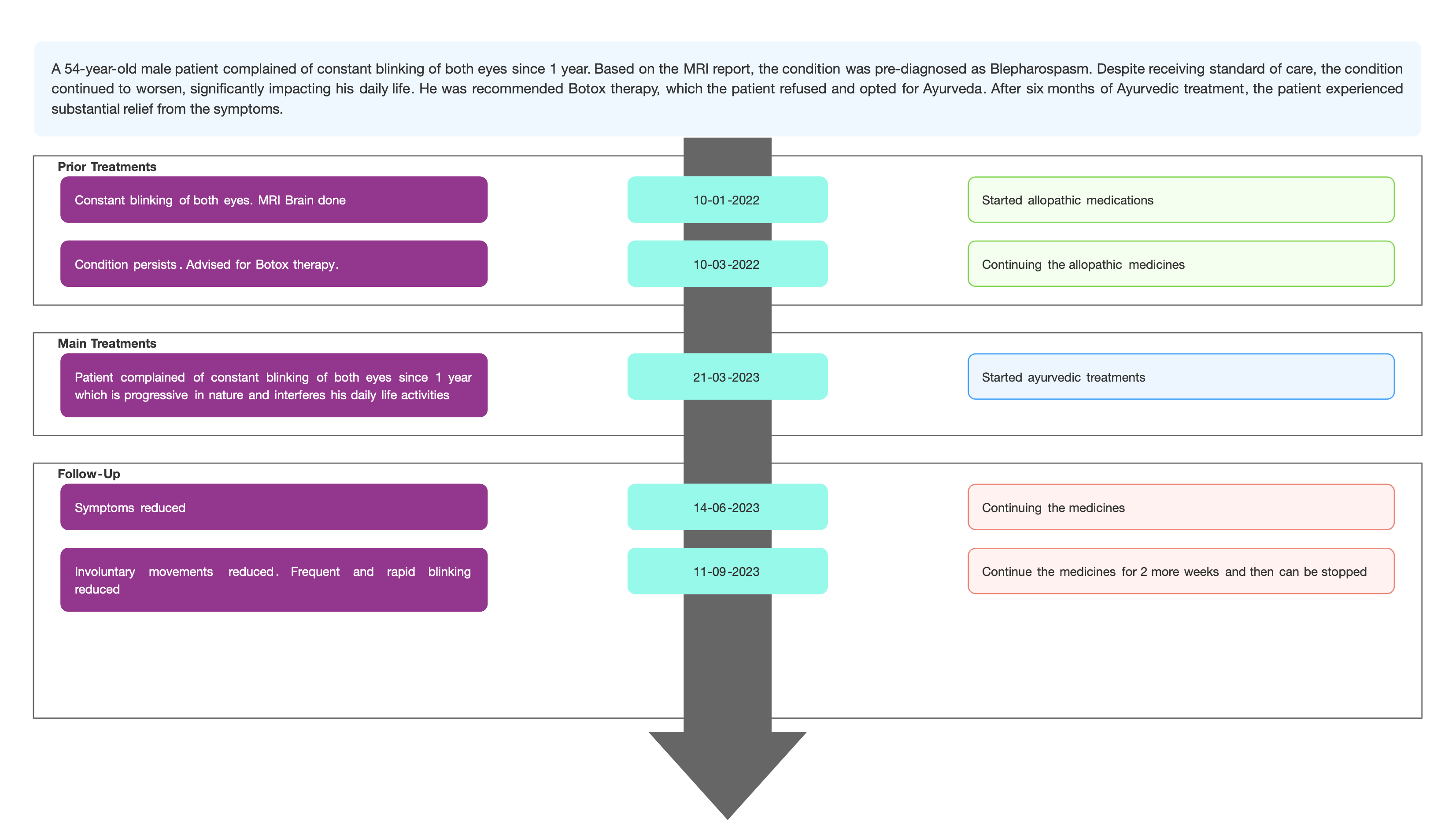
TIMELINE
Image 1. Timeline of events added below
DIAGNOSTIC ASSESSMENT
Modern Diagnostic parameter; Based on the clinical examination, MRI report, the biomedical diagnosis was confirmed as Blepharospasm.
Image 1. Diagnosis Proof document & Botox therapy suggested. Reports dated 23.6.2022.
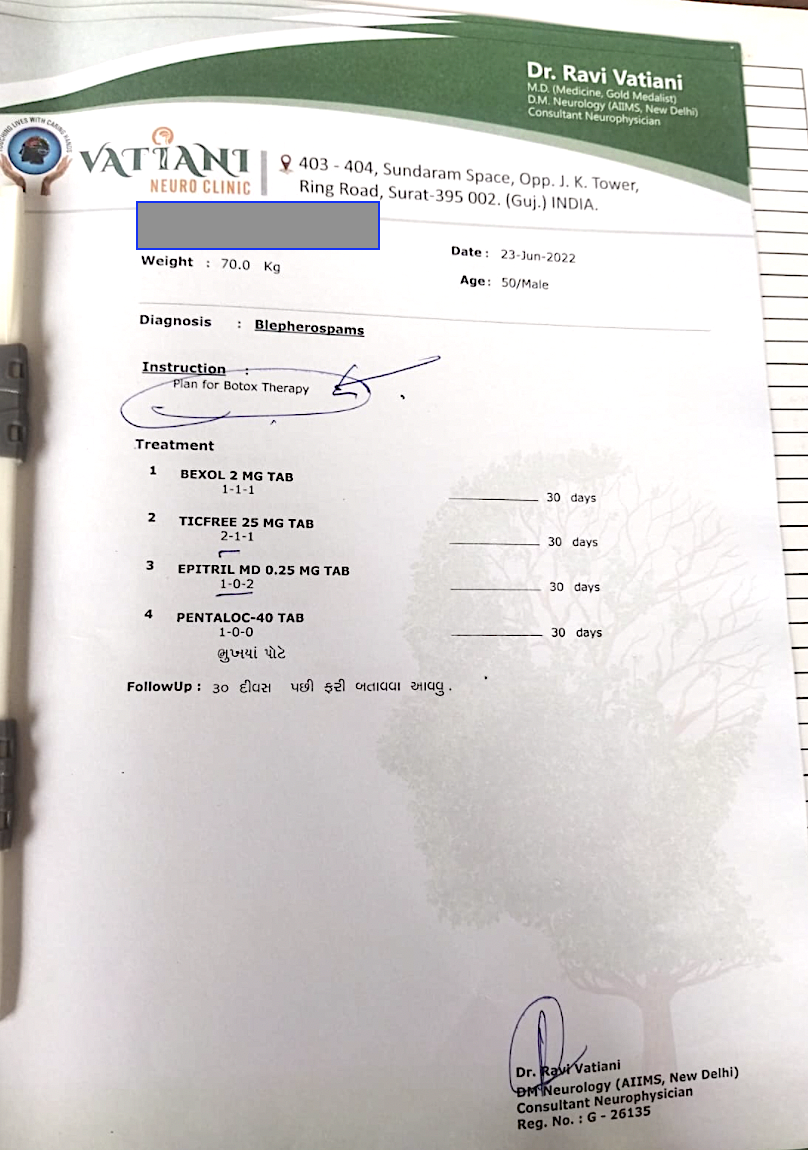
Image 2. MRI Brain done at baseline dated 11.1.2022

Video 1: The symptom of the patient before treatment dated 21.3.2023
https://www.youtube.com/watch?v=5ndiTFo6MW0
Ayurvedic Assessment was done based on the presenting complaints and clinical evaluation. The treating physician confirmed the Ayurvedic diagnosis as Pakshmagata vayu prakopa.
Differential Diagnosis- Eyelid myokymia, Secondary to ocular irritation, Secondary to meningeal irritation, Tardive dyskinesia, Meige syndrome, Facial tics, Hemifacial spasm, Cerebral palsy, Focal seizures. In this case report, the patient came in with the confirmed diagnosis.
Prognosis- 90% of the patients improve symptomatically with botulinum injections, although continued injections are necessary. In this patient, in spite of taking the standard of care, the condition progressed in such a way that, the patient is unable to temporarily open his eyelids. With Ayurvedic treatment, frequent and rapid blinking reduced. After 6 months of treatment, the patient could fully open his eyelids and noted
THERAPEUTIC INTERVENTION
Refer the tab ‘Treatment’ in the Portal.
FOLLOW-UP AND OUTCOMES
The patient had 2 follow ups in total, with a time gap of 3 months each.
Subjective parameters:
Clinician-based assessment; After 3 months of ayurvedic treatment, there was a significant reduction in symptoms. After 6 months of treatment, the patient could fully open his eyelids and noted a significant reduction in involuntary movements.
Video 2. Symptoms of the patient after 3 months of treatment
https://youtube.com/shorts/0HnbYRf0UWM
Video 3. Symptoms of the patient after 6 months of treatment
https://youtu.be/T1j17jd_JbI
Patient-assessed; Not relevant.
Intervention adherence and tolerability – The patient adhered to the prescribed treatments and tolerated the treatments well.
Method of assessment- Subjective and objective parameters were the main assessment tools.
Adverse and unanticipated events; None reported
DISCUSSION:
Blepharospasm is a neurologic disorder that causes uncontrollable muscle movements that causes the eyelids to close or have difficulty opening (dystonia). This can affect patients’ ability to see. It's a rare disease and can be difficult to diagnose. 90% of the patients improve symptomatically with botulinum injections, although continued injections are necessary. In this patient, the line of treatment followed was Vatapitta hara and shotha hara. The medicines were picked targeting the relief from the symptoms and boosting the immunity and promoting the digestion.
PATIENT’S PERSPECTIVE
Not available.
LEARNING POINTS/TAKE HOME MESSAGES
This case report demonstrates the successful standalone ayurvedic management of Blepharospasm in a patient who was not getting satisfactory relief inspite of standard of care and was recommended Botox therapy as the solution.
INFORMED CONSENT
Written consent obtained from patient for publishing of the case report in the Portal
ACKNOWLEDGEMENTS
None
CONFLICT OF INTEREST
None declared.
FUNDING
None
REFERENCE
- https://my.clevelandclinic.org/health/diseases/21546-blepharospasm
-
Immersive Learning
-
Modern Diagnosis
MODERN DIAGNOSIS: Blepharospasm
ABOUT THE DISEASE:
Blepharospasm is a neurologic disorder that causes uncontrollable muscle movements that causes the eyelids to close or have difficulty opening (dystonia). This can affect patients’ ability to see. It's a rare disease and can be difficult to diagnose. Approximately 2,000 people are diagnosed with it each year.
Symptoms and causes: Researchers are still working to confirm its cause. Blepharospasm may be due to abnormal electrical activity in the basal ganglia, structures deep within the brain that help control movement. Usually people get blepharospasm in middle age, but it can occur at any age. Sometimes dry eye may look like blepharospasm so it is important to get medical advise. Certain medications can cause blepharospasm. People with certain medical conditions can get blepharospasm. These conditions include:
General dystonia.
Meige syndrome.
Tardive dyskinesia.
Wilson's disease.
In the early stages, you may have frequent blinking and the symptoms come and go. You’ll experience them during the day, and they’ll go away while you are sleeping. As the disease progresses, they become more severe with fewer periods of relief.
The general symptoms are as follows: Constant blinking, Dry eyes, Eye narrowing, Tired, Irritated eyes and Difficulty keeping your eyes open.
Diagnosis; Medical history and clinical evaluation are the main diagnostic criteria. There are no laboratory tests to confirm the diagnosis of Blepharospasm.
In this case report, a 54-year-old male patient complained of constant blinking of both eyes since 1 year. Based on the MRI report, the patient was pre-diagnosed as Blepharospasm. Despite receiving standard of care, the condition continued to worsen, significantly impacting his daily life. He was recommended Botox therapy, which the patient refused and opted for Ayurveda.
Image 1. Diagnosis Proof document & Botox therapy suggested. Reports dated 23.6.2022.
Image 2. MRI Brain done at baseline dated 11.1.2022
Video of the patient before treatment dated 21.3.2023
https://www.youtube.com/watch?v=5ndiTFo6MW0
Treatment: Oral medications including drugs that block involuntary muscle movements (anticholinergics), but their effect is usually limited.
Botulinum toxin injections, which weaken the eye muscles’ ability to twitch. Botulinum toxin is one of the most effective treatments for blepharospasm. There are several variations available. Surgery (myectomy), a procedure to remove part or all of the overactive eye muscles. The most common and most effective treatment is botulinum toxin. Medications are effective in a small number of people. But they often cause side effects such as memory problems, drowsiness and dry mouth.
Prognosis: It depends on the severity of your symptoms and response to therapy. When blepharospasm is not improved with medical therapy, surgery may be indicated.
Reference
- https://my.clevelandclinic.org/health/diseases/21546-blepharospasm
-
Ayurveda Diagnosis
AYURVEDA DIAGNOSIS: Pakshmagata Vayu prakopa
ABOUT THE DISEASE:
The eye diseases are generally referred to as Netra rogas and they are 76 in number. These diseases are classified depending upon the predominance of the dosa, location, the treatment used and the prognosis. Here the ayurvedic diagnosis is Pakshma gata vayu prakopa. There is mention of Netra rogas and detailed classification with symptoms and treatments. But the direct correlation with the diagnosis made in this disease is not available. The eyes have mandalas or coverings. Pakshma is referred to as eyelashes and is the first and outermost mandala of the eye.
पक्ष्माणि वर्त्मरोमाणि……They are located in the lid margins and are called as Pakshma roma or pakshma sadana. Pakshma is a form of kesa and is an upadhatu of majja. The pakshma mandala is supported by rakta and jala. The uniqueness of this condition is that, Pakshmagata rogas are not mentioned in the classical textbooks of ayurveda. Sushruta in Chapter 3 of Uttara sthana mentions a condition called Pakshmakopa which is a type of Vartmagata roga. But this is different hypothetically from Pakshmagata roga mentioned as the symptoms are completely different. And vata being mentioned as the predominant dosa, the general vata lakshanas can be expected. Here there is continuous involuntary movement of the eyelids. This can be attributed to vata kopa.
In this case report, a 54-year-old male patient complained of constant blinking of both eyes since 1 year. Based on the MRI report, the patient was pre-diagnosed as Blepharospasm. Despite receiving standard of care, the condition continued to worsen, significantly impacting his daily life. He was recommended Botox therapy, which the patient refused and opted for Ayurveda.
Treatment: Virecana, ashcyotana, dhuma, nasya, lepa, anjana, sneha and rasakriya are recommended.
Rationale for specific selection of medicines as explained by the physician is mentioned below.
Table 1. Medicines and the rationale
Name of the medicine/therapy
Rationale
Netra Tarpana with Triphala ghrita
Vata pitta hara
Shuddha guggulu
Analgesic and anti inflammatory
Kampvatari rasa
To cure blinking of the eyes.
Palsineuron capsule
For the management of balance and co - ordination of the body.
Shuddha bhallataka
Improves immunity and promotes digestion.
Reference
- Susruta samhita. Utt.3 and 16
- Susruta Samhita. Uttara tantra. 58.
-
Treatment
Name of Medicine Dosage Form Dosage Mode of Administrtation From - To (Date) Medicine Reference Triphala ghrta Ghrtam Required Quantity Netra Tarpana 2023-03-21 - 2023-03-28 Bhaishajya Ratnavali. Netrarogadhikara 181- 186 Shuddha guggulu Tablet 2 With warm water, after lunch and dinner 2023-04-14 - 2023-09-10 Patent and Proprietary Medicine Kampvatari rasa Tablet 1 With warm water, after lunch and dinner 2023-04-14 - 2023-09-25 Patent and Proprietary Medicine Palsineuron capsule Capsule 1 With warm water, after lunch and dinner 2023-05-12 - 2023-09-25 Patent and Proprietary Medicine Shuddha bhallataka Powder 3-4 pinch With warm water, after lunch and dinner 2023-04-14 - 2023-09-10 Patent and Proprietary Medicine Sahacharadi Taila Taila Required Quantity Abhyanga 2023-04-14 - 2023-05-07 AH. Ci.29.66-68 Sudarshan arka Arka 2 drops Eye drops 2023-09-11 - 2023-09-25 Patent and Proprietary Medicine Tab. Rhumat G Tablet 1 With warm water, after lunch and dinner 2023-09-11 - 2023-09-25 Patent and Proprietary Medicine -
Outcome Measures
In this case report, a 54-year-old male patient complained of constant blinking of both eyes since 1 year. Based on the MRI report, the patient was pre-diagnosed as Blepharospasm. Despite receiving standard of care, the condition continued to worsen, significantly impacting his daily life. He was recommended Botox therapy, which the patient refused and opted for Ayurveda.
Assessment: Subjective parameters were assessed to analyse the outcome of the treatment.
Subjective parameters: After 6 months of starting ayurvedic treatments, the patient got complete relief form the symptoms.
Video 1. After 3 months of ayurvedic treatments
https://youtube.com/shorts/0HnbYRf0UWM
Video 2. After 6 months of ayurvedic treatment.
https://youtu.be/T1j17jd_JbI
-