Featured Case
-
Abstract
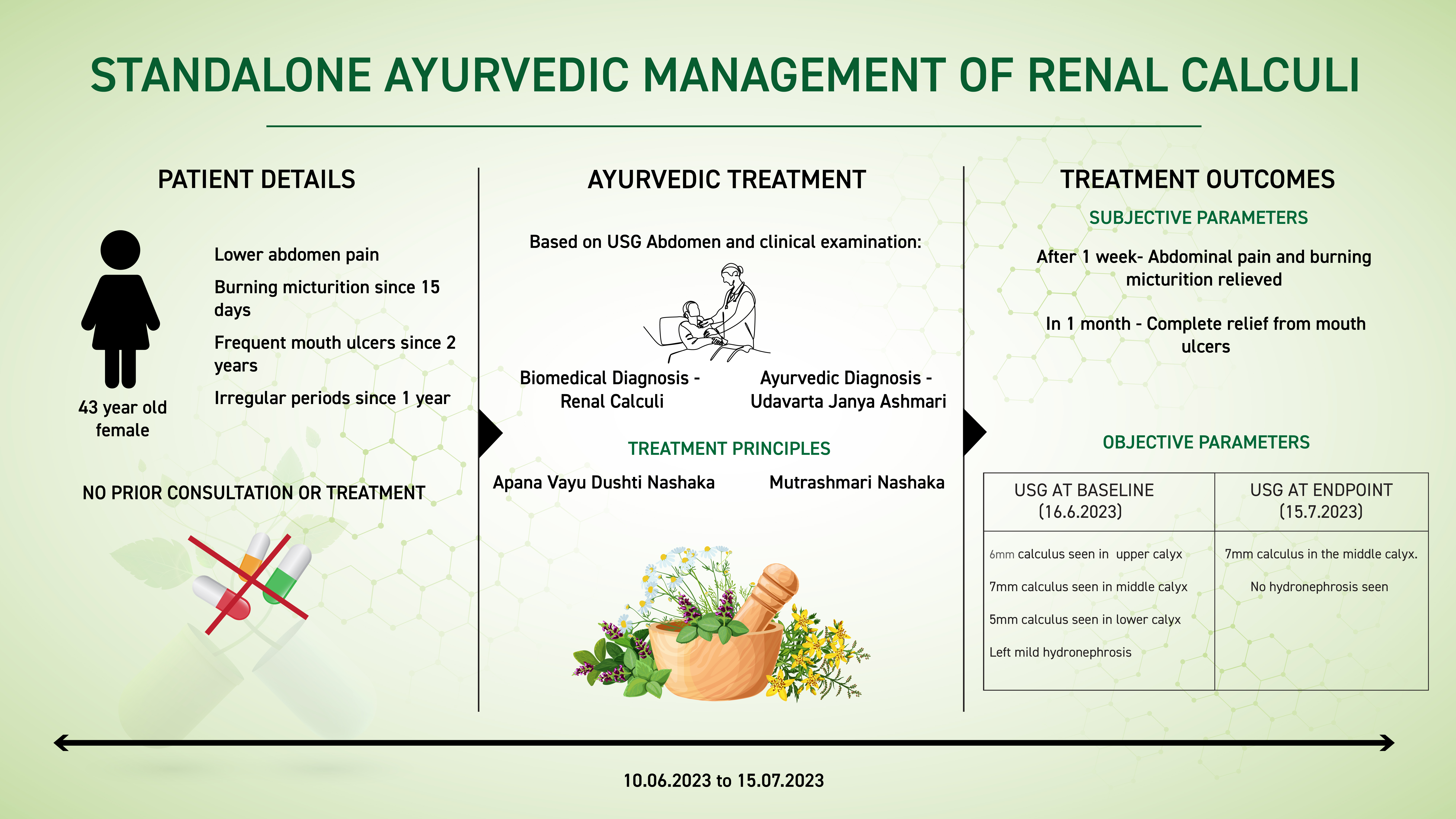
A 43-year-old female patient presented with lower abdomen pain and burning sensation in urine since 15 days associated with frequent mouth ulcer since 2 years and irregular periods since 1 year. There were no prior consultations or treatments. The patient consulted Dr Tara, for Ayurvedic management. Based on the clinical findings and USG report, the biomedical diagnosis was Multiple left renal calculi with mild hydronephrosis and the Ayurvedic diagnosis was Udavarta janya ashmari. The line of treatment followed basically targeted at strengthening the uterus and the pakvashaya. Pacification of Apanavayu dushti and Mustrashmari nashaka were also the targets of the treatment. Within 1 week of Ayurvedic treatments, the patient could get significant relief from the symptoms. The repeat USG done after 1 month of treatment, revealed only the 7 mm-sized calculus in the middle calyx, while the 6mm calculus in the upper calyx and 5 mm calculus in the lower calyx were not detected. Hydronephrosis is absent. This case report demonstrates the successful standalone ayurvedic management of Renal calculi.
-
Summaries
-
Listen
-
Watch
-
View
-
Read
A 43-year-old female patient presented with lower abdomen pain and burning sensation in urine since 15 days. The associated symptoms were frequent mouth ulcer since 2 years and irregular periods since 1 year. There were no prior consultations or treatments. The patient approached Dr Tara for ayurvedic management. Based on the clinical findings and USG report, the biomedical diagnosis was Multiple left renal calculi with mild hydronephrosis and the Ayurvedic diagnosis was Udavarta janya ashmari. The line of treatment followed basically targeted at strengthening the uterus and the pakvashaya. Pacification of Apanavayu dushti and Mustrashmari nashaka were also the targets of the treatment. Within 1 week of Ayurvedic treatments, the patient could get significant relief from the symptoms. The repeat USG done after 1 month of treatment, revealed only the 7 mm-sized calculus in the middle calyx, while the 6mm calculus in the upper calyx and 5 mm calculus in the lower calyx were not detected. Hydronephrosis is absent. This case report demonstrates the successful standalone ayurvedic management of Renal calculi.
-
-
Timeline
-
Tabulated Summary
-
Narrative
TITLE OF CASE
Standalone Successful Ayurvedic management of renal calculi- a case report
Dr Tara
ABSTRACT
A 43-year-old female patient presented with lower abdomen pain and burning sensation in urine since 15 days associated with frequent mouth ulcer since 2 years and irregular periods since 1 year. There were no prior consultations or treatments. The patient consulted Dr Tara, for Ayurvedic management. Based on the clinical findings and USG report, the biomedical diagnosis was Multiple left renal calculi with mild hydronephrosis and the Ayurvedic diagnosis was Udavarta janya ashmari. The line of treatment followed basically targeted at strengthening the uterus and the pakvashaya. Pacification of Apanavayu dushti and Mustrashmari nashaka were also the targets of the treatment. Within 1 week of Ayurvedic treatments, the patient could get significant relief from the symptoms. The repeat USG done after 1 month of treatment, revealed only the 7 mm-sized calculus in the middle calyx, while the 6mm calculus in the upper calyx and 5 mm calculus in the lower calyx were not detected. Hydronephrosis is absent. This case report demonstrates the successful standalone ayurvedic management of Renal calculi.
KEYWORDS
Renal, calculi, ashmari, case report, udavarta, udavarta janya ashmari
INTRODUCTION
Renal calculi are also called as Kidney stones, nephrolithiasis or urolithiasis. They are hard deposits made of minerals and salts that form inside your kidneys. Kidney stones can affect any part of your urinary tract — from your kidneys to your bladder. Often, stones form when the urine becomes concentrated, allowing minerals to crystallise and stick together. There are different types of Kidney stones- calcium, struvite, uric acid, and cystine, that differ from each other in cause and presentation. The risk factors are Family or personal history, dehydration, certain diet, obesity, diseases of the digestive tract and surgery, certain medical conditions, supplements and medications.
Causes: Diet, excess body weight, some medical conditions, and certain supplements and medications are among the many causes of kidney stones. Passing kidney stones can be quite painful, but the stones usually cause no permanent damage if they're recognised in a timely fashion.
Symptoms: A kidney stone usually will not cause symptoms until it moves around within the kidney or passes into one of the ureters. The ureters are the tubes that connect the kidneys and bladder. If a kidney stone becomes lodged in the ureters, it may block the flow of urine and cause the kidney to swell and the ureter to spasm, which can be very painful. At that point, you may experience these symptoms:
- Severe, sharp pain in the side and back, below the ribs
- Pain that radiates to the lower abdomen and groin
- Pain that comes in waves and fluctuates in intensity
- Pain or burning sensation while urinating
- Other signs and symptoms may include:
- Pink, red or brown urine
- Cloudy or foul-smelling urine
- A persistent need to urinate, urinating more often than usual or urinating in small amounts
- Nausea and vomiting
- Fever and chills if an infection is present
- Pain caused by a kidney stone may change — for instance, shifting to a different location or increasing in intensity — as the stone moves through your urinary tract.
Diagnosis: Medical history and clinical examination are the basic diagnostic tools. Blood tests, Urine tests, Imaging, and analysis of the passed out stones are some of the tools that may also be incorporated as a part of diagnosis. The doctor decides the type of test required depending upon the clinical presentation.
Treatment: In most of the cases, medications would suffice to get relief from the symptoms or the condition itself. But if the stones become lodged in the urinary tract, are associated with a urinary infection or cause complications — surgery may be needed.
Prognosis: Depends upon the size of the stone and the location of the stone. Small stones are completely curable, with lifestyle changes and supportive medicines. Larger stones may need medical intervention.
PATIENT INFORMATION
In this case report, the patient is a 43-year-old female patient presented with lower abdomen pain and burning micturition since 15 days. The associated symptoms were frequent mouth ulcer since 2 years and irregular periods since 1 year. There were no prior consultations or treatments. Based on the clinical findings and USG report, the biomedical diagnosis was Multiple left renal calculi with mild hydronephrosis.
No relevant family/genetic/surgical or psychosocial history.
Psychosocial history- Stresse
CLINICAL FINDINGS
Appetite - normal , sleep - normal , bowel - regular, urination - normal
Tongue - not coated
Blood pressure - 130/70P/A - tenderness+, Pain ++
TIMELINE
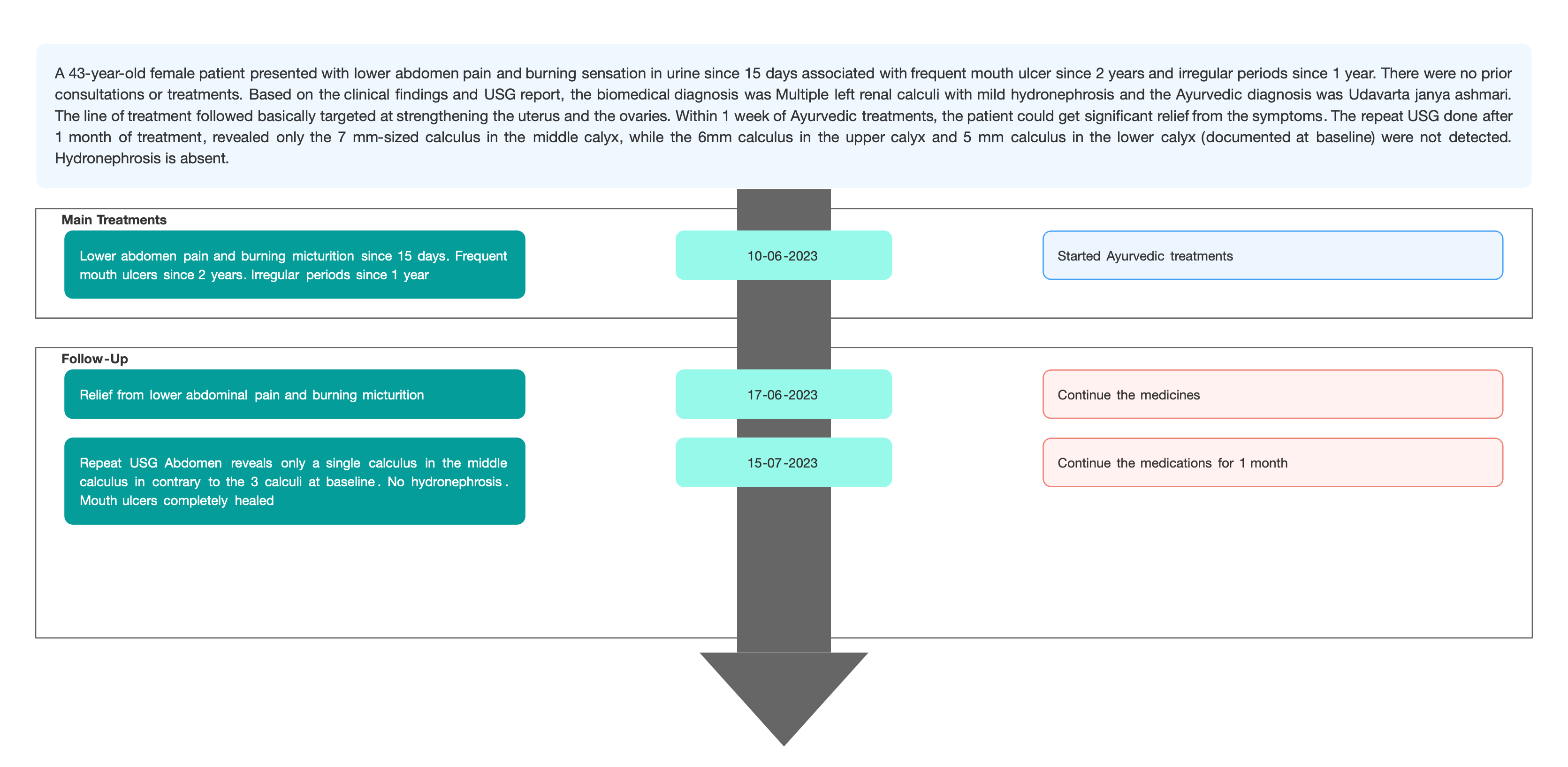
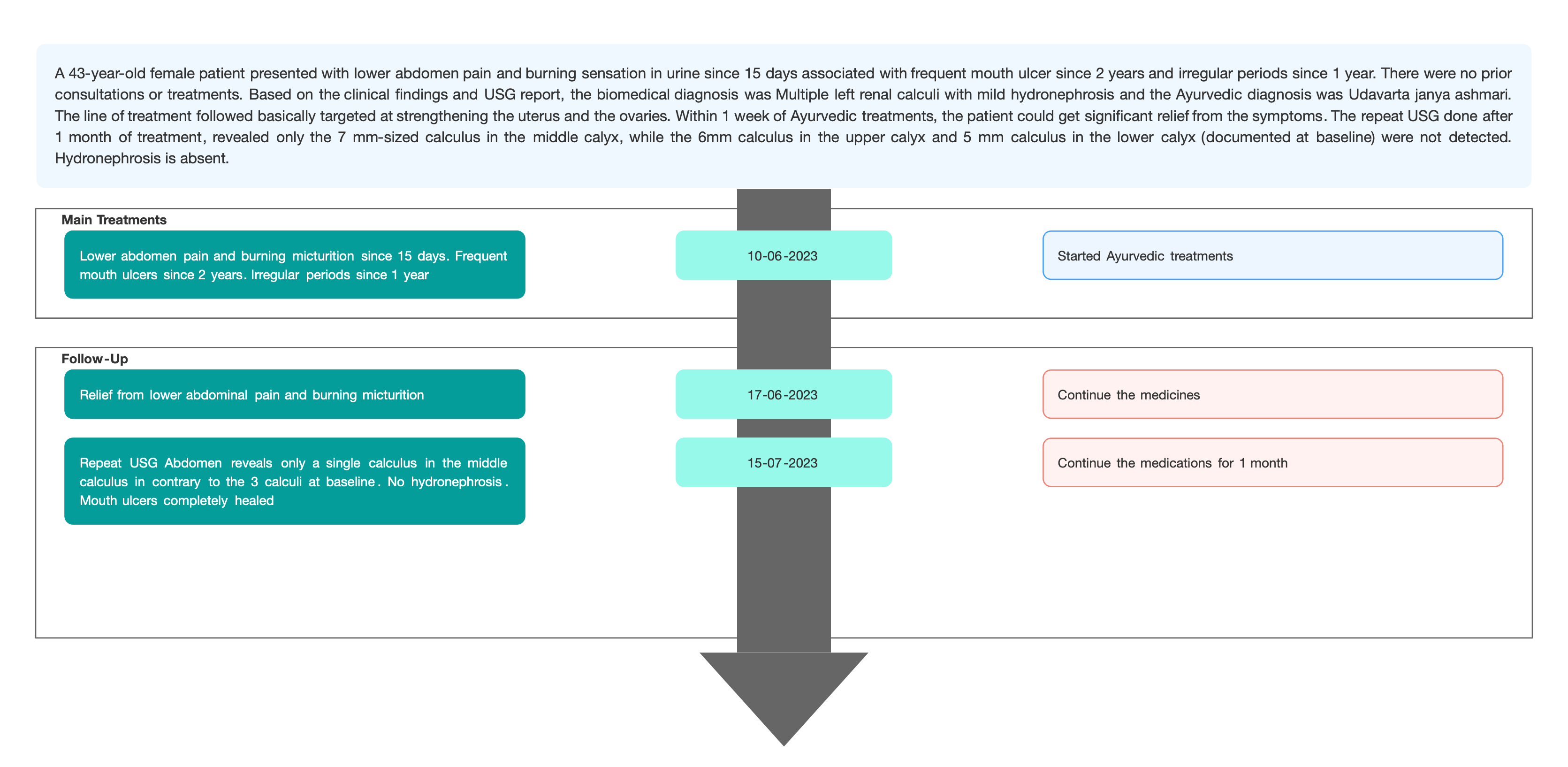
Image 1. Timeline of events added below
DIAGNOSTIC ASSESSMENT
Modern Diagnostic parameter; Based on the clinical examination and USG Reports, the biomedical diagnosis was made as Renal Calculi.
Image 2. USG Report at baseline dated 16.6.2023

USG revealed Left renal calculus - 6 mm seen in upper calyx, 7 mm seen in middle calyx, 5 mm seen in lower calyx. Left mild hydronephrosis probably due to mid-ureteric calculus.
Ayurvedic Assessment was done based on the presenting complaints and clinical evaluation. The treating physician confirmed the Ayurvedic diagnosis as Udavarta janya ashmari.
Differential Diagnosis-
Appendicitis
Cholecystitis
Acute epididymitis
Diverticulitis
Hernia
PID
Based on the clinical features and investigation reports done, the physician clinically diagnosed the condition as Renal calculi.
Prognosis- Smaller stones (less than 5 mm) have a greater chance (90%) of passing on their own with medical expulsion therapy (usually tamsulosin, nifedipine, or alfuzosin). Any hint of a urinary tract infection should be treated aggressively with antibiotics. Close to 80% to 90% of renal calculi pass spontaneously. About 3% of patients need admission because of pain, inability to pass the stone, or dehydration. A few patients may develop urinary tract obstruction and an upper urinary tract infection. This can result in urosepsis or pyelonephritis.
In this case report, the patient was diagnosed with multiple left renal calculi with mild hydronephrosis. The renal calculi was measured as 6 mm, seen in upper calyx 7 mm seen in middle calyx, 5 mm seen in lower calyx. All the presenting complaints were managed with ayurvedic treatment. The patient could get significant relief from the symptoms in one week. In repeated USG done after 1 month of treatment, shows only a 7 mm-sized calculus in the middle calyx-calculus and hydronephrosis is absent.THERAPEUTIC INTERVENTION
Refer the tab ‘Treatment’ in the Portal.
FOLLOW-UP AND OUTCOMES
The patient had 3 follow ups in total. Each follow up, the symptoms of pain and burning micturition were assessed to analyse the outcome.
Subjective parameters: In 1 week after starting ayurvedic medicines, there is no pain or burning sensation. In 1 month, complete relief from pain and burning micturition. The mouth ulcer completely healed.
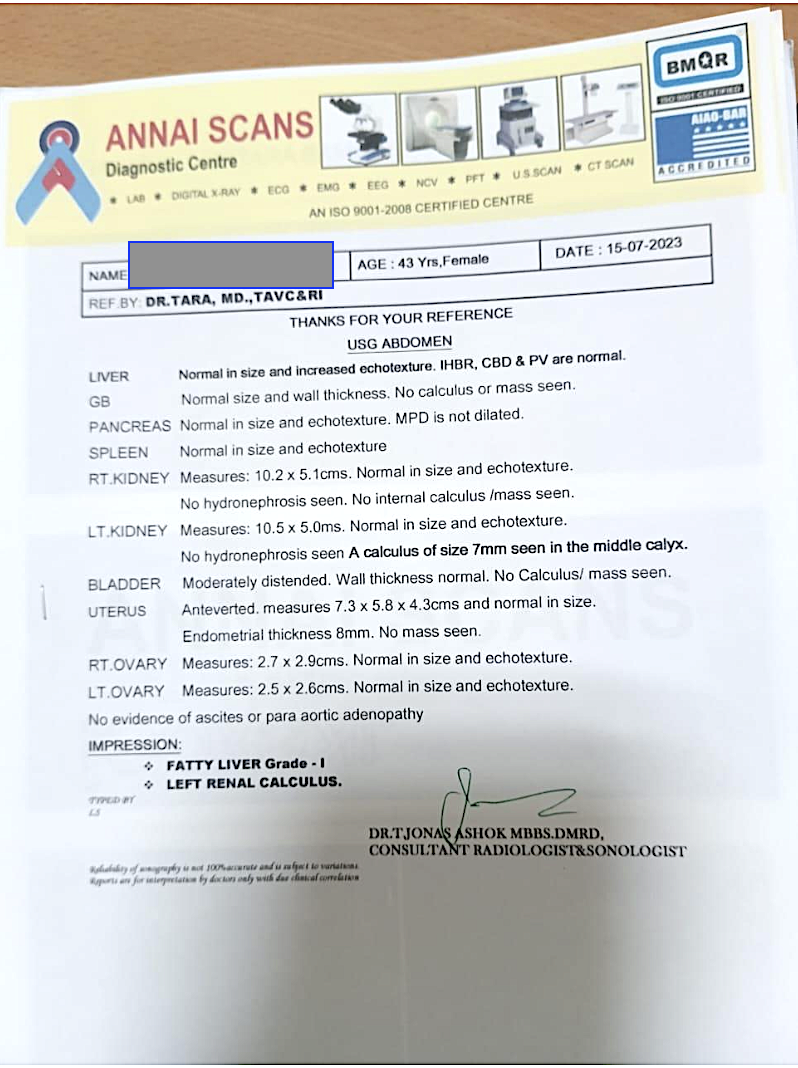
Clinician-based assessment; In 1 month, the patient got complete relief from all the symptoms. A repeat USG done at endpoint, dated 15.7.2023 revealed only a 7 mm calculus in the muddle calyx, while the other two were not detected.
Image 3. USG at endpoint dated 15.7.2023
Patient-assessed; Not relevant
Intervention adherence and tolerability – The patient adhered to the prescribed treatments and tolerated the treatments well.
Method of assessment- Subjective and objective parameters were the main assessment tools.
Adverse and unanticipated events; None reported
DISCUSSION:
Renal calculi area very commonly occurring condition, and in most of the cases can be resolved with just lifestyle and diet changes. But when the symptoms are very severe or when there is an infection then surgery is recommended. In this patient, there were no prior consultation or treatments. Here the diagnosis was Ashmari and the uniqueness is that the physician has connected Udaravarta to being the cause. The line of treatment followed was The line of treatment followed basically targeted at strengthening the uterus and the pakvashaya. Pacification of Apanavayu dushti and Mustrashmari nashaka were also the targets of the treatment.
PATIENT’S PERSPECTIVE
Not available.
LEARNING POINTS/TAKE HOME MESSAGES
This case report demonstrated that Ayurvedic medicine holds promise as a successful standalone complementary approach to the management of multiple renal calculi.
INFORMED CONSENT
Written consent obtained from patient for publishing of the case report in the Portal
ACKNOWLEDGEMENTS
None
CONFLICT OF INTEREST
None declared.
FUNDING
None
REFERENCE
- https://www.mayoclinic.org/diseases-conditions/kidney-stones/diagnosis-treatment/drc-20355759
-
Immersive Learning
-
Modern Diagnosis
MODERN DIAGNOSIS: Renal calculi
ABOUT THE DISEASE:
Renal calculi are also called as Kidney stones, nephrolithiasis or urolithiasis. They are hard deposits made of minerals and salts that form inside your kidneys. Kidney stones can affect any part of your urinary tract — from your kidneys to your bladder. Often, stones form when the urine becomes concentrated, allowing minerals to crystallise and stick together. There are different types of Kidney stones- calcium, struvite, uric acid, and cystine, that differ from each other in cause and presentation. The risk factors are Family or personal history, dehydration, certain diet, obesity, diseases of the digestive tract and surgery, certain medical conditions, supplements and medications.
Causes: Diet, excess body weight, some medical conditions, and certain supplements and medications are among the many causes of kidney stones. Passing kidney stones can be quite painful, but the stones usually cause no permanent damage if they're recognised in a timely fashion.
Symptoms: A kidney stone usually will not cause symptoms until it moves around within the kidney or passes into one of the ureters. The ureters are the tubes that connect the kidneys and bladder. If a kidney stone becomes lodged in the ureters, it may block the flow of urine and cause the kidney to swell and the ureter to spasm, which can be very painful. At that point, you may experience these symptoms:
- Severe, sharp pain in the side and back, below the ribs
- Pain that radiates to the lower abdomen and groin
- Pain that comes in waves and fluctuates in intensity
- Pain or burning sensation while urinating
- Other signs and symptoms may include:
- Pink, red or brown urine
- Cloudy or foul-smelling urine
- A persistent need to urinate, urinating more often than usual or urinating in small amounts
- Nausea and vomiting
- Fever and chills if an infection is present
- Pain caused by a kidney stone may change — for instance, shifting to a different location or increasing in intensity — as the stone moves through your urinary tract.
Diagnosis: Medical history and clinical examination are the basic diagnostic tools. Blood tests, Urine tests, Imaging, and analysis of the passed out stones are some of the tools that may also be incorporated as a part of diagnosis. The doctor decides the type of test required depending upon the clinical presentation.
In this case report, the patient is a 43-year-old female patient presented with lower abdomen pain and burning micturition since 15 days. The associated symptoms were frequent mouth ulcer since 2 years and irregular periods since 1 year. There were no prior consultations or treatments. Based on the clinical findings and USG report, the biomedical diagnosis was Multiple left renal calculi with mild hydronephrosis and the Ayurvedic diagnosis was Udavarta janya ashmari.
Image 1. USG Abdomen at baseline dated 16.6.2023
Treatment: In most of the cases, medications would suffice to get relief from the symptoms or the condition itself. But if the stones become lodged in the urinary tract, are associated with a urinary infection or cause complications — surgery may be needed.
Small stones Small stones with minimal symptoms.
Most small kidney stones won't require invasive treatment. You may be able to pass a small stone by:
Drinking water. Drinking as much as 2 to 3 quarts (1.8 to 3.6 liters) a day will keep your urine dilute and may prevent stones from forming. Unless your doctor tells you otherwise, drink enough fluid — ideally mostly water — to produce clear or nearly clear urine.
Pain relievers. Passing a small stone can cause some discomfort. To relieve mild pain, your doctor may recommend pain relievers such as ibuprofen (Advil, Motrin IB, others) or naproxen sodium (Aleve).
Medical therapy. Your doctor may give you a medication to help pass your kidney stone. This type of medication, known as an alpha blocker, relaxes the muscles in your ureter, helping to pass the stones.
In the case of large kidney stones, they cannot pass on their own, and may cause bleeding. There is also a possibility of kidney damage and ongoing urinary tract infections that may require more-extensive treatment. Procedures may include:
Using sound waves to break up stones.
Surgery to remove very large stones in the kidney.
Using a scope to remove stones.
Parathyroid gland surgery.
Lifestyle changes and diet habits will help prevent the condition to a great extent.
Prognosis: Depends upon the size of the stone and the location of the stone. Small stones are completely curable, with lifestyle changes and supportive medicines. Larger stones may need medical intervention.
Reference
-
Ayurveda Diagnosis
AYURVEDA DIAGNOSIS: Udavarta janya ashmari
ABOUT THE DISEASE:
About Udavarta: This means the upward or backward or reverse movement of Vata Dosha. Usually obstruction to the normal pathway of Vata results in reverse movement. Most commonly, this condition occurs due to the suppression or obstruction to the natural urges or natural functioning of vata. Rarely it occurs as a secondary to organic obstruction.
Acharya Sushruta explains that complete obstruction of Vata in its pathway by any suppression of the urges, constipation, dryness of the minute channels etc, lead to upward /backward course of Vata and hence Udavarta is caused. So, he emphasizes to treat all such conditions by Vata pacifying measures. The adharaniya vegas are Flatus, Faces, Urine, Hunger, Thirst, Yawning, Tears, Regurgitation, Sneezing, Vomiting, Semen, Respiration and Sleep. The symptoms produced are different in each type of Udavarta.
वेगान्न धारयेद्वातविण्मूत्रक्षवतृट्क्षुधाम्।
निद्राकासश्रमश्वासजृम्भाश्रुच्चर्दिरेतसाम्॥१॥ (AH.Su.4)
In this case report, the patient is a 43-year-old female patient presented with lower abdomen pain and burning micturition since 15 days. The associated symptoms were frequent mouth ulcer since 2 years and irregular periods since 1 year. There were no prior consultations or treatments. Based on the clinical findings and USG report, the biomedical diagnosis was Multiple left renal calculi with mild hydronephrosis and the Ayurvedic diagnosis was Udavarta janya ashmari.
Here the condition is diagnosed as Ashmari caused by Udavarta. The symptoms of Udavarta janya ashmari can be connected to the suppression of mutra vega.
अङ्गभङ्गाश्मरीबस्तिमेढ्रवंक्षणवेदनाः॥४॥
मूत्रस्य रोधात्पूर्वे च प्रायो रोगाः—————॥५॥(AH.Su.4)
The Lakshana of mutrarodha are severe pain, calculi, pain in the urinary bladder and the genitalia. This tallies with the symptoms of the biomedical diagnosis Renal calculi and also of the ayurvedic correlation of Ashmari.
Line of treatment mentioned is
----------------------------------तदौषधम्।
वर्त्यभ्यङ्गावगाहाश्च स्वेदनं बस्तिकर्म च॥५॥ (AH.Su.4)
The treatments given are varti, abhyanga, avagaha, svedana and vasti karma.
About Ashmari:
सामान्यलिङ्गं रुङ् नाभि सीवनिवस्तिमूर्धसु । विशीर्णधारं मूत्रं स्यात्तया मार्गे निरोधिते ॥
तद्व्यापायात्सुखं मेहेदच्छं गोमेदकोपमं । तड् सङ्क्षोभात् क्षते सास्रमायाच्चातिरुग्भवेत् ॥ (Va.Ni.A.9)
The General signs and symptoms of asmari (calculi) include – pain in the region of the umbilicus, perineum and dome of the bladder. In this condition, since the urinary passage is interrupted or blocked by the stone, the flow of urine comes out in many streams. When the stone gets dislodged, the person easily voids urine which is clear, having the colour of gomedaka gem (yellowish red in colour), of blood coloured or mixed with blood (due to bleeding in the urinary tract). If the interior of the urinary bladder (and urinary passages) get injured due to the friction by stone, bleeding also occurs along with urine. When the person tries to void the urine forcibly in spite of the stone being present in the urinary passage, the pressure causes severe pain.
In this case report, the type of ashmari is not mentioned. Just that the ashmari is caused by Udavarta.
The line of treatment mentioned by Sushruta for Ashmari is as follows:
Apakarshana –Shasta karma (Surgical intervention)
Prakrutivighatana – Shodhana and Shamana
Nidana parivarjana – Avoidance of causative factors
Shamanoushadhis: which are selected in Ashmari should have the following properties- Kaphahara , Mutra virechana and Apana vayu anulomana.
Rationale for treatment as mentioned by the physician:
Sukumara kashayam- Give strength to uterus and ovaries (apana vayu drushti nashaka and balance pitta and kapha), avrodha nashaka, regulation of menstrual cycle.
Drakshadi kashayam- Pitta and vata shamana, amlapitta nashaka,useful in burning sensation and hair fall, pittaja grahani nashaka, mukhapaka nashaka.
Shringa bhasma- Pitta shamaka, useful in gastritis.Sukumara Lehyam- Pitta and vata shamana. (Relief from Cramp and pain of abdomen in period) It mainly gives strength to uterus and pakvashaya region.
Virataradi kashayam - Mutrashamari nashaka
Brihatyadi kashayam - Useful in all urinary disorder.
Varanadi kashayam - Kapha and meda nashaka, useful in fatty liverChandraprabha vati- Tridosha shamaka, rasayana properties, gives strength to basti region
Gokshura curna- Klednashaka,brimhana (strengthens basti region), mutrala
Prognosis: Asmari is life threatening if it is associated with severe swelling in the scrotum (testes) and umbilicus, total obstruction of urine, severe pain and presence of gravel in it (because such asmari is incurable).
प्रशूननाभिवृषणं बद्धमूत्रं रुजातुरं। अश्मरी क्षपत्याशु सिकता शर्करान्विता॥१७॥ (MN. Chapter 32)
-
Treatment
Name of Medicine Dosage Form Dosage Mode of Administrtation From - To (Date) Medicine Reference Sukumara Kashayam + Drakshadi Kashayam + Shringa bhasma Samyoga 15 ml kashaya + 500 mg of bhasma Oral, with 60 ml warm water at 10 am & 3 pm 2023-06-10 - 2023-06-16 Sukumara kashayam, Drakshadi kashayam- ?Sahasrayogam. Kashaya prakaranam: ??Shringa bhasma - Rasatarangini 12. 105-107 Virataradi Kashayam + Varanadi Kashayam + Brihatyadi Kashayam. Kashayam 15 ml kashaya Oral, with 60 ml warm water at morning 6 am and evening 6 pm in empty stomach 2023-06-17 - 2023-08-15 Virataradi Kashayam- AH.Su.15/24-25.?Varanadi Kashayam - AH.Su15.21-22.?Brihatyadi Kashayam- AH. Ci. 11.35 Dhanwantaram gulika Gulika 1 Tablet Oral, with Kashaya 2023-06-10 - 2023-06-16 Sahasrayogam Gutika prakaranam Sukumara lehyam Lehyam 1 tsp Oral, with water at bed time 2023-06-10 - 2023-06-16 AH.Ci.13.41-47 Chandraprabha vati Vati 1 Tablet Oral, with Kashaya 2023-06-17 - 2023-08-15 Sha. Sam Madhyama khanda 7.40 Gokshura Curna Curna 30 gm Oral, curna boiled with 200ml water used for drinking every day 2023-06-17 - 2023-08-15 Sahasrayogam Curna Prakarana -
Outcome Measures
In this case report, the patient is a 43-year-old female patient presented with lower abdomen pain and burning micturition since 15 days. The associated symptoms were frequent mouth ulcer since 2 years and irregular periods since 1 year. There were no prior consultations or treatments. Based on the clinical findings and USG report, the biomedical diagnosis was Multiple left renal calculi with mild hydronephrosis and the Ayurvedic diagnosis was Udavarta janya ashmari.
Assessment: Subjective and objective parameters were assessed to analyse the outcome of the treatment.
Subjective parameters: In 1 week after starting ayurvedic medicines, there is no pain or burning sensation. In 1 month, complete relief from pain and burning micturition. The mouth ulcer completely healed.
Objective parameters: A repeat USG was done after 1 month of treatment.
Image 1. USG at endpoint dated 15.7.2023
Table 1. Findings of the USG at baseline and endpoint tabulated
USG Report dated 16.6.2023
USG Report dated 15.7.2023
6 mm calculus in the upper calyx
7 mm-sized calculus in the middle calyx
7 mm-sized calculus in the middle calyx
5 mm calculus in the lower calyx
-