Featured Case
-
Abstract
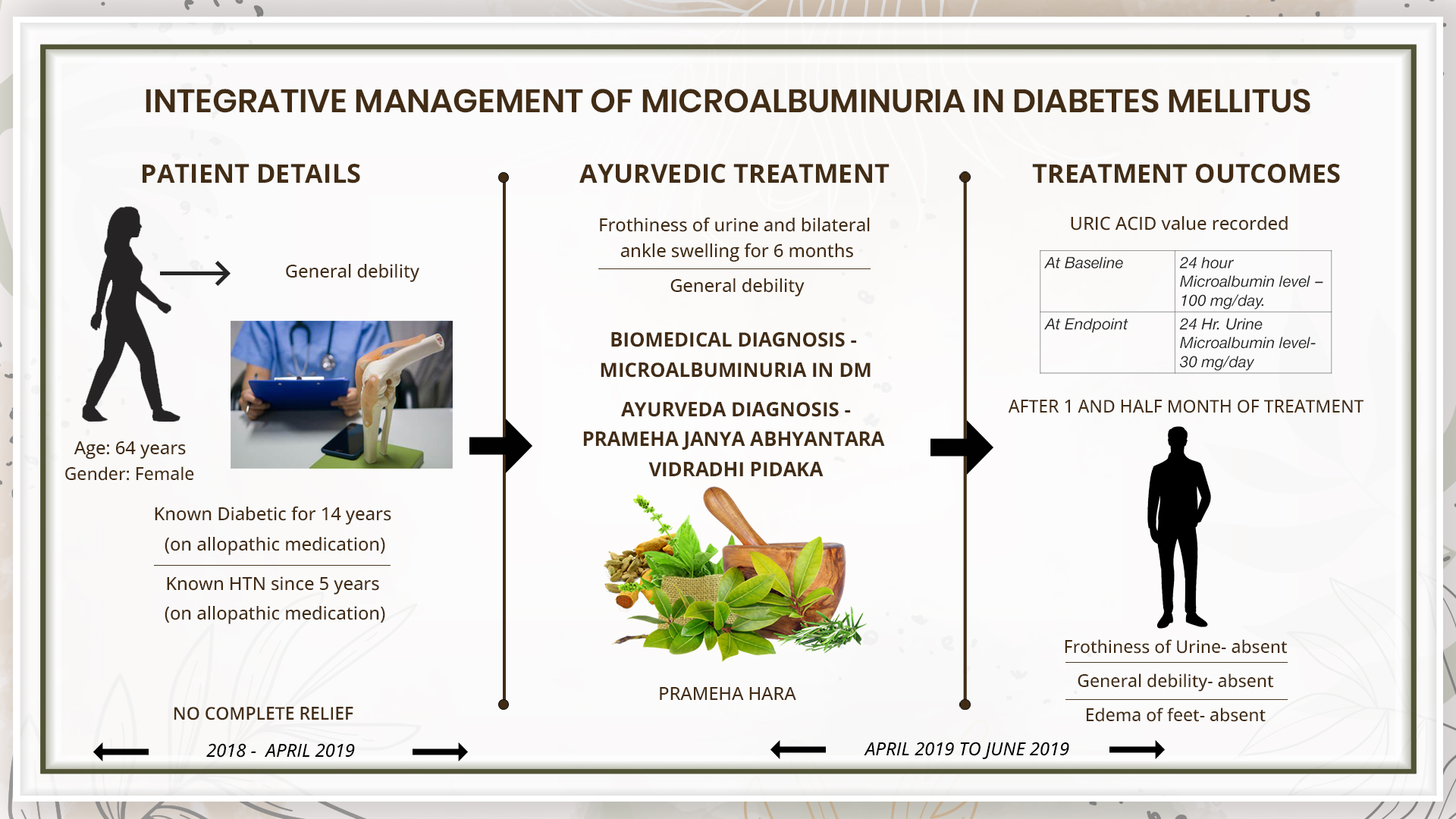
A 64-year-old female patient was a known diabetic for 14 years and hypertension for 5 years. She is on allopathic medication for diabetes and hypertension. She complains of frothiness of urine and bilateral ankle swelling since 6 months. She did not consult any allopath for this specific symptom. She consulted Dr Indu for Ayurvedic management. Based on the lab investigations, the biomedical diagnosis was made as Microalbuminuria in Diabetes Mellitus. Based on the clinical evaluation, the ayurvedic diagnosis was made as Prameha janya abhyantara vidradhi pidaka. The line of treatment followed was prameha hara. With one month of Ayurvedic treatment, the 24 hour Microalbumin level – 100 mg/day at baseline became 30 at endpoint level reached within normal limits and the patient got relief from all the symptoms. This case report highlights the clinical efficacy of ayurveda in treating Micro albuminuria using a simple single formulation.
-
Summaries
-
Listen
-
Watch
-
View
-
Read
A 64-year-old female patient was a known diabetic for 14 years and hypertension for 5 years. She is on allopathic medication for diabetes and hypertension. She complains of frothiness of urine and bilateral ankle swelling since 6 months. She did not consult any allopath for this specific symptom. She consulted Dr Indu for Ayurvedic management. Based on the lab investigations, the biomedical diagnosis was made as Microalbuminuria in Diabetes Mellitus. Based on the clinical evaluation, the ayurvedic diagnosis was made as Prameha janya abhyantara vidradhi pidaka. The line of treatment followed was prameha hara. With one month of Ayurvedic treatment, the 24 hour Microalbumin level – 100 mg/day at baseline became 30 at endpoint level reached within normal limits and the patient got relief from all the symptoms. This case report highlights the clinical efficacy of ayurveda in treating Micro albuminuria using a simple single formulation.
-
-
Timeline
-
Tabulated Summary
-
Narrative
TITLE OF CASE
Ayurvedic standalone management of Microalbuminuria in Type II DM - a case report
Dr Indu
ABSTRACT
A 64-year-old female patient was a known diabetic for 14 years and had hypertension for 5 years. She is on allopathic medication for diabetes and hypertension. She complains of frothiness of urine and bilateral ankle swelling for 6 months. She did not consult any allopath for this specific symptom. She consulted Dr Indu for Ayurvedic management. Based on the lab investigations, the biomedical diagnosis was made as Microalbuminuria in Diabetes Mellitus. Based on the clinical evaluation, the ayurvedic diagnosis was made as Prameha janya abhyantara vidradhi pidaka. The line of treatment followed was prameha hara. With one month of Ayurvedic treatment, the 24 hour Microalbumin level – 100 mg/day at baseline became 30 at endpoint level reached within normal limits and the patient got relief from all the symptoms. This case report highlights the clinical efficacy of ayurveda in treating Micro albuminuria using a simple single formulation.
KEYWORDS
Microalbuminuria, diabetic mellitus, madhumeha, case report, vidradhi, pidaka, abhyantara vidradhi pidaka
INTRODUCTION
Albuminuria means you have too much albumin in your urine. It is a sign of more significant kidney disease. Microalbuminuria is when a small amount of protein called albumin is present in your urine. Microalbuminuria indicates that your kidneys aren’t functioning optimally and can sometimes be a sign of kidney disease. It also is a risk factor for cardiovascular disease.
Cause: Microalbuminuria is caused by kidney damage. Some medical conditions that can lead to kidney damage include:
- High blood pressure: People who have high blood pressure for a long time often have microalbuminuria. In these people, the condition is often also associated with other cardiovascular problems.
- Metabolic syndrome: Microalbuminuria is also associated with metabolic syndrome, a cluster of conditions that increase your risk of developing heart disease, diabetes, and other chronic health conditions.
- Type I and type II diabetes: People with diabetes may develop scarring and thickening of the nephrons, which are the filters that help remove waste products from the blood. This can lead to poor kidney function and albumin leaking into the urine.
- Obesity: Obesity can cause damage to the structure of the kidneys, affecting their function and leading to microalbuminuria. Obesity is also associated with other risk factors for kidney disease such as diabetes and hypertension.
- Genetic kidney diseases: Microalbuminuria is often present in people with inherited kidney conditions such as polycystic kidney disease.
Symptoms: Usually, microalbuminuria does not cause any symptoms. It can, however, be one of the earliest ways to detect kidney disease.2 Kidney damage may become significant (and not easily reversed) before a person notices any symptoms. This is part of why it is important for people at risk of kidney disease to have the test repeatedly so that treatment can begin if necessary.
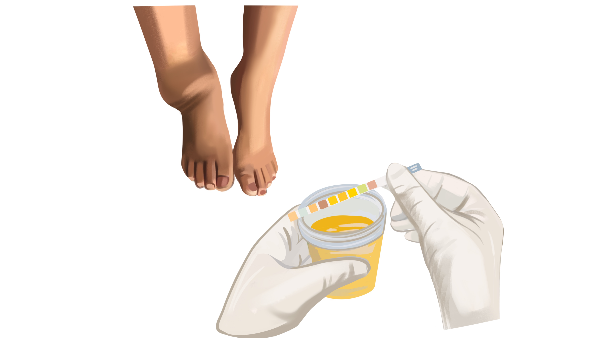
If microalbuminuria goes undiagnosed, your albumin levels will continue to rise. One of the symptoms you might notice when this happens is foamy urine. Kidney damage can also cause swelling of the hands, ankles, face, or abdomen.
Diagnostic Criteria: Microalbuminuria is diagnosed based on laboratory urine tests that might be performed along with a standard medical exam.
Prognosis & Treatment: Different treatments are available to address microalbuminuria. The best treatments may depend on the underlying causes, other medical conditions, and factors like your age and sex. In general, if you have medical conditions that may be worsening your kidney function (like diabetes), it’s helpful to get those under better control.
PATIENT INFORMATION
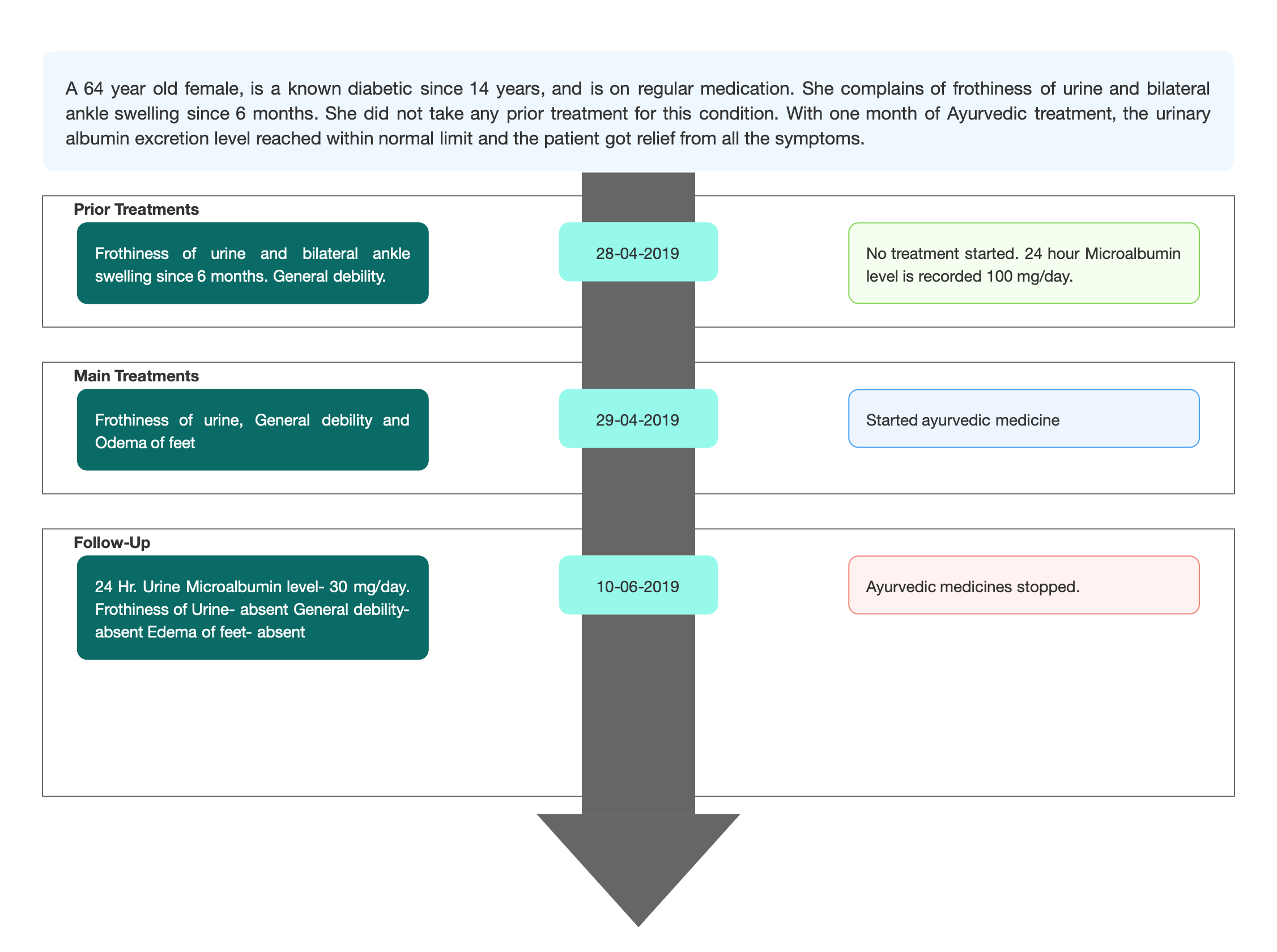
The patient is a 64 year old female patient, who is a known case of Diabetes mellitus since 14 years, complains of frothiness of urine and bilateral ankle swelling since 6 months. She had not taken any prior treatment for this condition.
Family History- Positive family history of DM2- father, mother, and siblings
No relevant genetic/surgical/psychosocial history.
No addictions documented.
CLINICAL FINDINGS
On examination:
General Examination:
Pulse rate – 74/min.
Respiration rate – 16/min.
Blood Pressure – 130/90 mm of hg.
Height – 165 cm.
Weight – 70 kg.
BMI – 25.4 kg/m2
Systemic Examination:
Urogenital system
Inspection:
Bipedal edema – Present.
Conjunctival pallor – Absent.
Sacral edema – Absent.
Urimic complexion – Absent.
Palpation:
Kidneys - Not ballotable.
Bladder - Not palpable.
No tenderness over renal angle and supra pubic region.
Percussion:
Renal bruits – Could not elicit.
Urine voiding symptoms
Frequency – Increased.
Nocturia – Present.
Fatigue – Present.
Incontinence – Absent.
Pain during micturition – Absent.
Cardiovascular and respiratory system –
No abnormality detected.
Locomotory system:
Ankle joint
Inspection:
Swelling– Present (B/L)
Palpation:
Pitting edema– Present (B/L)
ROM :
Flexion and Extension – Possible with pain (B/L)
TIMELINE
Image 1. Timeline of events added below
DIAGNOSTIC ASSESSMENT
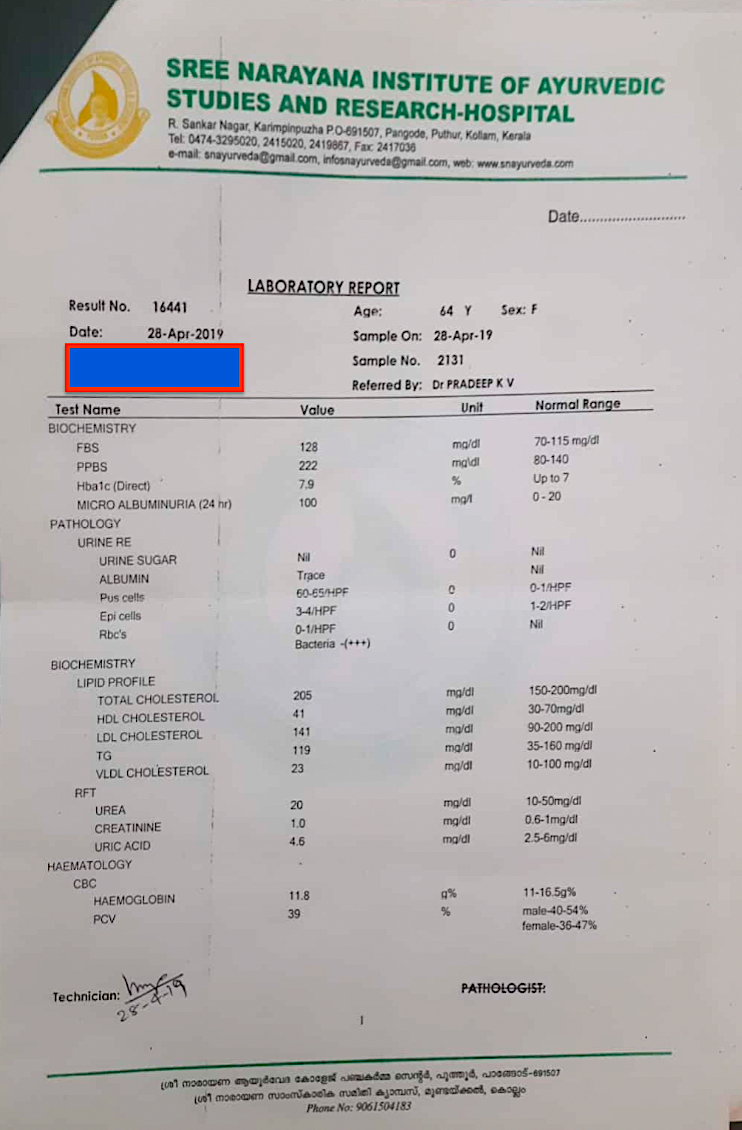
Modern Diagnostic parameter; The biomedical diagnosis was confirmed by the Ayurvedic physician based on the clinical evaluation and lab investigations.
Image 2. Baseline report dated 28.4.2019
Ayurvedic Assessment was done based on the presenting complaints and clinical evaluation. The treating physician confirmed the Ayurvedic diagnosis as Prameha janya abhyantara vidradhi pidaka.
Ashtastana Pareeksha done:
Nadi – Drutham
Mootram - Bahalam, Peetam, Phenilam, Visragandham.
Malam - Baddham, Alpam.
Jihva - Aliptham
Sabda - Vyaktham
Sparsa - Anushnaseetam
Drik - No Pramehajanya timira, Eshata tamra.
Akruti - Sthoolam.
Differential Diagnosis-
Organ-specific inflammatory conditions that have correlations with microalbuminuria are periodontitis, obstructive respiratory disease, hepatitis, bowel disease, pancreatitis, rheumatoid arthritis, and psoriasis. Based on the clinical evaluation and the lab investigations, the biomedical diagnosis was confirmed.
Prognosis: Microalbuminuria is an important clinical finding because it is not only associated with an increased risk of progression to overt proteinuria (macroalbuminuria) and renal failure, but also cardiovascular events. In patients with type 2 diabetes mellitus, hypertension, a decline in renal function may occur when albumin excretion is still in the normal range. In this case report, the patient is a known case of Type 2 Diabetes mellitus since 14 years and with hypertension. With one month of Ayurvedic treatment, the urinary albumin excretion level has reached within normal limit and the patient got relief from all the symptoms.
THERAPEUTIC INTERVENTION
Refer the tab ‘Treatment’ in the Portal.
FOLLOW-UP AND OUTCOMES
The patient had 2 follow ups in total. The subjective and objective parameters were assessed.
Clinician-based assessment; With 30 days of treatment, general debility of the patient reduced. Patient got complete relief from frothiness of urine and bilateral ankle swelling.
Patient-assessed; Not relevant
Image 3. Lab reports taken at endpoint dated 10.6.2019
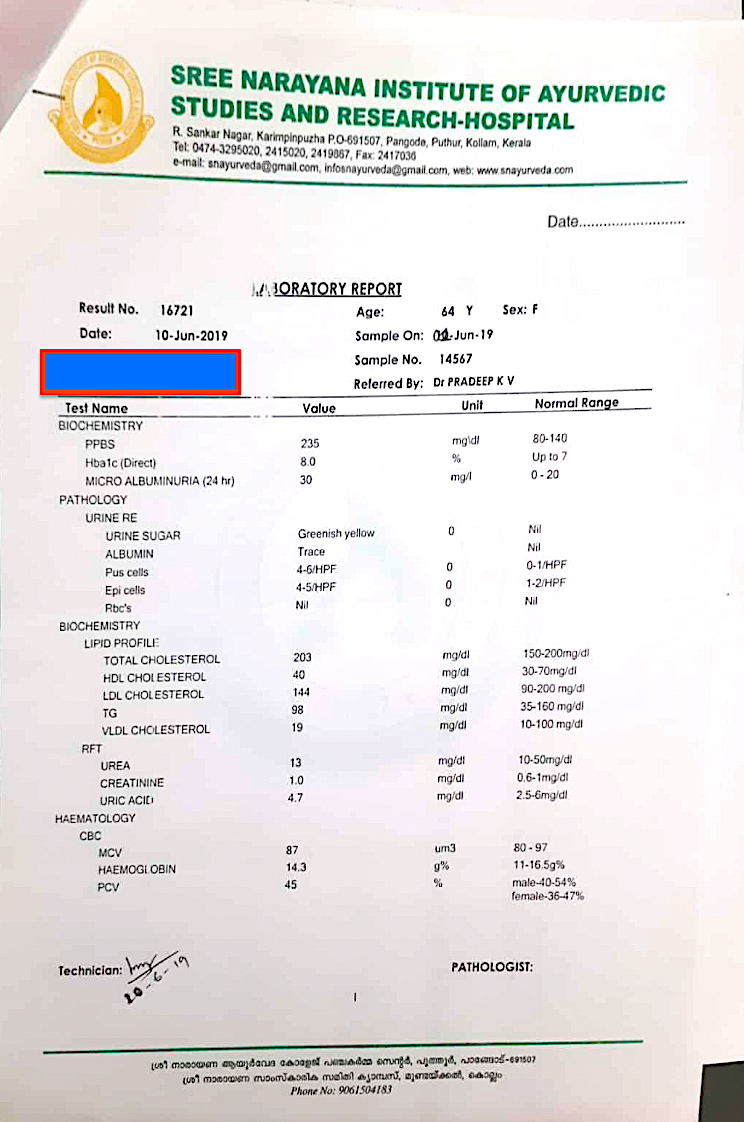
Table 1. The subjective and objective parameters tabulated before and after treatment.
OBSERVATIONS
BEFORE TREATMENT (29/4/2019)
AFTER TREATMENT (29/5/2019)
24 Hr. Urine Microalbumin level
100 mg/ day
30 mg/ day
Frothiness of urine
Present
Absent
General debility
Present
Reduced
Oedema of feet
Present
Absent
Intervention adherence and tolerability – The patient adhered to the prescribed treatments and tolerated the treatments well.
Method of assessment- Lab investigations and symptoms were the primary assessment criteria.
Adverse and unanticipated events; None reported
DISCUSSION:
In Microalbuminuria, there are subtle changes in the renal microstructures and are reversible. The chikitsa adopted must be Apatharpana focusing on kleda medo shoshana and tridosha shamana.The ingredients of Njara Njavaladi Kashaya are having pramehahara, kaphamedohara, mutrala, vatanulomana, raktha pitta sodhana and rasayana properties. Most of the drugs have kashaya tikta rasa, laghu ruksha guna, and katu vipaka. The kashaya rasa and laghu ruksha guna helps in shoshana of kapha, kleda and medas which can reduce the arterial proliferation and nodular sclerosis. The tikta rasa and shita virya of the drugs helps in pitta rakta shamana which can act on the vascular endothelium and control the renal hypertension. The katu vipaka helps in reducing the kapha and medo dushti.
PATIENT’S PERSPECTIVE
Not available.
LEARNING POINTS/TAKE HOME MESSAGES
This case report highlights the clinical efficacy of ayurveda in treating microalbuminuria using a very simple formulation, and within a short span of time.
INFORMED CONSENT
Written consent obtained from patient for publishing of the case report in the Portal
ACKNOWLEDGEMENTS
None
CONFLICT OF INTEREST
None declared.
FUNDING
None
REFERENCE
1. https://www.verywellhealth.com/microalbuminuria-overview-4684503
-
Immersive Learning
-
Modern Diagnosis
MODERN DIAGNOSIS: Microalbuminuria in Diabetes mellitus.
ABOUT THE DISEASE:
Albuminuria means you have too much albumin in your urine. It is a sign of more significant kidney disease. Microalbuminuria is when a small amount of protein called albumin is present in your urine. Microalbuminuria indicates that your kidneys aren’t functioning optimally and can sometimes be a sign of kidney disease. It also is a risk factor for cardiovascular disease.
Cause: Microalbuminuria is caused by kidney damage. Some medical conditions that can lead to kidney damage include:
- High blood pressure: People who have high blood pressure for a long time often have microalbuminuria. In these people, the condition is often also associated with other cardiovascular problems.
- Metabolic syndrome: Microalbuminuria is also associated with metabolic syndrome, a cluster of conditions that increase your risk of developing heart disease, diabetes, and other chronic health conditions.
- Type I and type II diabetes: People with diabetes may develop scarring and thickening of the nephrons, which are the filters that help remove waste products from the blood. This can lead to poor kidney function and albumin leaking into the urine.
- Obesity: Obesity can cause damage to the structure of the kidneys, affecting their function and leading to microalbuminuria. Obesity is also associated with other risk factors for kidney disease such as diabetes and hypertension.
- Genetic kidney diseases: Microalbuminuria is often present in people with inherited kidney conditions such as polycystic kidney disease.
Symptoms: Usually, microalbuminuria does not cause any symptoms. It can, however, be one of the earliest ways to detect kidney disease. Kidney damage may become significant (and not easily reversed) before a person notices any symptoms. This is part of why it is important for people at risk of kidney disease to have the test repeatedly so that treatment can begin if necessary.
If microalbuminuria goes undiagnosed, your albumin levels will continue to rise. One of the symptoms you might notice when this happens is foamy urine. Kidney damage can also cause swelling of the hands, ankles, face, or abdomen.
Diagnostic Criteria: Microalbuminuria is diagnosed based on laboratory urine tests that might be performed along with a standard medical exam.
Screening Method
Abnormal Result
24-hour collection
30 to 300 mg per 24 hours
4-hour collection
20 to 200 mcg
Spot result
30 to 300 mg per gram
In this case report, the patient is a 64 year old female patient, who is a known case of Diabetes mellitus since 14 years, complains of frothiness of urine and bilateral ankle swelling since 6 months. She had not taken any prior treatment for this condition. Based on clinical evaluation and lab investigations, the biomedical diagnosis was made as Microalbuminuria.
Image 1. Baseline lab report dated 28.4.2019
Prognosis & Treatment: Different treatments are available to address microalbuminuria. The best treatments may depend on the underlying causes, other medical conditions, and factors like your age and sex. In general, if you have medical conditions that may be worsening your kidney function (like diabetes), it’s helpful to get those under better control.
Reference
-
Ayurveda Diagnosis
AYURVEDA DIAGNOSIS: Prameha janya abhyantara vidradhi pidaka
The biomedical diagnosis of Microalbuminuria has been correlated to a spectrum of conditions- Abhyantara Vidradhi pidaka, due to prameha.
In this case report, the patient is a 64 year old female patient, who is a known case of Diabetes mellitus since 14 years, complains of frothiness of urine and bilateral ankle swelling since 6 months. She had not taken any prior treatment for this condition. Based on clinical evaluation and lab investigations, the biomedical diagnosis was made as Microalbuminuria. The ayurvedic diagnosis is very unique in the aspect that the treating physician has diagnosed Prameha as the root cause, and the disease as Abhyantara vidradhi pidaka. The diabetic carbuncle has presented as an abscess.
Prameha:
The word Prameha is derived from Pra – means excess, Meha – ksharane - passing of urine. ‘Pra’ means excess and ‘Meha’ means ‘ksharaNe’ (ie) passing of urine. Prameha can be defined as the disease characterised by passing excess urine. The Classical Texts also mention the turbid appearance of the urine.
प्रभूताविल मूत्रता......
Apart from this, symptoms like Malina danta, hasta pada daha, deha chikkanata, trshna, madhurya asya, madhu samana varna, angagandha, shithilangata are also mentioned.
Vidradhi:
Vidradhi is correlated to abscess. Abscess is a collection of pus that has built up within the tissues. It is thus a confined pocket of pus that collects in the tissues, organs or spaces inside the body. They are associated with pain, swelling and redness.
दुष्टरक्तातिमात्रत्वात् स वै शीघ्रं विदह्यते।
ततः शीघ्रविदाहित्वाद्विद्रधीत्यभिधीयते॥९५॥ (CS.Su.17)
Lakshanas:
सर्वासु च महच्चूलं विद्रधीषूपजायते॥९७॥ (CS.Su.17)
The main symptom in all types of vidradhi is the severe pain that manifests. When Vidradhi affects the internal organs, it is called as Abhyantara Vidradhi.
Prameha pidaka
ये यन्मयाः स्मृता मेहास्तेषामेतास्तु तन्मयाः || ३४ ||विना प्रमेहमप्येता जायन्ते दुष्टमेदसः |
तावच्चैता न लक्ष्यन्ते यावद्वास्तुपरिग्रहः || ३५ ||A particular variety of prameha is caused by the ulcers that are also caused by the doshas that generate prameha. These ulcers can occur in the people, in who fat, adipose tissue (medas) has undergone abnormal change. The ulcers could occur to even those without diabetes (prameha). However, until they get localized in specified parts these boils cannot be recognized.
Sadhyasadhyata:
गुदे हृदि शिरस्यंसे पृष्टे मर्मसु चोत्थिताः |
सोपद्रवा दुर्बलाग्नेः पिडकाः परिवर्जयेत् || ३६ ||Persons who have developed these ulcers in the rectum, region of the head, shoulders, on the back and vital parts of the body, along with the complications and the ones who possess a poor digestive capacity, the pidaka are said to be incurable.
Treatment & Rationale for treatment as explained by the physician: The patient was prescribed a single Kashaya, that was Prameha hara in nature. As the clinical presentation was due to Prameha, this was being addressed. In Microalbuminuria, there are subtle changes in the renal microstructures and are reversible. The chikitsa adopted must be Apatharpana focusing on kleda medo shoshana and tridosha shamana.The ingredients of Njara Njavaladi Kashaya are having pramehahara, kaphamedohara, mutrala, vatanulomana, raktha pitta sodhana and rasayana properties. Most of the drugs have kashaya tikta rasa, laghu ruksha guna, and katu vipaka. The kashaya rasa and laghu ruksha guna helps in shoshana of kapha, kleda and medas which can reduce the arterial proliferation and nodular sclerosis. The tikta rasa and shita virya of the drugs helps in pitta rakta shamana which can act on the vascular endothelium and control the renal hypertension. The katu vipaka helps in reducing the kapha and medo dushti.
Reference:
1. Madhava Nidana. Chapter 33. Prameha- Prameha Pidaka Nidanam.
2. https://www.easyayurveda.com/2016/10/30/vidradhi-causes-pathogenesis-treatment/ -
Treatment
Name of Medicine Dosage Form Dosage Mode of Administrtation From - To (Date) Medicine Reference Njara Njavaladi Kasayam Kasayam 50 ml Oral, twice daily on empty stomach 2019-04-29 - 2019-05-29 Yogamrutham- Prameha Prakarana -
Outcome Measures
OUTCOME MEASURES
In this case report, the patient is a 64 year old female patient, who is a known case of Diabetes mellitus since 14 years, complains of frothiness of urine and bilateral ankle swelling since 6 months. She was on allopathic medication for diabetes, but had not taken any prior treatment for the presenting complains. Based on clinical evaluation and lab investigations, the biomedical diagnosis was made as Microalbuminuria. The Ayurvedic diagnosis was Prameha janya abhyantara vidradhi pidaka.
Assessment: Subjective and objective parameters were assessed to analyse the outcome of the treatment.
Subjective parameters: The symptoms of frothiness of urine, general debility and oedema of feet before and after treatment were observed and tabulated.
Objective parameters: The lab reports before and after treatment were tabulated and the primary focus was on Urine microalbumin level.
OBSERVATIONS
BEFORE TREATMENT (29/4/2019)
AFTER TREATMENT (29/5/2019)
24 Hr. Urine Microalbumin level
100 mg/ day
30 mg/ day
Frothiness of urine
Present
Absent
General debility
Present
Reduced
Oedema of feet
Present
Absent
Image 1. Endpoint lab report dated 10.6.2019
-