Featured Case
-
Abstract
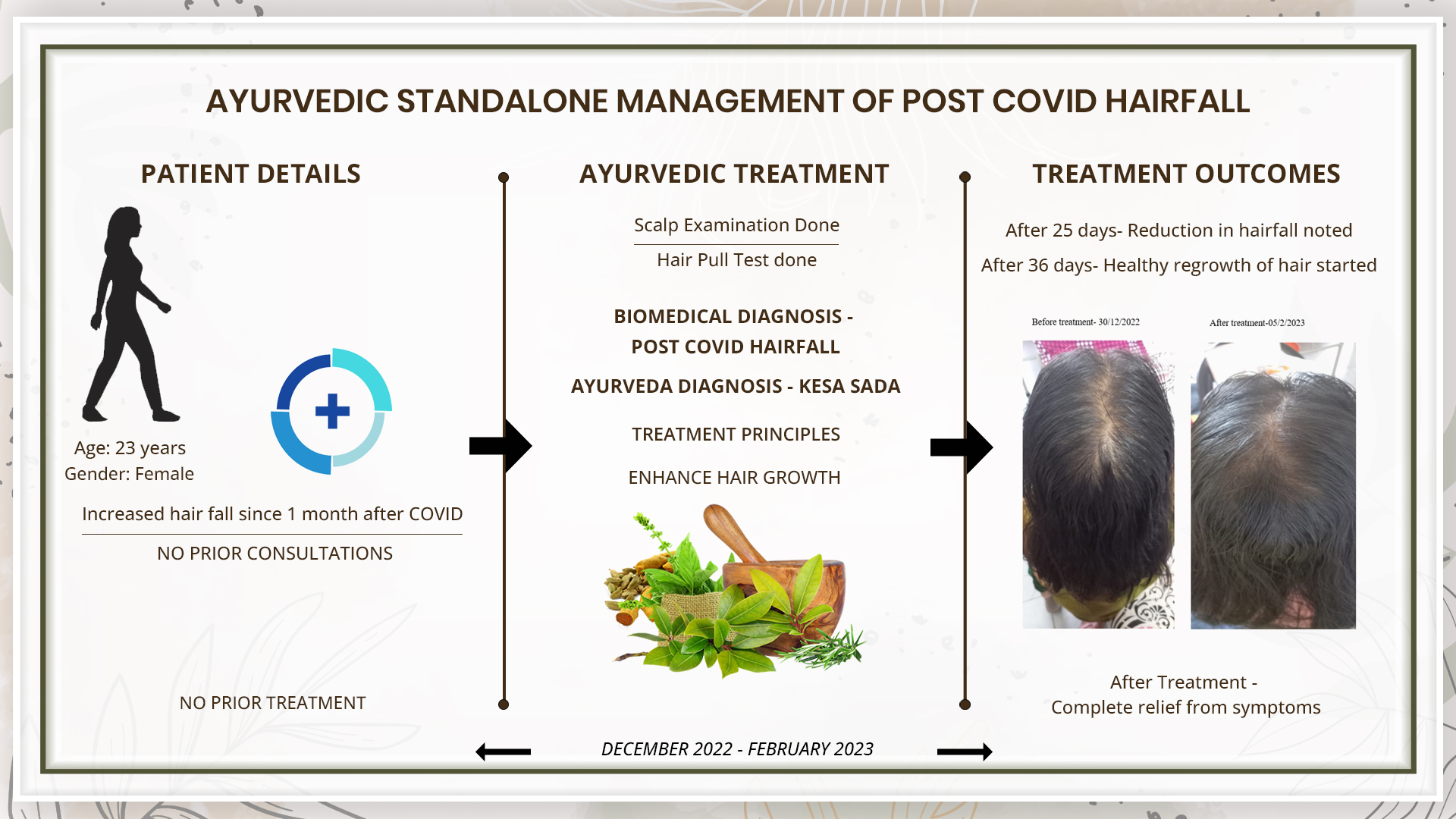
A 24-year-old female patient presented with increased hair fall. One month back, she tested COVID positive. After that she noticed hair fall. There were no prior consultations or treatments. The patient’s first consultation was with Dr Renjith for ayurvedic management. Based on the clinical evaluation, the biomedical diagnosis was made as Post Covid Hairfall, and the Ayurvedic diagnosis was Kesa sada. The line of treatment was to enhance hair growth and improve the blood circulation. The treatment targeted at pacifying vatapitta and pitta. The patient noticed a reduction in hair fall after 3 days of Ayurvedic treatment. With 14 days of treatment, there was a significant reduction in hair fall and new hair strands were noticed. After 1 month of treatment, the condition completely resolved. This case report is an example of the successful ayurvedic management of Post Covid Hairfall, in a young female who had tried hair oils and home remedies, but did not get relief.
-
Summaries
-
Listen
-
Watch
-
View
-
Read
A 24-year-old female patient presented with increased hair fall. One month back, she tested COVID positive. After that she noticed hair fall. There were no prior consultations or treatments. The patient’s first consultation was with Dr Renjith for ayurvedic management. Based on the clinical evaluation, the biomedical diagnosis was made as Post Covid Hairfall, and the Ayurvedic diagnosis was Kesa sada. The line of treatment was to enhance hair growth. The patient noticed a reduction in hair fall after 3 days of Ayurvedic treatment. With 14 days of treatment, there was a significant reduction in hair fall and new hair strands were noticed. After 1 month of treatment, the condition completely resolved. This case report is an example of the successful ayurvedic management of Post Covid Hairfall, in a young female who had tried hair oils and home remedies, but did not get relief.
-
-
Timeline
-
Tabulated Summary
-
Narrative
TITLE OF CASE
Standalone ayurvedic management of Post COVID hair fall- A Case report
Dr Renjith
ABSTRACT
A 24-year-old female patient presented with increased hair fall. One month back, she tested COVID positive. After that she noticed hair fall. There were no prior treatments. The patient’s first consultation was with Dr Ranjith for ayurvedic management of the same. Based on the clinical evaluation, the biomedical diagnosis was made as Post Covid Hairfall, and the Ayurvedic diagnosis was Kesa sada. The line of treatment was to enhance hair growth. The
patient noticed a reduction in hair fall after 3 days of Ayurvedic treatment. With 14 days of treatment, there was a significant reduction in hair fall and new hair strands were noticed. The hair pull test that was 120 at baseline, became 20 at the third follow up. After 1 month of treatment, the condition completely resolved. This case report is an example of the successful ayurvedic management of Post Covid Hairfall, in a young female who had tried hair oils and home remedies, but did not get relief.
KEYWORDS
Covid, hair fall, kesasadam, case report, standalone, ayurveda
INTRODUCTION
“Spondylolysis”
Hairfall is also referred to as hair loss. This can affect just your scalp or your entire body, and it can be temporary or permanent. It can be the result of heredity, hormonal changes, medical conditions or a normal part of aging. Anyone can lose hair on their head, but it's more common in men. Hair loss can appear in many different ways, depending on what's causing it. It can come on suddenly or gradually and affect just your scalp or your whole body.
Signs and symptoms of hair loss may include:
- Gradual thinning on top of head. This is the most common type of hair loss, affecting people as they age. In men, hair often begins to recede at the hairline on the forehead. Women typically have a broadening of the part in their hair. An increasingly common hair loss pattern in older women is a receding hairline (frontal fibrosing alopecia).
- Circular or patchy bald spots. Some people lose hair in circular or patchy bald spots on the scalp, beard or eyebrows. Your skin may become itchy or painful before the hair falls out.
- Sudden loosening of hair. A physical or emotional shock can cause hair to loosen. Handfuls of hair may come out when combing or washing your hair or even after gentle tugging. This type of hair loss usually causes overall hair thinning but is temporary.
- Full-body hair loss. Some conditions and medical treatments, such as chemotherapy for cancer, can result in the loss of hair all over your body. The hair usually grows back.
- Patches of scaling that spread over the scalp. This is a sign of ringworm. It may be accompanied by broken hair, redness, swelling and, at times, oozing.
Causes: Hereditary, hormonal changes, medical conditions, medications & supplements, radiation therapy, severe stress, hairstyles and specific treatments.
The hair loss that’s seen post-COVID-19 is usually telogen effluvium, a condition in which hair sheds in response to a stressor.
Diagnosis & Treatment: The basic diagnostic criteria is a medical history taking and physical examination. In order to identify the cause, blood test, pull test, scalp biopsy, and light microscopy may be done. The treatment is decided after identifying the cause. The cause is addressed. If there is a severe pathology, then managing the hair loss as a symptom may be very difficult. This patient only underwent ayurvedic treatment.
Prognosis: This also depends on the cause for hair fall. If it is a simple causative factor like stress, then it can be managed with counselling and supportive therapies. If it is due to a major pathology, then the prognosis is poor.
PATIENT INFORMATION
A 24 year old female, who presented with with increased hair fall. She tested COVID positive, one month back. The hairfall started after that. She tried different hair oils and home remedies, but still, the condition persisted. There were no prior consultations or treatments. Here the cause of the hair fall has been associated with COVID Infection.
No relevant family/genetic/surgical history/psychosocial history
CLINICAL FINDINGS
Scalp- Normal without dandruff
Hair pull test- more than 150 strands of hair fall in a dayTIMELINE
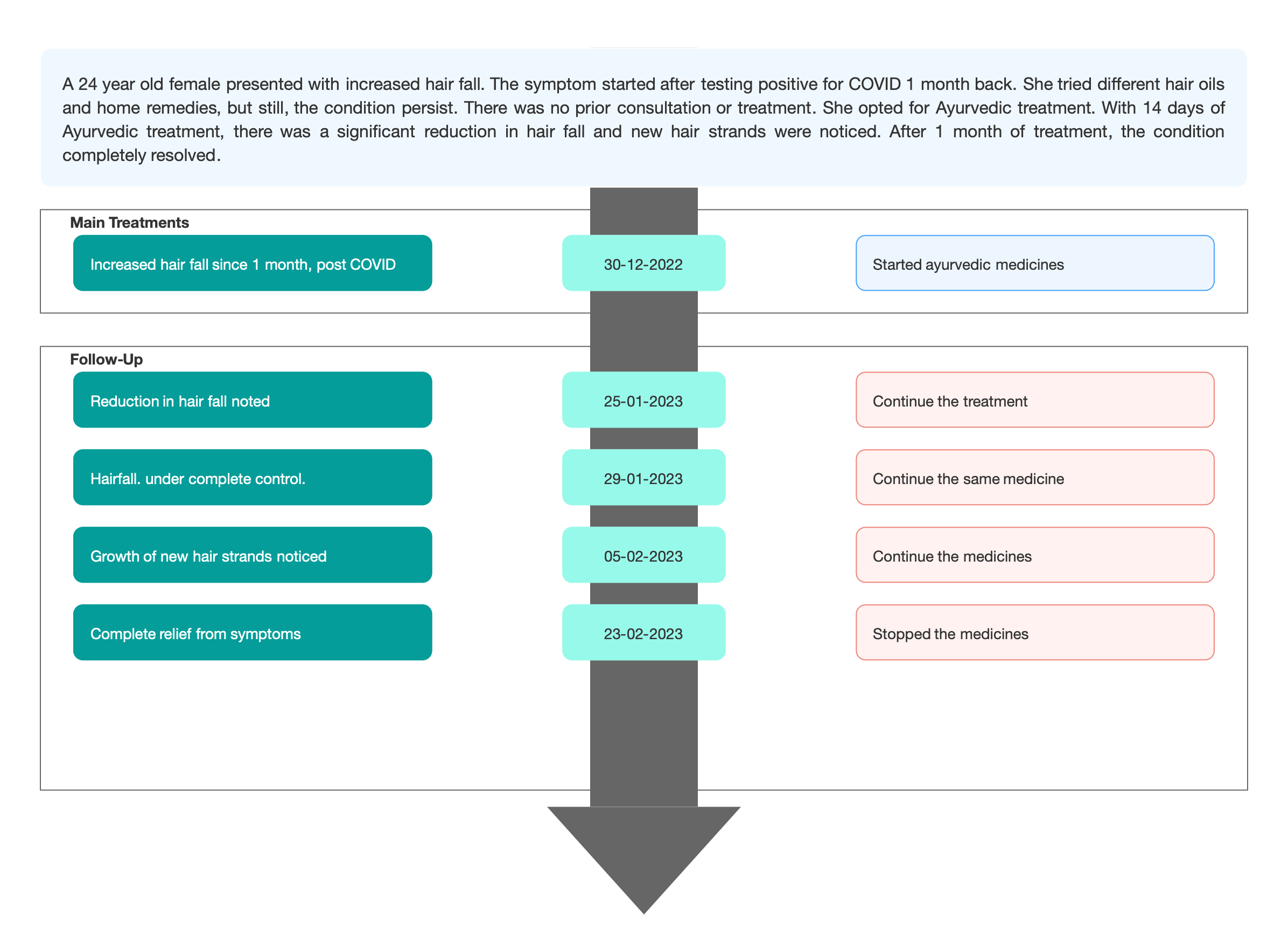
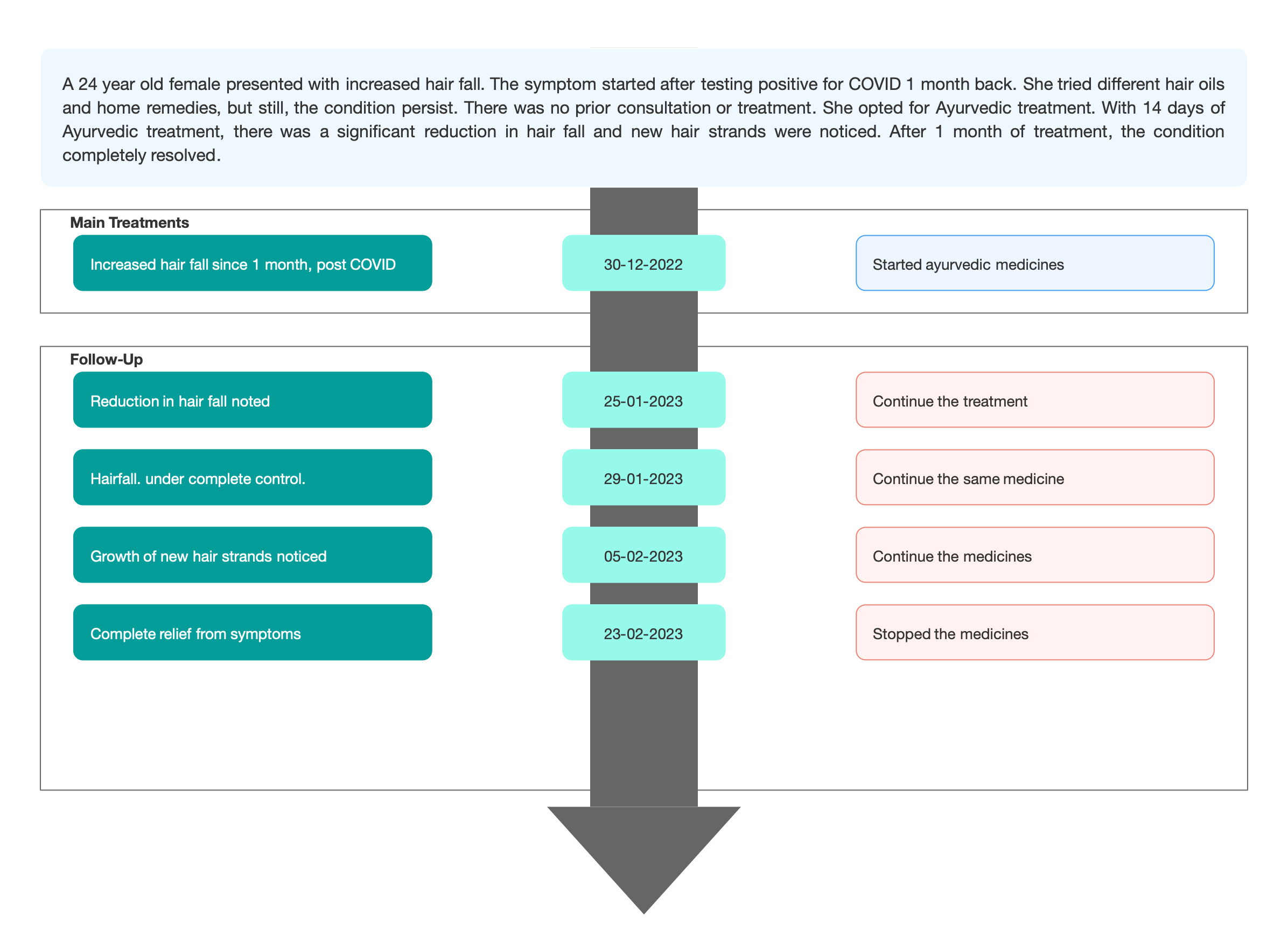
Image 1. Timeline of events added below
DIAGNOSTIC ASSESSMENT
Modern Diagnostic parameter; The biomedical diagnosis was confirmed by the Ayurvedic physician based on the clinical evaluation. There were no prior consultations or treatments.
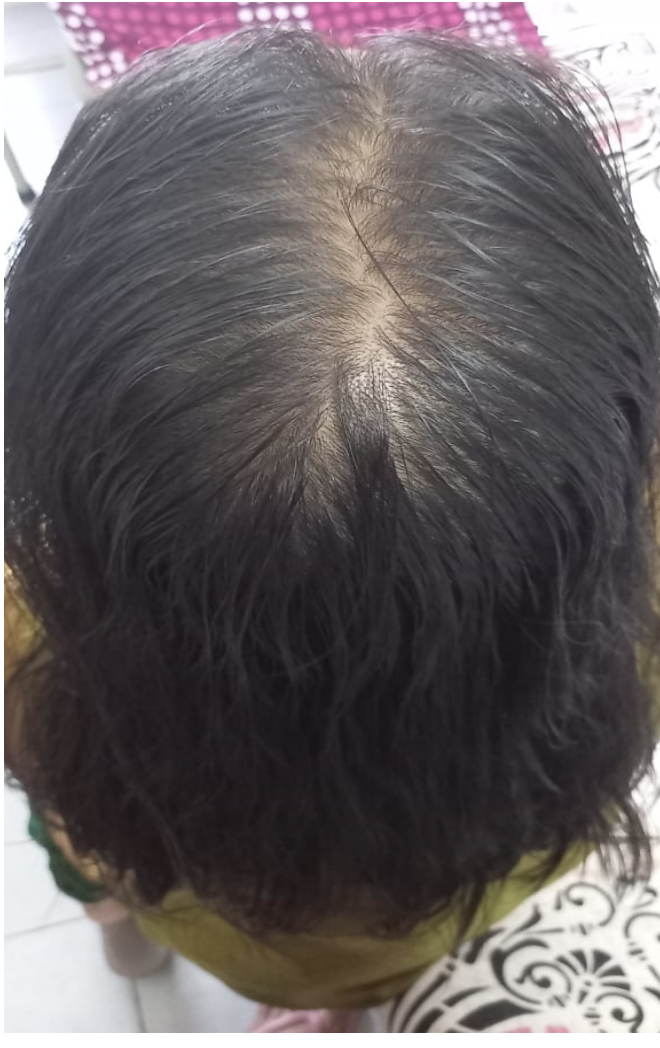
Image 2.Image of the scalp taken at baseline dated 30.12.2022
Ayurvedic Assessment was done based on the presenting complaints and clinical evaluation. The treating physician confirmed the Ayurvedic diagnosis as Kesasada.
Differential Diagnosis-
Alopecia
Stress hair loss
Scalp infection
Based on the symptoms and clinical examination, the diagnosis was confirmed as Post Covid hair fall.Prognosis- Post Covid hair fall is a self limiting condition, which can take 9 to 12 months. In this case with standalone Ayurvedic treatment, patient noticed significant reduction of the symptom in days and completely resolved in 1 month.
THERAPEUTIC INTERVENTION
Refer the tab ‘Treatment’ in the Portal.
FOLLOW-UP AND OUTCOMES
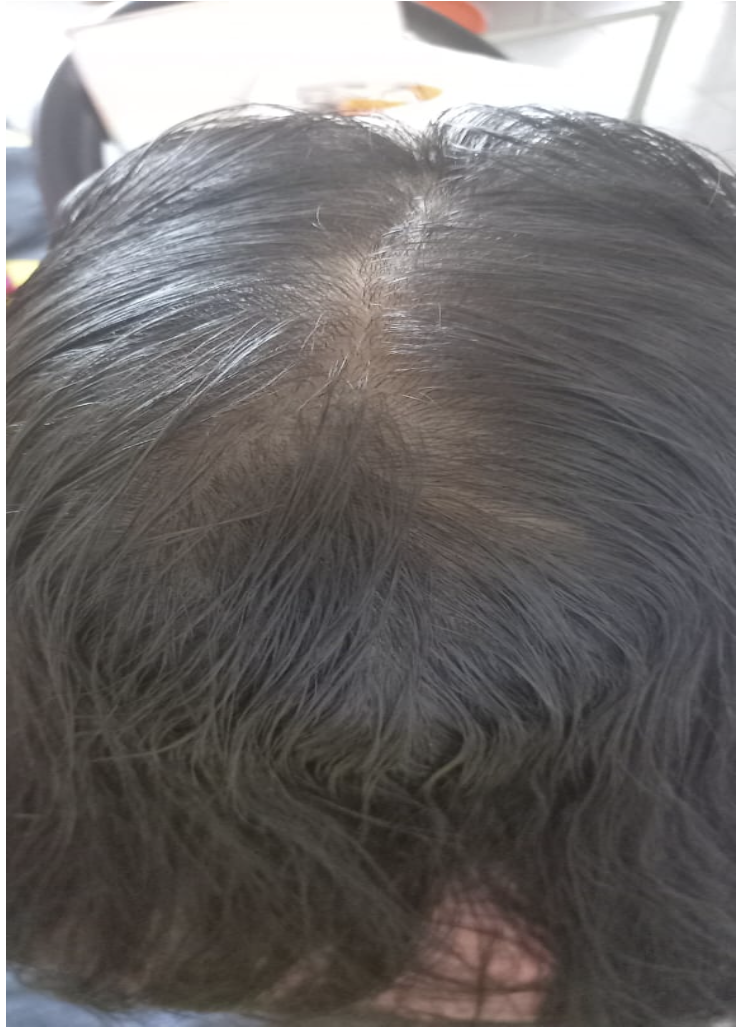
The patient had 4 follow ups in total. Each follow up, there was a significant reduction in the symptoms. Image was taken after treatment.
Image 3. Image taken after treatment dated 25.2.2023
Clinician-based assessment; Hair pull test - more than 150 strands of hair fall in a day, before treatment reduced to 20 strands of hair in a day at the 3rd follow up.
Patient noticed reduction in rate of hairfall after 3 days of treatment. With 14 days of treatment, there was significant reduction in hairfall and new hair strands were noticed. After 1 month of treatment, condition completely resolved.
Intervention adherence and tolerability – The patient adhered to the prescribed treatments and tolerated the treatments well.
Method of assessment- Subjective parameters were the main assessment tools.
Adverse and unanticipated events; None reported
DISCUSSION:
The patient tested Positive for Covid, one month back. The symptom of hairfall started after this. Post Covid hair is a self limiting condition, but it takes 9-12 months. But in this case report, the patient got complete relief with 1 month of ayurvedic treatments.
PATIENT’S PERSPECTIVE
Not available.
LEARNING POINTS/TAKE HOME MESSAGES
This case report is an example for the successful ayurvedic management of Post COVID hairfall in a 24 year old female, who had tried hair oils and home remedies, but did not get relief. With 1 month of Āyurvedic treatment, the symptoms completely resolved.
INFORMED CONSENT
Written consent obtained from patient for publishing of the case report in the Portal
ACKNOWLEDGEMENTS
None
CONFLICT OF INTEREST
None declared.
FUNDING
None
REFERENCE
-
Immersive Learning
-
Modern Diagnosis
MODERN DIAGNOSIS: Post Covid Hairfall
ABOUT THE DISEASE:
Hairfall is also referred to as hair loss. This can affect just your scalp or your entire body, and it can be temporary or permanent. It can be the result of heredity, hormonal changes, medical conditions or a normal part of aging. Anyone can lose hair on their head, but it's more common in men. Hair loss can appear in many different ways, depending on what's causing it. It can come on suddenly or gradually and affect just your scalp or your whole body.
Signs and symptoms of hair loss may include:
- Gradual thinning on top of head. This is the most common type of hair loss, affecting people as they age. In men, hair often begins to recede at the hairline on the forehead. Women typically have a broadening of the part in their hair. An increasingly common hair loss pattern in older women is a receding hairline (frontal fibrosing alopecia).
- Circular or patchy bald spots. Some people lose hair in circular or patchy bald spots on the scalp, beard or eyebrows. Your skin may become itchy or painful before the hair falls out.
- Sudden loosening of hair. A physical or emotional shock can cause hair to loosen. Handfuls of hair may come out when combing or washing your hair or even after gentle tugging. This type of hair loss usually causes overall hair thinning but is temporary.
- Full-body hair loss. Some conditions and medical treatments, such as chemotherapy for cancer, can result in the loss of hair all over your body. The hair usually grows back.
- Patches of scaling that spread over the scalp. This is a sign of ringworm. It may be accompanied by broken hair, redness, swelling and, at times, oozing.
Causes: Hereditary, hormonal changes, medical conditions, medications & supplements, radiation therapy, severe stress, hairstyles and specific treatments.
In this case report, the patient is a 24 year old female, who presented with with increased hair fall. She tested COVID positive, one month back. The hairfall started after that. She tried different hair oils and home remedies, but still, the condition persisted. There were no prior consultations or treatments. Here the cause of the hair fall has been associated with COVID Infection.
The hair loss that’s seen post-COVID-19 is usually telogen effluvium, a condition in which hair sheds in response to a stressor.
Diagnosis & Treatment: The basic diagnostic criteria is a medical history taking and physical examination. In order to identify the cause, blood test, pull test, scalp biopsy, and light microscopy may be done. The treatment is decided after identifying the cause. The cause is addressed. If there is a severe pathology, then managing the hair loss as a symptom may be very difficult. This patient only underwent ayurvedic treatment.
Image 1.Image of the scalp taken at baseline dated 30.12.2022
Prognosis: This also depends on the cause for hair fall. If it is a simple causative factor like stress, then it can be managed with counselling and supportive therapies. If it is due to a major pathology, then the prognosis is poor.
Reference
-
Ayurveda Diagnosis
AYURVEDA DIAGNOSIS: Kesha sada
ABOUT THE DISEASE:
In this case report, the patient is a 24 year old female, who presented with with increased hair fall. The biomedical diagnosis was Post Covid Hairfall and the treating physician has correlated this condition to Kesha sada in Ayurveda.
The word ‘Kesha’ means hair and ‘sada’ means ‘fall’ or ‘decrease’. This is not handled as a major disease entity in the classical textbooks of Ayurveda. But this does occur as a symptom in several other diseases. In general, this can be identified with the kshaya of asthi dhatu. In this case report, hair fall pertaining to the head is being considered.
Sadhyasadhyata: The details of sadhyasadhyata are not obtained from the classical textbooks of Ayurveda. But hypothetically, as the nidana is basically kshaya of asthi dhatu- vata vitiation primarily, this can be managed by pacifying vata. In this patient, the nidana is due to infection of Covid 1 month back. As the pathology is eliminated, and it is nava, this can be considered as sadhya.
Treatment and Rationale of treatment: The general line of treatment followed is pacification of dosas, and nourish the root of hair to initiate the hair growth. Rasayana and balya treatments are good.
Table 1. The list of medicines/therapy and the specific rationale
Medicine/ Procedure
Rationale
Draksharishtam
Pitta haram
Balaguluchyadi kashayam
Vata pitta haram
Nutrimix powder
Enhances hair growth
Madhuvanam Hair oil application(abhyangam)
Improves hair growth
Prachanam using derma roller
Helps improving blood circulation
Madhuvanam Hair mask
Enhances hair growth
-
Treatment
Name of Medicine Dosage Form Dosage Mode of Administrtation From - To (Date) Medicine Reference Draksharishtam Arishta 30 ml Twice daily after food 2023-01-23 - 2023-02-05 Sahasrayogam. Arista prakaranam Balaguluchyadi Kashayam Kashayam 15 ml With 45 ml of luke warm water on empty stomach twice daily 2023-01-23 - 2023-02-05 Sahasrayoga, Kashaya prakarana Nutrimix powde Powder 10 gms Twice daily after food, with warm water 2023-01-23 - 2023-02-12 Patent and Proprietary Medicine Madhuvanam Hair oil Taila Required Quantity Application on head 2023-01-23 - 2023-02-23 Patent and Proprietary Medicine Madhuvanam Hair mask Powder Required Quantity Application on head, once a week 2023-06-15 - 2023-08-15 Patent and Proprietary Medicine -
Outcome Measures
OUTCOME MEASURES
In this case report, the patient is a 24 year old female, who presented with with increased hair fall. She tested COVID positive, one month back. The hairfall started after that. She tried different hair oils and home remedies, but still, the condition persisted. There were no prior consultations or treatments. Here the cause of the hair fall has been associated with COVID Infection.
Assessment: Subjective parameters were assessed to analyse the outcome of the treatment. Images were taken before and after treatment.
Image 1. Image taken after treatment dated 25.2.2023
Hair pull test - more than 150 strands of hair fall in a day, before treatment reduced to 20 strands of hair in a day at the 3rd follow up.
Within 2 days, there was a reduction in the hairfall. Within 6 days, hairfall was under control. In 2 weeks, growth of new hair strands were noted. In 4 weeks, the patient is completely free form symptoms.
-