Featured Case
-
Abstract
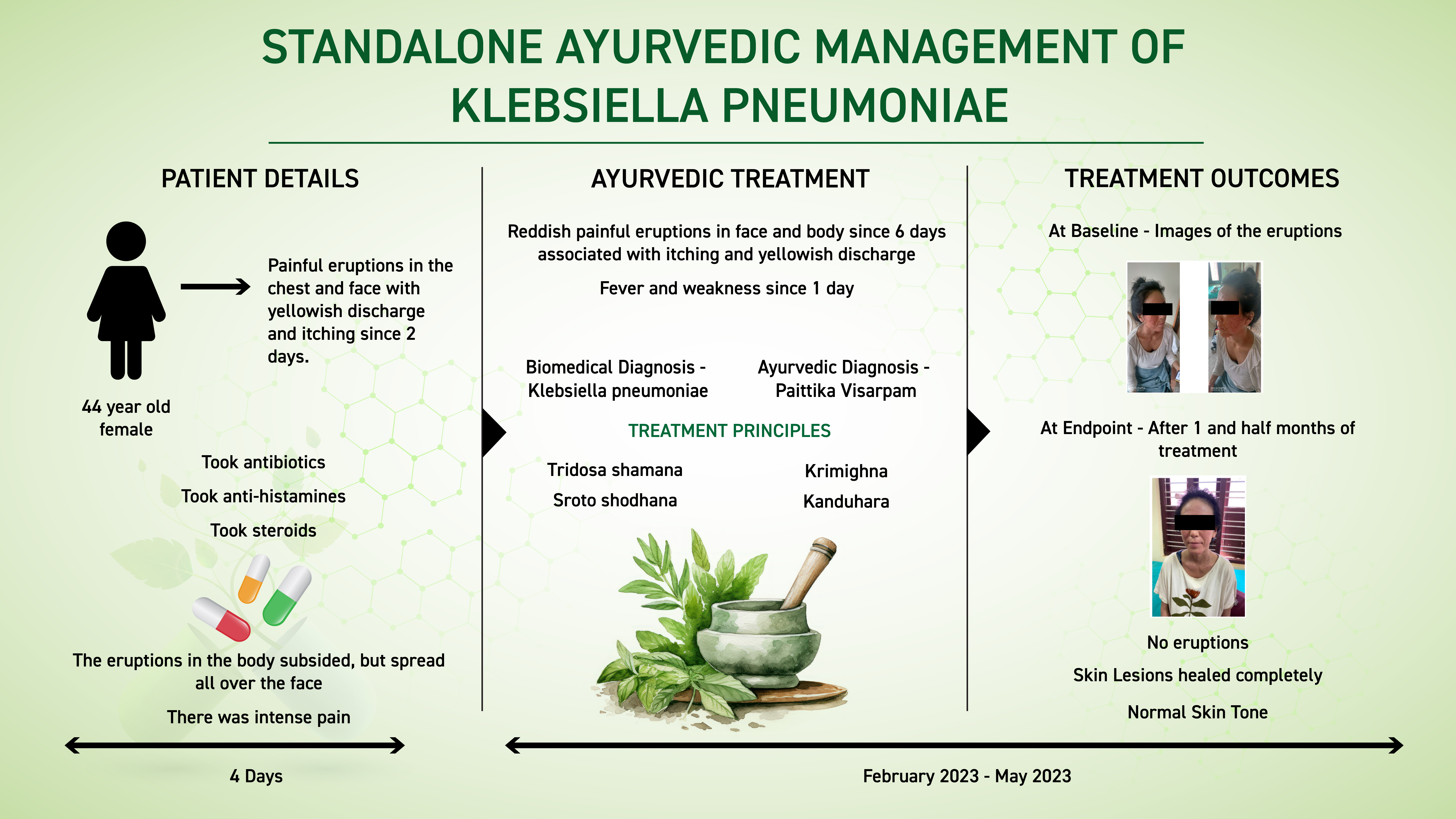
A 44-year-old female patient complained of reddish painful eruptions in her face and body for 6 days. The associated symptoms were itching and yellowish discharge from the eruptions, fever and weakness for 1 day. At the onset of symptoms, she consulted an allopathic doctor and tried topical applications and internal medications. The painful eruptions mostly increased and spread all over her face, while it subsided in the body. She felt intense pain and was advised to come for Ayurvedic treatment. She consulted Dr Sreejith. Based on the pus swab culture and sensitivity, the Biomedical diagnosis was made as Klebsiella pneumoniae induced infection and based on the clinical evaluation, the ayurvedic diagnosis was made as Paittika visarpam. The line of treatment followed was tridosha shamana, krimighna, sroto shodhana and kandu hara. With the initiation of ayurvedic care, after 2 days of treatment, the fever subsided. With the 2 weeks of Ayurvedic treatment, the patient noticed significant relief in symptoms. After 1 month of treatment, the lesions completely healed and the patient attained normal skin tone. This case report narrates the successful standalone āyurvedic management of Klebsiella pneumoniae infection female patient who was not responding to standard of care, and the symptoms were worsening.
-
Summaries
-
Listen
-
Watch
-
View
-
Read
A 44-year-old female patient complained of reddish painful eruptions in her face and body for 6 days. The associated symptoms were itching and yellowish discharge from the eruptions, fever and weakness for 1 day. At the onset of symptoms, she consulted an allopathic doctor and tried topical applications and internal medications. The painful eruptions mostly increased and spread all over her face, while it subsided in the body. She felt intense pain and was advised to come for Ayurvedic treatment. She consulted Dr Sreejith. Based on the pus swab culture and sensitivity, the Biomedical diagnosis was made as Klebsiella pneumoniae induced infection and based on the clinical evaluation, the ayurvedic diagnosis was made as Paittika visarpam. The line of treatment followed was tridosha shamana, krimighna, sroto shodhana and kandu hara. With the initiation of ayurvedic care, after 2 days of treatment, the fever subsided. With the 2 weeks of Ayurvedic treatment, the patient noticed significant relief in symptoms. After 1 month of treatment, the lesions completely healed and the patient attained normal skin tone. This case report narrates the successful standalone āyurvedic management of Klebsiella pneumoniae infection female patient who was not responding to standard of care, and the symptoms were worsening.
-
-
Timeline
-
Tabulated Summary
-
Narrative
TITLE OF CASE
Standalone ayurvedic management of Klebsiella pneumoniae infection- A case report
Dr Sreejith Kartha
ABSTRACT
A 44-year-old female patient complained of reddish painful eruptions in her face and body for 6 days. The associated symptoms were itching and yellowish discharge from the eruptions, fever and weakness for 1 day. At the onset of symptoms, she consulted an allopathic doctor and tried topical applications and internal medications. The painful eruptions mostly increased and spread all over her face, while it subsided in the body. She felt intense pain and was advised to come for Ayurvedic treatment. She consulted Dr Sreejith. Based on the pus swab culture and sensitivity, the Biomedical diagnosis was made as Klebsiella pneumoniae induced infection and based on the clinical evaluation, the ayurvedic diagnosis was made as Paittika visarpam. The line of treatment followed was tridosha shamana, krimighna, sroto shodhana and kandu hara. With the initiation of ayurvedic care, after 2 days of treatment, the fever subsided. With the 2 weeks of Ayurvedic treatment, the patient noticed significant relief in symptoms. After 1 month of treatment, the lesions completely healed and the patient attained normal skin tone.
KEYWORDS
Klebsiella, pneumoniae, case report, standalone, ayurveda
INTRODUCTION
A Klebsiella is a type of bacteria commonly found in nature. In humans, the bacteria are often present in parts of the digestive tract where they do not generally cause health issues. In the United States, Klebsiella pneumoniae and Klebsiella oxytoca are the two strains responsible for most of the human sickness. Many Klebsiella infections are acquired in the hospital setting or in long-term care facilities. In fact, Klebsiella accounts for up to 8% of all hospital-acquired infections. People with a compromised immune system and/or people who have an implanted medical device (such as a urinary catheter or airway tube) are more at risk for Klebsiella infections. Extensive use of antibiotics has resulted in the development of antibiotic-resistant strains of Klebsiella. These infections can be more aggressive and difficult to treat. Whenever klebsiella gets into other areas of the body, it can lead to a range of illnesses, including pneumonia, bloodstream infections, meningitis, and urinary tract infections.
Prognosis: Klebsiella species bacteria are antibiotic resistant. Hence, the disease is difficult to cure when it affects different organ systems at a particular time. The prognosis of Klebsiella pneumonaie is poor, especially in patients who are alcoholic, diabetic, have nosocomial infection or have septicemia.
Treatment: Given the low occurrence of K. pneumoniae in the community, the treatment should follow standard guidelines for antibiotic therapy. Once infection with K. pneumoniae is either suspected or confirmed, antibiotic treatment should be tailored to local antibiotic sensitivities. Current regimens for community-acquired K. pneumoniae include a 14-day treatment with either a third or fourth-generation cephalosporin as monotherapy or a respiratory quinolone as monotherapy or either of the previous regimes in conjunction with an aminoglycoside. If the patient is penicillin-allergic, then a course of aztreonam or a respiratory quinolone should be undertaken. For nosocomial infections, a carbapenem can be used as monotherapy until sensitivities are reported.
PATIENT INFORMATION
A 44 year old female patient complains of reddish painful eruptions in face and body since 6 days. She first consulted an allopathic doctor and underwent standard of care. The painful eruptions mostly increased and spread all over her face, while it subsided in the body. She felt intense pain and was advised to come for ayurvedic treatment.
Medical history: Patient travelled from Japan on the 5th of February. Since then she noticed lesions in the chest area. It worsened on 6th February when she reached Thiruvananthapuram. She claims that she washed with water from the hotel, which caused the eruptions to ooze out the yellowish liquid. She first consulted an allopathic doctor, who gave her penicillin, antibiotics (Cefuroxime), Paracetamol, Fusival b, Dexa 8mg injection. She alleges that the painful eruptions mostly increased and spread all over her face, while it subsided in the body.
CLINICAL FINDINGS
No physical examinations were undertaken as the infection was highly contagious.
TIMELINE
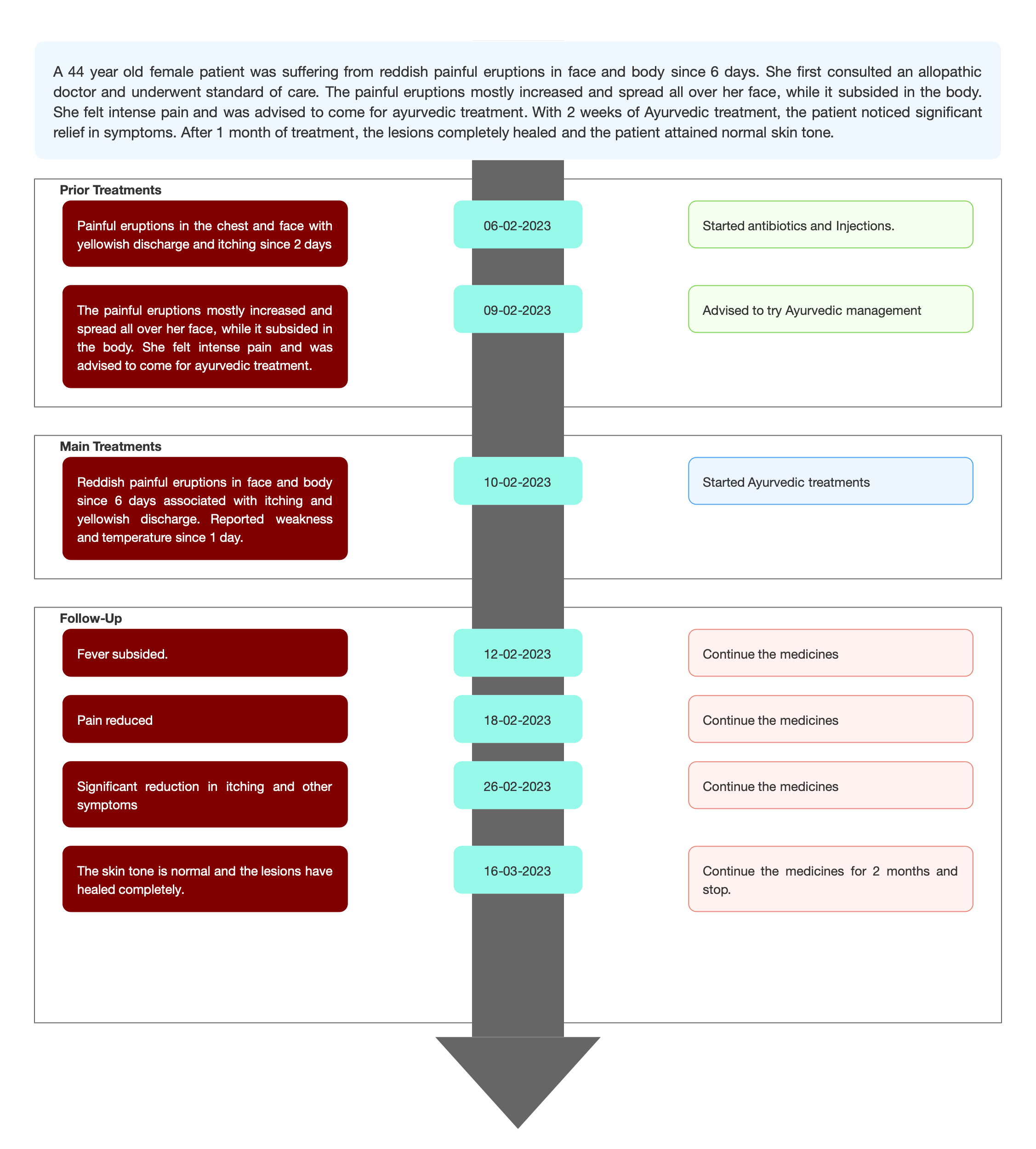
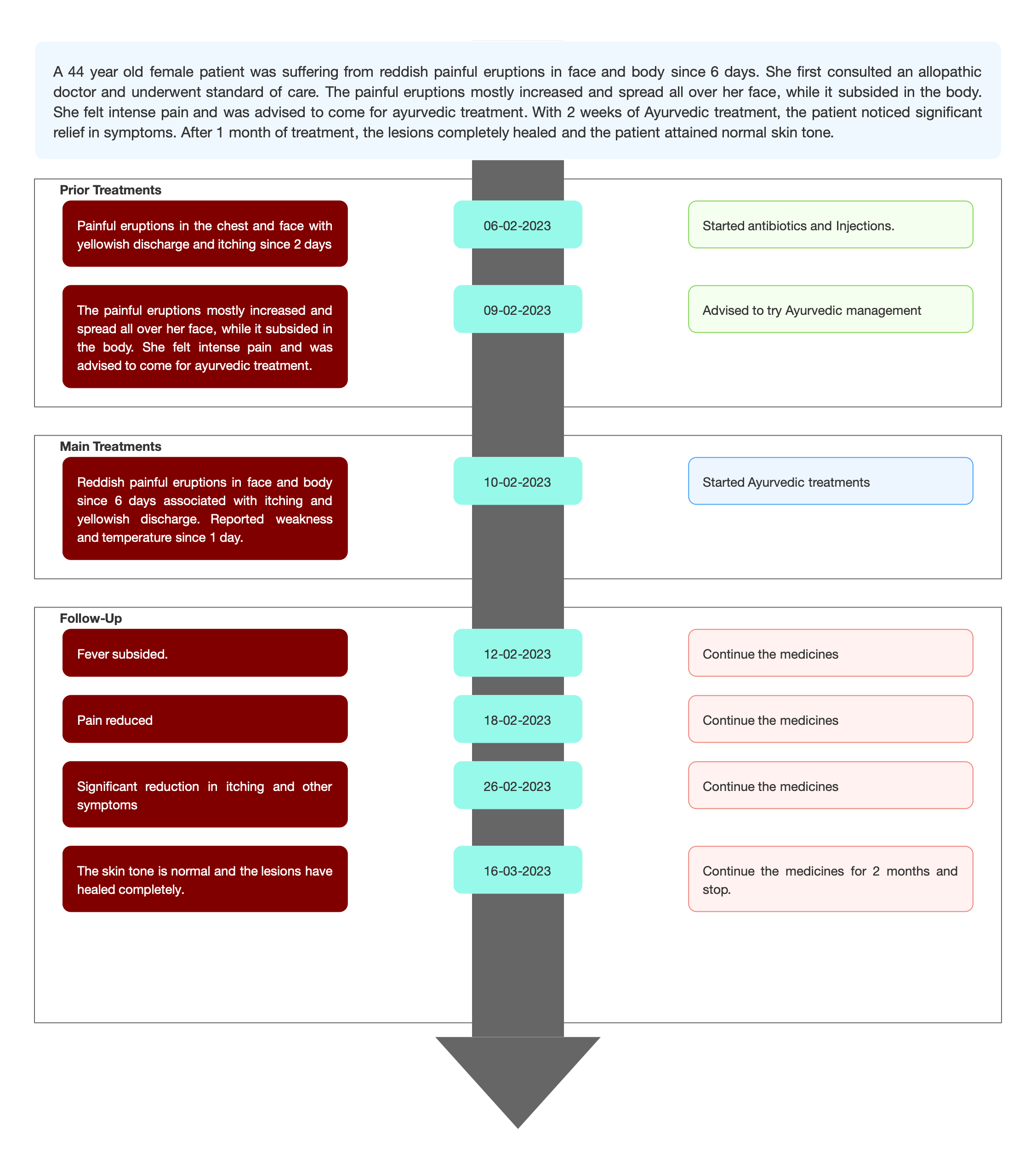
Image 1. Timeline of events added below
DIAGNOSTIC ASSESSMENT
Modern Diagnostic parameter; The biomedical diagnosis was confirmed based on the clinical evaluation and the Swab test done at baseline.
Image 2. Baseline Swab test dated 11.2.2023
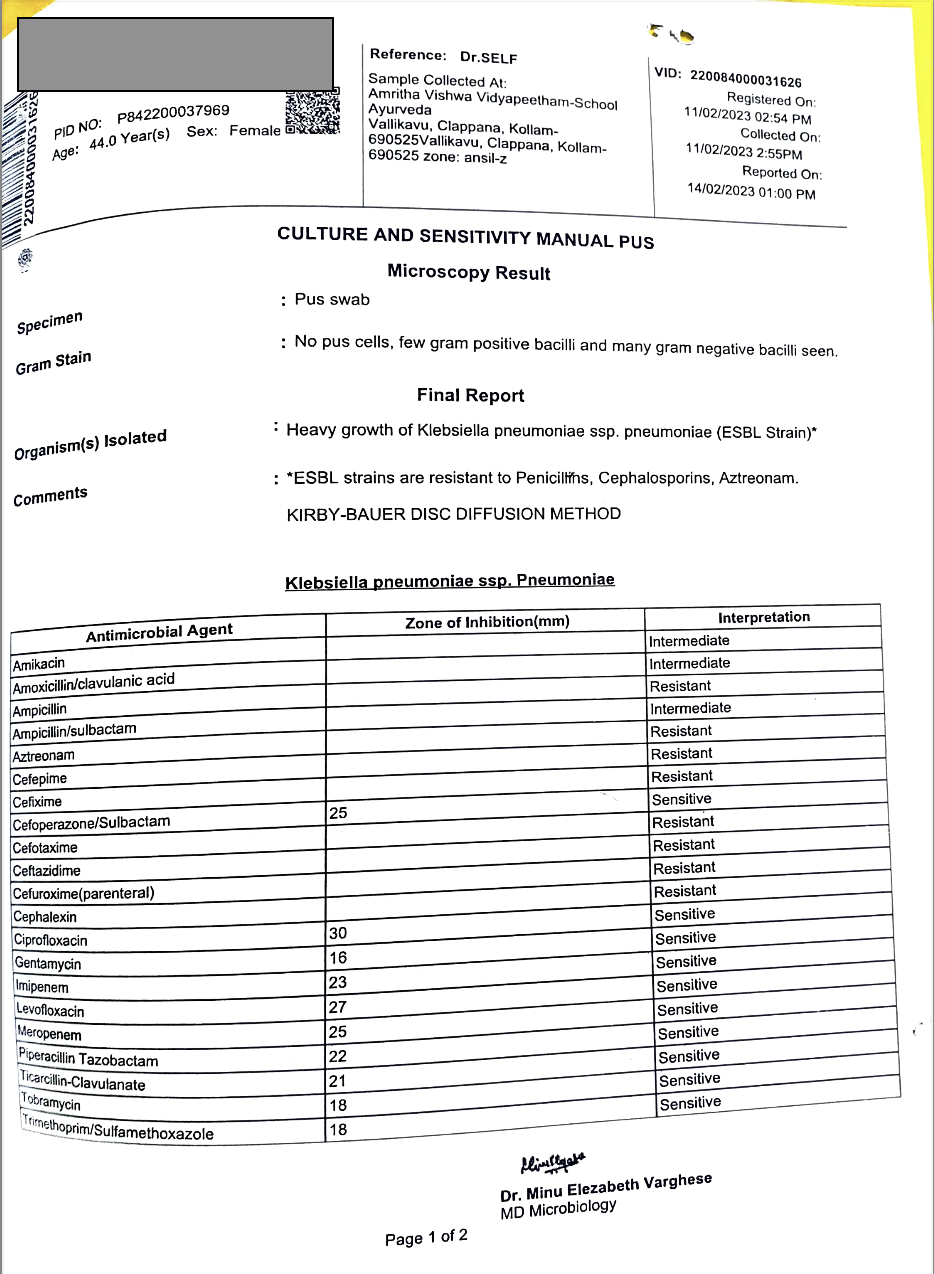
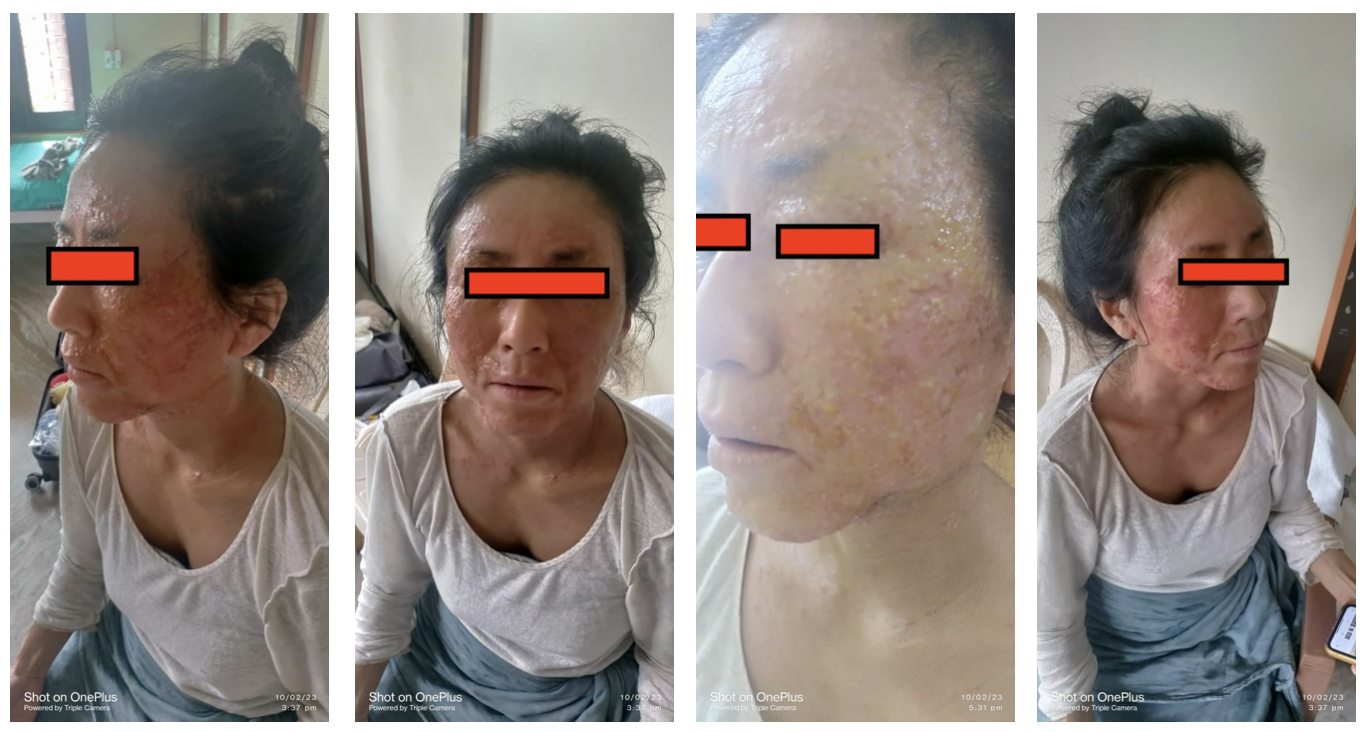
Image 3. Lesions photographed at baseline dated 10.2.2023
Ayurvedic Assessment was done based on the presenting complaints and clinical evaluation. The treating physician confirmed the Ayurvedic diagnosis as Paittika Visarpam.
Differential Diagnosis-
Allergic reaction
Chemical burn
Based on the clinical findings and investigation reports, the physician confirmed the condition as Klebsiella pneumoniae infectionPrognosis- Klebsiella pneumone is a gram negative bacteria which is highly antibiotic resistant. Hence, the disease is difficult to cure when it affects different organ systems at a particular time. The prognosis of Klebsiella pneumonaie is poor, especially in patients who are alcoholic, diabetic, have nosocomial infection or have septicemia. Inspite of taking 4 days of antibiotics the condition was not subsiding. With the initiation of ayurvedic care, after 2 days of treatment, the fever subsided. With the 2 weeks of Ayurvedic treatment, the patient noticed significant relief in symptoms. After 1 month of treatment, the lesions completely healed and the patient attained normal skin tone.
THERAPEUTIC INTERVENTION
Refer the tab ‘Treatment’ in the Portal.
FOLLOW-UP AND OUTCOMES
The patient had 4 follow ups in total. After 2 days of starting treatment, the fever subsided. After 1 week, the pain reduced. After 2 weeks, significant reduction in itching and other symptoms. After 4 weeks, lesions completely healed and the skin tone is normal.
Clinician-based assessment; On examination, the lesions are completely healed and the patient attained a normal skin tone.
Patient-assessed; Not relevant
Image 4. Blood culture report taken during the treatment dated 23.2.2023

Image 5. Images taken after the treatment dated 16.3.2023

Intervention adherence and tolerability – The patient adhered to the prescribed treatments and tolerated the treatments well.
Method of assessment- Photographs taken before and after treatment were the primary assessment criteria.
Adverse and unanticipated events; None reported
DISCUSSION ;
The patient had been suffering from complaints since 6 days. She tried the standard of care including antibiotics injections, but the symptoms persisted. The treating physician chose specific medicines and therapy to induce pacification of pitta. Kushtaghna dravya and medicines that had an anti-inflammatory and anti-microbial activity were used to manage the condition successfully.
PATIENT’S PERSPECTIVE
Not available.
LEARNING POINTS/TAKE HOME MESSAGES
This case report d the demonstrates the successful ayurvedic management of Klebsiella pneumoniae infection in a 44 year old female patient who was not responding to standard of care.
INFORMED CONSENT
Written consent obtained from patient for publishing of the case report in the Portal
ACKNOWLEDGEMENTS
None
CONFLICT OF INTEREST
None declared.
FUNDING
None
REFERENCE
- Wang G, Zhao G, Chao X, Xie L, Wang H. The Characteristic of Virulence, Biofilm and Antibiotic Resistance of Klebsiella pneumoniae. Int J Environ Res Public Health. 2020 Aug 28;17(17):6278. doi: 10.3390/ijerph17176278. PMID: 32872324; PMCID: PMC7503635.
- https://www.easyayurveda.com/2016/10/30/visarpa-causes-types-treatment-medicines/
- Singh et al. AYURVEDA AND MODERN PERSPECTIVE ON VISARPA AND ITS MANAGEMENT THROUGH CLASSICAL APPROACHES. wjpmr, 2020,6(12), 136-138.
-
Immersive Learning
-
Modern Diagnosis
MODERN DIAGNOSIS: Klebsiella pneumoniae infection
ABOUT THE DISEASE:
Klebsiella is a type of bacteria commonly found in nature. In humans, the bacteria are often present in parts of the digestive tract where they do not generally cause health issues. In the United States, Klebsiella pneumoniae and Klebsiella oxytoca are the two strains responsible for most of the human sickness. Many Klebsiella infections are acquired in the hospital setting or in long-term care facilities. In fact, Klebsiella accounts for up to 8% of all hospital-acquired infections. People with a compromised immune system and/or people who have an implanted medical device (such as a urinary catheter or airway tube) are more at risk for Klebsiella infections. Extensive use of antibiotics has resulted in the development of antibiotic-resistant strains of Klebsiella. These infections can be more aggressive and difficult to treat. Whenever klebsiella gets into other areas of the body, it can lead to a range of illnesses, including pneumonia, bloodstream infections, meningitis, and urinary tract infections.
Prognosis: Klebsiella species bacteria are antibiotic resistant. Hence, the disease is difficult to cure when it affects different organ systems at a particular time. The prognosis of Klebsiella pneumonaie is poor, especially in patients who are alcoholic, diabetic, have nosocomial infection or have septicemia.
In this case report, a 44 year old female patient complained of reddish painful eruptions in the face and body since 6 days. She first consulted an allopathic doctor and underwent standard of care. The painful eruptions mostly increased and spread all over her face, while it subsided in the body. She felt intense pain and was advised to come for ayurvedic treatment.
Image 1. Baseline photos of infection dated 10.2.2023
Diagnostic Criteria: Urine Culture and sensitivity test, swab test
Image 2. Baseline Swab test confirming the biomedical diagnosis dated 11.2.2023
Treatment: Given the low occurrence of K. pneumoniae in the community, the treatment should follow standard guidelines for antibiotic therapy. Once infection with K. pneumoniae is either suspected or confirmed, antibiotic treatment should be tailored to local antibiotic sensitivities. Current regimens for community-acquired K. pneumoniae include a 14-day treatment with either a third or fourth-generation cephalosporin as monotherapy or a respiratory quinolone as monotherapy or either of the previous regimes in conjunction with an aminoglycoside. If the patient is penicillin-allergic, then a course of aztreonam or a respiratory quinolone should be undertaken. For nosocomial infections, a carbapenem can be used as monotherapy until sensitivities are reported.
This patient underwent standard of care, but the painful eruptions mostly increased and spread all over her face, while it subsided in the body. She felt intense pain and was advised to come for ayurvedic treatment.
Reference
1. Wang G, Zhao G, Chao X, Xie L, Wang H. The Characteristic of Virulence, Biofilm and Antibiotic Resistance of Klebsiella pneumoniae. Int J Environ Res Public Health. 2020 Aug 28;17(17):6278. doi: 10.3390/ijerph17176278. PMID: 32872324; PMCID: PMC7503635.
-
Ayurveda Diagnosis
AYURVEDIC DIAGNOSIS: Paittika Visarpam
About the Disease:
Taking into consideration the clinical presentation, the treating physician has correlated the disease to Paittika Visarpam.
Tvacha word in Ayurveda is derived from the word ‘Tvac’ which means ‘to cover something’. It is first line of defense which protects body in various ways. According to Ayurvedic classics, Twacha Rogas are produced by the imbalance of Tridoshas-Dhatus and Raktadushti.
Visarpa is a disease that primarily affects the skin. This is so called because of the spreading nature of the disease like a snake.
विविधं सर्पति यतो विसर्पस्तेन स स्मृतः। परिसर्पो/थवा नाम्ना सर्वतः परिसर्पणात्॥११॥ (CS.Ci.6)
This is often been compared to erysipelas and herpes due to similarity in presentation. Since erysipelas doesn’t have elevated blisters, this can be ruled out. But most of the types of visarpa mimic erysipelas. In few types of erysipelas we can find symptoms similar to herpes zoster.
Causative Factors:
Caraka in Visarpa cikitsadhyaya, clearly explains the causative factors that lead to the pathology. Excess intake of lavana, alma, katu and ushna dravya, food products like dadhyamla, mastu, shukta, sura, sauvira etc will vitiate the dosas.
विषवाताग्निदोषाच्च विसर्पाणां समुद्भवः॥२१॥
एतैर्निदानैर्व्यामिश्रैः कुपिता मारुतादयः।
दूष्यान् सन्दूष्य रक्तादीन् विसर्पन्त्यहिताशिनाम्॥२२॥ (CS.Ci.6)
By the indulgence in causative factors, the vatadi dosa get aggravated and further vitiate. The raktadi chats, thus causing Visarpa.
Lakshana: This patient has been specifically identified as suffering from Pittaja Visarpam. The symptoms are
तस्य रूपाणि- ज्वरस्तृष्णा मूर्च्चा मोहश्चर्दिररोचको/ग़्गभेदः स्वेदो/तिमात्रमन्तर्दाहः प्रलापः शिरोरुक् चक्षुषोराकुलत्वमस्वप्नमरतिर्भ्रमः शीतवातवारितर्शो/तिमात्रं हरितहारिद्रनेत्रमूत्रवर्चस्त्वं हरितहारिद्ररूपदर्शनं च, यस्मिंश्चावकासे विसर्पो/नुसर्पति सो/वकाशस्ताम्रहरितहारिद्रनीलकृष्णरक्तानां वर्णानामन्यतमं पुष्यति, सोत्सेधैश्चातिमात्रं दाहसम्भेदनपरीतैः स्फोटकैरुपचीयते तुल्यवर्णास्रावैश्चिरपाकैश्च, निदानोक्तानि चास्य नोपछेरते विपरीतानि चोपशेरत इति पित्तविसर्पः॥३२॥ (CS.Ci.6)
The prominent symptoms are fever, thirst, giddiness, anorexia, body ache, burning sensation, headache etc. It is of a rapidly spreadably spreading nature. In this patient, the prominent symptoms were painful eruptions that were rapidly spreading.
Types of Visarpa:
स च सप्तविधो दोषैर्विञेयः सप्तधातुकः।पृथक् त्रयस्त्रिभिश्चैको विसर्पो द्वन्द्वजास्त्रयः॥१२॥
वातिकः पैत्तिकश्चैव कफजः सान्निपातिकः। चत्वार एते विसर्पा वक्ष्यन्ते द्वन्द्वजास्त्रयः॥१३॥
आग्नेयो वातपित्ताभ्यां ग्रन्थ्याख्यः कफवातजः। यस्तु कर्दमको घोरः स पित्तकफसम्भवः॥१४॥ (CS.Ci.6)
There are 7 types of Visarpa. The Era dosaja are 3 in number- vataja, pittaja and kaphaja. The Dvandvaja are 3 in number- Vatapitta, Vatakapha and Pittakapha. If the visarpa is caused by vitiated Vatapitta it is called as Agneya, Vatakapha is called as Granthi and Pittakapha is called as Karma Visarpa. The combination of all the vitiated tridosa causing visarpa is the sannipataja type. In this case report, the patient is a 44 year old female patient who complained of reddish painful eruptions in face and body since 6 days. She had consulted an allopathic doctor and underwent standard of care. The painful eruptions mostly increased and spread all over her face, while it subsided in the body. She felt intense pain and was advised to come for ayurvedic treatment. Based on the clinical evaluation, the treating physician has confirmed the diagnosis as Pittaja Visarpam.
Sadhyasadhyata of Visarpa: Visarpa caused by single dosha i.e. vataja, pittaja and kaphaja types are curable.
Among the visarpa caused by two doshas, agni visarpa (vata-pitta) and kardama visarpa (pitta- kapha) can be cured if they are not associated with complications and if the disease has not acicted to the vital organs and tissues, blood vessels, ligaments, muscles and Tuids of the body provided they are promptly treated and treatment continued till the disease goes away. If these conditions are not treated properly they may kill the person just like the poison of a snake. Granthi Visarpa (vata-kapha) should be treated as soon as possible. Granthi visarpa shall not be treated if associated with complications.
Sannipataja Visarpa (caused by all three doshas) is not curable since it has spread over into all the tissues, has tendency to form and spread quickly and the treatment strategies are mutually antagonistic amongst the doshas.As this patient was diagnosed as an Ekadosa Pradhana visarpa- pittaja, it is sadhya.
Treatment:
Caraka in Cikitsadhyaya of Visarpa that the treatments followed should be opposite properties of the vitiated pitta. General lines of treatment followed are:
- Principles of treating Visarpa:
Visarpa vis-à-vis blisters (erysipelas, herpes, dermatitis herpetiformis etc) should be promptly attended by the below said measures –
Langhana – fasting or lightening measures (to rectify metabolism, to digest ama or immature essence of digestion in circulation which is toxic to all cells)
Rukshana – to remove excess and unnecessary Tuidity in the body
Virechana – therapeutic purgation for expelling the morbid pitta and reduce the inTammatory process in the body
Vamana – therapeutic emesis for expelling the vitiated kapha from the body and to reduce excess kleda or unwanted blockage of srotas in the body
Lepa – application of medicinal pastes to hasten re recovery process and to heal the lesions (blisters)
Seka – stream pouring or sprinkling of medicinal fluids over the blisters to heal them Raktamokshana – bloodletting to remove the contaminated blood, also heals infections Avidahi ahara – non-corrosive foods - The Physicians also assess the Sthana and the Avastha of the dosa involved and then the treatment protocols are planned.
Rationale of treatment as explained by the Physician: The specific reason for choosing the medicine and therapy has been tabulated and presented.
Table 1. The medicine and the rationale for the choice
Name of the Medicine
Rationale
PATOLAKATUROHINYADI KASHAYAM
To nullify the toxins of microorganism. Kapha pitthaharam, antimirobial
AROGYAVARDHINI VATI
To stimuate liver to increase immunity
AMRITHARISHTAM+PUNARNAVASAVAM
Anti inflammatory, Amapacanam
KAMADUDHA RASA
Anti inflammatory, Pittashamanam
VETTUMARAN GULLIKA
As Analgesic to reduce pain
GOROCHANADI GULLIKA
Antimicrobial, to reduce infection
KAISHORA GUGGULU
As rasayana in kushta chikitsa
GUDUCHI THOYAPANAM
Acts well against skin lesions
NISHOTHAMADI KASHAYAM
Acts well against infectious diseases
C.ASWAL PLUS
To induce sleep
T.ALERT
To induce sleep
ULSET SYRUP
Antacid
T.ALLERCO
Good for sore throat
AVIPATHY CHOORNAM+AMLAKI CHOORNAM
Pittashamanam
MAHATIKTHAKAM KASHAYAM
Kushtaghnam
ARAGWADHARISHTAM+KHADIRARISHTAM
Kushtaghnam
SNEHAPANAM
Shodhana poorva snehapana to alleviate pitta kapha doshas. Mahatiktakam also contains amalaki, which acts as rasayana. Helps in tridosha shamana and prashasthadhatu formation
VIRECHANAM
Dosa hara
KSHEERA DHARA
It is indicated in infections. It is tridosha shamana and anti-inflammatory in action.
LEPAM
It is tridosha shamana and anti-inflammatory in action.
NEEM WATER BATH
It is antimicrobial in action and is mentioned in kushta chikitsa
NALPAMARADI THAILAM APPLICATION
As it belongs to varnya gana and imparts colour to newly formed skin
DURVADI KERAM
For controlling kleda over the skin.
TAKRA DHARA
To purify the srotas and to control inflammation
URTIPLEX LOTION
To reduce itching
Reference
- https://www.easyayurveda.com/2016/10/30/visarpa-causes-types-treatment-medicines/
- Singh et al. AYURVEDA AND MODERN PERSPECTIVE ON VISARPA AND ITS MANAGEMENT THROUGH CLASSICAL APPROACHES. wjpmr, 2020,6(12), 136-138.
- Principles of treating Visarpa:
-
Treatment
Name of Medicine Dosage Form Dosage Mode of Administrtation From - To (Date) Medicine Reference Patolakaturohinyadi Kashayam Kashayam 20 ml With 60 ml of luke warm water on empty stomach twice daily 2023-02-10 - 2023-02-14 AH Su 15.15 Arogyavardhini vati Tablet 2 Oral- with warm water twice daily 2023-02-10 - 2023-02-11 Rasendrasara Sangraha. Jwara Rogadhikara Amritarishtam+ Punarnavasam Samyoga 30 ml Twice daily after food 2023-02-10 - 2023-03-10 Amritarishtam- Bhaishajya Ratnavali Jwaradhikara 1257- 1260, Punarnavasavam- Bhaishajya Ratnavali. Shotha Rogadikar 197- 201. Kamadudha Rasa Tablet 2 Oral- with warm water twice daily 2023-02-10 - 2023-03-16 Ayurveda Sara sangraha - rasa rasayana prakarana Vettumaran Gulika Tablet 2 Oral- with warm water once daily 2023-02-10 - 2023-02-10 Sahasrayoga Gutika prakarana Gorochanadi Gulika Tablet 2 Oral- with warm water twice daily 2023-02-11 - 2023-03-06 Vaidya yoga ratnavali - gutika prakarana Kaishora Guggulu Tablet 1 Oral- with warm water twice daily 2023-02-11 - 2023-03-16 Sharngadhara Samhita. Madhyama Khanda 7.70- 81 Guduci Toyapanam Panam Required Quantity At regular intervals 2023-02-11 - 2023-02-22 Ekadravya Prayoga Nishottamadi Kashayam Kashayam 20 ml With 60 ml of luke warm water on empty stomach twice daily 2023-02-14 - 2023-03-04 AH Capsule Aswal Plus Tablet 2 Oral- with warm water at bedtime 2023-02-15 - 2023-02-21 Patent and Proprietary Medicine Tablet Alert Tablet 2 Oral- with warm water after food 2023-02-22 - 2023-03-16 Patent and Proprietary Medicine Ulset Syrup Syrup 5 ml Twice daily after food 2023-02-16 - 2023-03-16 Patent and Proprietary Medicine Tablet Allerco Tablet 2 Oral- with warm water after food 2023-03-02 - 2023-03-16 Patent and Proprietary Medicine Avipatti Curna+ Amalaki Curna Curna 1 Teaspoon Oral- with warm water at bedtime 2023-02-14 - 2023-03-16 Avipatti Curna- Sahasrayoga Curna prakaranam: Amlaki Curna- Sahasrayoga Curna prakaranam Mahatiktaka Kashayam Kashayam 20 ml With 60 ml of luke warm water on empty stomach twice daily 2023-03-07 - 2023-03-16 AH. Kushtacikitsa.19.8-10 Aragvadharishtam+Khadirarishtam Samyoga 30 ml Twice daily after food 2023-03-12 - 2023-03-16 Aragwadharishtam.AH.Su- 15.17-18, Khadirarishtam-Bhaishajya Ratnavali. 54.365-370 Mahatiktaka Ghrtam Ghrtam 30 ml, 50 ml, 75 ml Snehapanam, on empty stomach 2023-02-22 - 2023-02-24 Bhaishajya Ratnavali.Kustadhikara 118-124 Draksha Svarasam+ Trivrit Lehyam Samyoga 100 ml of svarasa+ 45 gms of lehya Virecana, on empty stomach 2023-02-25 - 2023-02-25 Trivrit lehyam- AH. Kalpa 2.9 Mahatiktaka Ghrtam Ghrtam 50 ml, 75 ml, 100 ml Snehapanam, on empty stomach 2023-03-08 - 2023-03-10 Bhaishajya Ratnavali.Kustadhikara 118-124 Draksha Svarasam+ Trivrit Lehyam Samyoga 100 ml of svarasa+ 45 gms of lehya Virecana, on empty stomach 2023-03-11 - 2023-03-11 Trivrit lehyam- AH. Kalpa 2.9 Yashtimadhu Ksheera Dhara Dravya Required Quantity Dhara done on the face 2023-02-10 - 2023-02-10 Anubhuta Yoga Jatamayadi Curna Curna Required Quantity External application on the affected site 2023-02-18 - 2023-03-20 Sahasrayoga Curna prakaranam: Amlaki Curna- Sahasrayoga Curna prakaranam Yashtimadhu Curna Curna for lepa Required Quantity Mixed with milk, External application on the affected site 2023-02-23 - 2023-02-28 Ekadravya Prayoga Nimba Toya Snana drava Required Quantity For bath 2023-02-11 - 2023-02-28 Ekadravya Prayoga Nalpamaradi Taila Taila Required Quantity External application on the affected site 2023-02-14 - 2023-02-20 Sahasrayogam. Tailaprakarana Urtiplex Lotion Lotion Required Quantity External application on the affected site 2023-02-25 - 2023-03-16 Patent and Proprietary Medicine -
Outcome Measures
OUTCOME MEASURES
The 44 year old female patient complained of reddish painful eruptions in face and body since 6 days. She first consulted an allopathic doctor and underwent standard of care. The painful eruptions mostly increased and spread all over her face, while it subsided in the body. She felt intense pain and was advised to come for ayurvedic treatment.
Assessment: Subjective and objective parameters were assessed to analyse the outcome of the treatment.
Subjective parameters: With 2 weeks of Ayurvedic treatment, the patient noticed significant relief in symptoms. After 1 month of treatment, the lesions completely healed and the patient attained normal skin tone.
Objective parameters: A culture and sensitivity test was done after 13 days indicated that there was no microbial manifestation.
Image 1. Image taken of the patient after treatment dated 16.3.2023.
Image 2. Blood culture and sensitivity test done during treatment dated 23.2.2023
-