Featured Case
-
Abstract
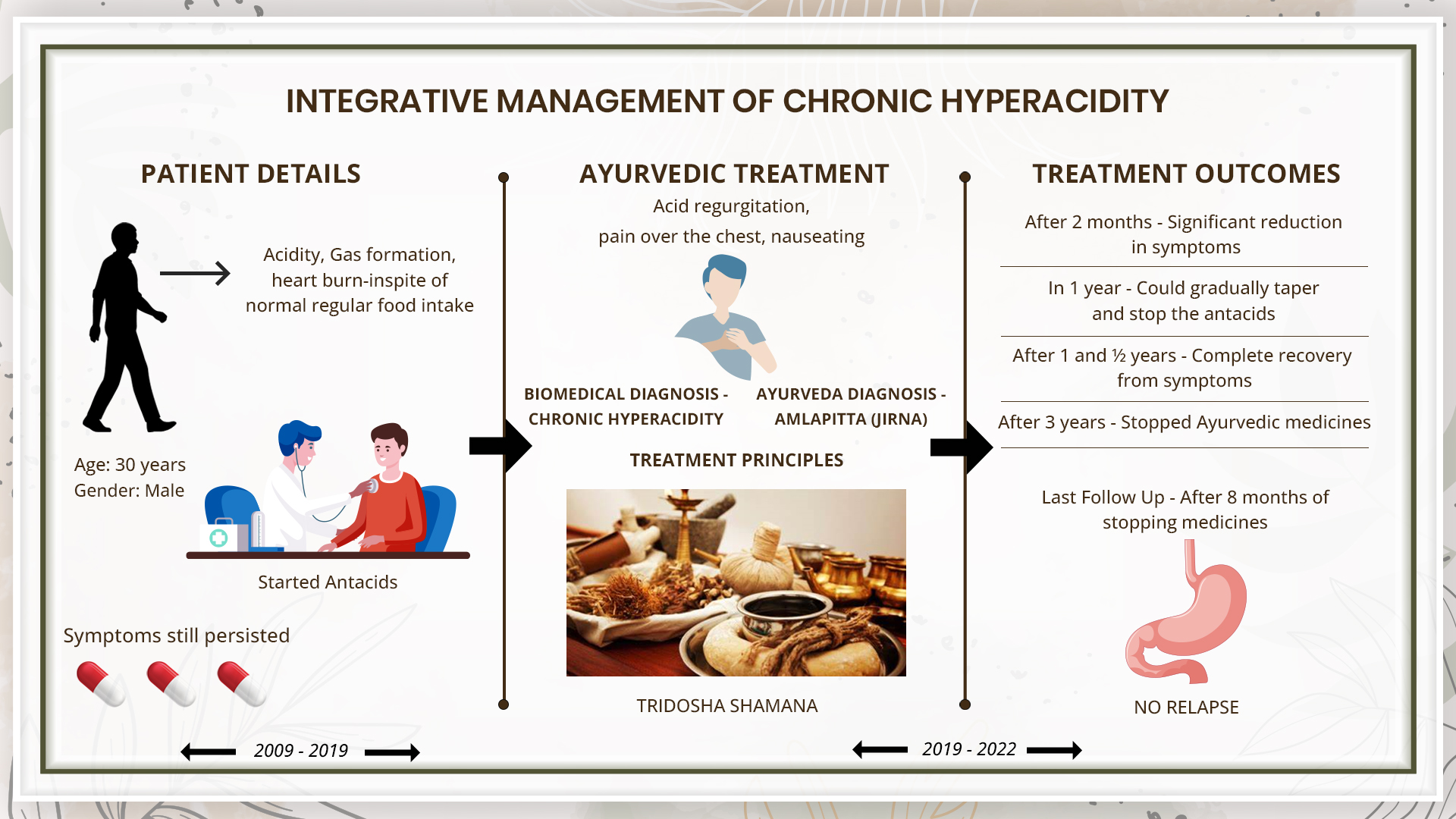
A 30-year-old male patient presented with acid regurgitation, pain over the retrosternal area, and nauseating feeling after having meals for 10 years. His daily activities were getting affected owing to the symptoms he used to get like severe episodes of headache which in turn affected his Quality of Life. His sleep cycle was affected as he used to get up in between sleep due to severe acid regurgitation. He took allopathic medicines and was on antacids. But the patient did not get relief. He then consulted Dr Partap Chauhan for better ayurvedic management. Based on clinical evaluation, the biomedical diagnosis was confirmed as Chronic Hyperacidity and the Ayurvedic diagnosis was Amlapittam (Jirna). The line of treatment followed was Tridosha shamana. With the initiation of Ayurvedic treatments, patient could taper the dose of regular antacids, and after 1 year he could completely stop the antacids. After 3 years of Ayurvedic treatments, he got complete relief. The last follow up was done after 8 months of stopping all his medicines, and there has been no recurrence. This case report demonstrates the successful ayurvedic management of a chronic case of Amlapitta in a 30 year old male patient who had been suffering from this condition for more than 10 years.
-
Summaries
-
Listen
-
Watch
-
View
-
Read
A 30-year-old male patient presented with acid regurgitation, pain over the retrosternal area, and nauseating feeling after having meals for 10 years (since 2009). His daily activities were getting affected owing to the symptoms he used to get like severe episodes of headache which in turn affected his Quality of Life. His sleep cycle was affected as he used to get up in between sleep due to severe acid regurgitation. He took allopathic medicines and was on antacids. But the patient did not get relief. He then consulted Dr Partap Chauhan for better ayurvedic management. Based on clinical evaluation, the biomedical diagnosis was confirmed as Chronic Hyperacidity and the Ayurvedic diagnosis was Amlapittam (Jirna). The line of treatment followed was basically pacifying all the three dosas. With the initiation of Ayurvedic treatments, patient could taper the dose of regular antacids, and after 1 year he could completely stop the antacids. After 3 years of Ayurvedic treatments, he got complete relief. The last follow up was done after 8 months of stopping all his medicines, and there has been no recurrence. This case report demonstrates the successful ayurvedic management of a chronic case of Amlapitta in a 30 year old male patient who had been suffering from this condition for more than 10 years.
-
-
Timeline
-
Tabulated Summary
-
Narrative
TITLE OF CASE
Intergrative approach in the management of chronic hyperacidity- A case report.
Dr Partap Chauhan
ABSTRACT
A 30-year-old male patient presented with acid regurgitation, pain over the retrosternal area, and nauseating feeling after having meals for 10 years (2019). His daily activities were getting affected owing to the symptoms he used to get severe episodes of headache which in turn affected his Quality of Life. His sleep cycle was affected as he used to get up in between sleep due to severe acid regurgitation. He took allopathic medicines and was on antacids. But the patient did not get relief. He then consulted Jiva Ayurveda. Based on clinical evaluation, the biomedical diagnosis was Chronic Hyperacidity and the Ayurvedic diagnosis was Amlapittam. The line of treatment followed was Tridosha hara. With the initiation of Ayurvedic treatments patient could taper the dose of regular antacids, and after 1 year he could completely stop the antacids. After 3 years of Ayurvedic treatments, he reported significant recovery and could stop all his regular allopathic medications.
KEYWORDS
Hyperacidity, chronic hyperacidity, amlapitta, integrative, ayurveda, jirna
INTRODUCTION
The hydrochloric acid in our stomach is needed for the digestion and breakdown of food. When there is an increase in the secretion of hydrochloric acid by the cells in the lining of our stomach, it is known as hyperacidity. These increased acid levels can cause many hyperacidity symptoms.
Causes of hyperacidity:
Hydrochloric acid is constantly present in our bodies. Its secretion increases when there is food to be digested. Hyperacidity is a pathological increase of the acid level in our stomach. This can happen in cases of:
Some infection that causes the stomach to secrete more acid to destroy the bacteria or virus.
Inadequate food or infrequent meal timings, which cause the acid to be underutilised.
Certain genetic conditions where the stomach secretes more acid than required.
Stress of the mental and physical type.
Increased intake of hot liquids and stimulants such as tea and coffee
Increased alcohol intake
Foods that upset the stomach and don’t suit the person, including those who are lactose intolerant or gluten intolerant.
Signs & Symptoms: Although hyperacidity symptoms are predominantly associated with burning, there are other symptoms too. Some other hyperacidity symptoms are described below:
Burning in the heart and chest region, above the stomach.
A burning sensation may sometimes be felt in the throat
A sour or bitter taste in the mouth that lasts for a while.
Sometimes, the hyperacidity symptoms can cause chest pain.
Due to burning in the throat, there can be a dry cough.
Asthma is also known to be a hyperacidity symptom.
Chronic sinusitis due to acid reflux.
Ear pain due to sinusitis caused by the reflux.
Diagnosis & Treatment: The primary diagnostic criteria for hyperacidity is medical history and clinical evaluation by the physician.
The cause is identified, and then the apt treatment is given. Mostly the treatment of choice is antacids, and pain killers to address the pain. Diet and lifestyle plays an important role in the management of the condition.
Prognosis: Hyperacidity is a mild condition, that can be managed well with medicine, diet and lifestyle. But if left untreated, this can become severe. Chronic (longterm) hyperacidity can result in ulcers and if the ulcers are not taken care of, it can result in perforation, which is a surgical emergency. Chronic ulcers can also become a malignancy. Prevention is better than cure.
PATIENT INFORMATION
A 30 year old male patient who presented with multiple ailments which includes acid regurgitation, pain over retrosternal area, nauseating feeling after having meals since 10 years . His daily activities were badly getting affected due to this and he used to get severe episodes of headache which in turns affects his Quality of life, including his sleep cycle because his sleep was disturbed due to severe acid regurgitation. He is on regular antacids since 1 year.
No relevant family/genetic/surgical history.
Psychosocial history- Disturbed sleep due to severe acid regurgitation
Mild stressCLINICAL FINDINGS
General examination was done.
Appetite- low
sleep- disturbed
stress +
pain + in retrosternal area.TIMELINE
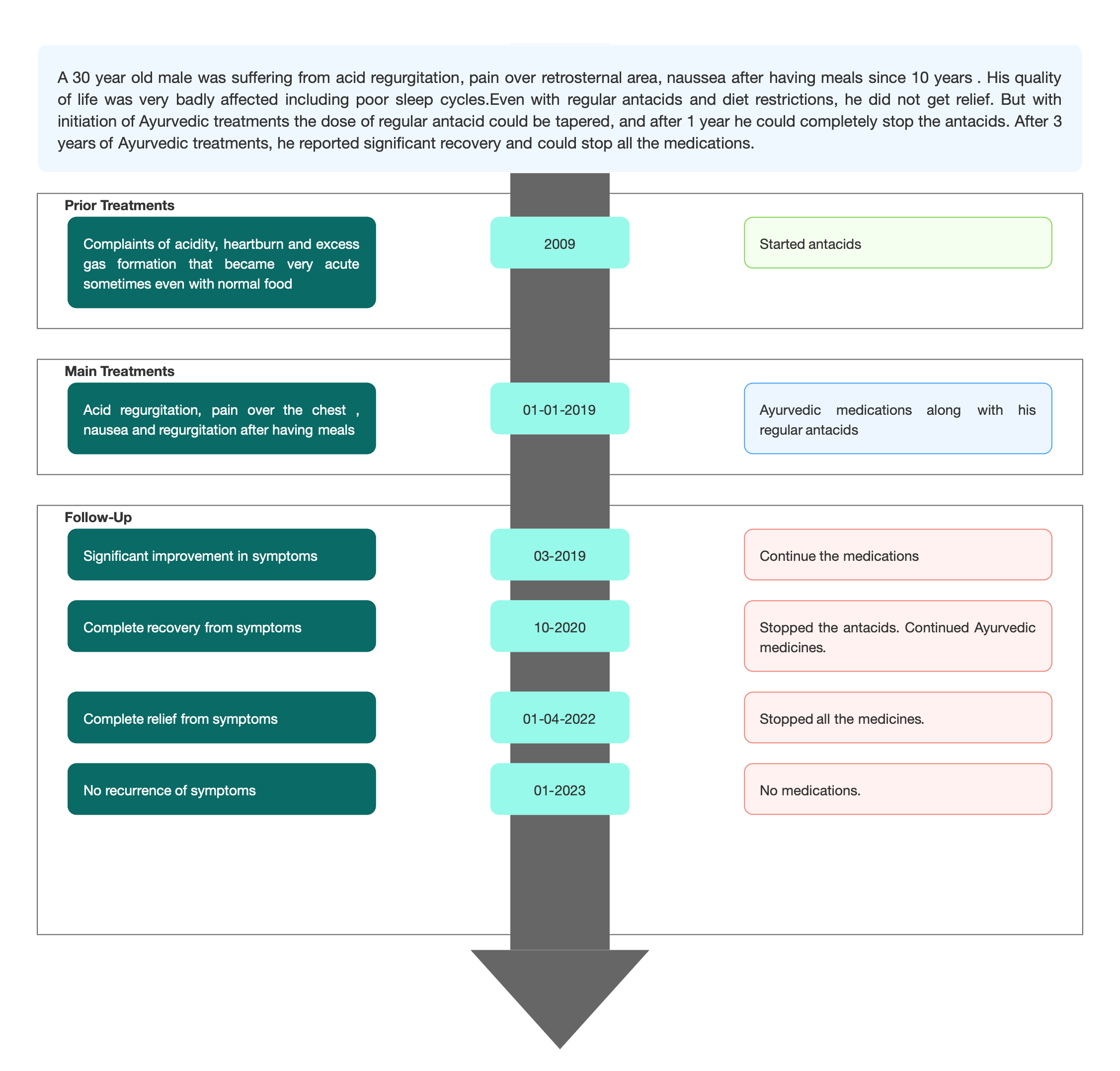
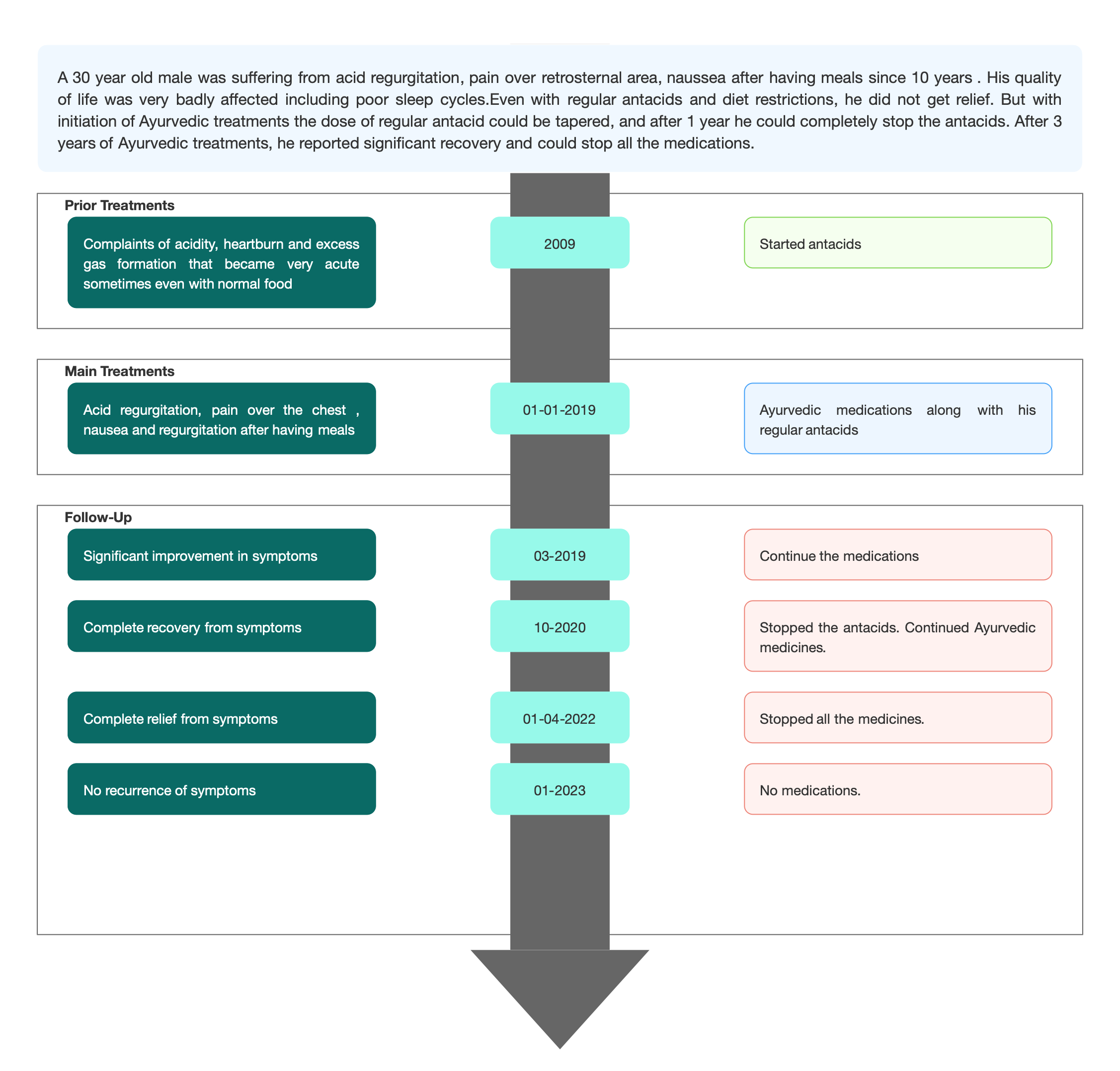
Image 1. Timeline of events added below
DIAGNOSTIC ASSESSMENT
Modern Diagnostic parameter; The biomedical diagnosis was confirmed by the Ayurvedic physician based on the clinical evaluation. The patient was on regular antacids since 1 year.
Table 1. Symptoms tabulated at baseline
Symptoms
Jan 2019
Heart Burn/Acidity
++++
Gas
++++
Burping
++++
Constipation
++++
Headache
++++
Allopathic medicines
continued
Ayurvedic Assessment was done based on the presenting complaints and clinical evaluation. The treating physician confirmed the Ayurvedic diagnosis as Amlapitta (Jirna).
Differential Diagnosis-
Coronary artery disease
Achalasia
Eosinophilic esophagitis (EoE)
Non-ulcer dyspepsia
Rumination syndrome
Esophageal diverticula
Gastroparesis
Esophageal and gastric neoplasm
Peptic ulcer disease (PUD)
On the basis of the previous treatment records and clinical findings the physician diagnosed the condition as chronic hyperacidity.
Prognosis- Hyperacidity is a mild condition, that can be managed well with medicine, diet and lifestyle. But if left untreated, this can become severe. Chronic (longterm) hyperacidity can result in ulcers and if the ulcers are not taken care of, it can result in perforation, which is a surgical emergency. Chronic ulcers can also become a malignancy. Prevention is better than cure.
THERAPEUTIC INTERVENTION
Refer the tab ‘Treatment’ in the Portal.
FOLLOW-UP AND OUTCOMES
The patient had 5 follow ups in total over a time period of 4 years. The last follow up done was in January 2023, which was 9 months after stopping all his medications. Each follow up, there was a significant reduction in the symptoms.
Clinician-based assessment; In the first follow up after 2 months, there was significant reduction in symptoms. After 12 months of starting ayurvedic treatment, patient reported only mild heart burn. After 21 months, the patient got complete recovery from symptoms and the antacids were stopped. After 3 years and 3 months all the medicines were stopped. The last follow up was done after 9 months of stopping medicines, and there has been no recurrence.
Table 2. Symptoms tabulated from baseline throughout the treatment date wise
Symptoms
Jan 2019
March 2019
Jan 2020
August 2020
March 2021
April 2022
Heart Burn/Acidity
++++
+
++
+
+
Absent
Gas
++++
++
+
+
Absent
Absent
Burping
++++
++
+
+
+
Absent
Constipation
++++
+
Absent
Absent
Absent
Absent
Headache
++++
+
Absent
Absent
Absent
Absent
Allopathic medicines
continued
continued
continued
continued till Oct 2020
Stopped
Stopped
Patient- based assessment: Not relevant
Intervention adherence and tolerability – The patient adhered to the prescribed treatments and tolerated the treatments well.
Method of assessment- Subjective parameters were the main assessment tools.
Adverse and unanticipated events; None reported
DISCUSSION:
Hyperacidity is a mild condition, that can be managed well with medicine, diet and lifestyle. But if left untreated, this can become severe. Chronic (longterm) hyperacidity can result in ulcers and if the ulcers are not taken care of, it can result in perforation, which is a surgical emergency. Chronic ulcers can also become a malignancy. Prevention is better than cure. In this case report, the patient had a chronic history of 10 years. He was on antacids since 1 year, but the symptoms persisted inspite of taking medicine and following a normal diet. With Ayurvedic treatments, over a period of 3 years, he got complete relief from all his symptoms, and there has been no relapse.
PATIENT’S PERSPECTIVE
Not available.
LEARNING POINTS/TAKE HOME MESSAGES
This case report demonstrates the successful integrative management of a chronic case of Amlapitta in a 30 year old male patient who had been suffering from this condition for more than 10 years, and was not getting relief inspite of taking antacids. Last followed up, there has been no recurrence.
INFORMED CONSENT
Written consent obtained from patient for publishing of the case report in the Portal
ACKNOWLEDGEMENTS
None
CONFLICT OF INTEREST
None declared.
FUNDING
None
REFERENCE
- https://manmatters.com/blog/hyperacidity/
- https://www.thehealthsite.com/diseases-conditions/hyperacidity-or-acid-dyspepsia-what-causes-it-and-how-to-avoid-it-786412/
- Madhava Nidana. Chapter 51. Amlapitta Nidana.
- https://www.easyayurveda.com/2021/03/10/amlapitta/
-
Immersive Learning
-
Modern Diagnosis
MODERN DIAGNOSIS: Chronic hyperacidity
ABOUT THE DISEASE:
The hydrochloric acid in our stomach is needed for the digestion and breakdown of food. When there is an increase in the secretion of hydrochloric acid by the cells in the lining of our stomach, it is known as hyperacidity. These increased acid levels can cause many hyperacidity symptoms.
Causes of hyperacidity:
Hydrochloric acid is constantly present in our bodies. Its secretion increases when there is food to be digested. Hyperacidity is a pathological increase of the acid level in our stomach. This can happen in cases of:
1) Some infection that causes the stomach to secrete more acid to destroy the bacteria or virus.
2) Inadequate food or infrequent meal timings, which cause the acid to be underutilised.
3) Certain genetic conditions where the stomach secretes more acid than required.
4) Stress of the mental and physical type.
5) Smoking
6) Increased intake of hot liquids and stimulants such as tea and coffee
7) Increased alcohol intake
8) Foods that upset the stomach and don’t suit the person, including those who are lactose intolerant or gluten intolerant.
Signs & Symptoms: Although hyperacidity symptoms are predominantly associated with burning, there are other symptoms too. Some other hyperacidity symptoms are described below:
1) Burning in the heart and chest region, above the stomach.
2) A burning sensation may sometimes be felt in the throat
3) A sour or bitter taste in the mouth that lasts for a while.
4) Sometimes, the hyperacidity symptoms can cause chest pain.
5) Due to burning in the throat, there can be a dry cough.
6) Asthma is also known to be a hyperacidity symptom.
7) Chronic sinusitis due to acid reflux.
8) Ear pain due to sinusitis caused by the reflux.
In this case report, the patient is a 30 year old male patient who presented with multiple ailments which includes acid regurgitation, pain over retrosternal area, nauseating feeling after having meals since 10 years . His daily activities were badly getting affected due to this and he used to get severe episodes of headache which in turns affects his Quality of life, including his sleep cycle because his sleep was disturbed due to severe acid regurgitation. He is on regular antacids since 1 year.
Table 1. Symptoms tabulated at baseline
Symptoms
Jan 2019
Heart Burn/Acidity
++++
Gas
++++
Burping
++++
Constipation
++++
Headache
++++
Allopathic medicines
continued
Diagnosis & Treatment: The primary diagnostic criteria for hyperacidity is medical history and clinical evaluation by the physician.
The cause is identified, and then the apt treatment is given. Mostly the treatment of choice is antacids, and pain killers to address the pain. Diet and lifestyle plays an important role in the management of the condition.
Prognosis: Hyperacidity is a mild condition, that can be managed well with medicine, diet and lifestyle. But if left untreated, this can become severe. Chronic (longterm) hyperacidity can result in ulcers and if the ulcers are not taken care of, it can result in perforation, which is a surgical emergency. Chronic ulcers can also become a malignancy. Prevention is better than cure.
Reference
- https://manmatters.com/blog/hyperacidity/
- https://www.thehealthsite.com/diseases-conditions/hyperacidity-or-acid-dyspepsia-what-causes-it-and-how-to-avoid-it-786412/
-
Ayurveda Diagnosis
AYURVEDA DIAGNOSIS: Amlapitta (Jirna)
ABOUT THE DISEASE:
In this case report, the patient is a 30 year old male patient who presented with multiple ailments which includes acid regurgitation, pain over retrosternal area, nauseating feeling after having meals since 10 years . His daily activities were badly getting affected due to this and he used to get severe episodes of headache which in turns affects his Quality of life, including his sleep cycle because his sleep was disturbed due to severe acid regurgitation.
The biomedical diagnosis was Chronic hyperacidity and the ayurvedic diagnosis was Amlapitta (Jirna).
The pitta which is sour or has developed sour taste due to it being burnt is called as amlapitta. According to Sushruta – the taste of prakrta pitta is pungent / bitter. The taste of vidagdha pitta is sour. This indicates that if pitta gets burnt due to certain etiological factors its taste gets transferred from pungent to sour. This pitta which has developed an abnormal taste i.e. sour taste is called as ‘amla pitta’ i.e. sour pitta.
Etiology of amlapitta –
Viruddha pana anna – foods and drinks of mutually opposite / antagonistic nature (qualities)
Dushta pana anna – contaminated foods and drinks
Amla pana anna – sour foods and drinksVidahi pana anna – foods and drinks which are corrosive in nature
Pitta prakopi pana anna – foods and drinks which tend to increase pitta to abnormal proportions.Samprapti:
Accumulation of pitta in monsoon season – The pitta gets accumulated due to the effect of monsoon / rainy season and other etiological factors of its own (causative factors which tend to increase pitta).
Aggravation of pitta in the autumn season – This pitta which has already accumulated will further get aggravated in the autumn season.
Pitta developing vidagdhata / sourness – This aggravated pitta gets vidagdha i.e. attains more sourness in persons who are influenced by the above mentioned etiological factors and cause a disease called as amlapitta.
Signs and Symptoms of Amlapitta
The signs and symptoms of amlapitta may be categorized and classiOed under 3 groups for better understanding of the disease.
Samanya Lakshanas
Avipaka – indigestion
Klama – exhaustion without exercise or physical workouts Utklesha – excessive salivation / nausea
Tikta udgara – bitter belching
Amla udgara – sour belching
Gaurava – heaviness of the body
Hrt daha – burning sensation in the chest
Kanta daha – burning sensation in the throat
Aruchi – tastelessnessThe treating physician has not specified the vitiated dosa or type of amlapitta. But taking into consideration, the symptoms of the patient, it can be connected to Urdhvaga amlapitta.
Sadhyasadhyata: The newly manifested (acute) form of amlapitta is curable with best efforts at treatment. When the disease becomes chronic it becomes manageable but cannot be cured totally. Sometimes the chronic conditions become incurable.
Treatment & rationale of treatment as specified by the treating physician:
Vamana and Virechana – form the key treatments to combat amlapitta in an effective way.
Emesis is preferred in the amlapitta having upward course and purgation is the treatment of choice in amlapitta having downward course. The intention is to eliminate the disease causing dosha(s) in the direction of their manifestation.Table 1. The medicines and the specific rationale why they were prescribed.
Medicines/ procedure
Rationale
Amlapittantak Rasayan
Vatapitta Shamana
Pitta recana
Shita virya
Yastimadhu churna
Pitta prasadana
Vata shamana
Daaha prashamana
Shita virya
Amrit Rasayan
Tridosha shaman
Muktashukti Pisti
Sheeta
Laghu
Vata shamana
Pitta prasadana
Eladi vati
Shita Virya
Pitta Kapha shamana
Amlaki loh
Shita
Guru
Vata shamana
Pitta prasadana
Kamdudha ras
Shita virya
Laghu
Tridosha shamana
Leelavilas ras
Ushna
Laghu
Vata Pitta shamana
Pitta prasadana
Prawal panchamrit ras
Pitta prasadana
Vata kapha Shamana
Rasayana
Mahadrakshadi syp
Kapha Pitta shamana
Laghu-Pitta recana
Shatavari tab
Vata Pitta Shamana
Pitta prasadana
Reference
- Madhava Nidana. Chapter 51. Amlapitta Nidana.
- https://www.easyayurveda.com/2021/03/10/amlapitta/
-
Treatment
Name of Medicine Dosage Form Dosage Mode of Administrtation From - To (Date) Medicine Reference Amlapittantak Rasayan Curna 0.75gm Oral, with warm water 2017-02-12 - 2017-04-17 Patent and Proprietary Medicine Amlapittantak Rasayan Curna 0.75gm Oral, with warm water 2017-11-11 - 2020-01-19 Patent and Proprietary Medicine Yastimadhu Curna Curna 0.75gm Oral, with warm water 2017-02-12 - 2017-04-17 Patent and Proprietary Medicine Yastimadhu Curna Curna 0.75gm Oral, with warm water 2017-11-11 - 2020-01-19 Patent and Proprietary Medicine Yastimadhu Curna Curna 0.75gm Oral, with warm water 2020-10-26 - 2022-12-25 Patent and Proprietary Medicine Amrit Rasayana Curna 0.125 gms Oral, with warm water 2018-09-23 - 2019-11-18 Patent and Proprietary Medicine Amrit Rasayana Curna 0.125 gms Oral, with warm water 2020-02-16 - 2021-03-20 Patent and Proprietary Medicine Muktashukti Pisti Curna 0.125 gms Oral, with warm water 2017-11-11 - 2019-11-18 Patent and Proprietary Medicine Muktashukti Pisti Curna 0.125 gms Oral, with warm water 2020-02-26 - 2021-03-20 Patent and Proprietary Medicine Muktashukti Pisti Curna 0.125 gms Oral, with warm water 2022-02-21 - 2022-12-25 Patent and Proprietary Medicine Eladi vati Tablet 1 Oral, with warm water once daily 2017-11-11 - 2017-12-24 Patent and Proprietary Medicine Eladi vati Tablet 1 Oral, with warm water once daily 2018-06-10 - 2020-12-05 Patent and Proprietary Medicine Eladi vati Tablet 1 Oral, with warm water once daily 2022-02-21 - 2022-03-20 Patent and Proprietary Medicine Amlaki loh Tablet 1 Oral, with warm water once daily 2017-08-09 - 2017-12-24 Patent and Proprietary Medicine Amlaki loh Tablet 1 Oral, with warm water once daily 2018-06-10 - 2019-08-18 Patent and Proprietary Medicine Amlaki loh Tablet 1 Oral, with warm water once daily 2019-10-13 - 2022-12-25 Patent and Proprietary Medicine Kamdudha ras Tablet 1 Oral, with warm water once daily 2017-02-12 - 2017-04-17 Ayurveda Sara Sangraha, Rasa Rasayana Prakarana Kamdudha ras Tablet 1 Oral, with warm water once daily 2017-05-31 - 2018-06-10 Ayurveda Sara Sangraha, Rasa Rasayana Prakarana Kamdudha ras Tablet 1 Oral, with warm water once daily 2018-07-09 - 2020-01-19 Ayurveda Sara Sangraha, Rasa Rasayana Prakarana Kamdudha ras Tablet 1 Oral, with warm water once daily 2021-01-24 - 2022-12-25 Ayurveda Sara Sangraha, Rasa Rasayana Prakarana Leelavilas ras Tablet 1 Oral, with warm water once daily 2017-03-18 - 2017-08-09 Patent and Proprietary Medicine Leelavilas ras Tablet 1 Oral, with warm water once daily 2020-01-19 - 2020-12-05 Patent and Proprietary Medicine Leelavilas ras Tablet 1 Oral, with warm water once daily 2022-03-27 - 2022-04-28 Patent and Proprietary Medicine Prawal panchamrit ras Tablet 1 Oral, with warm water once daily 2017-02-12 - 2017-08-09 Bhaishajya Ratnavali. Gulmadhikara. 139 - 143 Prawal panchamrit ras Tablet 1 Oral, with warm water once daily 2017-11-11 - 2018-01-25 Bhaishajya Ratnavali. Gulmadhikara. 139 - 143 Prawal panchamrit ras Tablet 1 Oral, with warm water once daily 2018-05-15 - 2018-09-23 Bhaishajya Ratnavali. Gulmadhikara. 139 - 143 Prawal panchamrit ras Tablet 1 Oral, with warm water once daily 2018-12-09 - 2022-04-28 Bhaishajya Ratnavali. Gulmadhikara. 139 - 143 Mahadrakshadi syp Syrup 15 ml Oral, with warm water twice daily 2018-09-23 - 2018-12-09 Patent and Proprietary Medicine Mahadrakshadi syp Syrup 15 ml Oral, with warm water twice daily 2020-01-19 - 2020-12-05 Patent and Proprietary Medicine Mahadrakshadi syp Syrup 15 ml Oral, with warm water twice daily 2022-02-21 - 2022-12-25 Patent and Proprietary Medicine Shatavari tab Tablet 1 Oral, with warm water once daily 2021-01-24 - 2021-03-20 Patent and Proprietary Medicine -
Outcome Measures
OUTCOME MEASURES
In this case report, the patient is a 30 year old male patient who presented with multiple ailments which includes acid regurgitation, pain over retrosternal area, nauseating feeling after having meals since 10 years . His daily activities were badly getting affected due to this and he used to get severe episodes of headache which in turns affects his Quality of life, including his sleep cycle because his sleep was disturbed due to severe acid regurgitation.
Assessment: Subjective parameters were assessed to analyse the outcome of the treatment.
Table 1. Symptoms documented at baseline and throughout the treatment date wise
Symptoms
Jan 2019
March 2019
Jan 2020
August 2020
March 2021
April 2022
Heart Burn/Acidity
++++
+
++
+
+
Absent
Gas
++++
++
+
+
Absent
Absent
Burping
++++
++
+
+
+
Absent
Constipation
++++
+
Absent
Absent
Absent
Absent
Headache
++++
+
Absent
Absent
Absent
Absent
Allopathic medicines
continued
continued
continued
continued till Oct 2020
Stopped
Stopped
In the first follow up after 2 months, there was significant reduction in symptoms. After 12 months of starting ayurvedic treatment, patient reported mild heart burn. After 21 months, the patient got complete recovery from symptoms and the antacids were stopped. After 3 years and 3 months all the medicines were stopped. The last follow up was done after 9 months of stopping medicines, and there has been no recurrence.
-