Featured Case
-
Abstract
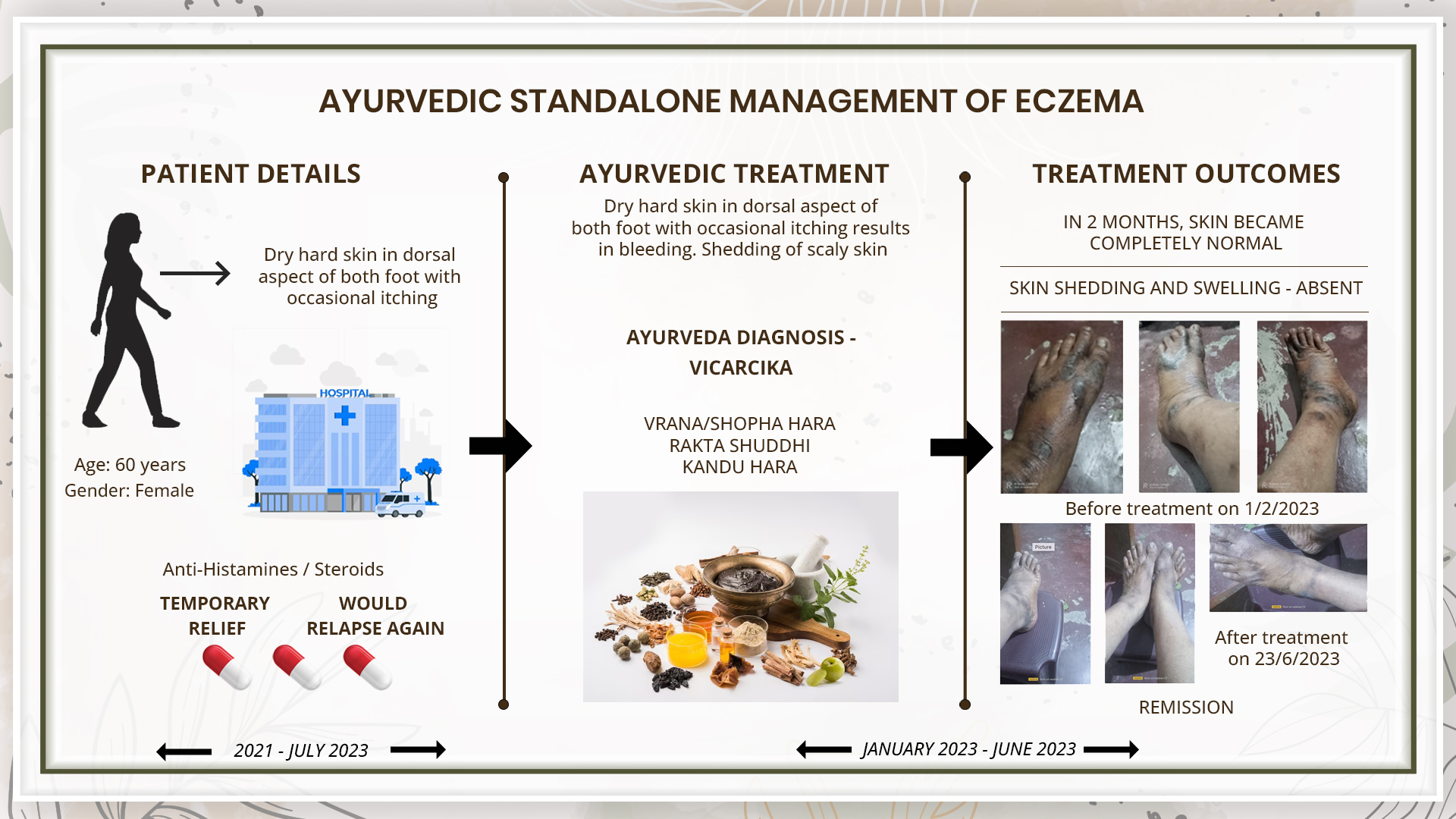
A 60-year-old female patient presented with dry hard skin in the dorsal aspect of both feet with occasional itching that resulted in bleeding followed by the shedding of scales for 2 years.
The patient had taken steroids and antihistamines, and oral medications past 2 years, but did not get relief. So she consulted Dr Soumya, for better Ayurvedic management of her symptoms. Based on the clinical evaluation, Dr Soumya made a biomedical diagnosis as Eczema and an ayurvedic diagnosis as Vicharcika. The line of treatment followed was Vishahara, kanduhara, vrana ropana and initiate rakta shuddhi. After one and half months of treatment, a significant reduction in the symptoms was observed. Itching followed by bleeding was observed rarely. After 5 months of Ayurvedic treatment, the patient is completely free from all the symptoms.This case report demonstrates the successful standalone ayurvedic management of a chronic case of eczema, in a patient who was not responding to the standard of care.
-
Summaries
-
Listen
-
Watch
-
View
-
Read
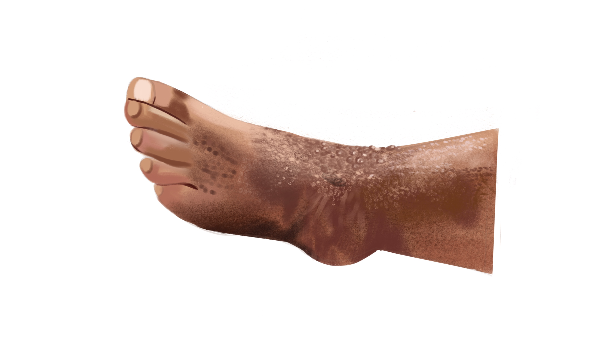
A 60-year-old female patient presented with dry hard skin in the dorsal aspect of both feet with occasional itching that resulted in bleeding followed by the shedding of scales for 2 years.
The patient had taken steroids and antihistamines, and oral medications past 2 years, but did not get relief. So she consulted Dr Soumya, for better Ayurvedic management of her symptoms. Based on the clinical evaluation, Dr Soumya made a biomedical diagnosis as Eczema and an ayurvedic diagnosis as Vicharcika. The line of treatment followed was Vishahara, kanduhara, vrana ropana and initiate rakta shuddhi. After one and half months of treatment, a significant reduction in the symptoms was observed. Itching followed by bleeding was observed rarely. After 5 months of Ayurvedic treatment, the patient is completely free from all the symptoms.This case report demonstrates the successful standalone ayurvedic management of a chronic case of eczema, in a patient who was not responding to the standard of care.
-
-
Timeline
-
Tabulated Summary
-
Narrative
TITLE OF CASE
Standalone Ayurvedic management of Eczema - A case report.
Dr Soumya
ABSTRACT
A 60-year-old female patient presented with dry hard skin in the dorsal aspect of both feet with occasional itching that resulted in bleeding followed by the shedding of scales for 2 years.
The patient had taken steroids and antihistamines, and oral medications past 2 years, but did not get relief. So she consulted Dr Soumya, for better management of her symptoms. Based on the clinical evaluation, Dr Soumya made a biomedical diagnosis as Eczema and an ayurvedic diagnosis as Vicarchika. The line of treatment followed was Vishahara, kanduhara, vrana ropana and initiate rakta shuddhi. After one and half months of treatment, a significant reduction in the symptoms was observed. Itching followed by bleeding was observed rarely. After 5 months of Ayurvedic treatment, the patient is completely free from all the symptoms.
KEYWORDS
Standalone, eczema, case report, ayurveda, vicharcika
INTRODUCTION
Eczema, also known as atopic dermatitis, is the most common form of dermatitis. Genetic as well as environmental factors are thought to play a part in the pathogenesis. Eczema is most commonly seen in children but can occur in adults also. People with the disease tend to have dry, itchy skin that is prone to infection. Eczema is commonly known as the "itch that rashes" due to dry skin that leads to a rash as a result of scratching or rubbing. The most important treatment of eczema is skin hydration followed by topical steroids to address flare-ups.
People with eczema have a dysfunctional barrier which causes various problems. The cells that make up our skin are essential for optimal skin hydration. People with eczema tend to have dry skin due to dysfunction in the skin barrier. Water can more easily escape from the skin leading to dehydrated skin. They are also more susceptible to infection. Harmful substances can more readily penetrate the skin due to dysfunction. People with this condition tend to have a skewed inflammatory immune response, and their skin is easily affected by irritants and allergens.
Prognosis
Overall, many patients with eczema do improve with time. However, patients may also have allergic rhinitis and asthma, which may not improve. In most cases of childhood-onset eczema, the symptoms can persist for decades. The condition has relapse and remission; relapses often require the use of medications. Individuals who are continuously exposed to smoke, tobacco, pet dander, fumes, pollen, soap, detergent, and wool will have continual symptoms and the overall quality of life is poor.
Persistent and recurrent itching not only is irritating but is costly to manage. A well-known complication is Kaposi varicelliform eruption, which is linked to a primary herpes infection.
Patients are also prone to skin infections with Staphylococcus and streptococcus.
Diagnostic Criteria: History taking, and clinical examination are the basic diagnostic criteria. A patch test can be performed on the skin to help identify allergies.
PATIENT INFORMATION
A 60 year old female patient presented with dry hard skin in dorsal aspect of both foot with occasional itching, which results in bleeding followed by shedding scaly skin since 2 years. On taking allopathic medicines, she would get temporary relief. But after sometime, the condition would relapse.
Surgical History- Underwent 2 cesarian section in 1984 & 1987.
No significant family/genetic history.
Psychosocial History- She is very stressed.
CLINICAL FINDINGS
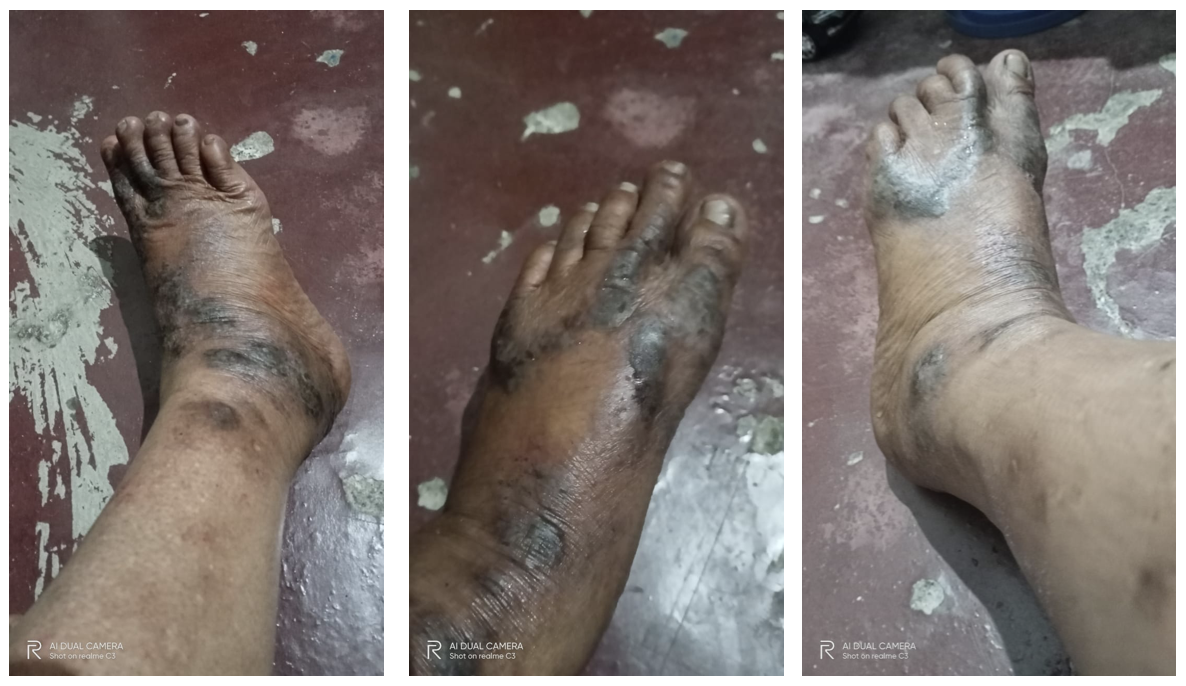
A General and systemic examination was done. On examination- Dry skin on dorsal aspect of both foot, scaling +. Swelling+ on both lower limbs.
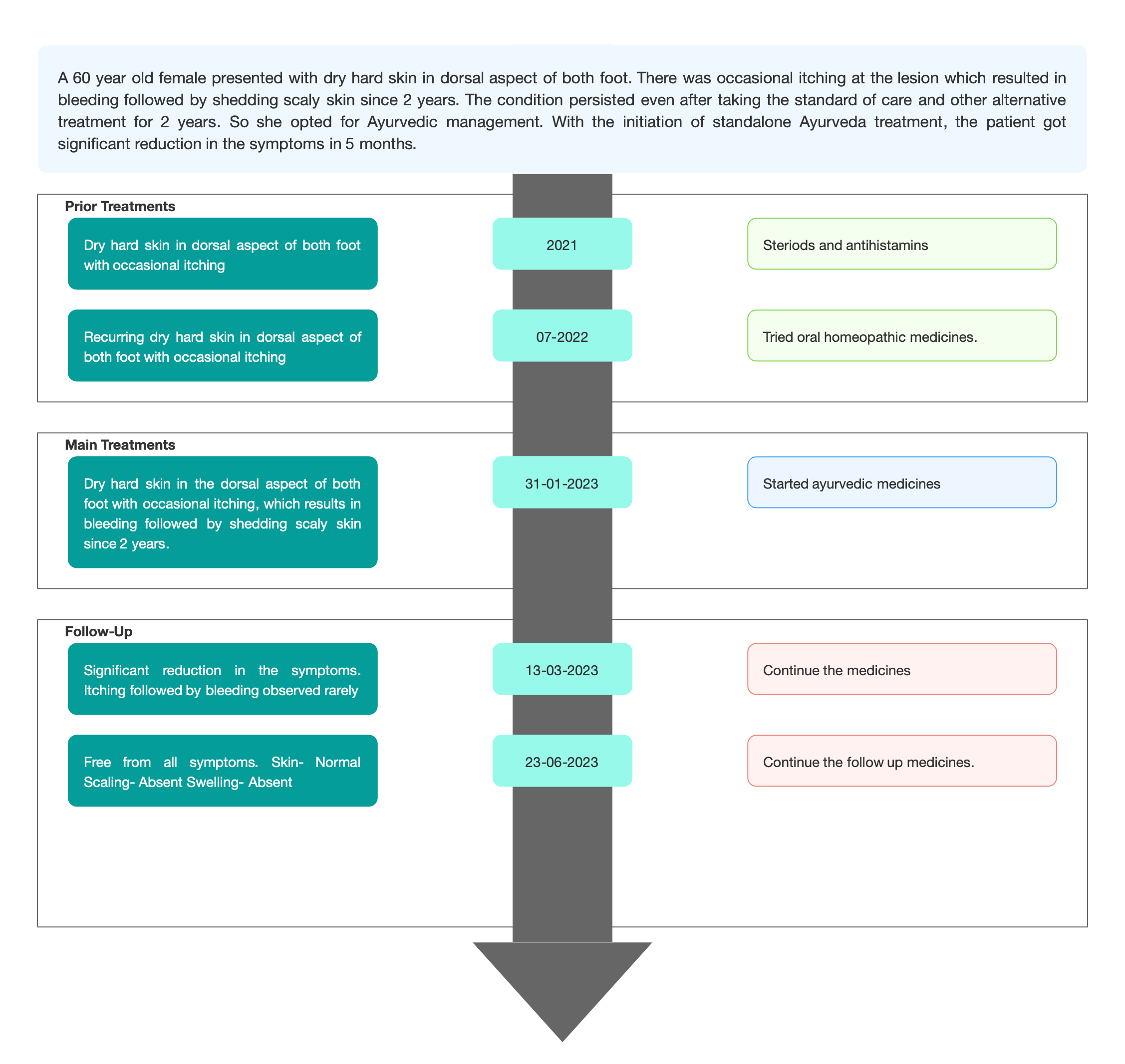
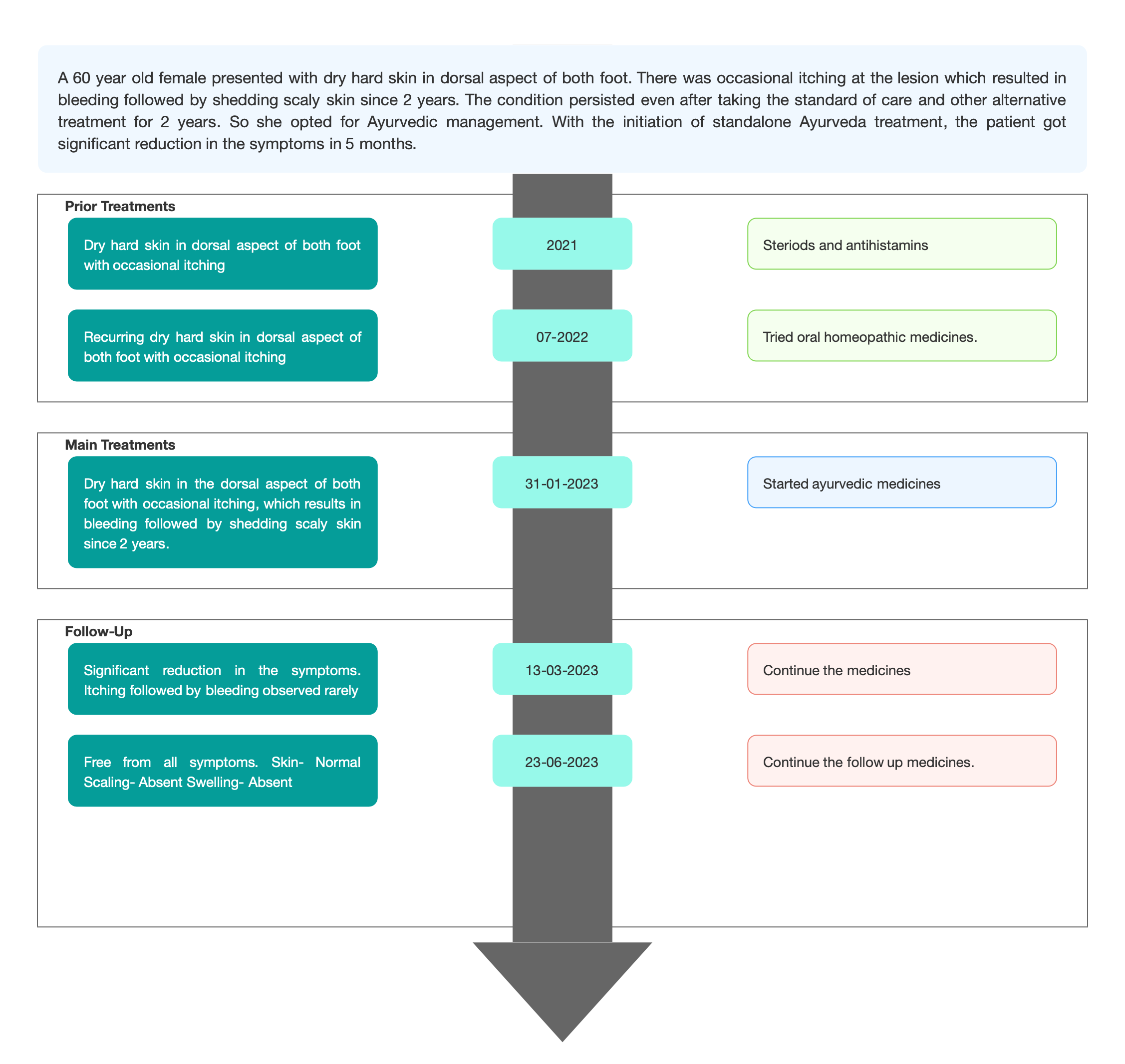
TIMELINE
Image 1. Timeline of events added below
DIAGNOSTIC ASSESSMENT
Modern Diagnostic parameter; Though the patient had been consulting and taking allopathic medications, past 2 years on & off, there was no confirmed biomedical diagnosis.
Ayurvedic Assessment was done based on the presenting complaints and clinical evaluation. The treating physician the confirmed diagnosis, both biomedical and ayurveda.
Differential Diagnosis- The different conditions are as follows
Cutaneous fungal infections
Seborrheic dermatitis
Drug eruptions
Scabies
Psoriasis
The physician clinically diagnosed the condition as eczema.
Prognosis- Overall, many patients with eczema do improve with time. However, patients may also have allergic rhinitis and asthma, which may not improve. In most cases of childhood-onset eczema, the symptoms can persist for decades. The condition has relapse and remission; relapses often require the use of medications. Individuals who are continuously exposed to smoke, tobacco, pet dander, fumes, pollen, soap, detergent, and wool will have continual symptoms and the overall quality of life is poor.
Persistent and recurrent itching not only is irritating but is costly to manage. A well-known complication is Kaposi varicelliform eruption, which is linked to a primary herpes infection.
Patients are also prone to skin infections with Staphylococcus and streptococcus. In this case report, the patient had a long history of eczema which persisted even after taking the standard of care and other alternative treatment for 2 years. With the initiation of standalone Ayurveda treatment, the patient got a complete relief from the symptoms in 5 months.
THERAPEUTIC INTERVENTION
Refer the tab ‘Treatment’ in the Portal.
FOLLOW-UP AND OUTCOMES
The first follow up was after one and half months, and there was significant reduction in symptoms.
The second follow up was after 5 months, where the patient was completely free from all the symptoms.
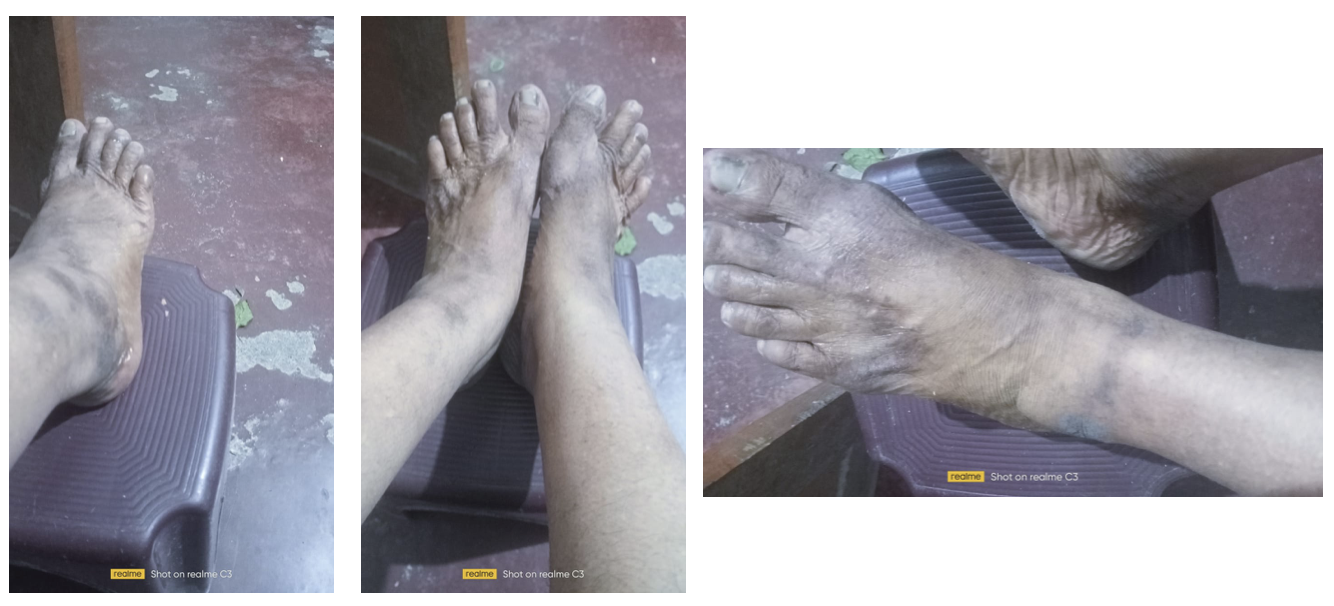
Clinician-based assessment; On examination, the skin is normal. There is no scaling and swelling.
Patient-assessed; Not relevant
Image 2. Baseline Photos dated 1.2.2023 added below.
Video 1. The symptoms being recorded on mobile
https://youtu.be/riZnitzGzjo?si=k3JKQiq89uDZVr9S
After undergoing one and half months of Ayurvedic treatment, there was a significant reduction in the symptoms- itching followed by bleeding observed rarely. After 5 months, the patient is completely free from all the symptoms. On examination, the skin is normal. There is no scaling or swelling. She is still continuing the Ayurvedic medicines.
Image 3. Images of the lesions taken after treatment dated 23.6.2023
Intervention adherence and tolerability – The patient adhered to the prescribed treatments and tolerated the treatments well.
Method of assessment- Images were taken before and after treatment.
Adverse and unanticipated events; None reported
DISCUSSION ;
The patient had been suffering from the skin complaints past 2 years. Inspite of taking steroids and antihistamines, she got only temporary relief. The symptoms would relapse again. The treating physician diagnosed the condition as Vicharcika and the appropriate line of treatment was planned. Being categorised as Kshudra kushta by the classical textbooks of Ayurveda, this is curable. But in a chronic condition, there are challenges. Here, with ayurvedic treatments over a period of 5 months, the patient got complete relief.
PATIENT’S PERSPECTIVE
Not available.
LEARNING POINTS/TAKE HOME MESSAGES
This case report demonstrates the potential effectiveness of Ayurveda as an alternative option for managing eczema when other methods fail. Continuing with the prescribed follow-up medicines is essential to sustain positive results.
INFORMED CONSENT
Written consent obtained from patient.
ACKNOWLEDGEMENTS
None
CONFLICT OF INTEREST
None declared.
FUNDING
None
REFERENCE
- Sohn A, Frankel A, Patel RV, Goldenberg G. Eczema. Mt Sinai J Med. 2011 Sep-Oct;78(5):730-9. doi: 10.1002/msj.20289. PMID: 21913202.
- Savalagimath MP, Rani J, Patil SF. Ayurvedic management of Vicarcika with special reference to eczema: A case report. Indian J Health Sci Biomed Res 2018: 11:92-6.
-
Immersive Learning
-
Modern Diagnosis
MODERN DIAGNOSIS: ECZEMA
ABOUT THE DISEASE:
Eczema, also known as atopic dermatitis, is the most common form of dermatitis. Genetic as well as environmental factors are thought to play a part in the pathogenesis. Eczema is most commonly seen in children but can occur in adults also. People with the disease tend to have dry, itchy skin that is prone to infection. Eczema is commonly known as the "itch that rashes" due to dry skin that leads to a rash as a result of scratching or rubbing. The most important treatment of eczema is skin hydration followed by topical steroids to address flare-ups.
People with eczema have a dysfunctional barrier which causes various problems. The cells that make up our skin are essential for optimal skin hydration. People with eczema tend to have dry skin due to dysfunction in the skin barrier. Water can more easily escape from the skin leading to dehydrated skin. They are also more susceptible to infection. Harmful substances can more readily penetrate the skin due to dysfunction. People with this condition tend to have a skewed inflammatory immune response, and their skin is easily affected by irritants and allergens.
In the case report, the 60-year-old female complained of dry hard skin in dorsal aspect of both foot with occasional itching, which results in bleeding followed by shedding scaly skin since 2 years. On taking steroids and antihistamines, she would get temporary relief, but after sometime the condition would recur. The biomedical diagnosis was made by the Ayurvedic physician, based on the history taking, and clinical evaluation.
Prognosis
Overall, many patients with eczema do improve with time. However, patients may also have allergic rhinitis and asthma, which may not improve. In most cases of childhood-onset eczema, the symptoms can persist for decades. The condition has relapse and remission; relapses often require the use of medications. Individuals who are continuously exposed to smoke, tobacco, pet dander, fumes, pollen, soap, detergent, and wool will have continual symptoms and the overall quality of life is poor.
Persistent and recurrent itching not only is irritating but is costly to manage. A well-known complication is Kaposi varicelliform eruption, which is linked to a primary herpes infection.
Patients are also prone to skin infections with Staphylococcus and streptococcus.
Diagnostic Criteria: History taking, and clinical examination are the basic diagnostic criteria. A patch test can be performed on the skin to help identify allergies.
Baseline Evaluation; Images were taken at the baseline of both the legs.
Image 1. Baseline Photos dated 1.2.2023 added below.
Video 1. The symptoms being recorded on mobile
https://youtu.be/riZnitzGzjo
Reference
- Sohn A, Frankel A, Patel RV, Goldenberg G. Eczema. Mt Sinai J Med. 2011 Sep-Oct;78(5):730-9. doi: 10.1002/msj.20289. PMID: 21913202.
-
Ayurveda Diagnosis
AYURVEDA DIAGNOSIS; Vicharcika
About the disease
According to Sushruta Samhita
राज्योऽतिकण्ड्वर्तिरुजः सरूक्षा भवन्ति गात्रेषु विचर्चिकायाम् |
कण्डूमती दाहरुजोपपन्ना विपादिका पादगतेयमेव ....(SS.Ni.5.13)
It is a condition in which the skin has linear rough lesions with intense itching and pain. When the symptoms appear only in the feet, it is termed as “vipadika”.
Vicarchika is a type of kshudra kushta characterised by symptoms namely kandu, srava, pitika and shyava varna. Vicarchika is often correlated to eczema based on clinical presentations. No satisfactory treatment is available in contemporary medical practice. The main line of treatment for vicarchika in Ayurveda is Shodhana and Shamana. In the Ayurvedic text, all skin diseases are included under Kushta roga. Kushta is classified as Mahakushta and Kshudrakushta. Vicarchika is described under Kshudra kushta- the management of this condition is not as difficult as Mahakushta, as they are a group of minor ailments.Samprapti
According to Charaka Nidana 5:6, samprapti of Kushta is as follows. By various causative factors as mentioned in Kushta nidana, all the three doshas are simultaneously triggered, the four dushyas (twak, mamsa, rakta and lasika) thin out or lose their natural properties. The tridosa along with the dushya manifests as Kushta.
Prognosis
Regarding prognosis, Acarya have stated that Kushta appearing in a person, who has full control over his sense organs, kiushtha is confined only to tvak, rakta and mamsa dhatu of the body, involving vata and kapha doshas should be regarded as curable and can be eradicated completely. In the case of one, whose infection has penetrated the medas is yapya. In a case when infection has reached the bone, the bone marrow or semen or ovum or which is caused by the three doshas together or Kushta presenting with complications are incurable.
In this 60 year old female patient, based on the clinical evaluation the diagnosis was confirmed as Vicharcika. So retrospectively, the twak, rakta, and mamsa dhatus are vitiated, and it is placed under Kshudra Kushta, it may be considered as sadhya. The presenting complaints of the patient was dry hard skin in dorsal aspect of both foot with occasional itching, which results in bleeding followed by shedding scaly skin since 2 years. She had tried allopathic medicines, but there was always a relapse.Treatment
Besides the classical references, the treatment of Kushta can broadly be classified as follows:
Shodhana
Antaha parimarjana
Bahi parimarjana
Shastra pranidha
Shamana
Nidana parivarjana
External Therapies – Vamana, virecana, rakta mokshana, lepa, pariseka, avagaha, dhuma are recommended taking into consideration the dosa and the dushya.
Internal medicines – In clinical practice, snehapanam is the most recommended by physicians in Kushta roga.
Rationale of treatment as explained by the treating physician: The rationale for choosing each medicine, both external and internal has been tabulated and presented below.Name of the medicine
Rationale
Avipatti churna
Clears vitiated pitta
Pachanamritam kashayam
Amapachanam, Srothoshodhanam
Sudarshanam tablet
Ama pachanam, Jwaraharam, To control infection
Gandarvahastadi kashayam
Mild laxative, Vata kapha haram
Vilwadi gulika
Vishaharam, To control infection
Eladi thailam
To remove scar and itching
Tiktakam kashayam
Blood purification, Pitta haram
Kaishora guggulu
Vrana ropanam
Kankayana gulika
Laxative, Arshoghnam
Reference
- Savalagimath MP, Rani J, Patil SF. Ayurvedic management of Vicarcika with special reference to eczema: A case report. Indian J Health Sci Biomed Res 2018: 11:92-6.
-
Treatment
Name of Medicine Dosage Form Dosage Mode of Administrtation From - To (Date) Medicine Reference Avipatti Curna Curna 3 tablespoons Oral, mixed with honey. Taken in the morning 8am in empty stomach. 2023-01-31 - 2023-01-31 Sahasrayogam. Curna Prakaranam Pachanamritam Kashayam Kashayam 20 ml Mix with 80 ml of warm water, on empty stomach twice daily 0023-02-01 - 2023-02-11 Sahasrayogam. Kashaya Prakaranam Sudarsanam tablet Tablet 1 With Kashayam 2023-02-01 - 2023-09-16 Patent and Proprietary Medicine Gandarvahastadi Kashayam Kashayam 15ml With 60 ml of luke warm water on empty stomach twice daily 2023-02-12 - 2023-02-26 Sahasrayogam. Kashayam prakaranam Vilwadi gulika Tablet 1 With Kashayam 2023-02-12 - 2023-09-16 Ashtanga Hridayam. Uttara sthanam. 36/84 - 85 Eladi Tailam Taila Required Quantity External application on the affected site 2023-02-12 - 2023-09-16 Sahasrayogam. Taila Prakaranam Tiktakam Kashayam Kashayam 15 ml With 60 ml of luke warm water on empty stomach twice daily 2023-02-24 - 2023-09-16 Ashtanga Hridayam. Ci.19/ 2-7 Kaishora guggulu Tablet 1 Oral- with Kashayam twice daily 2023-02-24 - 2023-03-12 Sharngadhara Samhita. Madhyama Khanda.. 7/70-81 Kankayana gulika Tablet 1 Oral- with takra twice daily after food 2023-03-13 - 2023-03-20 Bhaishajya Ratnavali. Gulmadhikara. 56- 62 -
Outcome Measures
OUTCOME MEASURES
The 60 year old female patient presented with dry hard skin in dorsal aspect of both foot with occasional itching, which results in bleeding followed by shedding scaly skin since 2 years. On taking allopathic medicines, she would get only temporary relief. After sometime, the symptoms would again relapse. So she opted for Ayurvedic management.
Assessment: Images were taken before and after Ayurvedic treatments, to assess the outcome of the treatment.
After undergoing one and half months of Ayurvedic treatment, there was a significant reduction in the symptoms- itching followed by bleeding observed rarely. After 5 months, the patient is completely free from all the symptoms. On examination, the skin is normal. There is no scaling or swelling. She is still continuing the Ayurvedic medicines.
Image 1. Images of the lesions taken after treatment dated 23.6.2023
-