Featured Case
-
Abstract
A 30-year-old female patient presented with a painful abscess over the chest, which was accompanied by swelling to the right side of the neck associated with occasional discharge and itching for 6 months. She tried various home remedies and conventional medicines but did not get any relief and her condition continued to worsen. The allopathic doctor had suggested that the only option was to undergo minor surgery or repeated incision and drainage procedures. The patient was not willing and so she approached Dr Partap Chauhan. Based on the clinical evaluation, the biomedical diagnosis was Abscess and the Ayurvedic diagnosis was Vidradhi. The line of treatment followed was basically srotoshodhana, rakta shodhana, vata-kapha shamana and tridosha hara. With 8 months of Ayurvedic treatment, the patient got relief from itching and pus discharge. Swelling and pain reduced. After 1 and a half years of treatment, the patient got relief from all the symptoms, and the wound healed completely. This case report demonstrates the successful ayurvedic management of an abscess, in a patient who was recommended repeated incision and drainage or a minor surgery.
-
Summaries
-
Listen
-
Watch
-
View
-
Read
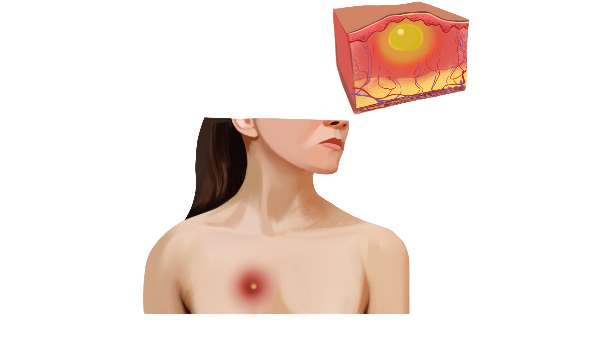
A 30-year-old female patient presented with a painful abscess over the chest, which was accompanied by swelling to the right side of the neck associated with occasional discharge and itching for 6 months. She tried various home remedies and conventional medicines but did not get any relief and her condition continued to worsen. The allopathic doctor had suggested that the only option was to undergo minor surgery or repeated incision and drainage procedures. The patient was not willing and so she approached Dr Partap Chauhan. Based on the clinical evaluation, the biomedical diagnosis was Abscess and the Ayurvedic diagnosis was Vidradhi. The line of treatment followed was basically srotoshodhana, rakta Shodhana, Vata-kapha shamana and Tridosha hara. With 8 months of Ayurvedic treatment, the patient got relief from itching and pus discharge. Swelling and pain reduced. After 1 and a half years of treatment, the patient got relief from all the symptoms, and the wound healed completely. This case report demonstrates the successful ayurvedic management of an abscess, in a patient who was recommended repeated incision and drainage or a minor surgery.
-
-
Timeline
-
Tabulated Summary
-
Narrative
TITLE OF CASE
Standalone Ayurvedic management of Abscess- A Case report
Dr Partap Chauhan
ABSTRACT
A 30-year-old female patient presented with a painful abscess over the chest, which was accompanied by swelling to the right side of the neck associated with occasional discharge and itching for 6 months. She tried various home remedies and conventional medicines but did not get any relief and her condition continued to worsen. The allopathic doctor had suggested that the only option was to undergo minor surgery or repeated incision and drainage procedures. The patient was not willing and so she approached Jiva Ayurveda. Based on the clinical evaluation, the biomedical diagnosis was Abscess and the Ayurvedic diagnosis was Vidradhi. The line of treatment followed was basically srotoshodhana, rakta Shodhana, Vata-kapha shamana and Tridosha hara. With 8 months of Ayurvedic treatment, the patient got relief from itching and pus discharge. Swelling and pain reduced. After 1 and a half years of treatment, the patient got relief from all the symptoms, and the wound completely healed.
KEYWORDS
Soft tissue inflammation, Abscess, Vidradhi, Ayurveda, Case report, Standalone
INTRODUCTION
An abscess is a buildup of a pus that can affect any part of your body. It can be called as a pocket of pus. There are many different types of abscesses. They can occur on your skin, in your mouth or around your organs. Skin abscesses may look red and swollen. When you get an infection, your body's immune system kicks into action to try to fight it. White blood cells travel to the infected area and build up within the damaged tissue. This buildup leads to inflammation, which causes a pocket to form. The pocket fills with pus, creating an abscess. Pus is made up of living and dead white blood cells, germs, fluid and dead tissue.
There are different types of abscess. It can be a skin (armpit, breast, anorectal): mouth (gingival, periapical, periodontal, tonsil, retrotonsillar, retropharyngeal) or internal (abdominal, spinal chord, brain). The symptoms are different depending on the type of abscess and the location.
Causes: Infections are the primary cause for abscesses. Mostly the infection is by bacteria. Rarely there are virus or fungi causing the infection.
Diagnostic criteria: Physical examination is the primary diagnostic criteria. Swab test can also be done to confirm the infection and the type. Deeper abscesses, including internal abscesses, are harder to diagnose since you can’t see them. In this case, ultrasound, CT and MRI may be recommended by the Doctor to confirm the diagnosis.
Prognosis: A small abscess closer to the surface of the skin can be treated quickly. But if the deeper tissues are affected or the internal organs are involved, then the prognosis is poor, or rather difficult to treat.
General line of treatment: In case of a small abscess, a warm compress is applied to the area. It may drain naturally, but never attempt to drain or burst an abscess at home. In this case, the infection can spread. On consultation, antibiotics will be prescribed, and sometimes surgical drainage may be recommended under anaesthesia. Once the drainage is done, then supportive treatments to heal the wound are applied.
PATIENT INFORMATION
The patient is a the patient is a 30 year old female patient presenting with a painful abscess over the chest, which was accompanied by swelling to the right side of the neck and occasional discharge since 6 months. Despite trying various home remedies and conventional medicines, the patient did not get any relief and her condition continued to worsen. The allopathic doctor had suggested that the only option was to undergo minor surgery or repeated incision and drainage procedures
No relevant family/genetic/surgical history.
Psychosocial history- Sleep disturbed, Mild stress
CLINICAL FINDINGS
On examination, Soft tissue enlargement with swelling. (appr. 5x 5 cm). Discharge ++
TIMELINE
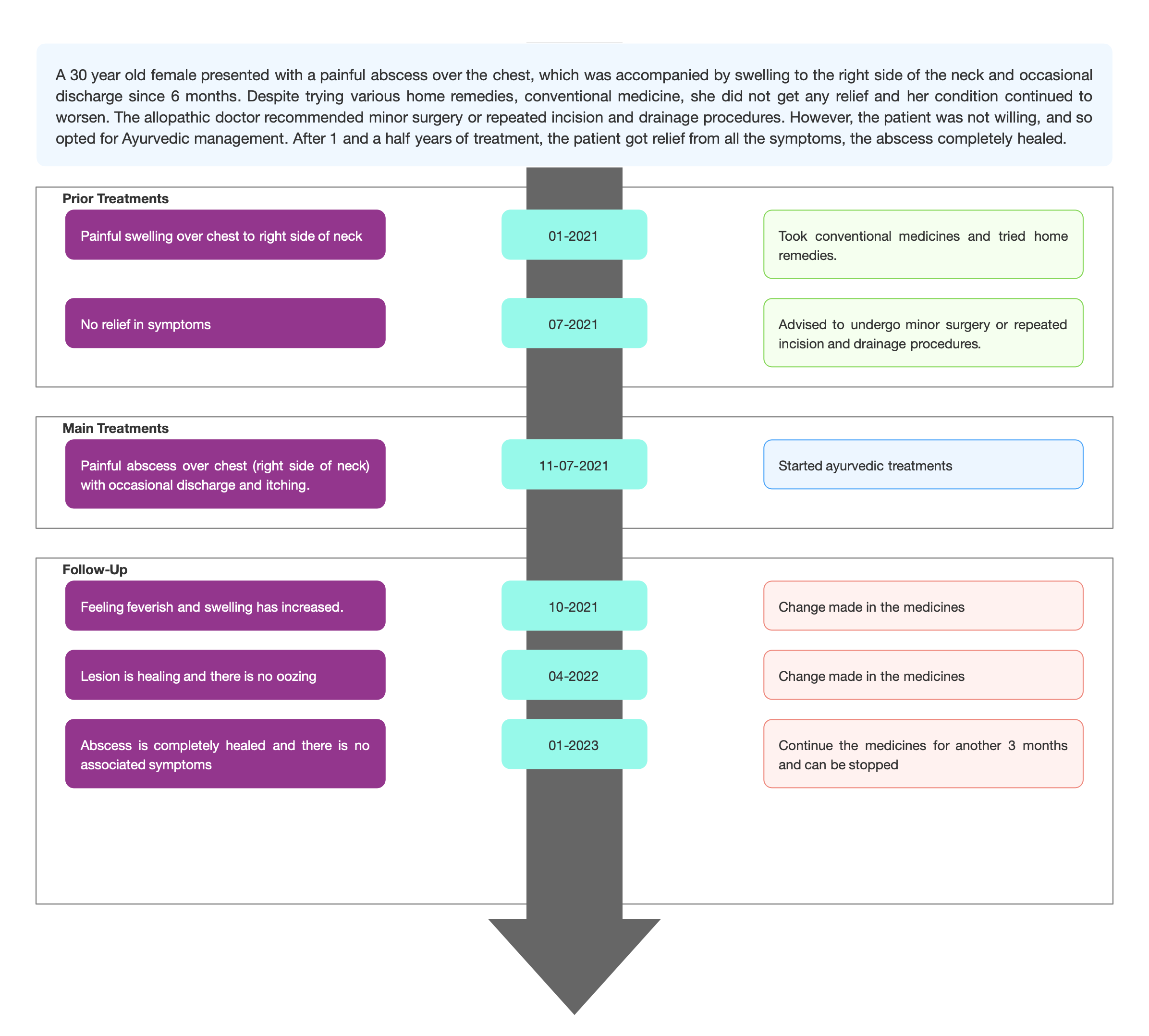
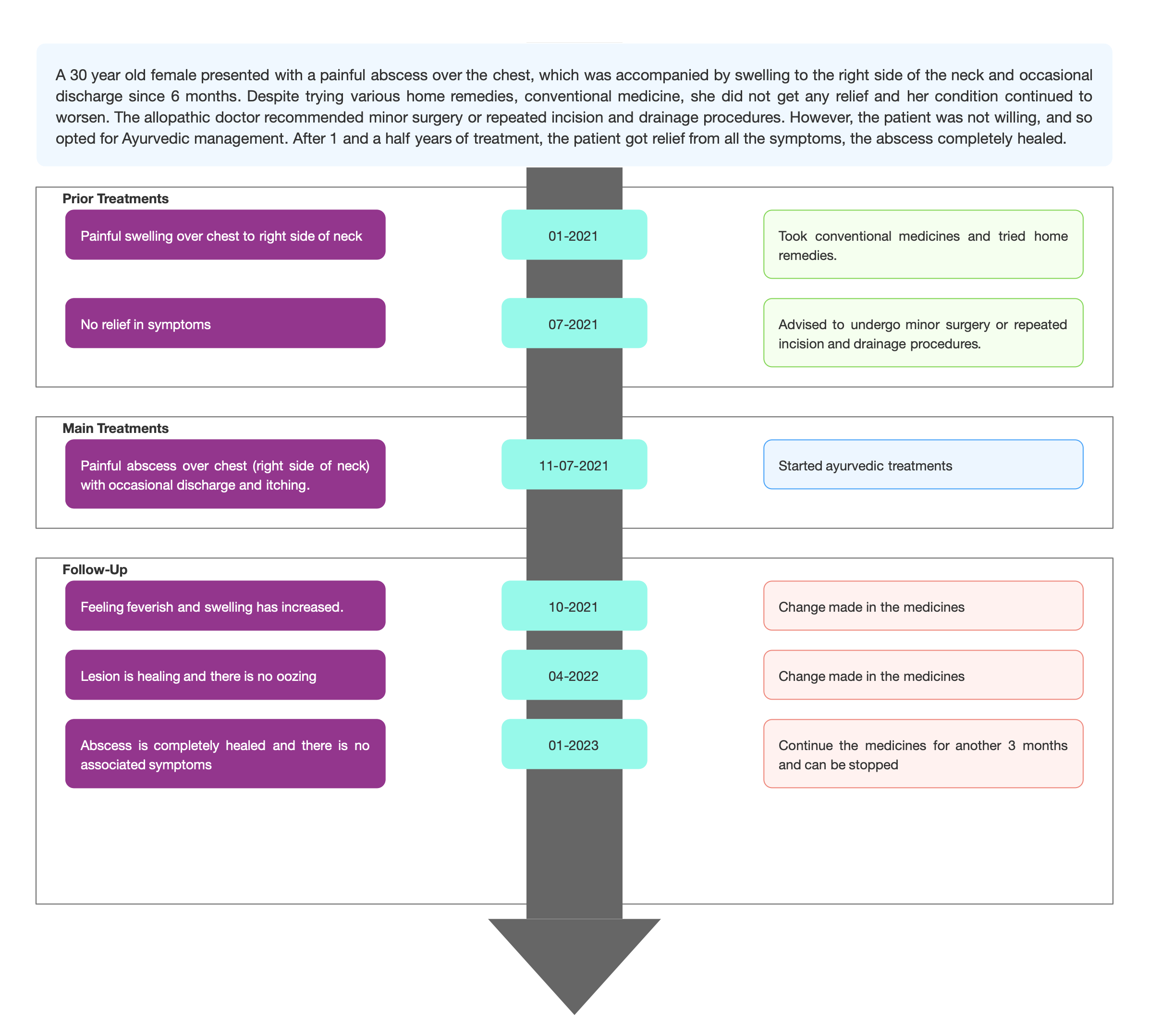
Image 1. Timeline of events added below
DIAGNOSTIC ASSESSMENT
Modern Diagnostic parameter; The biomedical diagnosis was confirmed by the Ayurvedic physician based on the clinical evaluation.
Image 2. Baseline image of the abscess dated 11.7.2021
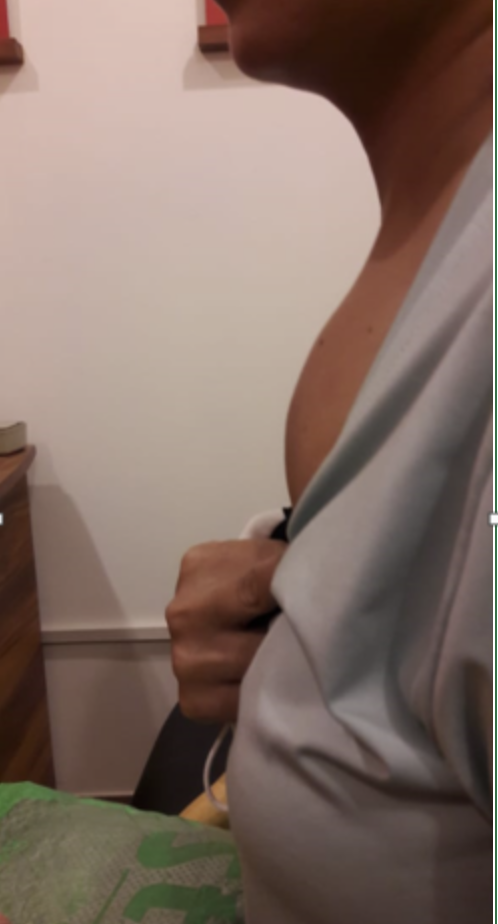
Image 3. Chest X Ray done dated 17.7.2021
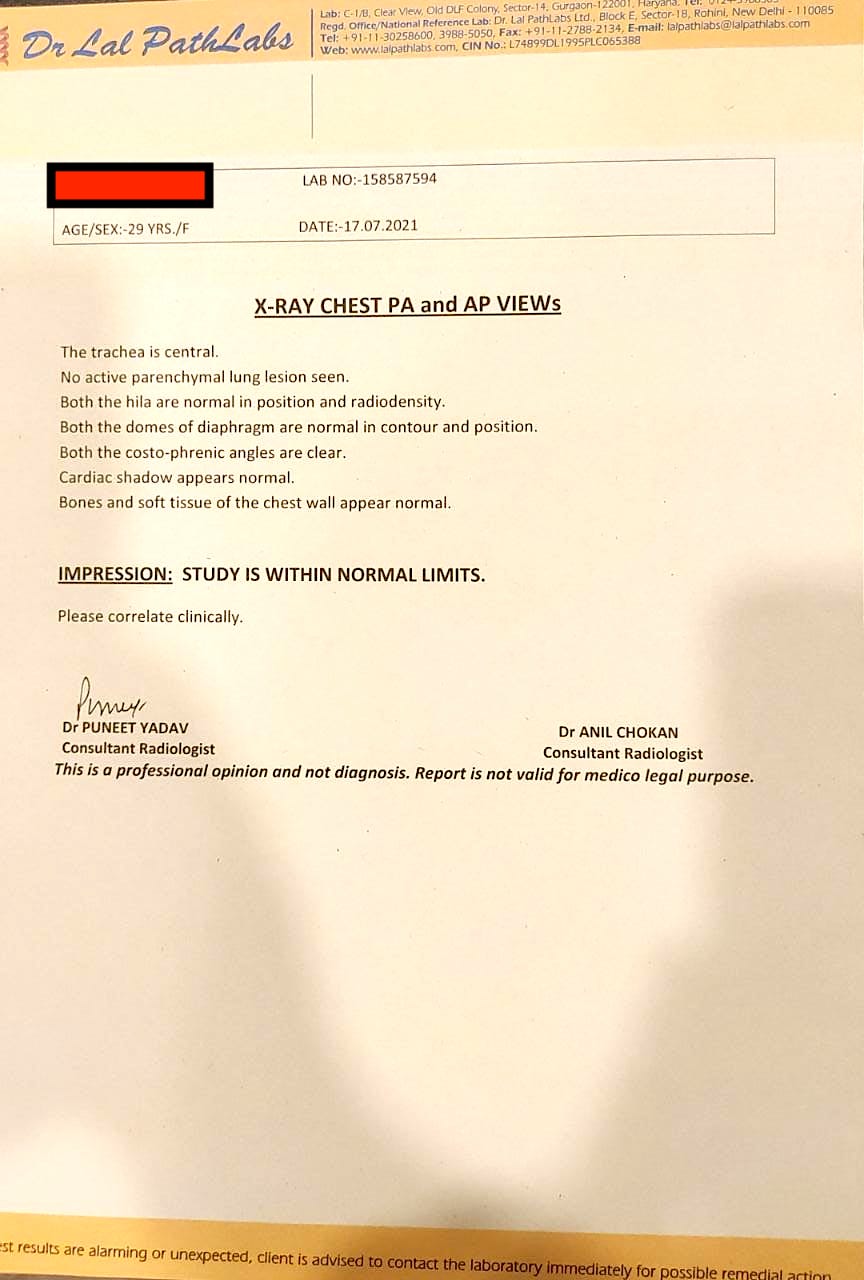
Malignancy was ruled out.
Image 4. Cytopathology report dated 17.7.2021
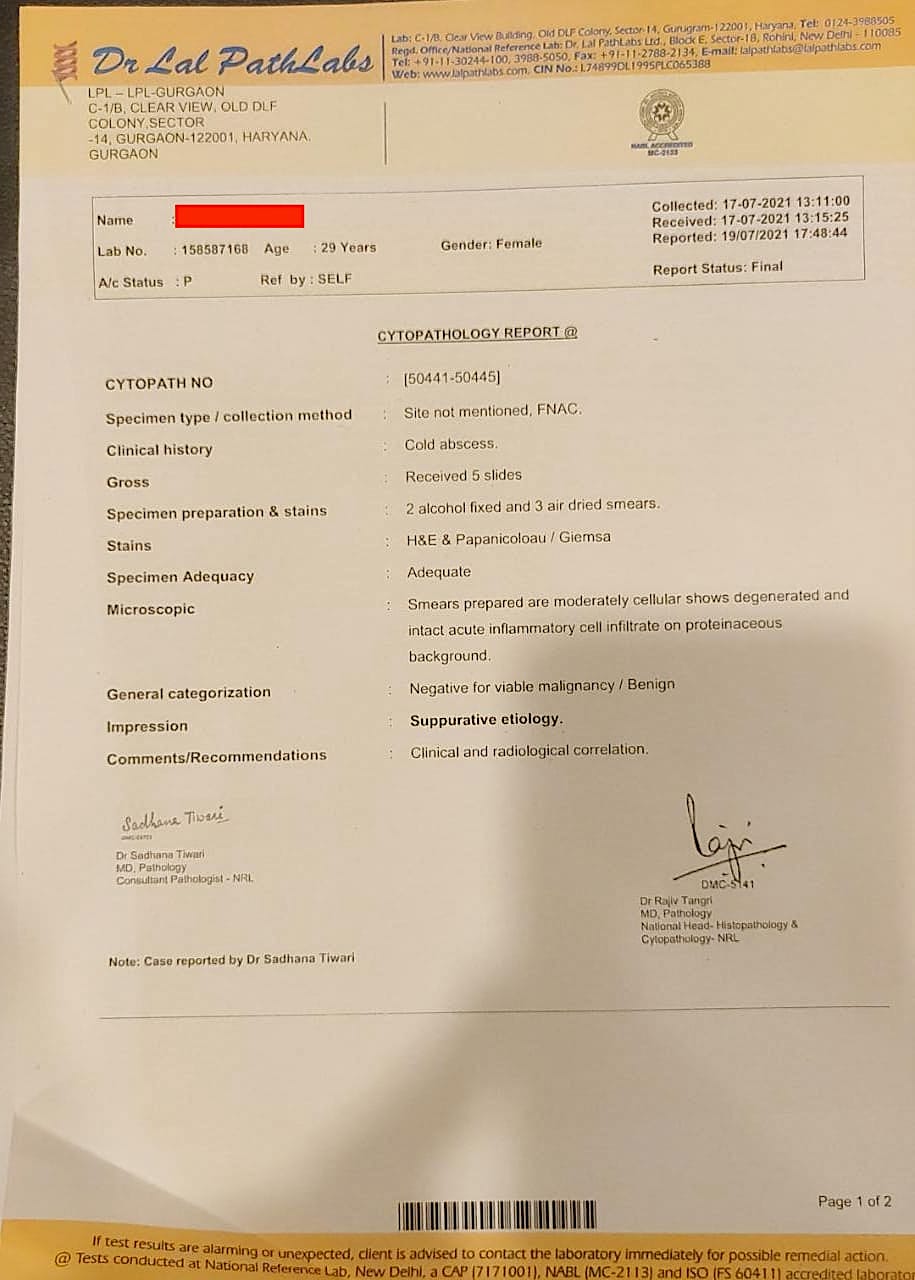
The impression was that there is a suppurative ethology.
Ayurvedic Assessment was done based on the presenting complaints and clinical evaluation. The treating physician confirmed the Ayurvedic diagnosis as Vidradhi.
Differential Diagnosis-
Cellulitis, empyemas, necrotising fasciitis.
The physician ruled out these conditions based on clinical evaluation
Prognosis- A small abscess closer to the surface of the skin can be treated quickly. But if the deeper tissues are affected or the internal organs are involved, then the prognosis is poor, or rather difficult to treat. The patient reports that the onset of the abscess was 2 years back. But only 6 months prior to the ayurvedic consultation, she had consulted an allopathic doctor. She did not get relief from her symptoms inspite of allopathic medications. The medical advise was to undergo a minor surgery and repeated incision and drainage. But with 1 an half year of ayurvedic treatment, she got complete relief from all the symptoms and the abscess healed completely.
THERAPEUTIC INTERVENTION
Refer the tab ‘Treatment’ in the Portal.
FOLLOW-UP AND OUTCOMES
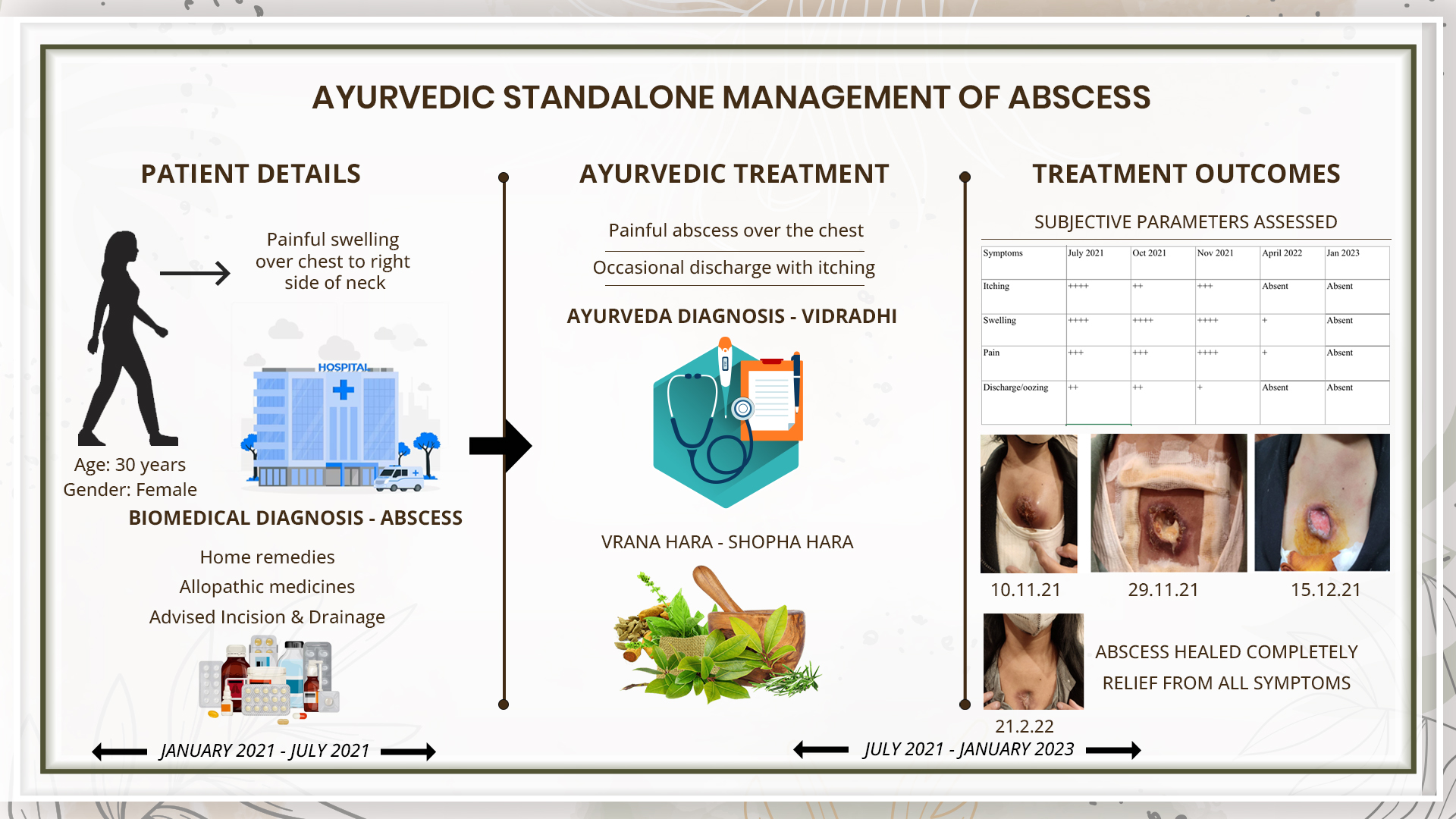
The patient had 4 follow ups in total. Each follow up, the symptoms of itching, pus discharge and the intensity of the abscess were noted. Images were taken throughout the treatment to assess the outcomes of the treatment.
Image 5. Photos of the abscess taken throughout the treatment date wise.
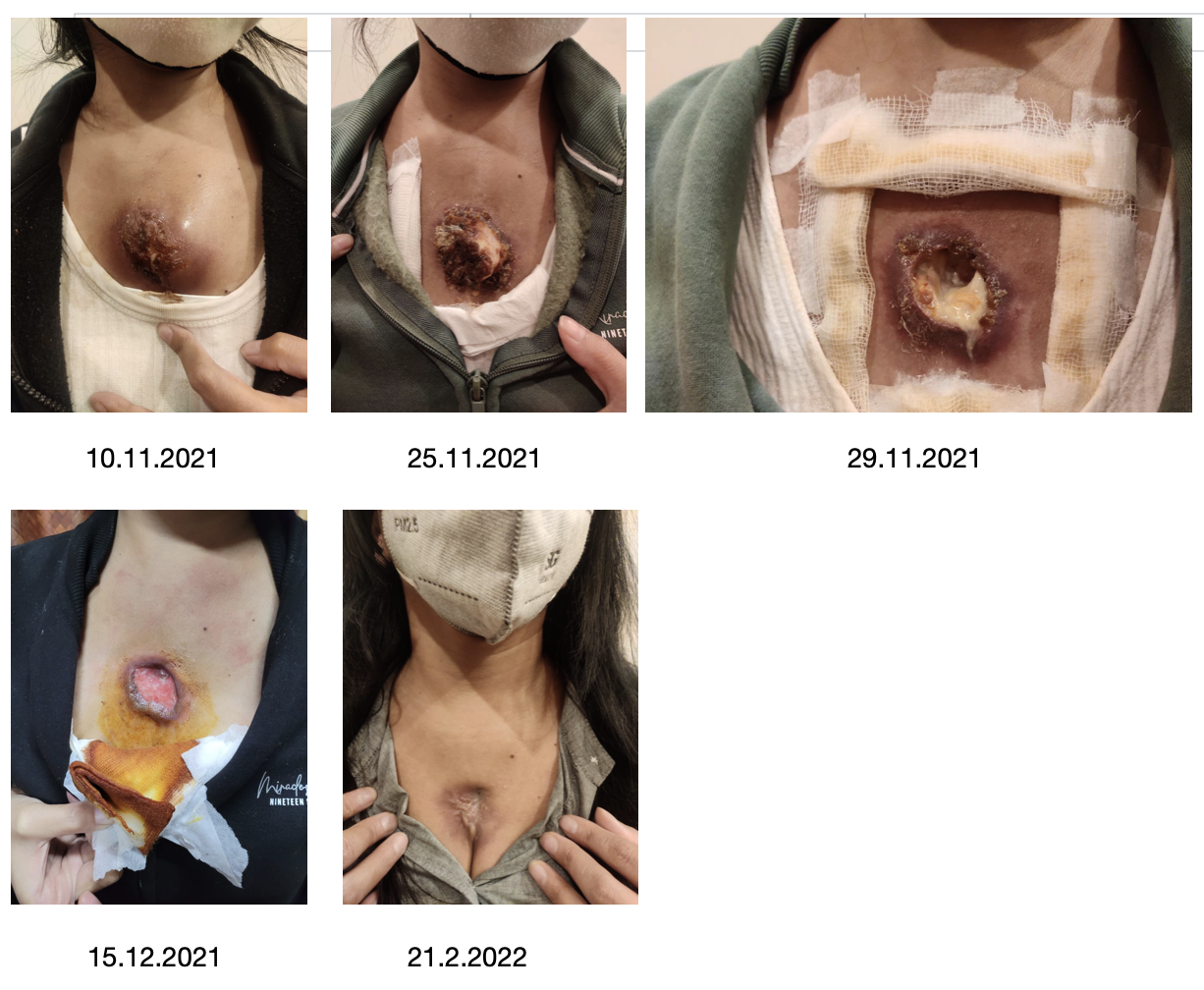
Image 6. Swab test done during treatment dated 29.11.2021
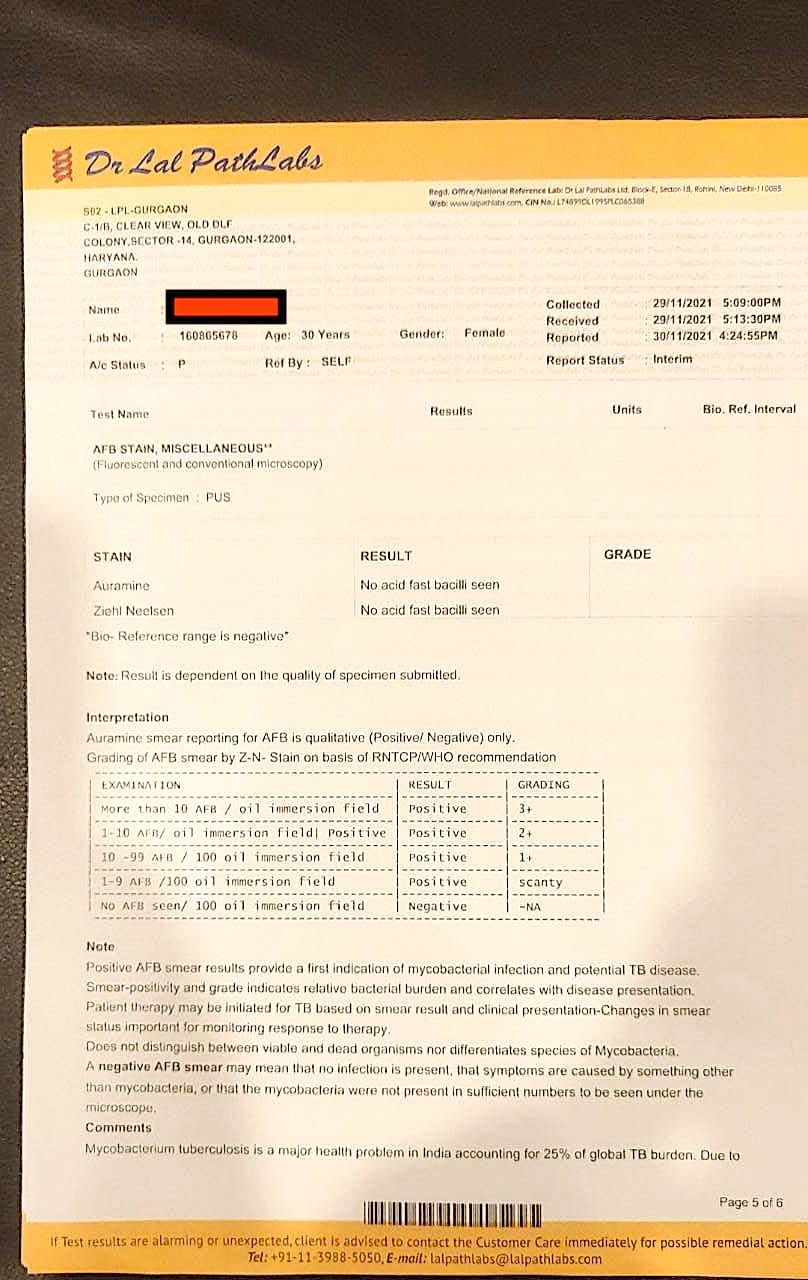
Image 7. Fluid test done during treatment dated 29.11.2021
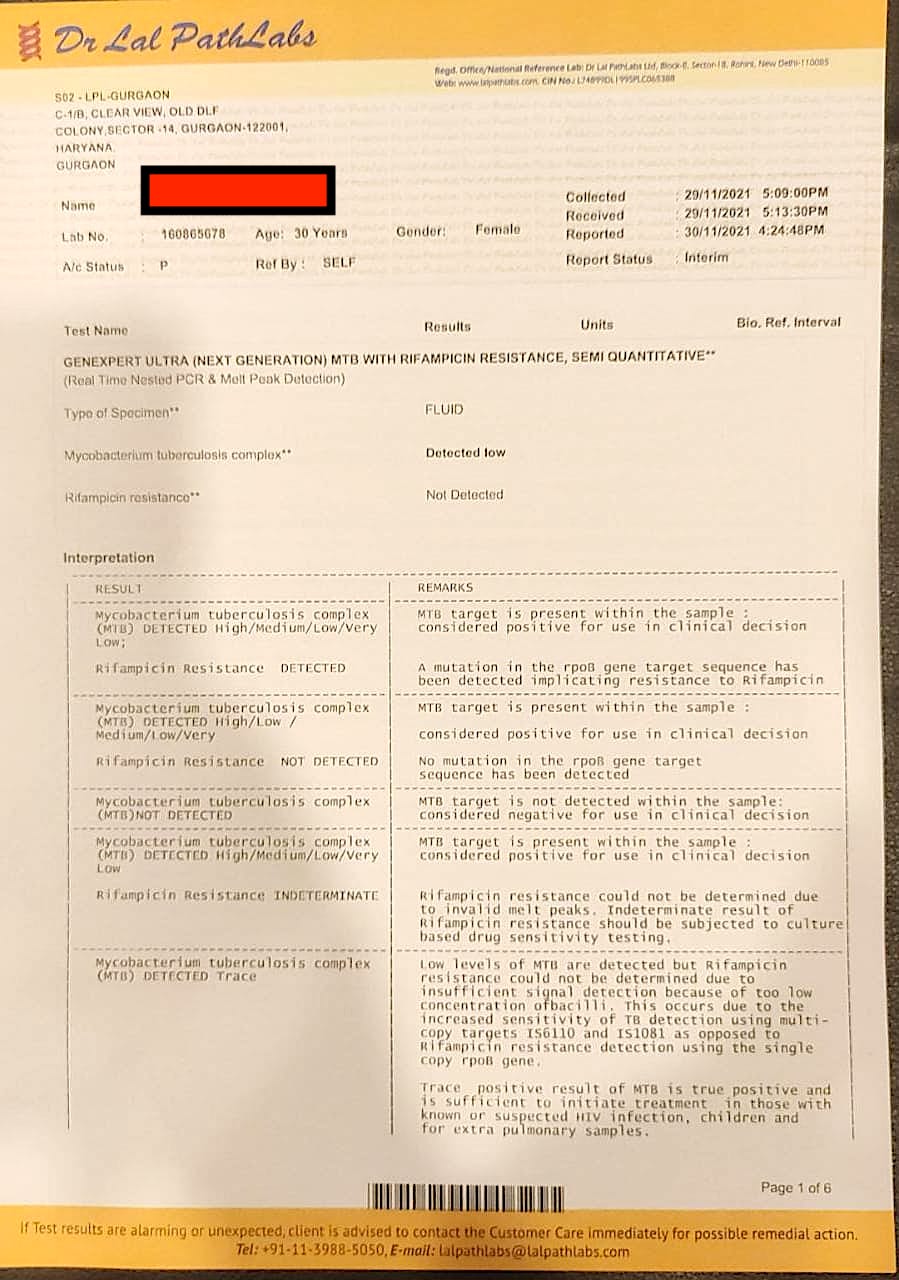
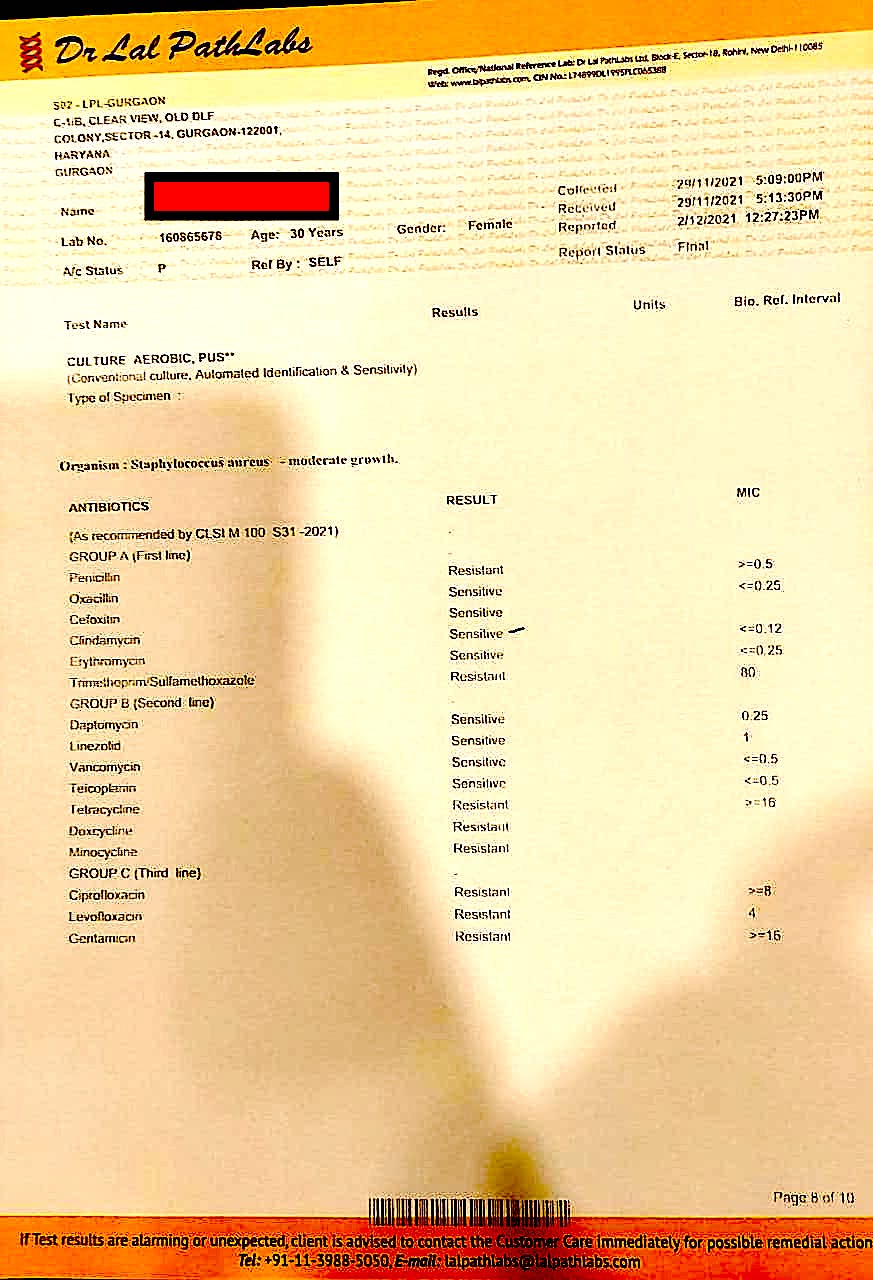
Image 8. Pus culture done during treatment dated 29.11.2021
Clinician-based assessment; After 8 months of treatment, patient is free from itching and pus discharge. Swelling and pain reduced. After 1 and a half years of treatment, the patient got relief from all the symptoms. The abscess has completely healed.
Patient-assessed; Not relevant
Intervention adherence and tolerability – The patient adhered to the prescribed treatments and tolerated the treatments well.
Method of assessment- Subjective parameters were the main assessment tools.
Adverse and unanticipated events; None reported
DISCUSSION:
An abscess is a buildup of a pus that can affect any part of your body. It can be called as a pocket of pus. When it is small and is closer to the surface of the skin, then it can be managed easily. In this patient, despite trying various home remedies and conventional medicines, the patient did not get any relief and her condition continued to worsen. The allopathic doctor had suggested that the only option was to undergo minor surgery or repeated incision and drainage procedures. The patient was not willing and so opted for ayurveda. The line of treatment followed was srotoshodhana, rakta shodhana, rasayana and tridosa hara.
PATIENT’S PERSPECTIVE
Not available.
LEARNING POINTS/TAKE HOME MESSAGES
This case report highlights the efficacy of ayurveda in treating cases of abscess that was not responding to the standard of care, and was recommended minor surgery and repeated incision and drainage.
INFORMED CONSENT
Written consent obtained from patient for publishing of the case report in the Portal
ACKNOWLEDGEMENTS
None
CONFLICT OF INTEREST
None declared.
FUNDING
None
REFERENCE
-
Immersive Learning
-
Modern Diagnosis
MODERN DIAGNOSIS: Abscess
ABOUT THE DISEASE:
An abscess is a buildup of a pus that can affect any part of your body. It can be called as a pocket of pus. There are many different types of abscesses. They can occur on your skin, in your mouth or around your organs. Skin abscesses may look red and swollen. When you get an infection, your body's immune system kicks into action to try to fight it. White blood cells travel to the infected area and build up within the damaged tissue. This buildup leads to inflammation, which causes a pocket to form. The pocket fills with pus, creating an abscess. Pus is made up of living and dead white blood cells, germs, fluid and dead tissue.
There are different types of abscess. It can be a skin (armpit, breast, anorectal): mouth (gingival, periapical, periodontal, tonsil, retrotonsillar, retropharyngeal) or internal (abdominal, spinal chord, brain). The symptoms are different depending on the type of abscess and the location.
In this case report, the patient is a 30 year old female patient presenting with a painful abscess over the chest, which was accompanied by swelling to the right side of the neck and occasional discharge since 6 months. Despite trying various home remedies and conventional medicines, the patient did not get any relief and her condition continued to worsen. The allopathic doctor had suggested that the only option was to undergo minor surgery or repeated incision and drainage procedures. In this patient as the location of the abscess is the chest it can be related to the skin.
Causes: Infections are the primary cause for abscesses. Mostly the infection is by bacteria. Rarely there are virus or fungi causing the infection.
Diagnostic criteria: Physical examination is the primary diagnostic criteria. Swab test can also be done to confirm the infection and the type. Deeper abscesses, including internal abscesses, are harder to diagnose since you can’t see them. In this case, ultrasound, CT and MRI may be recommended by the Doctor to confirm the diagnosis.
Image 1. Baseline image of the abscess dated 11.7.2021
Image 2. Chest X Ray done dated 17.7.2021
The Chest Ray was a normal study. There was no abnormality detected.
Image 3. Cytopathology report dated 17.7.2021
The impression was that there is a suppurative ethology.
Prognosis: A small abscess closer to the surface of the skin can be treated quickly. But if the deeper tissues are affected or the internal organs are involved, then the prognosis is poor, or rather difficult to treat.
General line of treatment: In case of a small abscess, a warm compress is applied to the area. It may drain naturally, but never attempt to drain or burst an abscess at home. In this case, the infection can spread. On consultation, antibiotics will be prescribed, and sometimes surgical drainage may be recommended under anaesthesia. Once the drainage is done, then supportive treatments to heal the wound are applied. In this case report, the patient did home remedies and took allopathic medications, but did not get relief. So she was advised to undergo Incision and drainage. But she was not ready to do that.
Reference
-
Ayurveda Diagnosis
AYURVEDA DIAGNOSIS: Vidradhi
ABOUT THE DISEASE:
Vidradhi is compared to abscess. Abscess is a collection of pus that has built up within the tissues. It is thus a confined pocket of pus that collects in the tissues, organs or spaces inside the body. They are associated with pain, swelling and redness.
दुष्टरक्तातिमात्रत्वात् स वै शीघ्रं विदह्यते।
ततः शीघ्रविदाहित्वाद्विद्रधीत्यभिधीयते॥९५॥ (CS.Su.17)
Samprapti: The doshas located around the asthi or bone tissue, on getting vitiated will contaminate twak (skin), rakta (blood), mamsa (muscle) and meda (fat) and will produce swelling which develops gradually and into big size and gets hard in consistency. This swelling (shopha) is called Vidradhi. Vidradhi are deep located and are associated with pain. They are either round (circular) or elongated (oval) in shape.
Types based on Dosa predominance: Vidradhis are said to be of 6 types and are caused due to vitiated vata (vataja), pitta (pittaja), kapha (kaphaja), all 3 doshas (tridoshaja or sannipataja), kshataja (due to injury) and raktaja (due to contaminated blood).
Lakshanas:
सर्वासु च महच्चूलं विद्रधीषूपजायते॥९७॥ (CS.Su.17)
The main symptom in all types of vidradhi is the severe pain that manifests.
Vata type of vidradhi presents with thin and transparent secretions or fluid, associated with pain, hard in texture, appears black in colour and inconsistent swelling which raises and goes away in an unpredictable way. Suppuration is also inconsistent. All painful blisters with serous fluid can be included in this type of vidradhi.
Pitta type of vidradhi looks yellow in colour, filled with yellow fluid or pus and is associated with burning sensation. The abscess or blister comes on quickly and suppurates quickly. All blisters with pus and infection comes under this category.
Kapha type of vidradhi is in the shape of sharava or crucible or lid of earthen material, appears white in colour, filled with white or pale coloured fluid, cold on touch, unctuous, associated with less or mild pain, slow raising and slowly suppurating abscess or blisters. Big blisters filled with clear fluid or pus fall under this category.
Sannipataja Vidradhi or abscess caused due to simultaneous vitiation of all 3 doshas have the mixture of symptoms of the three dosas.
Abhighataja vidradhi (caused due to injuries) are caused due to vitiation of Vata, pitta and rakta after an injury and is associated with fever, thirst, burning sensation etc symptoms.
Raktaja vidradhi caused due to vitiated blood are black in colour and are associated with burning sensation, fever and pain. It also resembles pitta type of vidradhi in terms of symptoms and is also closer to blood blisters.
Based on the Rogamarga: Vidradhi is of two types: Bahya (6 types based on doshas) and Abhyantara (10 types) that is Guda (anus), Bastimukha, Nabhi, Kukshi, Vankshana, Vrikka, Yakrit, Pleeha, Hridya, Kloma. (Acharya Charaka has excluded Guda).
In this case report, the patient is a 30 year old female patient presenting with a painful abscess over the chest, which was accompanied by swelling to the right side of the neck and occasional discharge since 6 months. Despite trying various home remedies and conventional medicines, the patient did not get any relief and her condition continued to worsen. The treating physician has not specified the type of vidradhi, but taking into consideration that the abscess is infected, and there is pus discharge, it can be related to Pittaja type.
Prognosis:
अथासां विद्रधीनां साध्यासाध्यत्वविशेषज्ञानार्थं स्थानकृतं लिङ्गविशेषमुपदेक्ष्यामः….(CS.Su.17.102)
The prognosis can be decided only depending upon the sthana and the linga. When located in the marma then it is krichra sadhya. When not located in the marma and of a recent onset, then it is sadhya. Shastra prayoga is indicated in the case of cirottha vidradhi.
General line of treatment: General treatments followed are Raktamokshana, Mrdu Virecana, and Svedana (except in pittaja). Apart from this , laghu ahara also has to be strictly followed. External therapies like lepa and upanaha are recommended. This is supported by internal medications.
Rationale of treatment as explained by the physician: The specific medicines and the rationale for choosing this medicine has been tabulated as told by the physician.
Table 1. Medicines and the specific rationale
NAME OF THE MEDICINE
RATIONALE
Rejuva churna
Vata kapha shamana, srotoshodhana
Shothahar churna
Vata shamana, rakta shodhana, srotoshodhana
Amlapittantak churna
Pacana, pitta vata shamana, recana, srotoshodhana
Mutrapravartak Rasayan
Recana, srotoshodhana
Giloy churna
Tridosha shamana, rasayana
Chopchinyadi churna
Vata kapha shamana, rakta shodhana, sroto shodhana
Vidangadichurna
Vata kapha shamana, krimighna, raktshodhana
Yashad bhasma
Lekhana, rasayana
Pachnimbadi churna
Pitta shamana, rakta shodhana, sroto shodhana
Peedantak Guggulu
Vatakapha shamana, vedana shamana, srotoshodhana
Chandra prakash rasayan vati
Vata kapha shamana, Srotoshodhana, rasayana
Trisidhha Guggulu -
Vata kapha shamana, rakta shodhaka, sroto shodhana
Reference
-
Treatment
Name of Medicine Dosage Form Dosage Mode of Administrtation From - To (Date) Medicine Reference Rejuva Curna Curna 0.75gm Oral- with warm water twice daily 2021-08-29 - 2021-11-21 Patent and Proprietary Medicine Shothahar Curna Curna 0.75gm Oral- with warm water twice daily 2021-08-29 - 2021-11-21 Patent and Proprietary Medicine Chopchinyadi Curna Curna 0.75gm Oral- with warm water twice daily 2021-08-29 - 2021-11-21 Yogaratnakara, Upadamsha Cikitsa Yashad bhasma Bhasma 0.125 gms Oral, after food 2021-08-29 - 2021-11-21 Rasatarangini, 19/95 Mahasudarshana Curnam Curna 0.75gm Oral, with warm water after food 2022-04-28 - 2023-04-16 Sharngadhara Sam. Madhyama khanda. 6/27-36 Giloy Curna Curna 0.75gm Oral- with warm water twice daily 2021-08-29 - 2021-11-21 Patent and Proprietary Medicine Vidangadi Curna Curna 0.75gm Oral- with warm water twice daily 2021-11-21 - 2023-04-16 Cakradatta, Krimi chikitsa, Chapter 7 Pachnimbadi Curna Curna 0.75gm Oral- with warm water twice daily 2021-11-21 - 2023-04-16 Bhaishajya Ratnavali, Kushtarogadikara 86-91. Trisidhha Guggulu Tablet 2 Oral- with warm water twice daily 2021-08-29 - 2023-04-16 Patent and Proprietary Medicine Astadashang Loha Tablet 1 Oral- with warm water twice daily 2021-08-28 - 2023-09-16 Patent and Proprietary Medicine Peedantak Guggulu Tablet 1 Oral- with warm water twice daily 2021-07-11 - 2021-07-28 Patent and Proprietary Medicine Chandra Prakash Rasayana Vati Tablet 1 Oral- with warm water twice daily, before food 2021-07-11 - 2021-07-28 Patent and Proprietary Medicine Saptvinshati Guggulu Tablet 1 Oral- with warm water twice daily 2021-11-21 - 2022-02-27 Patent and Proprietary Medicine Dasamoola Kwath Tablet Tablet 1 Oral, with warm water after food 2022-01-21 - 2022-03-27 Patent and Proprietary Medicine Sanjivani Vati Tablet 1 Oral- with warm water twice daily 2021-07-11 - 2023-03-18 Sharngadhara Samhita. Madhyama khanda.7/28-33 Sarveswar Parpati Tablet Tablet 1 Oral- with warm water once daily before food 2022-03-27 - 2023-01-29 Patent and Proprietary Medicine Punarnavadi Kwath Tablet Tablet 1 Oral, twice daily before food 2022-03-28 - 2023-01-29 Bhaishajya Ratnavali, 42/13 Praval Panchamrit Ras Tablet 1 Oral- with warm water once daily before food 2021-07-11 - 2021-07-28 Bhaishajya Ratnavali, Gulmarogadhikara 139-143 Dashang Lepa Lepa Required Quantity External application on the affected site 2021-07-11 - 2021-07-28 Bhaishajya Ratnavali, Visarparogadikara:16 Narisakhi Capsule Capsule 1 Oral, twice daily after food 2023-01-29 - 2023-03-18 Patent and Proprietary Medicine -
Outcome Measures
The patient is a 30 year old female patient presenting with a painful abscess over the chest, which was accompanied by swelling to the right side of the neck and occasional discharge since 6 months. Despite trying various home remedies and conventional medicines, the patient did not get any relief and her condition continued to worsen. The allopathic doctor had suggested that the only option was to undergo minor surgery or repeated incision and drainage procedures. The patient was not willing and so opted for ayurveda.
Assessment: Subjective and objective parameters were assessed to analyse the outcome of the treatment.
Subjective parameters: Images were taken at baseline, during and after treatment to assess the efficacy of the treatment.
Image 1. Photos taken throughout the course of the treatment with the respective dates
The healing of the abscess in stages can be visualised in these photos.
Objective parameters: During treatment, lab investigations were done to check for infections and pathogens.
Image 2. Swab test done during treatment dated 9.11.2021
Image 3. Fluid test done during treatment dated 29.11.2021
Image 4. Pus culture done during treatment dated 9.11.2021
The reports suggested moderate growth of Staphylococcus and aureus and Fluid test detected the low presence of Mycobacterium tuberculosis complex.
With 1 and a half years of Ayurvedic treatment, the patient got relief from all the symptoms and the wound completely healed.
-