Featured Case
-
Abstract
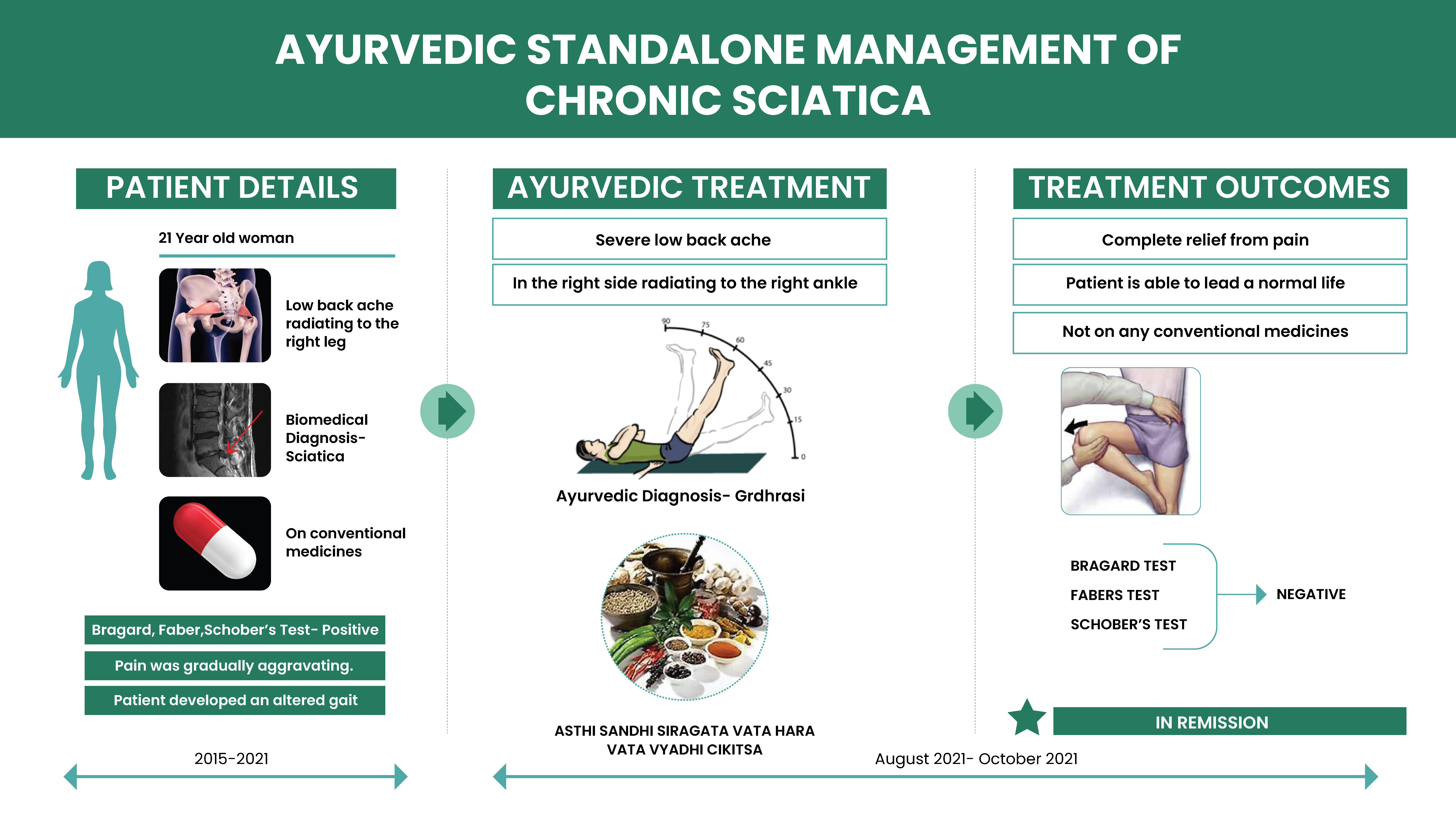
A 21-year-old female student has been suffering from chronic Sciatica pain in the right leg since 5 years. The biomedical diagnosis was confirmed with MRI that revealed moderate changes at L5-S1; Posterior disc bulge with focal central protrusion indenting the anterior thecal sac; No nerve root impingement and no neural foraminal narrowing. She was prescribed pain killers but did not get relief. She took allopathic medications for 2 years (2019-21) on & off but got no significant relief. The patient also started developing an altered gait. Now she consulted Dr Sreelekshmi and was diagnosed with Grdhrasi and Vatavyadhi Cikitsa was followed. The patient underwent a course of treatment as suggested by the Doctor for 20 days and got complete relief from sciatica pain. The SLR Test, Bragards Test, Fabers Test and Schobers Test were the assessment parameters. SLR on the Right side was 40 before treatment, became 90 after treatment. Bragards Test, Fabers Test and Schobers Test became negative after the treatments. She is completely free from the pain and not on any medicines at present. She is advised not to indulge in heavy physical and exhaustive activities like lifting heavy weights, climbing stairs, indulge in dancing and intense sports.
This case report demonstrates that with Ayurvedic treatments, even chronic cases like sciatica that was not satisfactorily responding to the standard of care, can be managed successfully.
-
Summaries
-
Listen
-
Watch
-
View
-
Read
A 21-year-old female student has been suffering from chronic Sciatica pain in the right leg since 5 years. The biomedical diagnosis was confirmed with MRI that revealed moderate changes at L5-S1; Posterior disc bulge with focal central protrusion indenting the anterior thecal sac; No nerve root impingement and no neural foraminal narrowing. She was prescribed pain killers but did not get relief. She took allopathic medications for 2 years (2019-21) on & off but got no significant relief. The patient also started developing an altered gait. Now she consulted Dr Sreelekshmi and was diagnosed with Grdhrasi and Vatavyadhi Cikitsa was followed. The patient underwent a course of treatment as suggested by the Doctor for 20 days and got complete relief from sciatica pain. The SLR Test, Bragards Test, Fabers Test and Schobers Test were the assessment parameters. SLR on the Right side was 40 before treatment, became 90 after treatment. Bragards Test, Fabers Test and Schobers Test became negative after the treatments. She is completely free from the pain and not on any medicines at present. She is advised not to indulge in heavy physical and exhaustive activities like lifting heavy weights, climbing stairs, indulge in dancing and intense sports.
This case report demonstrates that with Ayurvedic treatments, even chronic cases like sciatica that was not satisfactorily responding to the standard of care, can be managed successfully.
-
-
Timeline
-
Tabulated Summary
-
Narrative
TITLE OF CASE
Standalone Ayurvedic management of chronic case of Sciatica (Grdhrasi) in a young female, who got no significant relief with conventional medicines - A Case report
Dr Sreelekshmi VS
ABSTRACT
A 21-year-old female patient was suffering from sciatica in 2016. The X Ray done initially was normal but to address the symptoms, pain killers were prescribed. But the pain persisted. She consulted a Neurologist only in the year 2019. An MRI (lumbar spine 2019) at baseline revealed - moderate disc desiccation changes at the L5-S1 level, and a mild posterior disc bulge with focal central protrusion indenting the anterior thecal sac. No nerve root impingement and neural foramina narrowing. She was provisionally diagnosed as Sciatica based on the clinical presentation. After 2 years of taking conventional medicines, the pain was still aggravating, and the patient was developing an altered gait. So, she opted for Ayurveda. Dr Sreelekshmi diagnosed this condition as Grdhrasi [2], and the Vatavyadhi cikitsa sutra was followed. After 1 month of Ayurvedic treatments both as Outpatient and Inpatient, subjective assessments were done to measure the outcomes. She got complete relief from her symptoms. The Bragards, Faber and Schober Test that was positive before treatment, became negative after treatment. She is advised to not involve in exhaustive and intense physical activities.
KEYWORDS
Sciatica, Grdhrasi, Ayurveda, Standalone
INTRODUCTION
Sciatica [1] is pain experienced due to an injury or irritation to the sciatic nerve that has its origin in the buttock/gluteal area. The sciatic nerve is the longest and thickest (almost finger-width) nerve in the body. Compression or pinching of the nerve can also cause this type of pain. The most common cause of nerve compression or pinching can be caused by a slipped disc or a herniated disc.
Diagnostic Criteria: History taking, and physical examination are the basis for diagnosis. Subjective and objective assessments are the primary diagnostic criteria. In the subjective assessment, SLR with clinical presentations is considered. In the objective assessment, Imaging may be advised to assess the severity of the damage.
PATIENT INFORMATION
A 21-year-old female presented with severe pain in the right low back region radiating to the right ankle since 5 Years.
Medical History:
Patient was normal 5 years back. In 2015, a car hit her lower back. There were no major injuries but only that of a mild hand injury. Later in 2016, the patient started experiencing pain in the right calf region. She was active in dance and sports. This aggravated the pain. She consulted an allopath and X Ray was done, but it was normal. At this point, she was prescribed pain killers, but despite this she did not get relief. In 2019, she consulted a Neurologist, who suggested MRI. MRI revealed disc desiccation at L5-S1 with mild posterior bulge. She took allopathic medications for another 2 years but got no significant relief. At the same time, she started experiencing pain in the right lower back region radiating through the posterior aspect of thighs and calf up to the ankle. Pain aggravated on lying posture and resolved sitting in dorsal stretch posture with forward bending. Patient also started developing altered gait. On 30.7.21, she consulted in Nangelil, and decided to take Inpatient treatment as suggested by the Doctor.
PHYSICAL EXAMINATION/CLINICAL FINDINGS
Nothing specific. There is no swelling or discolouration. On Palpation- tenderness on the low back region at the level of L5-S1 right side. There is a slight rise in temperature noted. Lumbar Spine Movements- Compression & extension movements are painful and restricted. Left side bending is normal. Right side bending is painful. SLR positive 40-degree right side. Bragard Test positive. Faber Test positive on the right side. Faber Test positive on the right side.
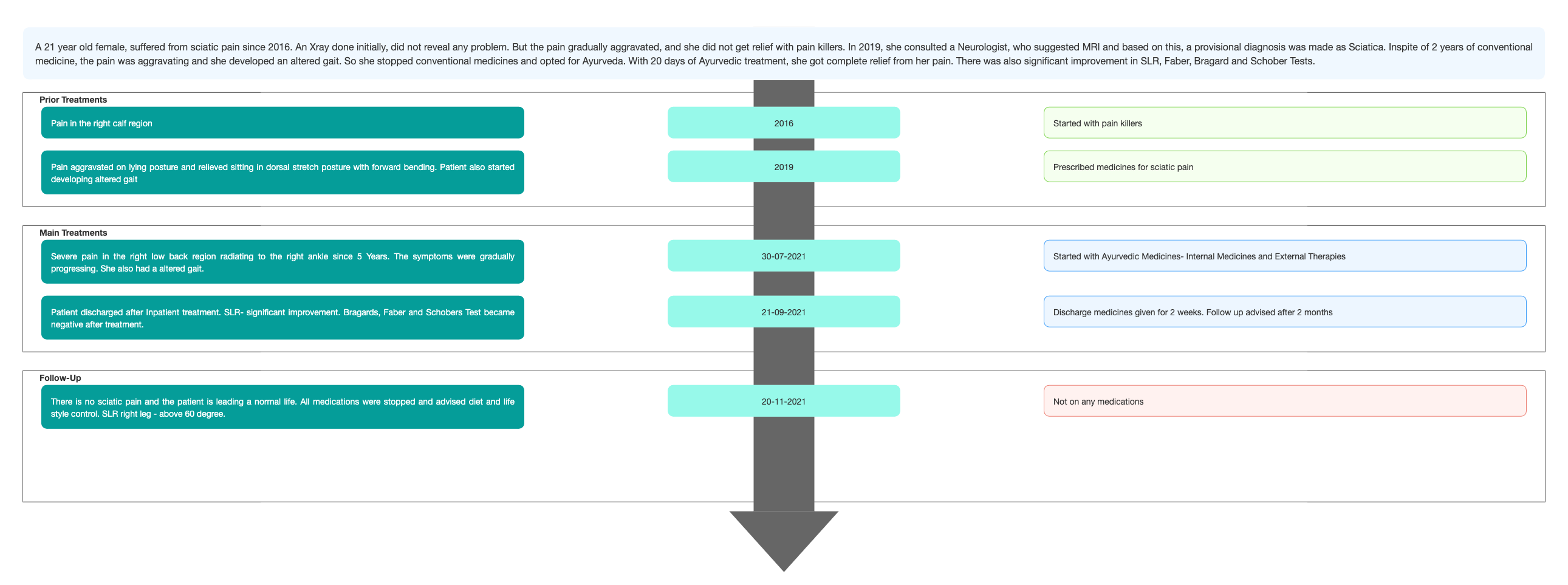
TIMELINE
Image 1. Timeline of events attached below
DIAGNOSTIC ASSESSMENT
Modern Diagnostic parameter: The diagnosis was basically made based on clinical presentation. MRI reports dated 2019 helped identify the cause and confirm the diagnosis.
Image 2. Old MRI Reports dated 2019 attached below
Ayurvedic Assessment was done based on the clinical evaluation by the ayurvedic physician, the confirmed diagnosis from the modern hospital.
Differential Diagnosis- This does not apply as the patient came in with a definite diagnosis.
Prognosis- Grdhrasi2 is considered as Yapyam, according to Ayurveda. Sciatica resolves itself within 6 months, but if the pain has persisted for more than a year, then the prognosis is very grim. Years of medication may not give any relief at all as in the case of this patient. This patient had been suffering from severe pain for 5 years, without any response to conventional medicines. Her symptoms were gradually aggravating, and she was also developing an altered gait. With Inpatient Ayurvedic treatment, she got complete relief from pain and is able to lead a normal life.
THERAPEUTIC INTERVENTION
See the tab "Treatment Details'
FOLLOW-UP AND OUTCOMES
Follow up done after 2 months (20.11.2021): There is no pain, and the patient is leading a normal life. All ayurvedic medications were stopped and advised a strict diet and lifestyle. SLR right leg - above 60 degrees, but she can perform all her activities with ease and comfort. She is advised not to indulge in heavy physical and exhaustive activities like lifting heavy weights, climbing stairs, indulge in dancing and intense sports.
Clinician-based assessment: 30 Days of treatment- patient had remarkable change in symptoms. After 20 days the pain completely disappeared. SLR - 90 degree after treatment. Bragard Test negative: Faber Test negative on the right side: Schober Test is negative.
Objective parameters:
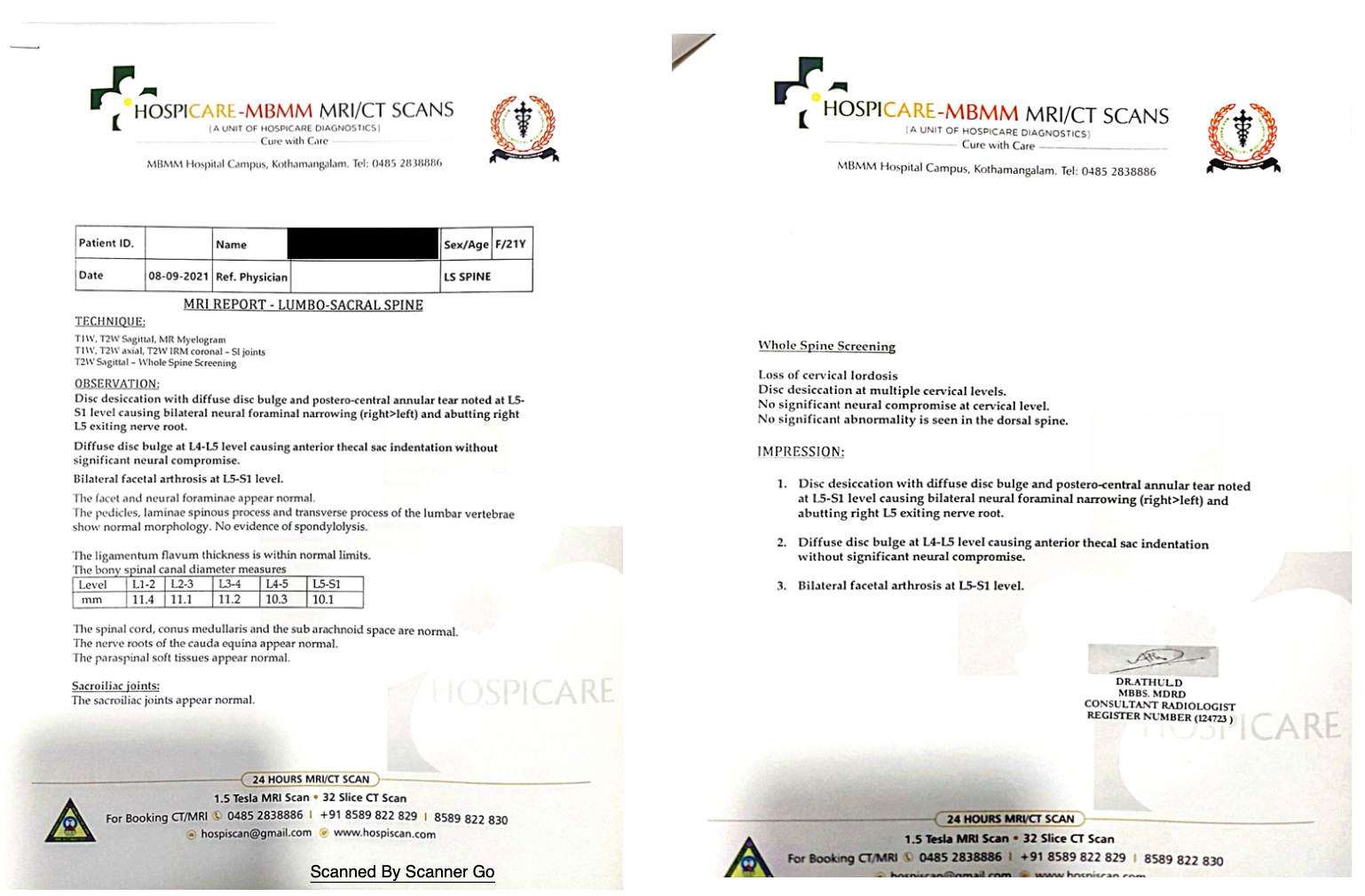
Imaging was done during the Ayurvedic treatment in 2021, which revealed that over the two years (2019-2021), the clinical condition had worsened. But endpoint MRI though crucial could not be done owing to the expenditure, and the low economic status of the patient.
Image 3. MRI Reports September 2021
Patient-assessed: Not relevant
Follow up test results: No repeat MRI was done owing to the cost.
Intervention adherence and tolerability – The patient adhered to the prescribed treatments and tolerated the treatments well.
Method of assessment- By monitoring the patient.
Adverse and unanticipated events: Gandarvahastadi Eranda tailam 30 ml was administered at 5 am for Virecanam on 14.8.21. Patient vomitted at 8 am (1 Vamana Vega). Virecana Vega started at 9 am (2 Vega).
DISCUSSION
Condition was diagnosed as Grdhrasi, vasti was planned but could not be done as the patient was unable to be positioned for it. To manage the pain, general Vatavyadhi treatment line especially that of Sandhi asthi siragata vata was taken into consideration. Hence internal medicines and external treatments targeted pacifying vata dosa.
PATIENT’S PERSPECTIVE
Not available.
LEARNING POINTS/TAKE-HOME MESSAGES
Even in chronic cases of Sciatica, as in this patient, where after taking conventional medicines for a long period, there was no significant relief, Ayurveda can be very effective.
INFORMED CONSENT
Written consent obtained from patient, for publishing this case report.
ACKNOWLEDGEMENTS
None
CONFLICT OF INTEREST
None declared.
FUNDING
None
REFERENCE:
- Jensen RK, Kongsted A, Kjaer P, Koes B. Diagnosis and treatment of sciatica. BMJ. 2019 Nov 19;367:l6273. doi: 10.1136/bmj.l6273. PMID: 31744805.
- Mohan M, Sawarkar P. Ayurvedic management of Gridhrasi with special respect to Sciatica: a case report. J Indian Sys Medicine 2019; 7: 131-8
Image 1. Timeline of events
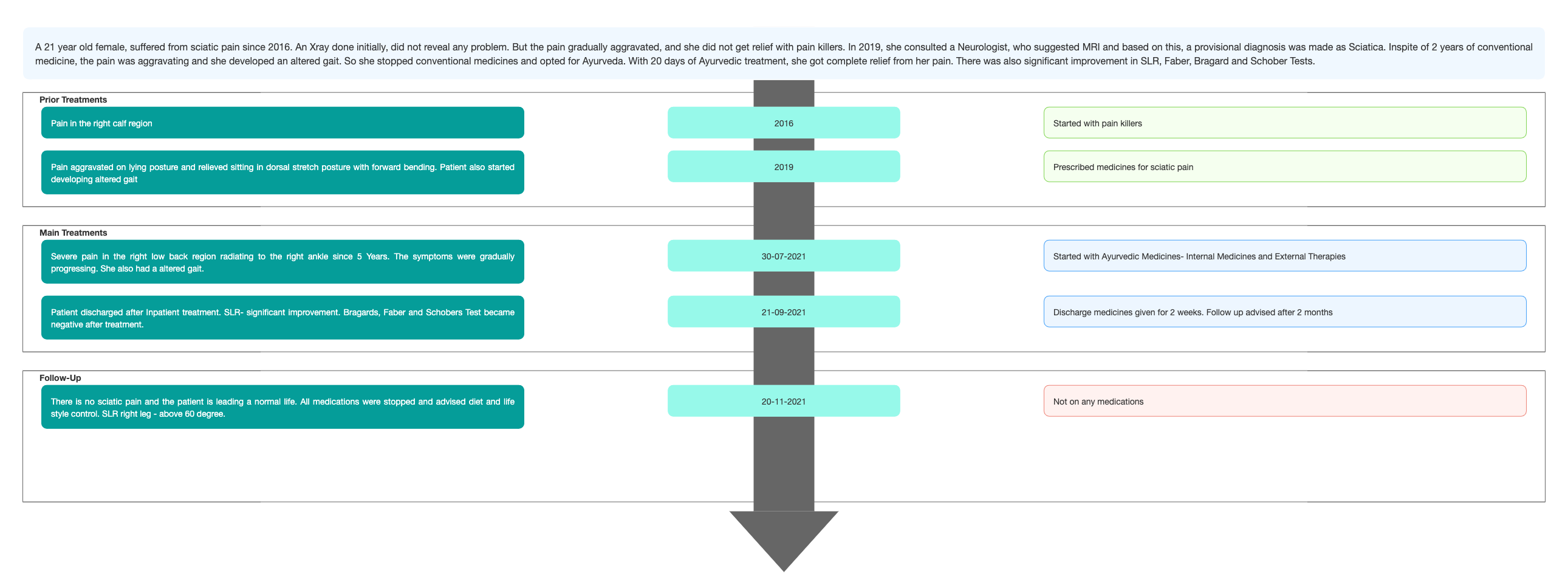
Image 2. Old MRI Reports dated 2019 attached below
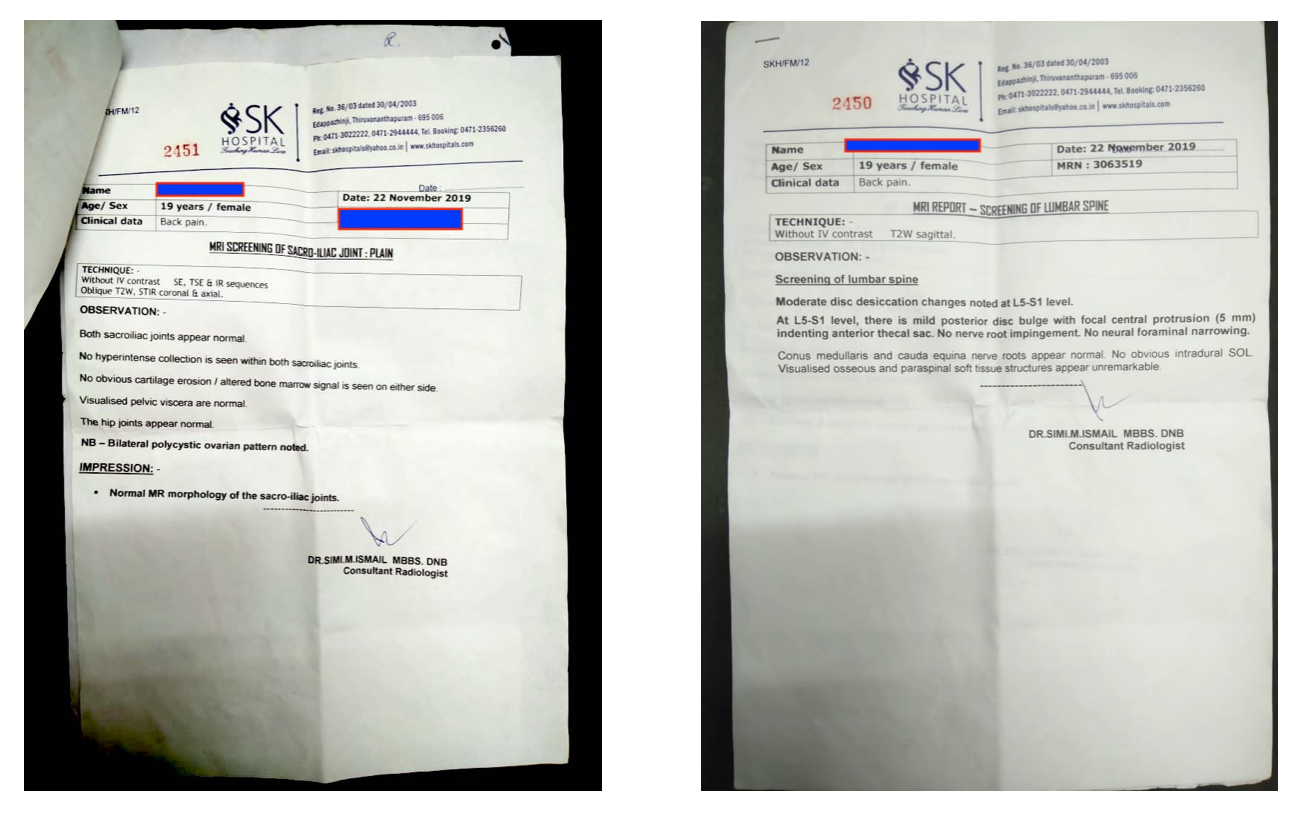
Image 3. MRI Reports September 2021
-
Immersive Learning
-
Modern Diagnosis
MODERN DIAGNOSIS: SCIATICA
About The Disease:
Sciatica is pain experienced due to an injury or irritation to the sciatic nerve that has its origin in the buttock/gluteal area. The sciatic nerve is the longest and thickest (almost finger-width) nerve in the body. Compression or pinching of the nerve can also cause this type of pain. The most common cause of nerve compression or pinching can be caused by a slipped disc or a herniated disc.
Diagnostic Criteria: History taking and physical examination are the basis for diagnosis. Subjective and objective assessments are the primary diagnostic criteria. In the subjective assessment, SLR with clinical presentations is considered. In the objective assessment, Imaging may be advised to assess the severity of the damage.
Prognosis & Treatment: A recent systematic review found that conservative treatments do not clearly improve the natural course of sciatica in most patients or reduce symptoms. Strong evidence of effectiveness is lacking for most of the available interventions. There is a little difference in the effect on pain and functional status, between bed rest and staying active. As a result of this finding, bed rest—for a long time the mainstay of treatment for sciatica—is no longer widely recommended. Analgesics, non-steroidal anti-inflammatory drugs, and muscle relaxants do not seem to be more effective than placebo in reducing symptoms. Evidence for opioids and various compound drugs is lacking.
(Diagnosis and treatment of Sciatica; BW Koes et al.Clinical Review)
A 21-year-old female who suffered from trauma-induced Sciatica, since 5 years, came to the Ayurvedic hospital unable to sit or lie down in a comfortable position due to the excruciating pain on the right side. The initial X Ray done was normal and inspite of taking pain killers, she did not get relief. She consulted a Neurologist in 2019 and the diagnosis was confirmed with a MRI. She tried conventional medicines for more than 2 years (2019-2021), but with no relief.
Image 1. Old MRI Reports dated 2019 Attached Below
Image 2. MRI done as Baseline in September 2021 Attached Below
-
Ayurveda Diagnosis
AYURVEDA DIAGNOSIS: GRDHRASI
ABOUT THE DISEASE:
Based on the clinical presentation, Sciatica can be correlated to Ghrdhrasi in Ayurveda. The classical texts mention the symptoms of Grdhrasi as Injury (Abhighata), unhealthy activities (Visama chesta), carrying heavyweight (Bharavahana), overexerting (Atichesta), continuous violent movements, sedentary lifestyle, psychological factors (cinta, soka, etc.,) are considered to be the nidana of this disease. The disease gets its name from ‘ghrdhra’ meaning vulture referring to the typical gait of the patient. The disease is considered as a Nanatmaja Vatavyadhi.
The common symptoms of Grdhrasi are–pain radiating from Sphik (buttock) the to kati, prsta, uru, janu, jangha and pada associated with stambha (stiffness), toda (pricking pain), spandana (twitching) and causes the Sakti utksepanigraha(restricted movement of the lifting of the leg). Commentator Arunadatta mentions the inability of the patient to lift his leg when affected with this condition. Specific symtpoms like ‘dehasya vakrata’ and kati- janusandhi sphuranam are mentioned as symptoms in vataja grdhrasi. Depending upon the dosa responsible for the pathology, the respective symptoms will be produced.
Adhishtana of the disease; According to Cakradatta, kati and sphik are the initial sites of manifestation. According to Susruta, kandara of parshni, pada and anguli are affected.
Treatment; Vangasena mentions Dipana, pacana, vamana, virecana, vasti and siravyadha as the line of treatment. This being a vatavyadhi, the basic treatment target is to pacify vata.
In this patient, vasti was planned but could not be done as the patient was unable to be positioned on the treatment table due to her excruciating pain. To manage pain in general, Vatavyadhi line of treatment especially that of Sandhi asthi siragata vata was taken into consideration. Hence internal medicines and external treatments targeted pacifying vata dosa.
Prognosis; Tridosaja is asadhya, especially if it is cirakala. In this patient, the clinical condition persisted for more than 5 years, and hence it was a krcchrasadhya vyadhi.
-
Treatment
Name of Medicine Dosage Form Dosage Mode of Administrtation From - To (Date) Medicine Reference Gandarvahstadi Kasayam Kasayam 30 ml+ 60 ml warm water. Oral- Twice daily, before food 2021-08-09 - 2021-08-14 Sahasra yoga. Kasaya Prakarana. Rasnerandadi Kasayam + Punarnavadi Kasayam Kasayam 15 ml Kasayam (mixed) with 45 ml warm water Oral, twice daily before food 2021-08-09 - 2021-08-12 Sahasrayogam, Kasaya Prakaranam Nirgundi eranda capsule Capsule 1-0-1 Oral, after food with warm water 2021-08-09 - 2021-08-12 Proprietary Medicine Yogarajaguggulu Gulika 1-0-1 Oral, after food with warm water 2021-08-09 - 2021-08-12 Sharngadhara Samhita. Madhyama Khanda.7.56- 69 Dhanvantaram Gulika Gulika 1-0-1 Oral, with warm water after food 2021-08-09 - 2021-08-12 Sahasrayogam. Gulika Prakarana Fortiflam Capsule 1 Oral with warm water- H S, after food 2021-08-09 - 2021-08-11 Proprietary Medicine Sinduvara eranda capsule Capsule 1-0-1 Oral, with warm water after food 2021-08-09 - 2021-08-19 Proprietary Medicine Lumbatone Capsule Capsule 2-0-2 Oral, with warm water after food 2021-08-09 - 2021-08-19 Proprietary Medicine Sallaki Capsule 1 STAT, oral with water 2021-08-09 - 2021-08-09 Proprietary Medicine Kapporamarmani Tailam + Murivenna Tailam Required quantity Local external application 2021-08-09 - 2021-08-19 Anubhuta Yogam karpooramarmani Tailam + Murivenna Tailam Ratio of taila taken 3:1 Abhyanga with 20 minutes 2021-08-09 - 2021-08-11 Anubhuta Yogam Nadi Svedam Sveda drava Required quantity Fomentation- External application 2021-08-09 - 2021-08-13 Anubhuta Yogam Nagaradi Curnam + Dhanyamlam Lepa Dravyam Required quantity Local External application 2021-08-11 - 2021-08-13 Nagaradi Curnam- CS.Ci.15.129-131 Gandharavahastadi Eranda Tailam Tailam Virecana matra Oral 2021-08-14 - 2021-08-14 Sahasra Yogam. Taila Prakaranam Kolakulatthadi Curnam + Kottamchukkadi Curnam Curnam Required quantity Curna Pinda Svedam 2021-08-16 - 2021-08-19 Kolakulatthadi Curnam- CS.Su.3. Kottamchukkadi.Sahasra Yogam, Curna Prakaranam Murivenna + Dhanvantaram Tailam Tailam Required quantity Kati vasti for 20 minutes/daily 2021-08-16 - 2021-08-19 Dhanvantara Tailam- Sahasra Yogam. Taila Prakaranam Agni lepam Lepa Dravyam Required quantity Local External application 2021-08-17 - 2021-08-19 Proprietary Medicine -
Outcome Measures
OUTCOME MEASURES
A 21 year old female patient was suffering from severe low back ache radiating in nature, since 2016. But her first consultation with a Neurologist was in 2019. An MRI (lumbar spine 2019) at baseline revealed - Moderate disc desiccation changes at the L5-S1 level, and a mild posterior disc bulge with focal central protrusion indenting the anterior thecal sac. There was no nerve root impingement and neural foramina narrowing. With the MRI findings as the base, and clinical examination, she was provisionally diagnosed as Sciatica. After 2 years of taking conventional medicines, the pain was still aggravating and the patient was developing an altered gait. So she opted for Ayurveda. After 1 month of Ayurvedic treatments both as Outpatient and Inpatient, subjective assessments were done to measure the outcomes.
Subjective parameters: Clinical examination of the patient done after treatment were as follows;
- SLR positive 90 degree right side (was 40 degree at baseline)
- Bragards Test negative (was positive)
- Fabers Test negative on the right side (was positive)
- Schobers Test is negative (was positive)
Clinician based assessment: After 20 days of starting the treatment, the patient got complete relief from pain.
Follow up done after 2 months (20.11.2021): There is no pain and the patient is leading a normal life. All ayurvedic medications were stopped and advised a strict diet and lifestyle. SLR right leg - above 60 degrees, but she is able to perform all her activities with ease and comfort. She is advised not to idulge in heavy physical and exhaustive activities like lifting heavy weights, climbing stairs, indulge in dancing and intense sports.
Objective parameters:
An endpoint MRI was not done owing to the lower economic status of the patient.
-