Featured Case
-
Abstract
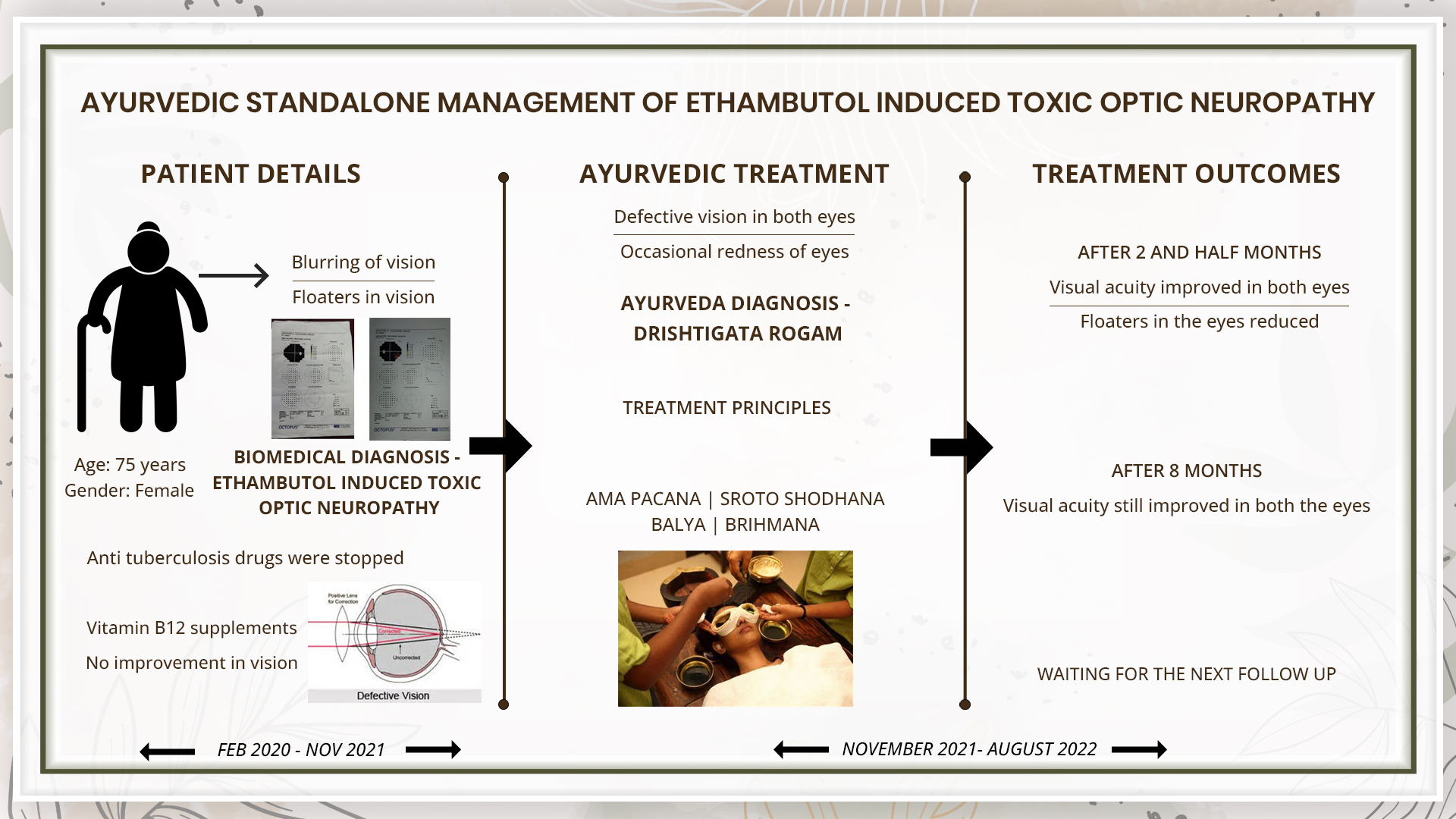
A 75-year-old female patient approached Dr Sreekanth with defective vision in both eyes for 2 years and occasional redness of the eyes. She had been taking Category 1 Anti Tubercular Treatment with topical steroids and cycloplegic drugs - Ethambutol since November 2019. It was in February 2020 that the blurring of vision started. In August 2020, the symptoms worsened and there were floaters in the eye. The Biomedical diagnosis was Ethambutol-induced toxicity, and the ATTs were stopped immediately, and she was put on vitamin supplements. But even in further follow-ups, there were no improvements in the vision. So she opted for Ayurveda. Dr Sreekanth diagnosed this condition as Drishti gata rogam. The line of treatment followed was pacifying the tridoshas, and improving the agni, do ama pacana and sroto shodhana, by administering balya and brmhmana dravya. After 3 weeks of ayurveda treatment, visual acuity improved in both eyes and the floaters in the right eye reduced significantly. The patient is advised regular follow-ups.
-
Summaries
-
Listen
-
Watch
-
View
-
Read
A 75-year-old female patient approached Dr Sreekanth with defective vision in both eyes for 2 years and occasional redness of the eyes. She had been taking Category 1 Anti Tubercular Treatment with topical steroids and cycloplegic drugs - Ethambutol since November 2019. It was in February 2020 that the blurring of vision started. In August 2020, the symptoms worsened and there were floaters in the eye. The Biomedical diagnosis was Ethambutol-induced toxicity, and the ATTs were stopped immediately, and she was put on vitamin supplements. But even in further follow-ups, there were no improvements in the vision. So she opted for Ayurveda. Dr Sreekanth diagnosed this condition as Drishti gata rogam. The line of treatment followed was pacifying the tridoshas, and improving the agni, do ama pacana and sroto shodhana, by administering balya and brmhmana dravya. After 3 weeks of ayurveda treatment, visual acuity improved in both eyes and the floaters in the right eye reduced significantly. The patient is advised regular follow-ups.
-
-
Timeline
-
Tabulated Summary
-
Narrative
TITLE OF CASE
Successful standalone ayurvedic management of Ethambutol toxic optic neuropathy - A case report
Dr Sreekanth P Namboothiri
ABSTRACT
A 75-year-old female patient approached Dr Sreekanth with defective vision in both eyes for 2 years and occasional redness of the eyes. She had been taking Category 1 Anti Tubercular Treatment with topical steroids and cycloplegic drugs - Ethambutol since November 2019. It was in February 2020 that the blurring of vision started. In August 2020, the symptoms worsened and there were floaters in the eye. The Biomedical diagnosis was Ethambutol-induced toxicity, and the ATTs were stopped immediately, and she was put on vitamin supplementation. But even in further follow-ups, there were no improvements in the vision. So she opted for Ayurveda. Dr Sreekanth diagnosed this condition as Drishti gata rogam. The line of treatment followed was pacifying the tridoshas, and improving the agni, ama pacana, sroto shodhana, by administering balya and brmhmana dravya. After 3 weeks of ayurveda treatment, visual acuity improved in both eyes and the floaters in the right eye reduced significantly. The patient is advised regular follow-ups.
KEYWORDS
Ethambutol, Optic neuropathy, Drishtigata Rogam, Ayurveda, Ethambutol toxicity, Case report
INTRODUCTION
Ethambutol (EMB) is an antibiotic used to treat infection by Mycobacterium species, particularly Mycobacterium tuberculosis and non-tubercular infections like M. avium complex and M. kansasii. Unfortunately, one serious and vision-threatening side effect of EMB is ethambutol-induced optic neuropathy (EON). Less common side effects of EMB include peripheral neuropathy, cutaneous reactions, thrombocytopenia, and hepatitis
Diagnosis: The diagnosis of EON (Ethambutol induced Optic Neuropathy) is made clinically with visual acuity, formal perimetry and color vision testing. Fundoscopy is necessary to exclude other aetiologies of visual loss in particular retinal disease. The presence of optic disc oedema or macular pathology would argue strongly against EON. Patients should receive a baseline eye exam prior to initiation of EMB therapy in order to document pre-treatment ocular pathology.
Treatment: Currently, there is no effective treatment for EON. However, if the condition is detected early and the drug is discontinued promptly (before the development of irreversible optic atrophy), between 30-64% of patients have been reported to show visual improvements over a course of several months. However, full recovery is rare.
Prognosis: Most patients who discontinue EMB after the onset of visual changes (without optic atrophy) will recover their vision over weeks to months. The presence of optic disc pallor at the onset of visual symptoms is associated with poor prognosis. (Taken from Ethambutol optic neuropathy by American Academy of Opthalmology. EyeWiki.)
PATIENT INFORMATION
A 75-year-old female patient approached Dr Sreekanth with defective vision in both eyes for 2 years and occasional redness of the eyes.
Medical History: She had been taking Category 1 Anti Tubercular Treatment with topical steroids and cycloplegic drugs - Ethambutol since November 2019. It was in February 2020 that the blurring of vision started. In August 2020, the symptoms worsened and there were floaters in the eye. The Biomedical diagnosis was Ethambutol-induced toxicity, and the ATTs were stopped immediately, and she was put on vitamin supplements. But even in further follow-ups, there were no improvements in the vision. So she opted for Ayurveda. Dr Sreekanth diagnosed this condition as Drishti gata rogam. The line of treatment followed was pacifying the tridoshas, and improving the agni, ama pacana, sroto shodhana, by administering balya and brmhmana dravya.
CLINICAL FINDINGS/PHYSICAL EXAMINATION
On examination of the eye,
Sclera: Clear BE
Cornea Arcus senilis BE
P/R: reactive BE
Fundus-Mature cataract (BE)
Shallow anterior chamber
Optic atrophy in query
Post uveitis in query
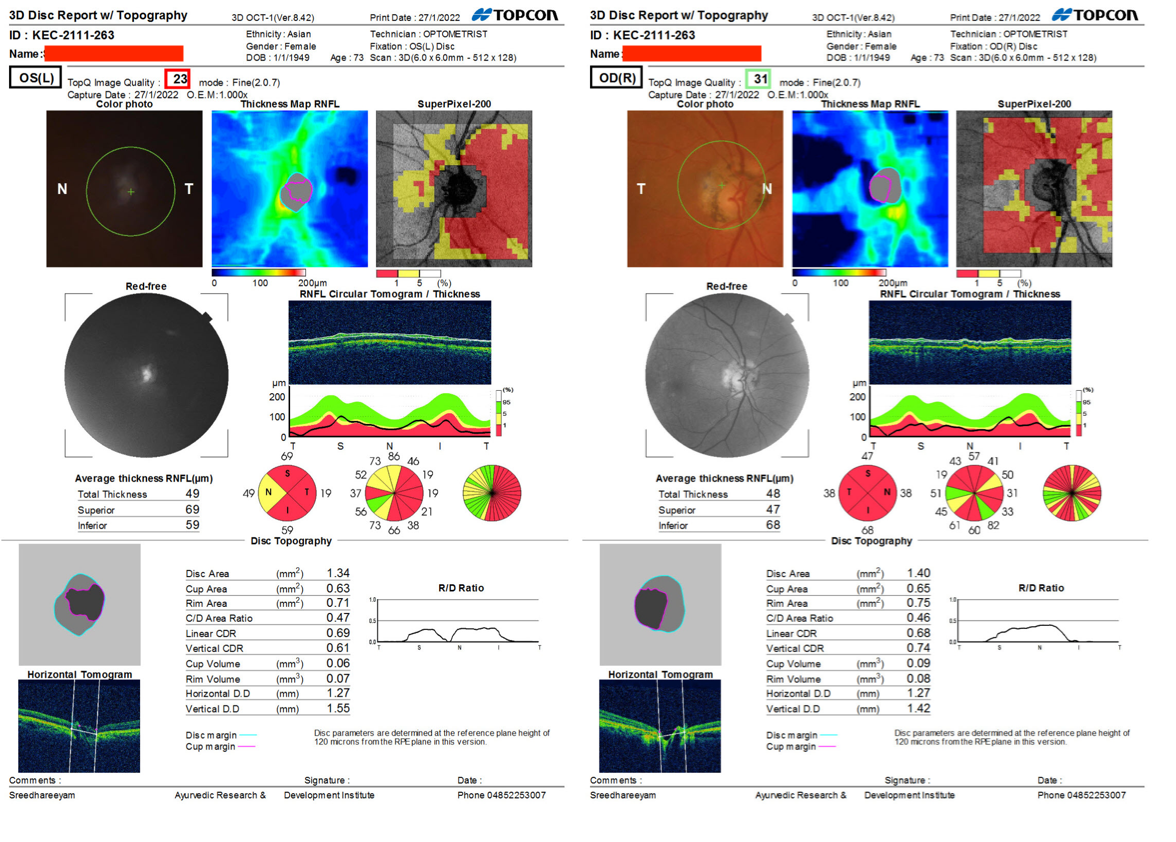
OCT Findings: RNFL Thinning BE
Disc pallor BE
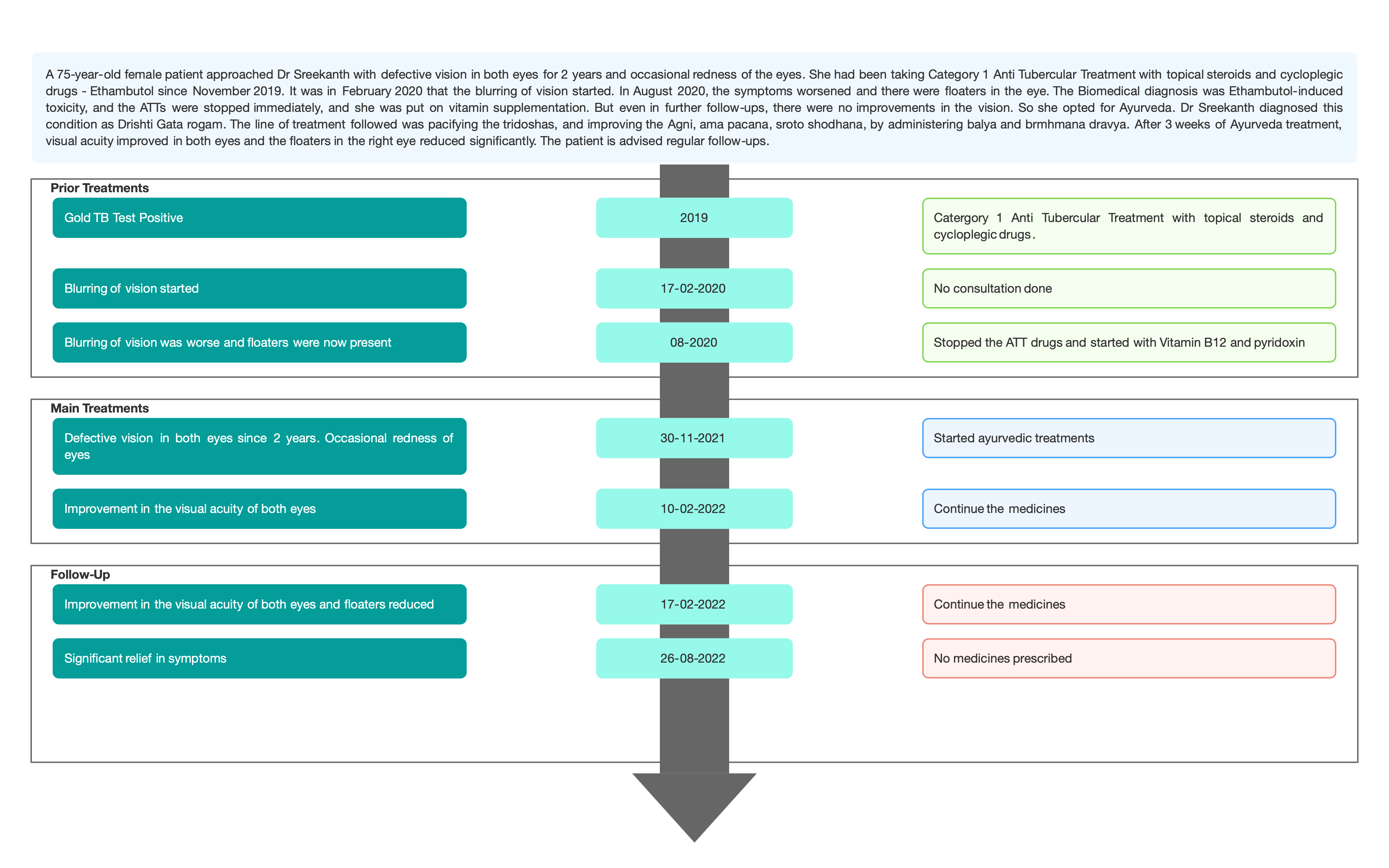
TIMELINE
Image 1. The timeline of events is attached below
DIAGNOSTIC ASSESSMENT
Modern Diagnostic parameter: The biomedical diagnosis was made depending on the presenting complaints and the clinical evaluation. The diagnosis was confirmed with Topography at baseline.
Image 2. Reports dated 2020 added below
Ayurvedic Assessment was done based on the clinical evaluation by the ayurvedic physician.
Differential Diagnosis- This does not apply as the patient came in with a definite diagnosis.
Prognosis- Most patients who discontinue EMB after the onset of visual changes (without optic atrophy) will recover their vision over weeks to months. The presence of optic disc pallor at the onset of visual symptoms is associated with poor prognosis. In this case, there was optic pallor was noted in both eyes. Also, due to the patient’s ignorance, she continued ATT drugs 6 more months after the onset of blurring. With the initiation of Ayurveda treatments, for 3 months, visual acuity improved in both eyes (RE- 3/60, LE- 3/60), and floaters in RE were reduced.
THERAPEUTIC INTERVENTION
See the tab ‘Treatment details’
FOLLOW-UP AND OUTCOMES
Clinician-based assessment; After 6 months of treatment- The patient is able to read big letters and write a complete sentence correctly within a line. Colour vision has improved. Floater- Now only one black spot is present.
Redness – There was no other episode of redness in the eyes.
The patient feels more confident to carry out day-to-day now activities.
After 3 weeks of ayurveda treatment, visual acquity improved in both the eyes (RE- 3/60, LE- 3/60), floaters in RE reduced.
Objective parameters: During treatment, Topography images were taken to help assess the effect of ayurvedic treatments.
Image 3. The topography reports dated 27.1.2022 during treatment are added below
Patient-assessed; Not relevant.
Intervention adherence and tolerability – The patient adhered to the prescribed treatments and tolerated the treatments well.
Method of assessment- By monitoring the patient.
Adverse and unanticipated events; None reported.
DISCUSSION ;
The targets of medicines prescribed for treatment are as follows:
Amrtottaram Kwatha- Ama Pachana and Sroto Sodhana; ensuring a normal digestion to facilitate delivery of proper rasadhatu and nutrients to the eyes and nerves
Bharngyadi Kvatha- Dipana and Pachana actions; ensuring a normal digestion to facilitate delivery of proper rasadhatu and nutrients to the eyes and nerves.
Trikatu with lime juice, Cough mix, Fever mix- These medicines were prescribed to alleviate mild fever and cough-like symptoms that the patient developed early on in the treatment.
Varanadi Kvatha, Punarnavadi Kvatha- Addressing the Avarana of Kapha and Vata; re-instigating Vyana Vata to ensure supply of nutrition to the nerve, further enhancing Jatharagni to ensure delivery of properly formed rasadhatu to the eyes and nerves.
Dhanadarasnadi Kvatha- Enhancing the activity of Vyana Vata in the nerves and delivery of essential nutrients and vascular supply to the optic nerve and eyes
Drakshadi Kvatha- Balancing Vata and Pitta in the eyes, enhancing vision and restore neuronal activity
Guggulu Pancapala Tablet- Abolishing the Avarana of Kapha and Vata and enabling nutrition to reach the nerves by its Srotoshodhaka property
AsvagandhaTablet- Enhancing the supply and activity of the nerves and eyes by its Balya and Brmhana properties
Sudarsana Gutika- Enhancing the Jatharagni, cleansing the srotas, enabling delivery of nutrients and enhancing function to the eyes and nerves.
Patoladi Ghrta- Enhancing vision and strengthening the retina and nerves by its Pitta-Kapha Samana and Sroto Sodhana properties.
Agastya Haritaki- -Enhancing nervous supply and nutrition by its Balya and Brmhana property.
PATIENT’S PERSPECTIVE
Not available.
LEARNING POINTS/TAKE-HOME MESSAGES
This case report demonstrates the successful ayurvedic management of ethambutol-induced toxic neuropathy in a 75-year-old woman, who tried conventional medicines for 3 months and did not get any satisfactory outcome. Her visual acuity improved and the floaters in the eyes were reduced.
INFORMED CONSENT
Written consent was obtained from the patient to publish the case report.
CONFLICT OF INTEREST
None declared.
FUNDING
None
REFERENCE
Ethambutol optic neuropathy by American Academy of Opthalmology. EyeWiki.
Image 1. Timeline of events added below
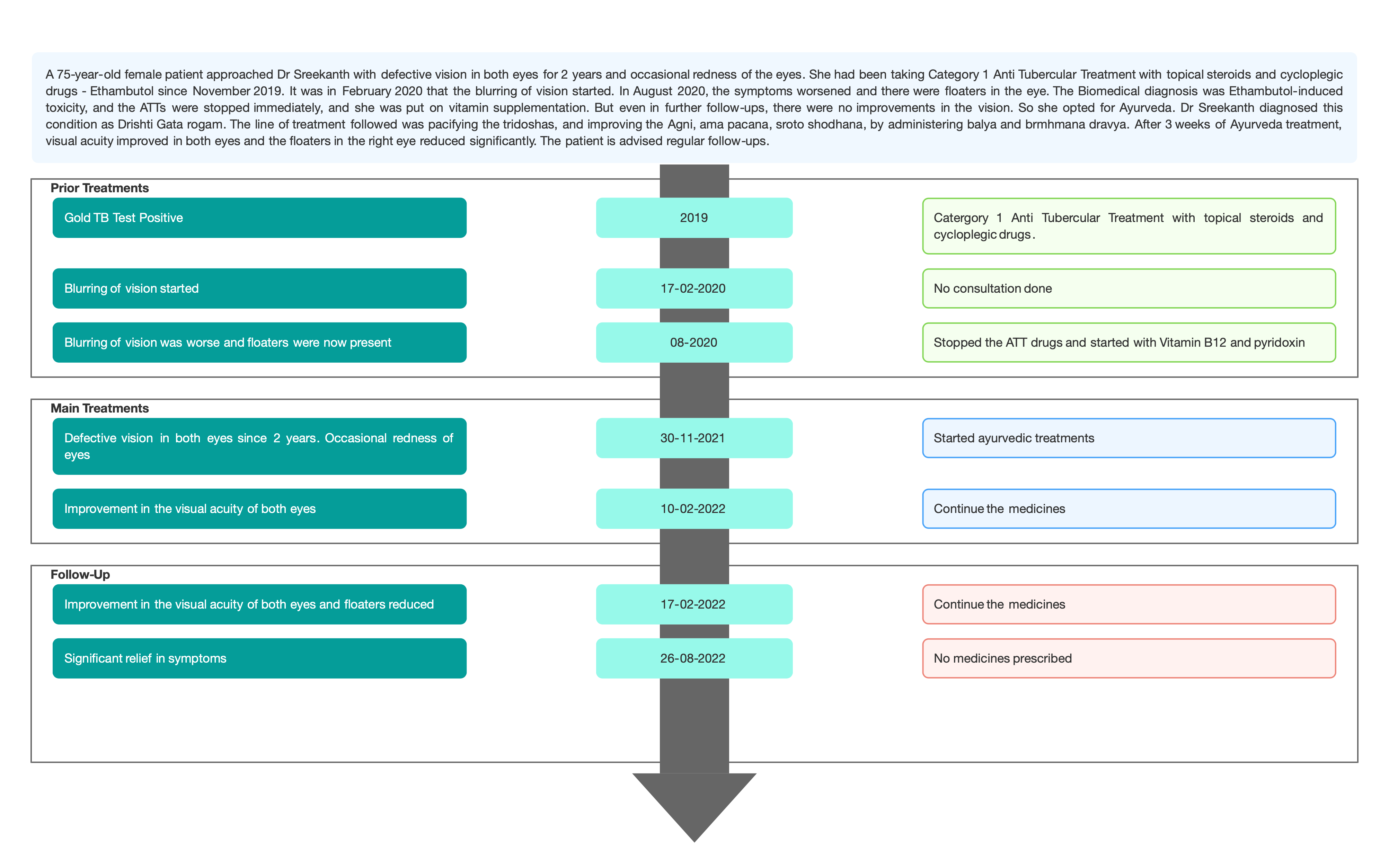
Image 2. Reports dated 2020 added below
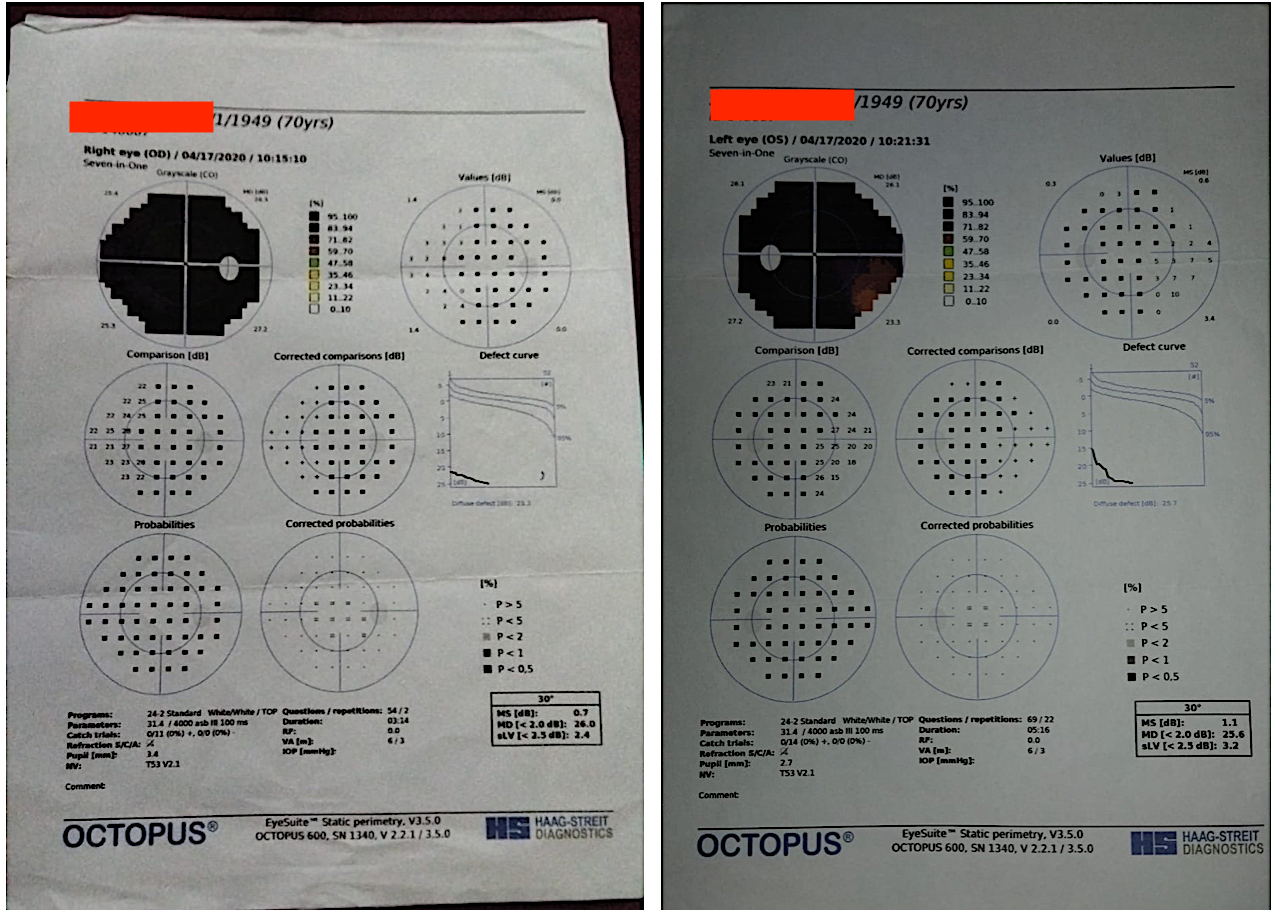
Image 3. The topography reports dated 27.1.2022 during treatment
-
Immersive Learning
-
Modern Diagnosis
MODERN DIAGNOSIS: Ethambutol toxic optic neuropathy
ABOUT THE DISEASE:
Ethambutol (EMB) is an antibiotic used to treat infection by Mycobacterium species, particularly Mycobacterium tuberculosis and non-tubercular infections like M. avium complex and M. kansasii. Unfortunately, one serious and vision-threatening side effect of EMB is ethambutol-induced optic neuropathy (EON). Less common side effects of EMB include peripheral neuropathy, cutaneous reactions, thrombocytopenia, and hepatitis.
Pathogenesis:
Retrobulbar optic neuropathy (normal-appearing optic disc on presentation) is the most common form of EOM. While the exact mechanism of the neurotoxic effect of EMB on the optic nerve is unknown, it is believed that the metal-chelating effects of this drug may be responsible. One theory is that the chelation of copper disrupts oxidative phosphorylation, as there is less copper available in human mitochondria. Another theory is that the chelation of zinc inhibits lysosomal activation. Moreover, in animal studies on rat optic nerves, zinc deficiency has been associated with the destruction of myelin and glial cell proliferation, suggesting that there may be a similar effect in humans. In addition, prolonged EMB use has been shown to be associated with deficiencies in vitamin E and vitamin B1 which may exacerbate optic neuropathy.
Diagnosis: The diagnosis of EON is made clinically with visual acuity, formal perimetry and color vision testing. Fundoscopy is necessary to exclude other aetiologies of visual loss in particular retinal disease. The presence of optic disc oedema or macular pathology would argue strongly against EON. Patients should receive a baseline eye exam prior to initiation of EMB therapy in order to document pre-treatment ocular pathology. Unfortunately unlike other toxic maculopathies (e.g. hydroxychloroquine), there is no pre-toxicity finding in EON for screening. Nevertheless, high-risk patients for EON (e.g., long duration or high dose EMB, renal dysfunction) should have a visual assessment every month and all patients on EMB should have central vision assessment (e.g., visual acuity, Amsler grid) monthly (although this screening does not require a full dilated ophthalmology exam). If vision changes are noticed, the patient should see an ophthalmologist and if there is a suspicion for EON, the treating physician must be contacted in order to make a decision of whether to continue or discontinue EMB therapy.
Image 1. Perimetry reports dated April 2020 are added below (old reports)
Treatment: Currently, there is no effective treatment for EON. However, if the condition is detected early and the drug is discontinued promptly (before the development of irreversible optic atrophy), between 30-64% of patients have been reported to show visual improvements over a course of several months. However, full recovery is rare, and the average improvement is two lines on the Snellen chart. Older patients, especially those over 60 years of age, have been found to have poorer recovery compared to younger patients.
In this case report, the 75-year-old female patient approached Dr Sreekanth with defective vision in both eyes for 2 years and occasional redness of the eyes. She had been taking Category 1 Anti Tubercular Treatment with topical steroids and cycloplegic drugs - Ethambutol since November 2019. It was in February 2020 that the blurring of vision started. In August 2020, the symptoms worsened and there were floaters in the eye. The Biomedical diagnosis was Ethambutol-induced toxicity, and the ATTs were stopped immediately, and she was put on vitamin supplements. But even in further follow-ups, there were no improvements in the vision. So she opted for Ayurveda.
Prognosis: Most patients who discontinue EMB after the onset of visual changes (without optic atrophy) will recover their vision over weeks to months. The presence of optic disc pallor at the onset of visual symptoms is associated with poor prognosis. In this case, there was optic pallor noted in both eyes. Also, due to the patient’s ignorance, she continued ATT drugs 6 more months even after the onset of blurring. With the initiation of Ayurveda treatments, for 3 months, visual acuity improved in both eyes (RE- 3/60, LE- 3/60), and floaters in RE were reduced.
Reference
Ethambutol optic neuropathy by American Academy of Opthalmology. EyeWiki.
-
Ayurveda Diagnosis
AYURVEDA DIAGNOSIS: Drishtigata Rogam
ABOUT THE DISEASE:
Eye diseases are generally referred to as Netra rogas, and diseases affecting vision are generally referred to as Drishti Rogas.
Susruta explains the shape of drishti with the masoor daal (Lens culinaris) i.e. the biconvex shape of the lens, formed by the finest part of the combination of five basic elements and fire spark or glow-worm-like gleaming in texture, filled with the teja, covered with patalas.
Netra rogas are Raktapradoshaja Vikaras. The Vitiated Doshas in the body move to Urdhvajatru i.e, upper parts of body through the sira and gets sthanasanshraya in netra which results in netraroga. In Ayurveda, the treatment modality like Shodhana Cikitsa i.e, detoxification destroys the complete pathophysiology of the disease. There are 12 drishti roga according to Susruta and 27 according to Vaghbhata. This includes diseases like Timira, nakulandhya, vidagdha drishti, dhumadarshi, hrsvajadhya.
The general explanation of Drishti roga are related to the various layers called patala. They are Prathama, dvitiya, Tritiya and Caturtha patala gata roga. Depending on the patala affected by the disease, the symptoms will vary.
This case report is of a 75-year-old female patient who approached Dr Sreekanth with defective vision in both eyes for 2 years and occasional redness of the eyes. This was attributed to her taking the category 1- antituberculosis drug Ethambutol. The medicine was stopped and she tried conventional medicine for 3 months but did not get relief.
Sadhyasadhyata: Depending upon the drishtigata roga, the sadhyasadhyata varies. But in this case report, the specific type is not mentioned. So the prognosis from the theoretical point of view cannot be mentioned, but this is a chronic condition and was not responding to conventional management. So this can be placed under the category of kricchrasadhya.
Rationale of treatment: The targets of medicines prescribed for treatment are as follows: Amrtottaram Kwatha- Ama Pachana and Sroto Sodhana; ensuring normal digestion to facilitate delivery of proper rasadhatu and nutrients to the eyes and nerves
Bharngyadi Kvatha- Dipana and Pacana karma ensuring a return to normal digestion to facilitate delivery of proper rasadhatu and nutrients to the eyes and nerves.
Trikatu with lime juice, Cough mix, and Fever mix- These medicines were prescribed to alleviate mild fever and cough-like symptoms that the patient developed early in the treatment.
Varanadi Kvatha, Punarnavadi Kvatha- Abolishing the Avarana of Kapha and Vata; re-instigating Vyana Vata to ensure supply of nutrition to the nerve, further enhancing Jatharagni to ensure delivery of properly formed rasadhatu to the eyes and nerves.
Dhanadarasnadi Kvatha- Enhancing the activity of Vyana Vata in the nerves and delivery of essential nutrients and vascular supply to the optic nerve and eyes
Drakshadi Kvatha- Balancing Vata and Pitta in the eyes, enhancing vision and restore neuronal activity
Guggulu Pancapala Tablet- Addressing the Avarana of Kapha and Vata and enabling nutrition to reach the nerves by its Sroto shodhana property
AsvagandhaTablet- Enhancing the supply and activity of the nerves and eyes by its Balya and Brmhana property
Sudarsana Gutika- Enhancing the Jatharagni, cleansing the srotas, enabling delivery of nutrients and enhancing function to the eyes and nerves.
Patoladi Ghrta- Enhancing vision and strengthening the retina and nerves by its Pitta-Kapha Samana and Sroto shodhana properties.
Agastya Haritaki- -Enhancing nervous supply and nutrition by its Balya and Brmhana properties.
Reference
- Susruta Samhita. Uttara tantra. 7th Chapter and 17th Chapter.
-
Treatment
Name of Medicine Dosage Form Dosage Mode of Administrtation From - To (Date) Medicine Reference Amruthotharam Kasayam Kasayam 15 ml Kasayam (mixed) with 45 ml warm water Oral, before breakfast and dinner 2022-09-30 - 2022-11-30 Sahasrayogam, Kashaya Prakaranam Amruthotharam Kasayam + Varanadi Kasaya Kasayam 7.5 ml of each Kasayam (mixed) with 45 ml warm water Oral, before breakfast and dinner 2022-02-18 - 2022-03-18 Sahasrayogam, Kashaya Prakaranam Punarnavadi Kasayam Kasayam 7.5 ml of each Kasayam (mixed) with 45 ml warm water Oral, before breakfast and dinner 2022-01-27 - 2022-01-29 Sahasrayogam, Kashaya Prakaranam Drakshadi Kasaya Kasayam 15 ml of Kasayam (mixed) with 45 ml warm water Oral, before breakfast and dinner 2022-01-27 - 2022-01-29 Sahasrayogam, Kashaya Prakaranam Tab Guggulu panchapala Tablet 15 ml Kasayam (mixed) with 45 ml warm water 1-0-1, with warm water 2022-10-30 - 2022-11-30 Patent & Proprietary Medicine Tab Guggulu panchapala Tablet 15 ml Kasayam (mixed) with 45 ml warm water 1-0-1, with warm water 2022-01-27 - 2022-02-17 Patent & Proprietary Medicine Sudarshana gulika Gulika 1-0-1 With warm water after breakfast and dinner 2022-02-18 - 2022-03-18 Proprietary Medicine Sudarshana gulika Gulika 1-0-1 With warm water after breakfast and dinner 2022-01-27 - 2022-02-17 Proprietary Medicine Netramritham Eye Drops One drop In each eye, twice a day 2022-10-30 - 2022-11-30 Patent & Proprietary Medicine Netramritham Eye Drops One drop In each eye, twice a day 2022-08-26 - 2022-09-26 Patent & Proprietary Medicine Netramritham Eye Drops One drop In each eye, twice a day 2022-01-26 - 2022-01-30 Patent & Proprietary Medicine Netramritham Eye Drops One drop In each eye, twice a day 2022-02-06 - 2022-02-17 Patent & Proprietary Medicine Dhanwantaram Tailam Tailam 10 ml Picu applied on the thoracic spine 2022-01-29 - 2022-01-31 Sahasrayogam. Taila Prakarana: AH.Ci. 21.58 Kasyapam Kasayam Kasayam 100 ml Seka over the eyelids, for 5 minutes 2022-01-27 - 2022-01-30 Patent & Proprietary Medicine Kasyapam Kasayam Kasayam 100 ml Seka over the eyelids, for 5 minutes 2022-02-06 - 2022-02-09 Patent & Proprietary Medicine Ksheerabala 21 Tailam 5 drops Applied over the eyelids with a gentle massage 2022-01-27 - 2022-01-30 Anubhuta Yogam Bala+ Vidari+ Kachooradi in Triphala Kasaya + Nimbamruthadi Eranda Tailam Veshtana dravya Bala+ Vidari+ Kachooradi mixed 45g in Triphala Kasaya (600 ml )+ Nimbamruthadi Eranda Tailam (10 ml) Siroveshtana is done 2022-01-28 - 2022-01-30 Anubhuta Dravya Prayoga Ksheerabala 21 Tailam 3 drops Nasya 2022-01-07 - 2022-02-12 Anubhuta Yogam Ksheerabala 21 Tailam 3 drops Nasya 2022-01-07 - 2022-02-12 Anubhuta Yogam Dhanadarasnadi Kasayam Kasayam 15 ml Kasayam (mixed) with 45 ml warm water On empty stomach, twice daily before food 2022-01-30 - 2022-01-31 Patent & Proprietary Medicine Dhanadarasnadi Kasayam Kasayam 15 ml Kasayam (mixed) with 45 ml warm water On empty stomach, twice daily before food 2022-08-26 - 2022-09-26 Patent & Proprietary Medicine Aswagandha Tablet Tablet 1-0-1 With warm water after breakfast and dinner 2022-08-26 - 2022-09-26 Patent & Proprietary Medicine Coughmix Powder 90 gms With warm water 2022-01-30 - 2022-01-30 Patent & Proprietary Medicine Fever mix Powder 10 gms With warm water 2022-01-30 - 2022-01-30 Patent & Proprietary Medicine Bharangyadi Kasayam Kasayam 15 ml of Kasayam (mixed) with 45 ml warm water At 6 am, 10 am and 4 pm 2022-01-26 - 2022-01-26 Sahasrayogam, Kashaya Prakaranam Agastya Rasayanam Lehyam 5 gms After breakfast and dinner 2022-02-10 - 2022-02-16 AH. Ci. 3.127- 132 Triphala Ghritam+ Jataveda Ghritam Ghrtam Both ghrta together 5 drops Ashcyotanam followed by Bandhanam 2022-02-10 - 2022-02-16 Triphala ghrita- Bhaishajya Ratnavali Netraroga adhikara 181-186. Jataveda Ghrita- Patent & Proprietary Medicine -
Outcome Measures
OUTCOME MEASURES:
A 75-year-old female patient approached Dr Sreekanth with defective vision in both eyes for 2 years and occasional redness of the eyes. She had been taking Category 1 Anti Tubercular Treatment with topical steroids and cycloplegic drugs – Ethambutol (EMB) since November 2019. It was in February 2020 that the blurring of vision started. In August 2020, the symptoms worsened and there were floaters in the eye. The Biomedical diagnosis was Ethambutol-induced toxicity, and the ATTs were stopped immediately, and she was put on vitamin supplements. But even in further follow-ups, there were no improvements in the vision. So she opted for Ayurveda. Dr Sreekanth diagnosed this condition as Drishti gata rogam. The line of treatment followed was pacifying the tridoshas, and improving the agni, ama pacana, sroto shodhana, by administering balya and brmhmana dravya.
Subjective parameters: As on 26/6/2022:
The patient is able to read big letters and write a complete sentence correctly within a line. Colour vision has improved
Floater- Now only one black spot is present.
Redness - No another episode of redness in the eyes.
Patient feels more confident to carry out day-to-day now activities.
After 3 weeks of ayurveda treatment, visual acuity improved in both eyes (RE- 3/60, LE- 3/60), floaters in RE reduced.
Objective parameters:
The topography reports dated 27.1.2022 during treatment are added below
-