Featured Case
-
Abstract
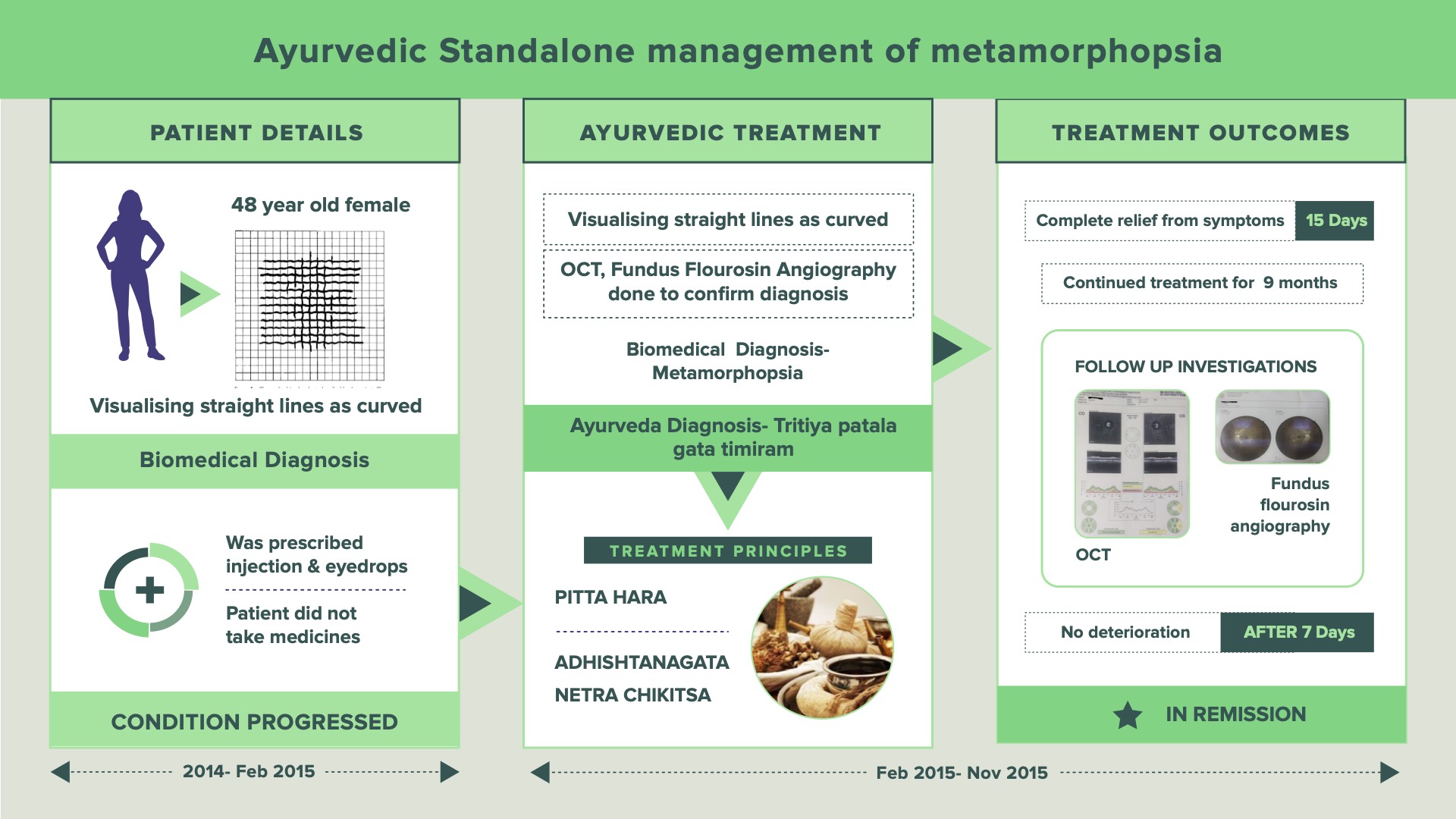
A 42-year-old female patient, an Ayurvedic Doctor by profession presented with visualizing straight lines/objects as curves (metamorphopsia). She consulted an ophthalmologist who diagnosed the clinical condition as ARMD (age-related macular degeneration) which is unique considering the patient’s age. The patient refused to take the injections and drops prescribed by the ophthalmologist. After 1 year, when the symptoms worsened, she consulted Dr Sreevidhya Unni who diagnosed it as Tritiya patala gata timiram (ie pittaja kacam), which is kricchrasadhya. The line of treatment followed was pittahara and adhishtanagata netra cikitsa to address the symptoms of Drishti vihvalata. After 15 days of Ayurvedic treatments, almost all the symptoms disappeared. But the treatments were continued. Inpatient treatments were done in March- April and November-December 2021. Last followed up, the patient is completely free from symptoms and even after 7 years, the latest OCT, perimetry and fundus fluorosin angiography showed a significant improvement and there is no deterioration. Even after stopping all Ayurvedic medicines in 2015, the latest OCT, fundus flourosin angiography and perimetry done in 2022 show no deterioration. The patient is in remission.
-
Summaries
-
Listen
-
Watch
-
View
-
Read
A 42-year-old female patient, an Ayurvedic Doctor by profession presented with visualizing straight lines/objects as curves (metamorphopsia). She consulted an ophthalmologist who diagnosed the clinical condition as ARMD (age-related macular degeneration) which is unique considering the patient’s age. The patient refused to take the injections and drops prescribed by the ophthalmologist. After 1 year, when the symptoms worsened, she consulted Dr Sreevidhya Unni who diagnosed it as Tritiya patala gata timiram (ie pittaja kacam), which is kricchrasadhya. The line of treatment followed was pittahara and adhishtanagata netra cikitsa to address the symptoms of Drishti vihvalata. After 15 days of Ayurvedic treatments, almost all the symptoms disappeared. But the treatments were continued. Inpatient treatments were done in March- April and November-December 2021. Last followed up, the patient is completely free from symptoms and even after 7 years, the latest OCT, perimetry and fundus fluorosin angiography showed a significant improvement and there is no deterioration. Even after stopping all Ayurvedic medicines in 2015, the latest OCT, fundus flourosin angiography and perimetry done in 2022 show no deterioration. The patient is in remission.
-
-
Timeline
-
Tabulated Summary
-
Narrative
TITLE OF CASE
Standalone successful ayurvedic management of Metamorphopsia- A Case report
Dr Sreevidya Unnikrishnan
ABSTRACT
A 42-year-old female patient, an Ayurvedic Doctor by profession presented with visualizing straight lines/objects as curves (metamorphopsia). She consulted an ophthalmologist who diagnosed the clinical condition as ARMD (age-related macular degeneration) which is unique considering the patient’s age. The patient refused to take the injections and drops prescribed by the ophthalmologist. After 1 year, when the symptoms worsened, she consulted Dr Sreevidya who diagnosed it as Tritiya patala gata timiram (ie pittaja kacam), which is kricchrasadhya. The line of treatment followed was pittahara and adhishtanagata netra cikitsa to address the symptoms of Drishti vihvalata. After 15 days of Ayurvedic treatments, almost all the symptoms disappeared. But the treatments were continued. Inpatient treatments were done in March- April and November-December 2021. The patient is completely free from symptoms and even after 7 years, the latest OCT, perimetry and fundus fluorosis angiography showed a significant improvement and that there is no deterioration. Even after stopping all Ayurvedic medicines in 2015, the latest OCT, fundus flourosin angiography and perimetry done in 2022 show no deterioration. The patient is in remission.
KEYWORDS
Standalone, metamorphopsia, age-related macular degeneration, Tritiya patala gata timiram
INTRODUCTION
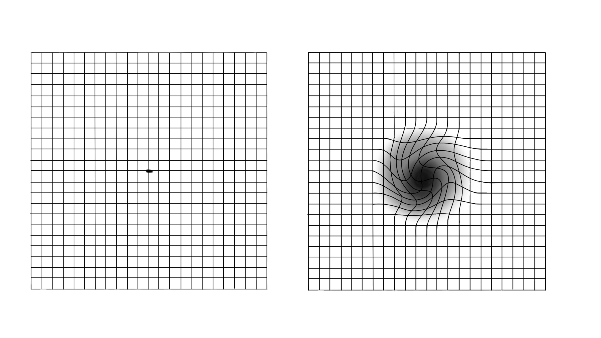
Metamorphopsia is a clinical condition where straight lines are visualised as curved images. This is commonly associated with vitreomacular interface disorders (epiretinal membrane) and has also regularly been noted in diseases of the retina and choroid, particularly age-related macular degeneration and central serous chorioretinopathy.
Diagnostics & Assessment criteria; Diagnosis is basically done by clinical evaluation. An assessment is done by using different imaging technologies. Developments in optical coherence tomography retinal imaging have enabled improved imaging of the foveal microstructure. They have led to the localisation of the pathophysiology of metamorphopsia within the retinal layers of the macula. Alteration of inner and outer retinal layers at various retinal loci has been identified using multimodal imaging in patients with metamorphopsia in a range of conditions. Although the Amsler Grid assessment of metamorphopsia is a useful clinical indicator, new emerging methods of metamorphopsia assessment with psychophysical tests such as M-CHARTS and preferential hyperacuity perimetry have been developed.
Macular degeneration is a major cause of vision impairment among elderly people. Although its underlying cause is unknown, it sometimes appears to run in families.
Prognosis & Treatment; Normally there is an underlying cause for metamorphopsia. The treatment targets at addressing the cause. When the cause is brought under control, then mostly there can be a change in the clinical presentation also.
PATIENT INFORMATION
A 42-year-old female patient, an Ayurvedic Doctor by profession presented with visualizing straight lines/objects as curves (metamorphopsia).
Medical History: When the complaints of visualising straight lines as curved started in 2014, she had consulted Dr Leila (Ophthalmologist). The tests were done after eye dilation, as she suspected glaucoma, and underwent a field test which was normal. The patient recollected that in the earlier investigations, there were no degenerative changes.
The modern diagnosis made was Macular oedema right eye with degenerative changes. (Comtrust Hospital Kozhikode 2014)- (In the patient's words) Perimetry reports dated 2014 were submitted. She was prescribed injections and eye drops, but she was unwilling. One year passed by and her condition progressed. She chose to take Ayurvedic treatment and in 2015 consulted Dr Sreevidhya.
History- The patient has been myopic since childhood. She has had a history of sneezing since a very young age but did not know the reason. It is only a year ago, she realised that the non-vegetarian food she was frequently consuming was causing the allergic reaction. With the sudden shift in diet from non-vegetarian to vegetarian and being lazy to prepare vegetarian food, she stuck to just daal with no vegetables. This probably led to her weight loss. In her words, she lost 9 kgs in the past 1 year (2014-15). She had knee pain on exertion, which subsided after a Calcium supplement. She had tried an oil application for her knee pain but did not get any relief. Only by taking the Calcium supplement, she got relief. The patient feels she is malnourished.
CLINICAL FINDINGS/PHYSICAL EXAMINATION
None documented.
TIMELINE
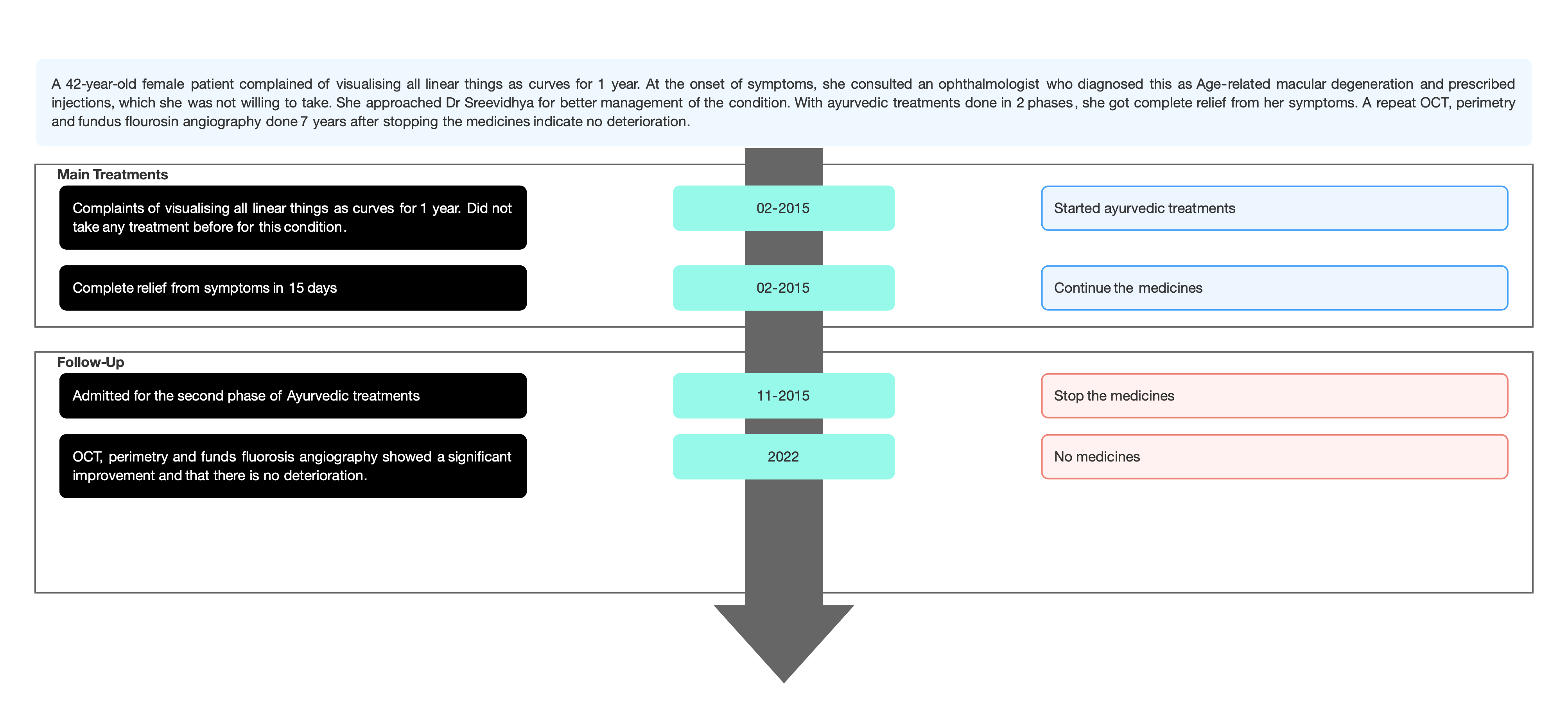
Image 1. Timeline of events to be added
DIAGNOSTIC ASSESSMENT
Modern Diagnostic parameter: The biomedical diagnosis of Metamorphopsia was given by Dr Sreevidya based on the presenting complaints and the tests done.
Image 2. Baseline images dated 2014 are added below
Ayurvedic Assessment was done based on the investigation reports and the clinical evaluation by the ayurvedic physician.
Differential Diagnosis- The diagnosis was confirmed with clinical presentation and imaging.
Prognosis- Treatment for Age-related macular degeneration (AMD/ARMD) depends on the stage and type. There is currently no treatment for early ARMD, in intermediate AMD in 1 or both eyes, special dietary supplements (vitamins and minerals) may be able to stop it from turning into late ARMD. If you have late AMD in only 1 eye, these supplements may slow down AMD in your other eye. This patient presented with metamorphosia which indicates late ARMD as was diagnosed earlier, present in both eyes. This could cause vision loss, but with Ayurvedic OP treatment and 2 IP treatments in 2015, she got complete relief from her symptoms. In 2022, a repeat OCT, perimetry and fundus flourosin angiography indicates no deterioration. The patient is free from symptoms.
THERAPEUTIC INTERVENTION
See the tab ‘Treatment details’
FOLLOW-UP AND OUTCOMES
Clinician-based assessment; After 15 days of Ayurvedic treatments, almost all the symptoms disappeared. But the treatments were continued. After November 2015, all the medicines were stopped. The patient is completely free from symptoms and even after 7 years, the latest OCT, perimetry and fundus fluorosin angiography showed a significant improvement and that there is no deterioration.
Patient-assessed: Not relevant.
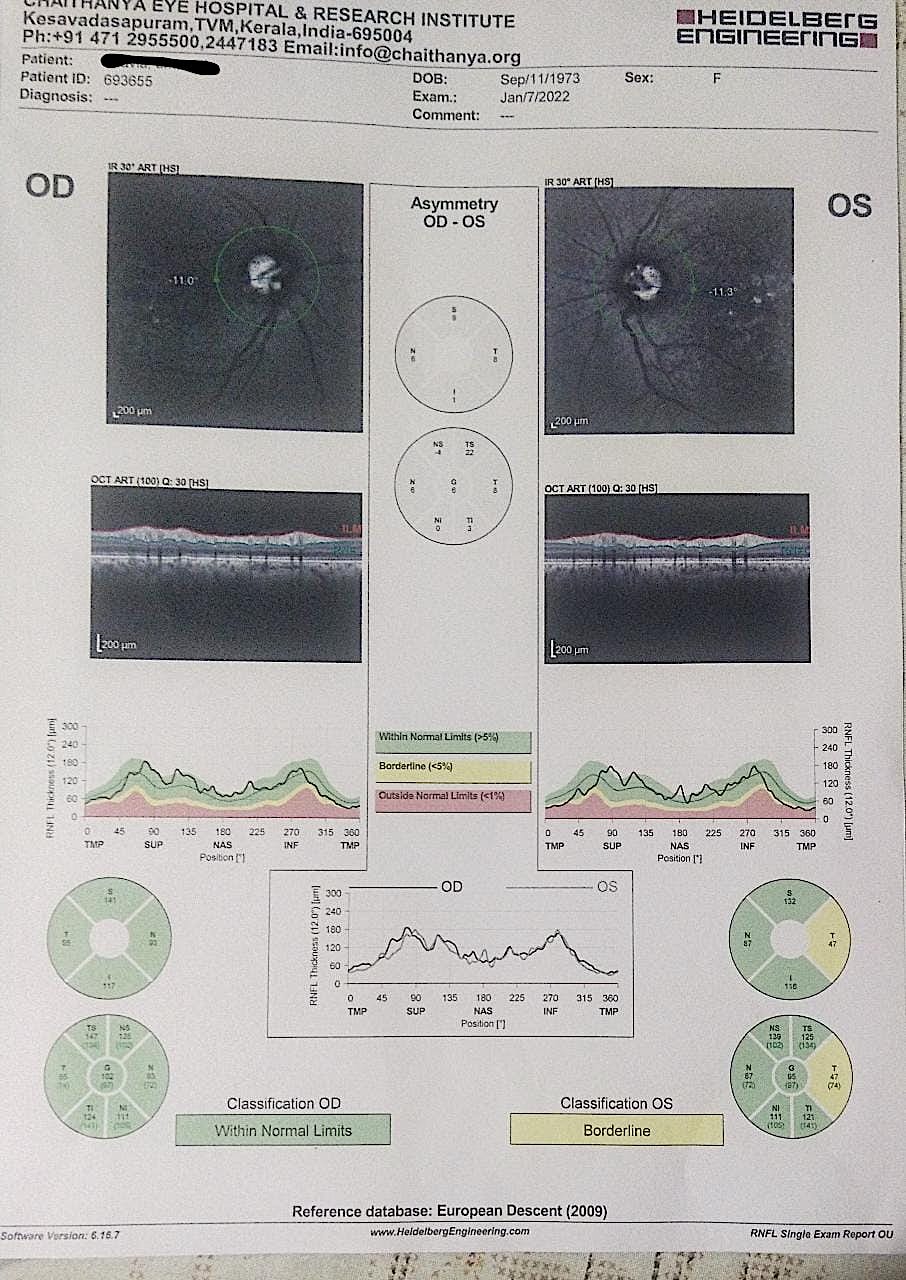
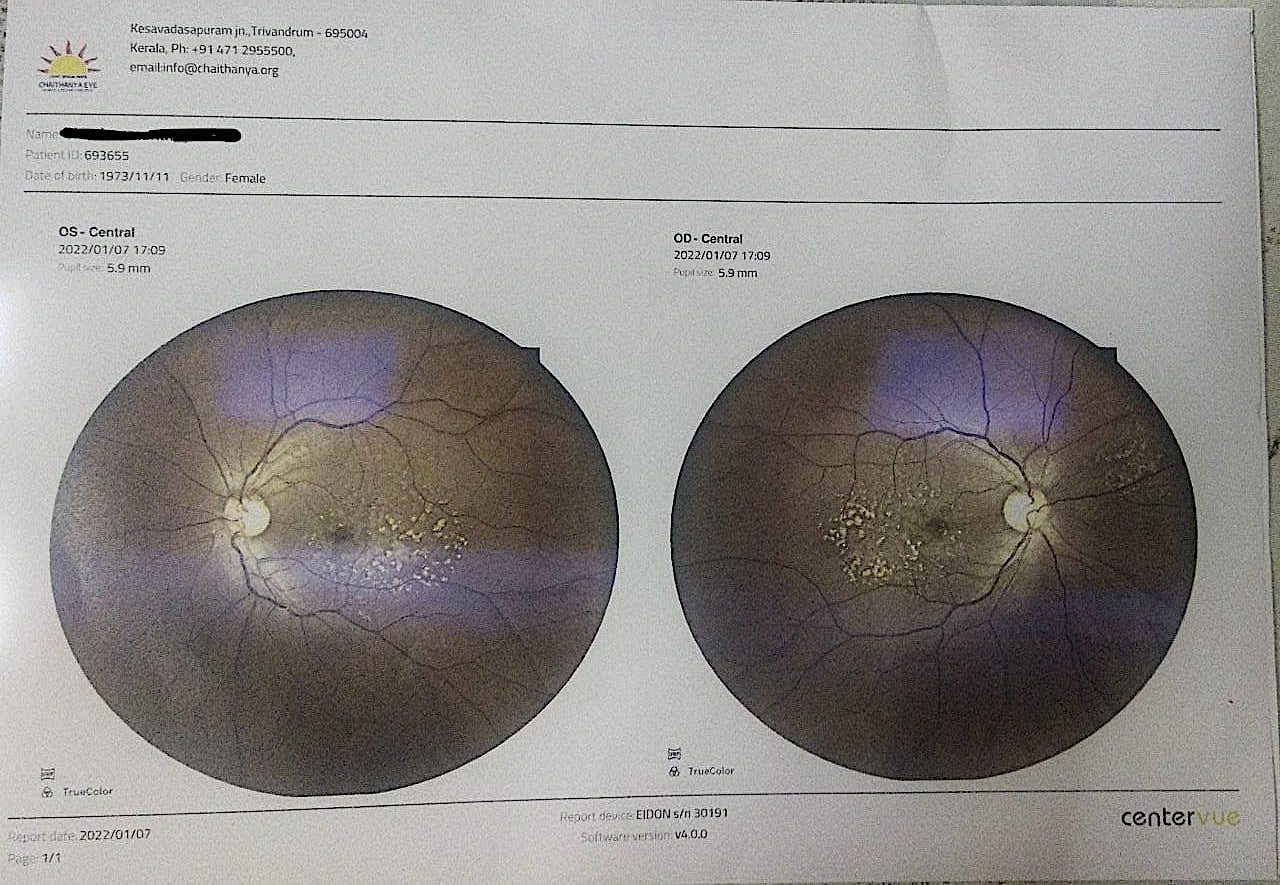
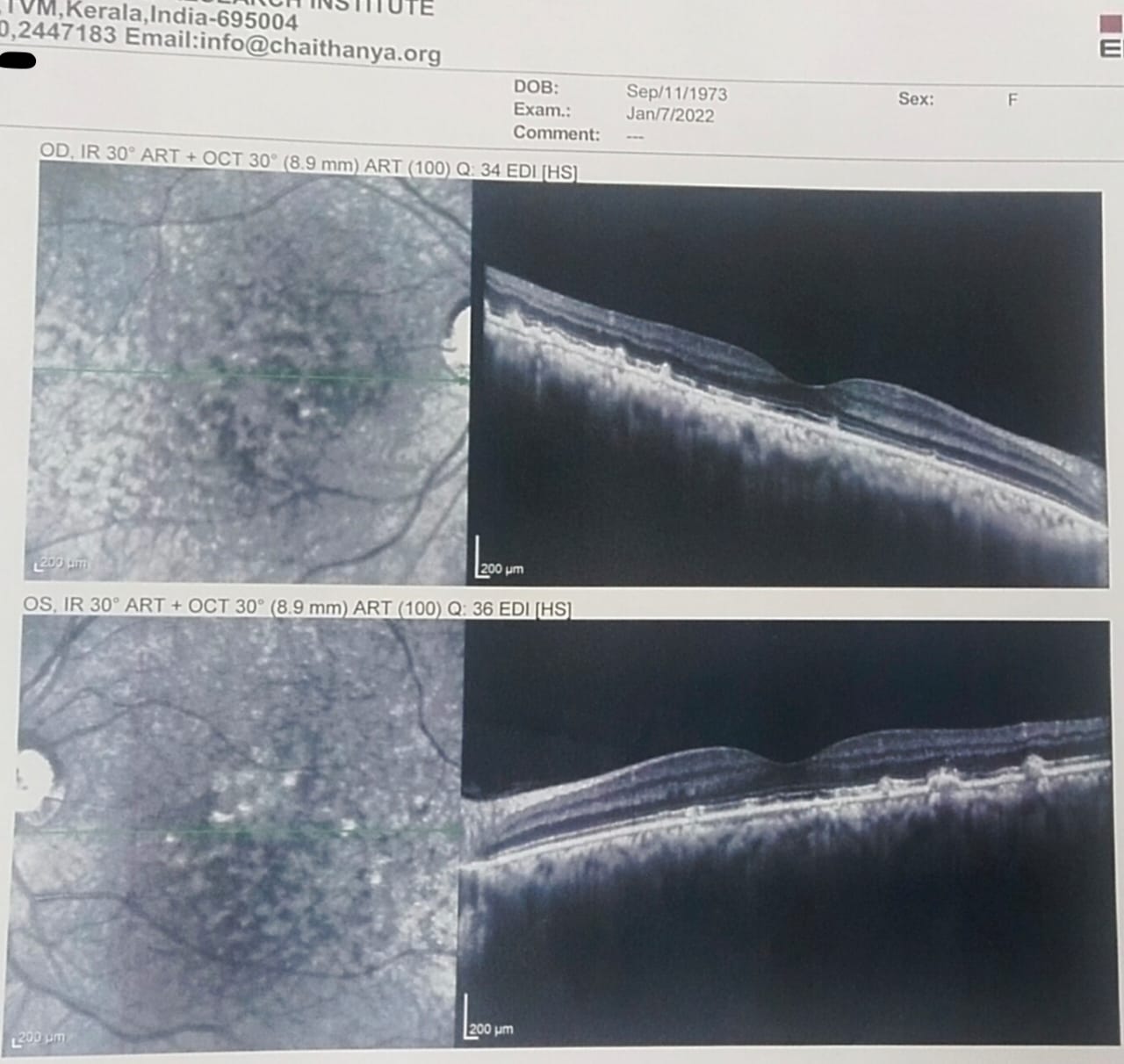
Image 3. Images taken after 7 years of stopping medicines added below.
Intervention adherence and tolerability – The patient adhered to the prescribed treatments and tolerated the treatments well.
Method of assessment- By monitoring the patient and imaging.
Adverse and unanticipated events; None reported.
DISCUSSION ;
In this case report- a drishti vihvalata (ie) vakradrishti (ie) is present indicating an absence of the normal visual perception. Such symptoms are classical presentations of Tritiya patalashrita gata timiram. This can also be called as Kaca- pittaja kaca. This is a kricchrasadhya vyadhi according to our Acaryas. So pittahara and adhishtanagata netra cikitsa were adopted.
PATIENT’S PERSPECTIVE
Not available.
LEARNING POINTS/TAKE-HOME MESSAGES
The 42-year-old female patient was diagnosed with Age-related macular oedema and prescribed injections, which she was unwilling to take and opted for Ayurveda. The patient’s symptom was visualising straight lines as curves. With Ayurvedic treatment, she got relief from her symptoms and has not taken any medicines since 2015. The OCT, perimetry and fundus fluorosin angiography done in 2022 after seven years of Ayurvedic treatment shows a significant improvement, and there is no deterioration.
INFORMED CONSENT
Written consent was obtained from the patient to publish the case report.
CONFLICT OF INTEREST
None declared.
FUNDING
None
REFERENCE
- Hanumunthadu D, Lescrauwaet B, Jaffe M, Sadda S, Wiecek E, Hubschman JP, Patel PJ. Clinical Update on Metamorphopsia: Epidemiology, Diagnosis and Imaging. Curr Eye Res. 2021 Dec;46(12):1777-1791.)
- Netra patala Vivechana- A scientific insight; Pasha SM. Indian Journal of Applied Research. Vo.9; Iss.4.2019
Image 1. Timeline of events
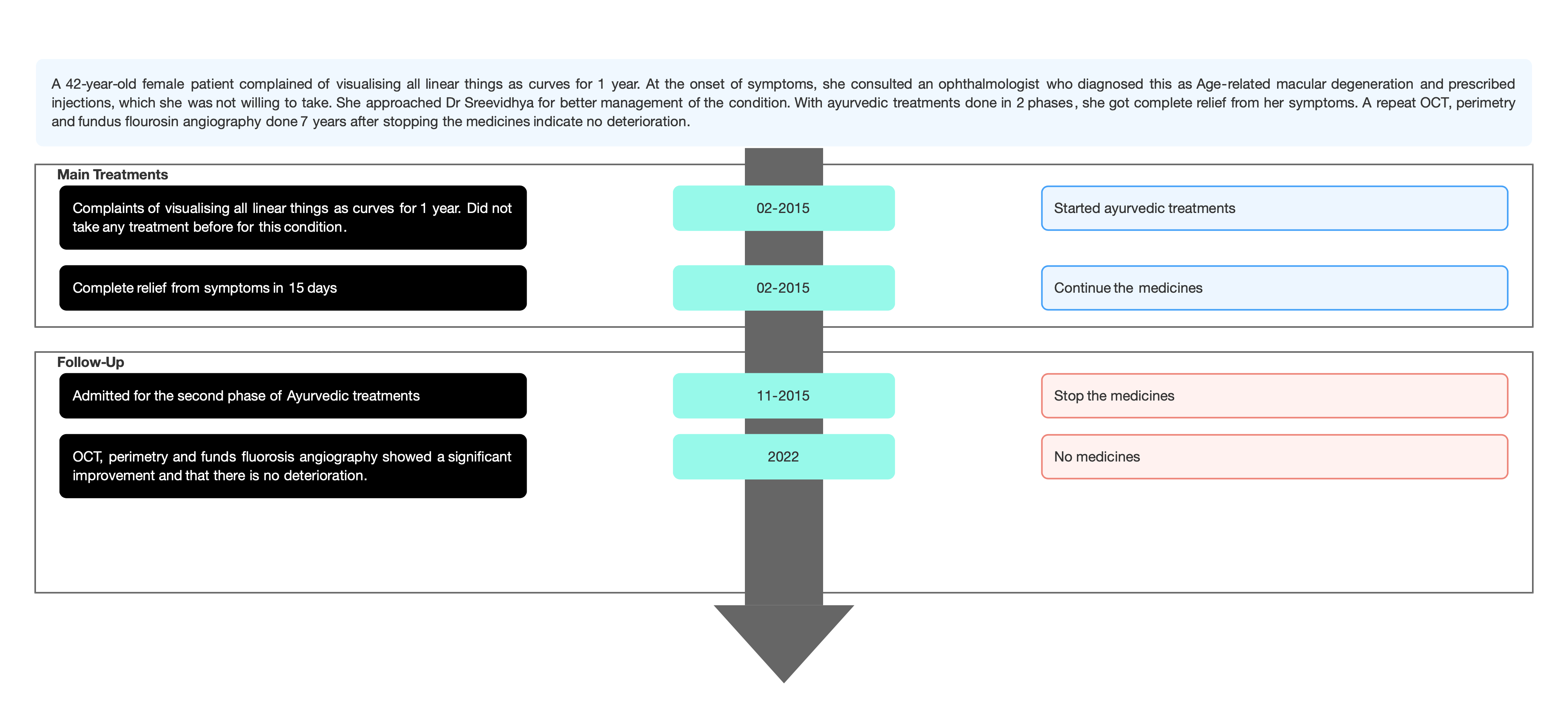
Image 2. Baseline images dated 2014 are added below
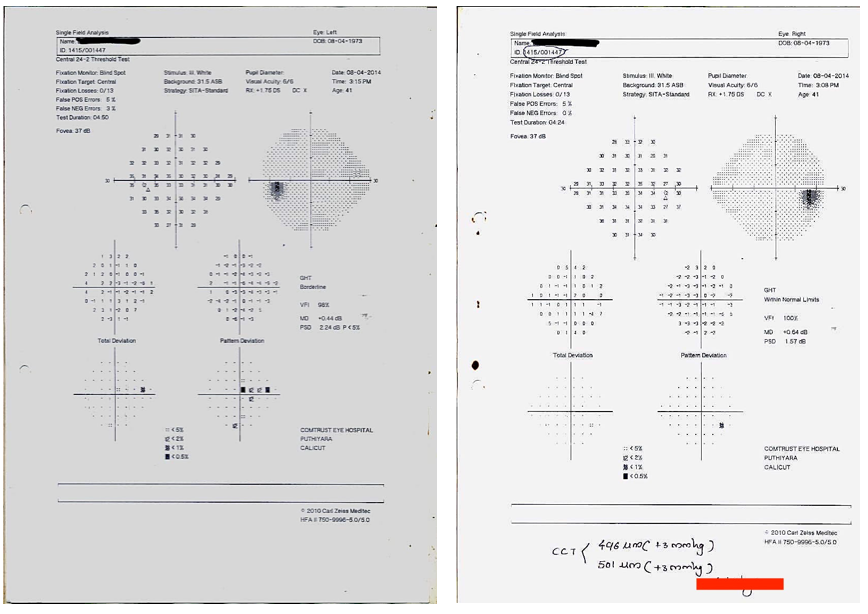
Image 3. Images were taken after 7 years of stopping medicines dated 2022
-
Immersive Learning
-
Modern Diagnosis
BIOMEDICAL DIAGNOSIS:; METAMORPHOPSIA
ABOUT THE DISEASE
Metamorphopsia is a clinical condition where straight lines are visualised as curved images. This is commonly associated with vitreomacular interface disorders (epiretinal membrane) and has also regularly been noted in diseases of the retina and choroid, particularly age-related macular degeneration and central serous chorioretinopathy.
Diagnostics & Assessment criteria; Diagnosis is basically done by clinical evaluation. An assessment is done by using different imaging technologies. Developments in optical coherence tomography retinal imaging have enabled improved imaging of the foveal microstructure. They have led to the localisation of the pathophysiology of metamorphopsia within the retinal layers of the macula. Alteration of inner and outer retinal layers at various retinal loci has been identified using multimodal imaging in patients with metamorphopsia in a range of conditions. Although the Amsler Grid assessment of metamorphopsia is a useful clinical indicator, new emerging methods of metamorphopsia assessment with psychophysical tests such as M-CHARTS and preferential hyperacuity perimetry have been developed. (Hanumunthadu D, Lescrauwaet B, Jaffe M, Sadda S, Wiecek E, Hubschman JP, Patel PJ. Clinical Update on Metamorphopsia: Epidemiology, Diagnosis and Imaging. Curr Eye Res. 2021 Dec;46(12):1777-1791.)
In this case report, the patient presented with symptoms that were diagnosed as Metamorphopsia. She was earlier diagnosed with Macular oedema- Right eye with degenerative changes by an ophthalmologist. (In the patient’s words)
Macular degeneration is a major cause of vision impairment among elderly people. Although its underlying cause is unknown, it sometimes appears to run in families.
In this patient, the presentation of metamorphopsia could have been caused by Macular degeneration but is a rare presentation because normally this is seen in elderly people. The Ayurvedic doctor made a provisional biomedical diagnosis of Metamorphopsia based on the clinical evaluation.
Prognosis & Treatment; Normally there is an underlying cause for metamorphopsia. The treatment targets at addressing the cause. When the cause is brought under control, then mostly there can be a change in the clinical presentation also.
Image 1. Perimetry reports dated 2014 added below
Image 2. Fundus flourosin angiography dated 18.2.2015 added below
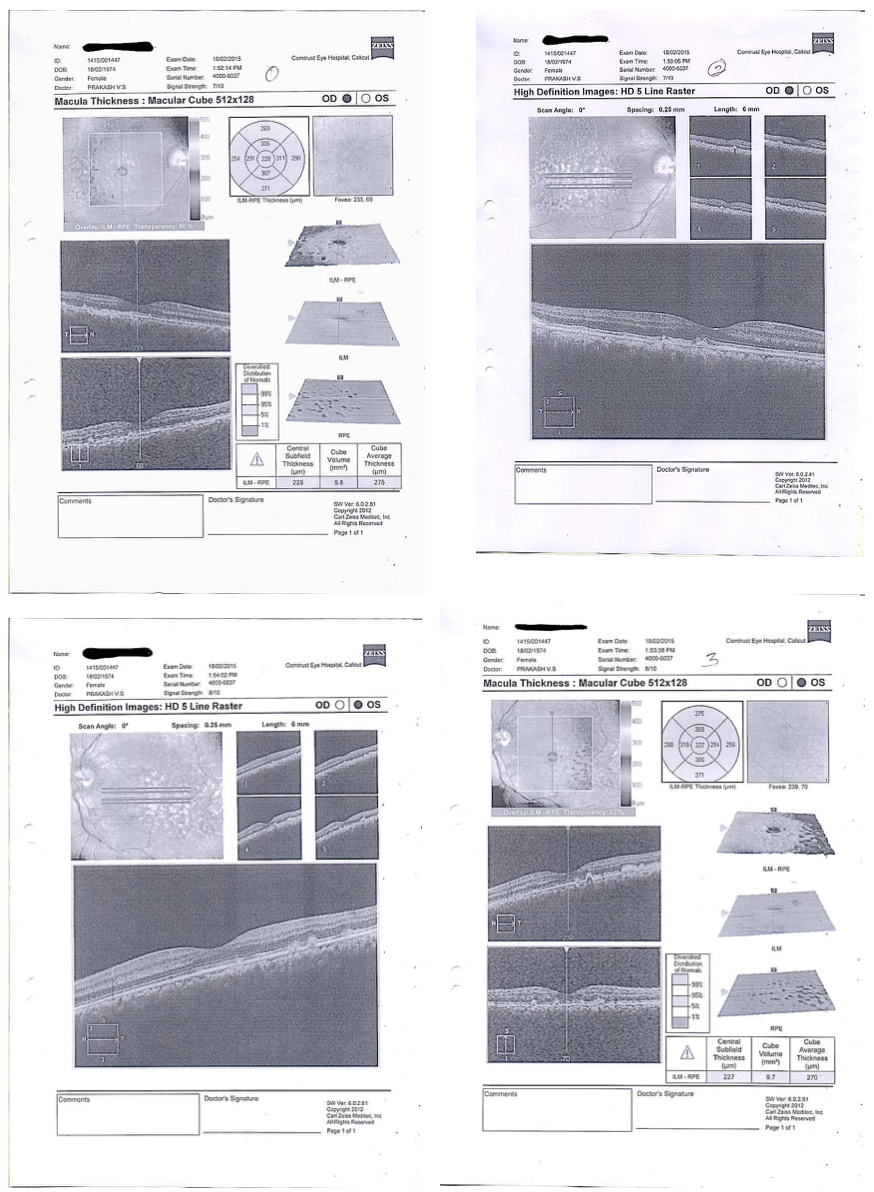
Image 3. OCT Images dated 18.2.2015 added below
Summary of the Investigation findings:
1. Pigment epithelial disruptions
2. Soft/ hard drusens
3. Central macular thickness normal
4. HFA field analysis - no field constriction
Image 1. Perimetry reports dated 2014
Image 2. Fundus flourosin angiography dated 18.2.2015
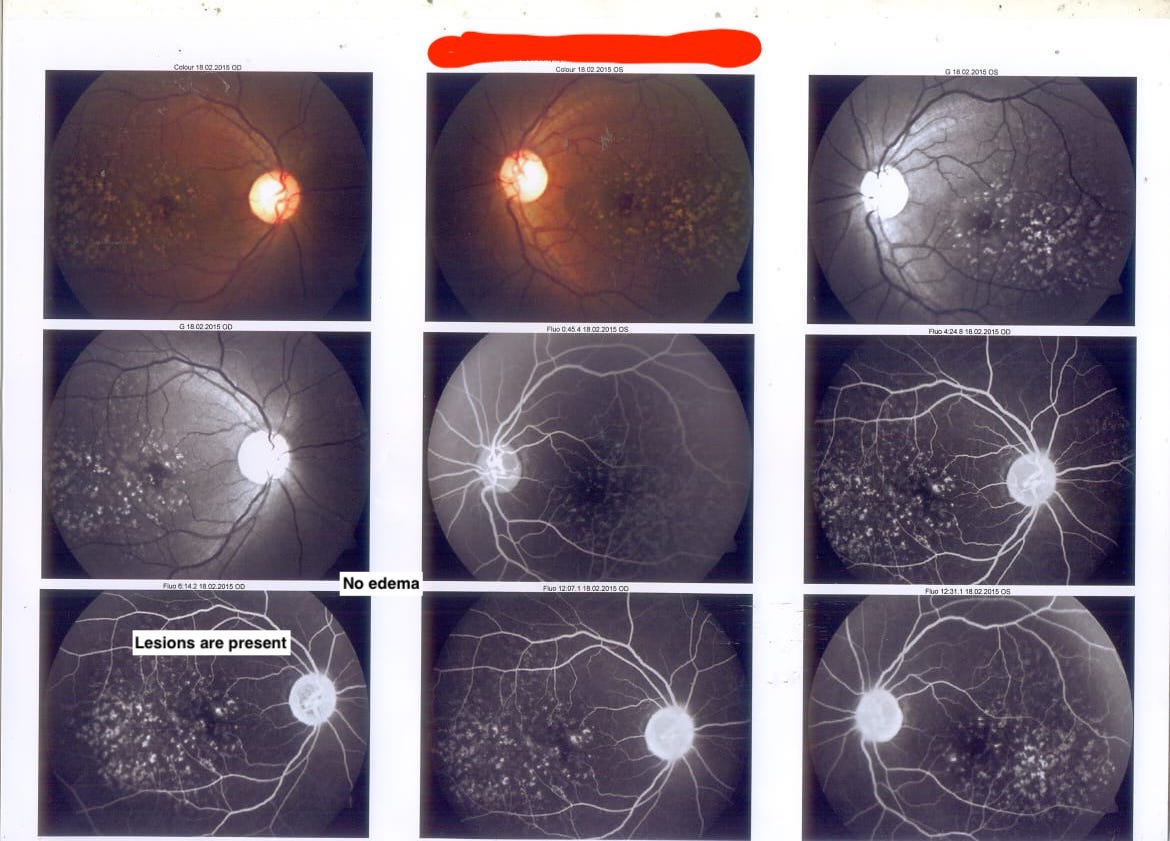
Image 3. OCT Images dated 18.2.2015
-
Ayurveda Diagnosis
AYURVEDA DIAGNOSIS: TRITIYA PAtALA GATA TIMIRAM
ABOUT THE DISEASE;
The word “PATALA”- “avritta patalena akshaṇo” – literally patala is understood as a thin layer/membrane-like structure covering the Drishti bhaga which is arranged in concentric layers.
“drishti” itself means “The act of vision‟. Functionally it may be considered as all refractive media of the eye, retina and the whole visual pathway. So, the diseases in which pathology is found in the visual pathway beyond the cornea come under Patalagata Rogas.
Among these diseases, Timira (derived from the word meaning ‘darkness’) involving the patalas – layers of the eye is considered to be the most important & serious as far as its prognosis and treatment are concerned. This is a ‘yapya’ vyadhi and timira is a disease of the anterior & posterior segments of the eye in which vision is hampered. If it is not treated in time it leads to Kaca & then Liṅganasha i.e. total blindness which simulates refractive errors, presbyopia, very early lenticular hydration, vitreous pathologies & diseases of the retina. Timira is a drishtigata roga which occurs in the inner four patalas of the eye. Tritiyagata Patala or Medo ashrita Patala can be taken as Vitreous humour, as vitreous is a jelly-like structure which resembles fat.
As netra is a pancabhautika entity and regulated by tridosha, saptadhatu and mala, the treatment of ocular disorders is in no way different from systemic disorders, except that kriyakalpas will be used. (Netra patala Vivechana- A scientific insight; Pasha SM. Indian Journal of Applied Research. Vo.9; Iss.4.2019)
This patient presented with visualising straight lines as curved for 1 year. She had a pre-diagnosis of Age-related Macular Degeneration but did not take any conventional medicines for the same. Depending on the clinical symptoms, the Ayurvedic physician diagnosed the condition as Tritiya patala gata timira and the treatment was given.
Treatment principles and the rationale of treatment of the physician; Virechana, Nasya and Basti are suggested as the appropriate choice of treatments (Vidwansa. (2015).pp.225-226. Netraroga Vidnyana: A textbook of Ayurvedic ophthalmology-Shalakya Vol-1. (1st ed.). Prakash Mudranalaya.)
In this case report- a drishti vihvalata (ie) vakradrishti (ie) was present, indicating that the normal visual perception is absent. Such symptoms are classical presentations of Tritiya patalashrita gata timiram. This can be considered as Kaca also- pittaja kaca. This is a kricchrasadhya vyadhi according to our Acaryas. So pittahara and adhishtanagata netra cikitsa were adopted.
-
Treatment
Name of Medicine Dosage Form Dosage Mode of Administrtation From - To (Date) Medicine Reference Tiktaka Ghritam Ghritam 20 gms Snehapanam- Empty stomach early morning 2021-02-21 - 2021-02-25 AH. Ci.19 Avipatthi curnam Curnam 20 gms Virecanam, On empty stomach, early morning 2015-02-25 - 2015-02-25 Sahasrayogam, Curna prakarana Avipatthi curnam Curnam 1 tsp With warm water, HS 2015-02-26 - 2015-03-04 Sahasrayogam, Curna prakara?a Avipatthi curnam Curnam 20 gms Virecanam, On empty stomach, early morning 2015-11-07 - 2015-11-07 Sahasrayogam, Curna prakarana Tiktaka Ghritam + Avipatti curnam Ghritam+ Curnam 5 ml ghrita +1 tsp curna At bedtime 2015-02-21 - 2015-11-06 Tiktaka Ghritam + Avipatti curnam Ghritam+ Curnam 5 ml ghrita +1 tsp curna At bedtime 2015-11-11 - 2015-11-25 Aragvadhasavam+ Mustarishtam Asava+ Arishta Mixed 30 ml BD, after food 2015-02-26 - 2015-03-20 Sahasrayogam, Asavarishta prakara?am Biogest Tablets 2-0-2 Oral, with warm water 2015-02-26 - 2015-03-20 Patent & Proprietary medicine Kshira Kshira Required quantity As netra dhara, once a day 2015-11-11 - 2015-11-25 Anubhuta dravya prayoga Lodhra, yashti, triphala, daruharidra Kvatha 5 gms each Boiled in 6 glasses of water- Sekam on eyes 2015-02-26 - 2015-03-05 Anubhuta yoga Kachuradi Vati+ Kayyunyadi Kera Tailam Tala dravya Required quantity Talam a t 5.30 pm 2015-02-26 - 2015-03-05 Anubhuta yoga Candana, raktacandana, yashti, manjishtha, triphala, raw kadali), black raisins Lepa dravya Required quantity. Raisins 5-6 in number, kadaai - 1/2 piece specified Mukhalepam 2015-02-26 - 2015-03-05 Anubhuta dravya prayoga Jatimukuladi varti Varti Required quantity Anjanam- once a day both eyes 2015-03-05 - 2015-03-20 AH.Utt.11 Jatimukuladi varti Varti Required quantity Anjanam- once a day both eyes 2015-11-11 - 2015-11-25 AH.Utt.11 Anutailam Taila 2 drops Pratimarsha nasya 2015-11-18 - 2015-11-25 Sahasra yogam. Taila prakaranam Lodhra, yashti, triphala, daruharidra Kvatha 5 gms each Boiled in 6 glasses of water- Sekam on eyes 2015-11-11 - 2015-11-25 Anubhuta yoga -
Outcome Measures
OUTCOME MEASURE;
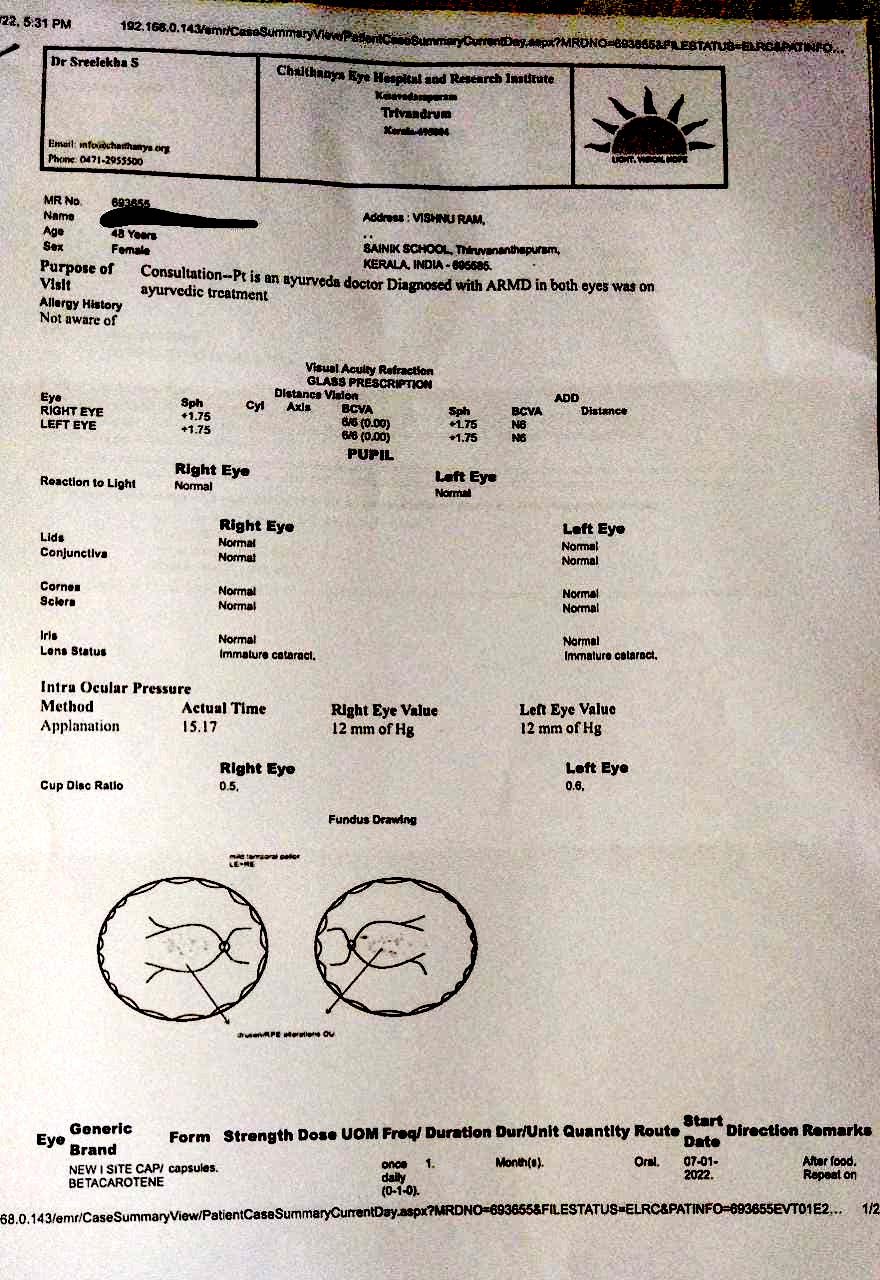
The patient is a 43-year-old female patient who was myopic since childhood. She presented with metamorphopsia for 1 year. At the onset of her symptoms, she had consulted an ophthalmologist who diagnosed it as Macular oedema of the right eye with degenerative changes (in the patient's words). Proof document in 2022 mentions ARMD (age-related macular degeneration in both eyes). In 2015, she started Ayurvedic medicines and after 2 courses of Inpatient treatments, she got relief from her symptoms.
First Ayurvedic consultation - 15.2.2015
First IP treatment - 18.2.2015- 5.4.2015.
Second IP treatment - 7.11.2015 – 21.11.2015
Not on any medications since then.
Findings in the baseline documents; Pigment epithelial disruptions; Soft/ hard drusens; Central macular thickness normal; HFA field analysis - no field constriction (2014-15).
The latest OCT, fundus flourosin angiography reveals; Pigment epithelial alterations reduced; Hard drusens; Mild RNFL degeneration in the left eye; Drusens mostly around the macula. Not generalised in the whole fundus.
The Ayurvedic treatment was stopped in 2015 after she got complete relief from her symptoms. She has been in remission since then. After 7 years in 2022, OCT, fundus flourosin angiography and perimetry revealed there is no deterioration and there is a significant improvement.
Image 1. OCT, Fundus flourosin angiography and perimetry done in 2022 added below
Disease-modifying effect: The patient is in remission.
-